Thursday, 29 October 2015

Richard Dadd and the Deadman's Head

This is Richard Dadd.


In 1842, Dadd went to Egypt. While he was out there, something happened. Convinced that he was the chosen emissary and son of the ancient Egyptian god Osiris, Dadd returned to England and murdered his father, believing that he was a demon in human form. He then fled to France, where he was arrested after attempting to murder another 'demon'. He spent the rest of his life in lunatic asylums, first in Bedlam and then in Broadmoor, painting pictures like these:

'The Fairy-Feller's Master-stroke', by Richard Dadd.
One of his less well-known paintings is called 'Patriotism'. It looks like this:


It's a map of an imaginary landscape, accompanied by a lengthy description of an imaginary war which was fought over it. (Those markings in the bottom left are miniscule text.) Here is an extract from that text:

The Deadman’s Head was quite empty when it was entered by the Victors. The Devil was very busy in Gales of Wind and from the nature of the defences would have been unconquerable, but he sunk from want of support, having no other than the lunatic asylum, which was not only unfit but was not enough. It required three Generals to conquer it & the less we say about how it was done, the better for some of us. Nobody knows what became of it and it is not usual to ask after such a savage thing as that was. The Devil was on the wrong side or rather the other side of the water.

Here's another extract:

Many brave warriors fell on both sides at Fort Fatal Truth where things were said in presences that are never forgiven any more than the Devil is forgiven. The Cheek exceeds belief. Of the City itself it may be said that it was built to obviate the effects of ignorance and vice, and fell by those causes as all others may be said to have done that have done so. It does not matter now who was right and who was wrong. 

I have no idea what it means. I don't suppose that anyone has ever had any idea what it means. But some of it sounds extremely ominous. 'It does not matter now who was right and who was wrong.' 'The less we say about how it was done, the better for some of us...'

None of this has anything to do with Central Asia. But this is exactly the sort of thing that might turn up scrawled on a wall somewhere in the depths of the Wicked City.

Tuesday, 27 October 2015

The Legend of Aži Dahāka

The binding of Aži Dahāka (aka Zahhak), from the Shahnama of Baysunghur.

One of the inspirations for the Wicked King was the Persian legend of Aži Dahāka, the dragon-tyrant of the ancient world, which has haunted me ever since I first learned it many years ago. I know Persia isn't really part of Central Asia proper; but the legend formed part of the mythic history of Zoroastrianism, which was historically practised in Central Asia, and also fed into more definitively Central Asian religions such as Manicheanism and Yazdanism. Besides, the whole thing is much too good to miss.

The story goes like this: long ago, the world was ruled by a sorcerer-king called Jamshid. Jamshid was originally benevolent, and did all kinds of good for humanity; but as the years passed he became proud and narcissistic, demanding to be worshipped as a god. In so doing he forfeited the favour of heaven, which departed from him in the form of a bird and flew away. The spirit of evil, Ahriman, knew this meant that Jamshid's days were numbered, and began looking for the one who would overthrow him.

The man Ahriman chose for his purposes was the son of a great chieftain. First Ahriman persuaded him to murder his father, inheriting his wealth and lands; then he came to the young man's court disguised as a cook, and made him a delicious banquet, for which the only payment he requested was permission to kiss the new chief between his shoulder-blades. After Ahriman departed the spot he had kissed swelled up and burst open, and out of it rose two huge serpents, twisting and snapping and ravening for human brains. So the young man became Aži Dahāka, the serpent king; and so his reign of terror began.

Aži Dahāka made war on Jamshid, and overthrew him. He took the two sisters of Jamshid as his brides, teaching them his evil sorcery and corrupting them with his evil ways. Jamshid fled his armies and went into hiding; for a hundred years Aži Dahāka hunted him, and in the hundredth year he caught him on the coast of the sea of Chin and had Jamshid torn to pieces. For a thousand years he maintained his cruel tyranny over the world, ordering everything he desired to be carried to him in golden cages, and feeding human brains to the serpents that grew from his spine; he even prayed to the goddess Anahita for power to exterminate humanity, but his wickedness was such that she ignored him no matter how many thousands of sacrifices he offered to her. Finally a humble blacksmith named Kaveh, who had seen seventeen of his eighteen children taken one after another to feed the snake-heads of Aži Dahāka, tied his leather apron to a pole and raised it as a flag of rebellion; he was joined by the hero Faridun, and together they rescued Jamshid's sisters and overthrew the tyrant. Faridun wounded Aži Dahāka three times, but from each wound a great tide of poisonous vermin leaped out to infest the world; so finally, instead of killing him, they bound him to mountainside, and there he remains to this day. According to some versions of the story, his shoulder-snakes have been eating his brains ever since.

(That leather apron banner, by the way? It became the royal banner of the kings of Iran, and was carried by them in all their battles until it was lost during the Arab conquest in the seventh century.)

So: what can we do with all this from a gaming perspective?

  1. Make a race out of them. Call 'em 'Dahakans', maybe, for maximum linguistic mangling: a breed of towering monsters, seven feet tall, with serpents snapping and darting over their shoulders. They have a natural predisposition towards cruelty, tyranny, and black magic, and can usually be found ruling over barbarian tribes out in the deserts, dominating their followers with an iron fist.
  2. Or make it a recognisable condition. Fall too far into villainy and sorcery and your body starts to warp: first a hard, discoloured lump develops between your shoulder-blades, then it swells up to cover half your back, and finally it bursts open and serpents spring out, their fangs dripping with all the venom distilled in your wicked, wicked heart. With a big enough robe you might be able to conceal them for a while, but really at this stage it's time to start thinking about setting up your evil sorcerer lair out in the wilderness.
  3. Or just use it as a one-off horror. PCs break into an ancient ruin on a mountaintop, and find some massive broken chains, plus one that's still connected to the rock; the monster stalks the ruins, mad and hungry, but unable to move more than a few hundred feet from the rock due to the chain still locked around its ankle. It has the whole deal: gigantic size and strength, brain-eating shoulder-snakes, AND horrible black magic, and when injured its wounds vomit forth waves of venomous stinging insects instead of blood, which means that hacking it to death is probably a great way of getting eaten alive by a zillion poisonous bugs. Of course, whatever the PCs came to the ruin for will be well within its wander range...
Dahākans (race): AC 14 (superhuman toughness), 4 HD, AB +4, damage by weapon plus two snake-bites (damage 1d4 + poison: FORT save or take 2d6 extra damage next round), FORT 10, REF 10, WILL 10, morale 9. For each week a person spends in their power (as a follower, a prisoner, etc), they must make a WILL save or start to accept their authority and begin a slide into moral corruption.

Dahākanism (magical affliction): You are so evil that poisonous snakes have started growing out of your back. You get two extra melee attacks each round, at your normal attack bonus: these do only 1 HP of damage, but they inject a poison which grows more potent the more evil you are. Regular old villainy might just do 1d6 extra damage on a failed FORT save; total lunatic evil might inflict 3d6 or more. You look like a hideous mutant freak and everybody hates you. If you cut the snakes off they just grow back.

Aži Dahāka (primordial monster): AC 16 (iron-hard skin), 12 HD, AB +10, huge claws (2d6 damage) plus two snake-bites (damage 2d6), FORT 4, REF 6, WILL 4, morale 8. If injured, everyone within 10' must make a REF roll or be covered in the biting insects which pour from its wound, suffering a -2 penalty to all rolls due to painful stinging, and losing 1 HP per minute due to the cumulative effect of their poisons filling your system; these penalties are cumulative for multiple injuries, and last until you manage to get them off via crushing, drowning, fumigation, etc. Horrible black magic powers at GM's discretion.

Saturday, 24 October 2015

Random encounter tables: the Maze

OK - last one, now, at least until I get over-ambitious and decide to do them for the Road, Steppe, Desert, and Taiga as well. (I probably don't need one for the tundra. '1-3: Rocks. 4-5: Ice. 6-7: Icy rocks. 8-9: Rocks with lichen on them. 10: A lonely reindeer.') The Maze is the one area of the Wicked City which is pretty much totally outside the control of its government, so that's where you'll find a lot of the radicals and crazies hiding out. A big enough force of the King's Men could comb through the Rubble block by block if they really had to; but down in the Maze, unless they had some good information to go on, they wouldn't even know where to begin to look...

What's hiding in the darkness? Roll on the table to find out!

Random Encounters: The Maze

  1. A network of recently-excavated tunnels, which seem to loop around at random, serving no clear purpose. Through them clank a work-gang of clockwork automata, diggers built by long-dead cultists to expand this section of the Maze; every time they sense their mainsprings winding down they stomp back to the underground riverside which serves as their base of operations and dip their water-wheels into the current, remaining stationary until the water-power has fully wound them up again ready for another shift of digging. If anyone tries to stop them from continuing their pointless excavations they will lash out with pickaxes and shovels, but otherwise they're harmless so long as they're left alone. If deactivated and reprogrammed they could be turned to all kinds of useful purposes. 
  2. The angry ghosts of unfortunate souls who have died in the Maze, furious at being unable to find their way to the afterlife and willing to take out their rage on anyone who comes too close. They express their fury through poltergeist activity, sudden shocking apparitions, and ghastly screams that come echoing down the tunnels; get too close and your world will become a horrorshow of howling spectres and telekinetic storms. They will follow their victims remorselessly, partly out of spite and partly in the hope that their targets will flee back towards the surface, thus helping them to find their way out. (However, there's a 90% chance that they're so crazy they wouldn't recognise such an exit even if they saw one, unless someone explicitly pointed it out to them.) They were highly religious souls in life, and are easily scared off by displays of holiness and religious devotion; unfortunately, there's a 10% chance that your prayers or rituals will happen to remind them of those used by a rival sub-sect, in which case they'll just get even angrier. The only way to get rid of them permanently is to lead them back onto the surface, at which point they'll vanish off to whatever afterlife they should have gone to in the first place.
  3. A bunch of political dissidents, hiding down in the tunnels. The only reason they have survived this long is by being very, very paranoid; their first assumption will be that anyone they meet is probably an undercover secret policeman sent to kill them all, and they will need an enormous amount of convincing to persuade them otherwise. (Even then, they will never really trust anyone who isn't part of their own group.) They have good maps of the nearby tunnels, but they're running low on food and they're almost out of ammunition. There is a 20% chance that one of them has actually been an undercover agent of the Secret Police all along.
  4. A criminal gang which is using part of the Maze as their base of operations, smuggling contraband through the tunnels in order to avoid having to pay bribes to the King's Men. (They also engage in freelance extortion and theft on the side.) They will fight viciously to keep their lair secret and to protect their loot, but their motivations are basically mercenary and they'll agree to pretty much anything if offered a large enough bribe.
  5. A bunch of Labyrinth cultists, who have laid claim to a section of the Maze where they try to practice their religion in peace, using secret tunnels that only they know about to make occasional supply runs to the surface. Here one can find shrines and ritual chambers actually being used in the ways their builders intended, as the cultists pursue their abstruse religious studies and mystical contemplations in the hope of attaining higher levels of enlightenment. They're not unfriendly, but they do want to be left alone: years spent meditating in darkness and silence has given them a very low tolerance for disruption. Sufficiently quiet and respectful PCs could find them very useful guides through this area of the Maze.
  6. A Secret Police death squad, hunting an enemy of the state who is believed to be hiding down in the Maze. They've been down here for days, now, and most of them are injured, but they have no intention of returning to the surface without their target. Any PCs they get hold of will be subjected to interminable interrogations on the off-chance that they might know where their target can be found.
  7. A huge flooded chamber, inhabited by some kind of gigantic, pallid tentacle monster. (No, not that kind of tentacle monster... unless that's what your group is into, I guess.) It lies in wait at the bottom of the pool until its victims are right in the middle of the water, before trying to grab them in its tentacles and yank them down to a watery death. It's sufficiently huge that killing it is unlikely, but the loss of a few tentacles should be enough to persuade it to back down, at least temporarily.
  8. An extremist Labyrinth cult, who were forced into a corner of the Maze by their rivals in some long-ago sectarian struggle and simply never left; they've been down there for decades, now, living in complete darkness, eating blind fish they catch from their underground rivers and chanting their interminable prayers. A whole generation of them have grown up never knowing any other life, and they react with extreme hostility to outsiders, whom they view as being radically spiritually unclean. With enormous patience it might be possible to befriend them, and possibly even persuade a few of them to return to the surface, but their elders are pretty much completely crazy and will fight such 'ideological contamination' at every step.
  9. A series of corridors which are filled with lethal traps, all of which were designed by long-dead Labyrinth cultists as tests of scriptural knowledge. (You know the kind of thing: go through the door with a scriptural misquotation on it, get a spring-loaded axe in the face.) Navigating them without the aid of someone expert in the Labyrinth doctrines is very, very dangerous. 
  10. A bunch of pig-men, who claim to have just wandered up here from some even deeper network of tunnels and caverns below. Navigating the Maze is far beyond their feeble intellects, so they spend most of their time wandering in circles, usually without even noticing that they're doing so; they couldn't find their way back to the caves they originally came from if they tried. They are dragging a couple of luckless human captives along with them, but could probably be tricked, bribed, or intimidated into releasing them. One of them is a radical enemy of the state who fled into the Maze in order to escape a death squad sent after him by the Secret Police.
  11. An old Labyrinth shrine, inhabited by an ancient hermit who has spent the last thirty years waiting for pilgrims to turn up so that he can test their spiritual purity. (What he has been eating all this time is deeply unclear.) The tests in question are trials by ordeal, and the penalty for failure is supposed to be death, inflicted via a poisoned blade that the hermit has been keeping concealed in his sleeve the whole time; but over the years he has become so mad and senile that any halfway decent attempt at deception will be able to take him in. Kind-hearted PCs may want to try to save him, but his mind is completely gone, and all he'll ever do is mumble fragments from the scriptures. 
  12. A band of weird, bald, pale-skinned, lantern-eyed things, which might once have been human but definitely aren't any more. They have long, sensitive fingers, which they use to feel the air currents, sensing motion from hundreds of feet away; their sense of hearing is acute, and they need only the slightest glimmer of light to see in the dark. (Bright light pains and blinds them, however.) They are decked out in the ritual regalia of some long-lost sub-cult of Labyrinth faithful, much of it extremely valuable and covered with gold and jewels. They don't speak, and respond to threats by fleeing back into the darkness, relying on their stealth and heightened senses to allow them to evade would-be attackers. They know every trap, every monster lair, and every secret passage, and if approached by someone who is able to make the correct ritual signs once used by their sub-cult, they'll willingly guide that person to any part of the Maze they want to visit by the shortest and safest path possible. If approached by someone who makes the wrong gestures, they will instead lead them into the middle of some horrible deathtrap and then leave them alone in the dark. 

'You are in a maze of twisty little passages, all different...'

Monday, 19 October 2015

Monsters from Central Asian Mythology 5: Ironclaw Ravens

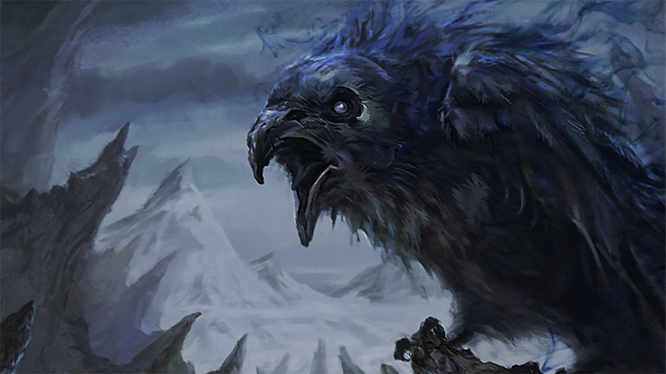
Remember the Buryat version of the King Gesar epic? In it, all kinds of evil beasts are sent into the world by the evil spirits born from the corpse of the dead sky-monster, Atai Ulaan. The first ones are rats with brass muzzles. The next ones are ravens with iron beaks and claws:


From the very beginning of the east,
In an ugly land,
In a meagre country,
In a place withered and dried by grief,
By three marshy rivers,
In a place of slippery slopes,
A dwelling place of demons and evil spirits,
A scorching hot land,
A dark and sunless country,
A place dry and devoid of plants,
Two ravens came flying,
Cawing and croaking.
They hovered over the face of Bukhe Beligte,
They planned to blind him by pecking out his eyes.

The baby Bukhe Beligte lay in the cradle gathering his strength,
He quickly grabbed the wings of the two black ravens.
“What kinds of devils are you,
Flying about the wide world,
With beaks and talons made of iron?!”


If one wanted to go full-on science fantasy with this, it would be easy to imagine Atai Ulaan as some kind of immense bio-mechanical construct - a space station, an aerial warbase, whatever - which, after it crashes, continues to churn out cyborg monsters and unleash them onto the surrounding world. (Maybe its malfunctioning programming leads it to grab local lifeforms, like giant rats or ravens, and replace random chunks of their bodies with cybernetic prosthetics.) Given that ATWC doesn't go quite that far, though, I'm going to keep them, like the Brass-Snouts, as weird monsters of uncertain origin, possibly created by some long vanished civilization out on the steppes. They're bigger than normal ravens, with a six-foot wingspan, and they weigh as much as a small child; their beaks and claws are made from black iron, and are as sharp as knives. Like all ravens they are primarily scavengers, but their size and their fearsome natural weaponry makes them much braver than their mundane cousins, and a flock of ironclaw ravens will not willingly yield up their carrion even to a pack of wolves. Their talons can slice flesh to ribbons, and their beaks can stab a man to the heart.


Well: if that were all, they'd just be another hazard of the steppes and the taiga, like the wolves and the tigers and the bears. But the ironclaws are clever: not quite in the same way as humans are clever, or even in the way that the Wise Folk are, but with a weird, cold, avian intelligence all of their own. They communicate with one another across immense distances, and when they spot an opportunity to create a true carrion feast - a drover's bridge that could be sabotaged, for example, sending a whole herd of cattle tumbling to their deaths where the ironclaws can devour them, or a warning sign that can be stolen, leading horses and riders into dangers from which they might never escape - then entire flocks of them will descend in great flapping clouds, slicing through ropes, pulling away markers, and even killing witnesses if necessary. The worst of them make common cause with outcast bands of robbers, outlaws, and scavengers, in which the ravens provide the aerial scouting and the humans provide the opposable thumbs. In such pairings, it is not at all clear who has domesticated who.

Ironclaw meat is rank and foul-tasting, but the ravens are widely hunted: their talons make excellent knives and bladed tools, and their beaks need only be mounted onto handles to become cruelly effective punch-daggers. Many a nomad tribe, with no access to iron ore or forges, relies upon the hunting of ironclaws almost exclusively to provide them with the metal implements they need. The price for such hunting is high, however; the ironclaws mark such tribes out as their enemies, and their members exist in a state of continual low-level hostilities with the vicious birds, never daring to let their children out of their sight for fear some knife-clawed bird will descend upon them and mutilate them out of revenge before flying away.

Ironclaw ravens have an instinctive affection for members of the Unkindness, and will happily become their henchmen if offered the chance.

  • Ironclaw Raven: AC 12 (feathers and agility), 1 HD, AB +1, iron beak and claws (1d6 damage), FORT 14, REF 14, WILL 14, morale 6. 

Ironclaw ravens have an instinctive knack for slicing open arteries and stabbing vital organs. If one rolls a 6 for damage, then it has hit an artery or impaled something vital, inflicting an extra 1d6 damage on the target.

Thursday, 15 October 2015

Monsters from Central Asian Mythology 4: Balbals

Just beyond the Burana Tower site are "balbals", or stone monuments to fallen warriors and to ancient gods and goddesses.:

I've mentioned Balbals before: they're the stone statues set to guard the tombs of dead kings and warriors, into which the souls of the foes slain by that person in life, or sacrificed to him in death, are bound in order to ensure the protection of his tomb. In any Central Asian fantasy setting, I think it's pretty safe to assume that they come to life and beat would-be tomb robbers to death with their big stone hands at the drop of a hat.

Here's how it works: first, someone has to die. As they die, their killer openly and publicly declares that they (or the person to whom they are being sacrificed) is taking possession of their soul: in a human sacrifice this might be formal and ritualistic, but in the middle of a pitched battle it's more likely to take the form of a blood-splattered warrior screaming 'I own your soul, dog!' as their just-slain adversary topples to the ground. Then, when you die - and you must be dead, because until then the soul just hangs around waiting for you - a stone statue needs to be built to house the soul of the victim. This statue must be specific: you can't just say, 'Oh, Uncle Aybek said he'd killed six men in various battles, so we'll put up six statues of generic warriors and that'll do the trick.' They don't have to be lifelike, but you do need to have some kind of distinguishing mark that links each statue to one specific soul. (Maybe Uncle Aybek remembers that the man he killed at the Three Hills battlefield was wearing a bearskin, and the man who he killed by the banks of the Red River had a long beard; carving one statue with a big beard and another with a bearskin cloak would be quite sufficient.) Finally, a friendly shaman needs to perform a brief ceremony on each statue, calling that specific soul down into it and binding it in place. That done, you can rest in your grave in peace, secure in the knowledge that the souls of your vanquished enemies are watching over your bones.

Balbals only serve as tomb guardians, and the souls that inhabit them exist in a state of sleep or suspended animation, waking only when there is an intruder to be slain. If anyone looks like they might be about to disturb the grave they're bound to, they come to life and attack until the would-be desecrater is dead or driven off; then they return to their normal, inanimate state. It would be rash to assume, however, that only tomb-robbers have cause to clash with them; clans have been known to 'game the system' by burying lines of dead warriors and their attendant balbals to block off places where, for whatever reason, they don't want anyone to go, knowing that if anyone attempts to pass that way the balbals will believe their tombs to be threatened and rise up to defend them. There is also the fact that, unsurprisingly, the relatives of those whose souls are bound into balbals are seldom thrilled by the idea of their loved ones slumbering through the centuries guarding the tombs of their killers, rather than progressing to the afterlife or to their next incarnation; if they discover that this has happened, they often seek to have the balbal in question destroyed, in order to allow the soul of their relative to go free. Whenever there's been a recent war on the steppe, it's common for newly-unemployed mercenaries to seek work as freelance balbal demolitionists, hiring themselves out to any family who wants the souls of their recently-dead loved ones liberated from their stony servitude. It's dangerous work, though: attacking one of a tomb's balbals will rouse them all. In the case of great kings and conquerors, who may have hundreds or thousands of balbals defending their graves, the best idea is probably to identify the correct target from as far away as possible, destroy it as quickly as possible, and then turn and flee from the resulting stone army that rises up to protect and avenge it, secure in the knowledge that they will never go far from the tomb to which they are bound...

Turkic balbal image, Altai Mongolia:

Most balbals are man-sized, because that's all that a regular soul has the strength to animate. Occasionally giant balbals are built to house the souls of particularly mighty heroes. Would-be demolitionists might want to invest in several barrels of gunpowder before taking one on.
  • Warrior Balbal (man-sized): AC 18 (made of stone), 4 HD, AB +2, stone fists (1d6 damage), FORT 8, REF 15, WILL 12, morale 12. Immune to poison, disease, and anything else that only affects creatures of flesh and blood. Takes half damage from everything except crushing attacks (hammers, maces, cannonballs, etc) and explosions. Bullets do only 1 HP of damage per hit, and piercing weapons (arrows, knives, etc) do no damage at all. Can never travel more than a mile from the tomb it is bound to.
  • Heroic Balbal (10'-12' tall): AC 20 (made of stone), 8 HD, AB +4, giant stone fists (1d12 damage), FORT 4, REF 10, WILL 8, morale 12. Resistances and immunities as above.
It is speculated that the statue network of the Wicked City may have been created through some modified (possibly inverted) balbal creation rite. Most of the balbals in the city's old cemeteries were smashed years ago, and their creation has fallen out of fashion amongst the families of the Cobweb; but a few functional ones might still be found out in the Rubble, or down in the lightless burial chambers of the Maze...

Wednesday, 14 October 2015

Random encounter tables: the Rubble

Just this one and the Maze to go, now. Unlike the streets, the Rubble doesn't change much between day and night; whatever malevolent force operates on the streets, making the vermin huge and the ruins stealthy and mobile, doesn't seem to work out there. Maybe it's a side-effect of the absence of the statue network... or maybe all those weird rituals the People of the Rubble keep performing are more effective than anyone suspects.

The Rubble by night. Image by John Avon.

Random Encounters: The Rubble
  1. This area is home to a nest of brightly-coloured snakes, all of which are poisonous. Horribly poisonous. FORT-save-or-die style poisonous. They're not big or aggressive, but they slither around through the rubble in places where you don't expect them and will bite anyone who looks like they might be about to step on them. Tread very carefully here.
  2. A group of 2d6 People of the Rubble, out patrolling their territory while scavenging for food and any other useful items they might find; they gather roots and berries, hunt and trap small animals, root through ruins that might still have usable metal tools in them, and cast their nets into ponds in the hope of bringing up edible fish (or edible frogs, or edible water-snakes - they're not picky). They carry bows and knives, and their blades and arrowheads are coated in lethal snake venom - make a FORT save or die screaming over the next 3d6 hours. (They carry an antidote, but only a skilled chemist or doctor would recognise it.) They're very suspicious of outsiders, but gifts of food and useful objects will do a great deal to help win their trust. 
  3. This area is riddled with traps: concealed pits, deadfall traps, tripwires that drop people into snake pits or flooded basements, punji sticks in shallow leaf-filled trenches, and so on. PCs might assume that all these traps mean that there's something here the People of the Rubble really value, but in fact it's just the home of a rather crazy old trapmaker who builds them as a hobby. He's notionally a member of the nearest Rubble clan, but they only come to see him when they need his expertise, and the rest of the time he's happy to live alone. (The traps rather discourage casual visitors, in any case.) A lifetime of bad experiences have left him extremely suspicious of anyone who is not one of the People of the Rubble.
  4. The burned-out ruin of what was once an alchemist's lab, overgrown with thorny creepers. Something weird has seeped into the waters, here, turning the local vegetation mobile and predatory: now it preys upon anything that gets too close, entangling its victims in its tendrils before sucking the nutrients out of them. Observant PCs may notice a large number of skeletons from rats, snakes, dogs, and other animals who have run afoul of this killer foliage, with creepers wrapped around their limbs and necks and growing through their bones. Unobservant PCs may not realise anything is wrong until thorned tendrils start lashing out and wrapping themselves around people's necks.
  5. A young Blighted couple - a boy in his late teens and a girl in her early twenties - are living here amongst the rubble. Both tried, and failed, to undertake Mindblade training, and now they live out here to avoid endangering anyone else with their uncontrolled psychic powers. They are very strongly attached to one another, and spend a great deal of time and effort calming one another down to avoid dangerous psychic outbursts. The People of the Rubble regard them as unlucky, and avoid them whenever possible. They are perpetually on the brink of starvation, and their friendship can easily be bought with regular gifts of food. Stressing them out is probably a very bad idea.
  6. An area of flooded ruins, which are home to a truly enormous poisonous serpent, almost twenty feet in length. It spends most of its time basking in a sunken pool, emerging to eat the odd dog, rat, or cat. There is a 10% chance that it is hungry, in which case it will lash out at any nearby PCs, trying to bite, crush, or drown them before eating them; otherwise it will only attack if its pool is disturbed. The People of the Rubble are well-aware of this monster, and will try to lure people they don't like into disturbing it, usually with fatal results. 
  7. 1d6 young People of the Rubble out on an initiation rite, led by a clan elder. The initiates have all been dosed up with snake venom and hallucinogenic mushrooms, and they're babbling and hallucinating wildly; the elder's job is to make sure that they complete their ritual tour of this area of the Rubble without too many broken limbs. PCs will be instantly worked into whatever tapestry of fantasy and delusion is currently working its way through their fevered minds, and may find themselves worshipped as spirits, attacked as demons, or anything in-between: make an unmodified reaction roll, but exaggerate the result to slightly surreal levels, and reroll every 1d10 minutes regardless of what is going on. The elder will try to keep things from getting too out of hand, however, as too much excitement tends to cause the initiates to drop dead of snake-venom poisoning. 
  8. A huge clockwork beast, escaped from some Clanker arsenal or Steel Aspirant foundry-temple, which has smashed its way into the rubble and now lies quiescent. It may look inactive, but would-be scavengers are in for a nasty surprise; its mainspring still turns, albeit extremely slowly, letting its tremor-sensors continue to run even while all the rest of its systems remain at rest. If it detects motion nearby it will lash out violently - anything larger than a dog will set it off - and the local animals have learned to avoid it, as have the People of the Rubble. After 1d10 hours of activity (or the same number of months of inactive monitoring) its spring will be completely unwound and it will collapse to the ground, at least until someone winds it up again. It would be worth a small fortune if looted for spare parts, and a rather larger one if repaired and returned to fully operational status.
  9. A nest of brass-snout rats. The People of the Rubble hunt them for their meat and their metal jaws, which has made them very wary of humans. They have burrowed deeply into the rubble here, and their burrows (which are flooded in places) connect at multiple points to the Maze. 
  10. A stretch of cleared land, on which the People of the Rubble grow crops: rice, vegetables, and lots and lots of huge, vividly-coloured, violently hallucinogenic mushrooms. The farmers who work these fields have a habit of snacking on these as they work to alleviate the boredom of agricultural labour, and live in a state of perpetually stoned low-level delirium. They still remember how to shoot just fine, though, and they carry the same bows and horribly-poisonous arrows as the rest of their clansmen. 
  11. A waterhole, the home of a herd of feral swine which inhabit this area of the rubble, foraging for food amongst the ruins. The People of the Rubble prize them as a delicacy, and carefully manage their numbers, hunting them to provide hog roasts for their most important feasts. PCs who see them as an opportunity for an all-you-can-eat bacon buffet will incur the enmity of the nearby Rubble clans. 
  12. A Rubble priestess on some kind of vision quest: she's wandering around in huge, looping circles, singing constantly, and smoking something foul-smelling and mind-altering in a battered wooden pipe. Live snakes slither all over her: if hassled she'll throw them at people, who will rapidly learn that they're intensely venomous and much less friendly towards people other than her. People willing to tolerate all the singing, smoking, hissing, and general weirdness will find that she's not bad company, however, and anyone who can actually help her in her search for enlightenment will receive a warm welcome from her clan when she finally returns to them. 

Tuesday, 13 October 2015

Horrors of the Wicked City 2: The Man With Stones For Eyes


People who try to leave the Wicked City against the wishes of its government find him waiting for them, pale and silent, standing in the middle of the road. He looks ordinary enough from a distance, but a closer look reveals otherwise: his skin is sheened with frost, and instead of eyes he has two grey frozen pebbles, crusted with ice, which rattle loosely in his empty sockets. He shivers constantly, his teeth chattering uncontrollably as he warns them to return to their homes as soon as possible. The wise ones obey.

Anyone who tries to evade him soon learns that he is almost impossible to escape: he can move instantaneously to any location within his line of sight, the very air between his position and his destination seeming to shiver as he ripples through space. The air around him is so cold that anyone who approaches within 5' of him must make a FORT save or be incapacitated by the intense chill; a new save is permitted each round to break the effect. Any kind of physical contact with him – even a mere brush of his fingertips - causes 1 HP of cold damage every round: simply grabbing someone by the hand and holding on for a minute or two is enough to leave them frozen solid, turning their blood to red ice in their veins. These abilities alone are quite sufficient for him to deter most would-be emigrants; but for those who attempt to fight him, or persist in defying his warnings, he has other horrors in store. He will lunge forwards, his jaws distending impossibly, yawning open two, three, or even four feet wide: then his teeth will snap shut, slicing through flesh and bone as easily as a man might bite through soft cheese, leaving the severed flesh flash-frozen in the process. After watching him bite the arms and faces off anyone who tries to push past him, all but the very bravest are likely to flee back to the Wicked City as fast as possible.

The Man With Stones For Eyes has a reputation as being unavoidable, but this isn't actually true: he can only be in one place at once, and the city's government can only set him on people if they know roughly when and where they'll be leaving the city, whether due to Secret Police spying, statue network observation, or ordinary surveillance by their minions, guards, and spies. Once he's onto you, however, defeating him in battle is extremely unlikely: his frozen flesh is as hard as iron, and knits back together almost as fast as it can be damaged. His only weak points are the stones in his eyes, which can be dislodged by any attack that specifically aims for them and succeeds in hitting an AC of 20: one hit is needed to dislodge each pebble. With one knocked out, he can no longer see in three dimensions, preventing him from teleporting until he has picked it up and replaced it; with both knocked out he is completely blind, and can do nothing except scrabble about on the ground for his eyes whilst wailing about the unfairness of his life. Running off with them is not a good idea – they are so cold that anyone carrying one, even in a backpack, takes 1 HP of cold damage per pebble per round – but if thrown far away, it'll be hours before he's able to find them, providing plenty of time for his vanquishers to escape.

The Man With Stones For Eyes does not consider himself to be a monster. Unlike the Men Without Faces, who communicate entirely through violence, he is articulate, even loquacious; and when his victims beg him for mercy, he will express his sincere regret at the fact that his duties leave him with no choice but to carry out his orders. (Then he'll bite their legs off.) If given half a chance he will happily launch into lengthy, self-pitying speeches about how wearisome he finds his role as the city's guardian, and how, in truth, he is the real victim here: he will do this even if his latest victims are currently crawling around on the flash-frozen stumps of what were once their limbs, apparently with no sense of irony whatsoever. He can actually be quite friendly towards anyone who's willing to sit and listen sympathetically to him for long enough, but he still won't let them pass: the one thing that could tempt him to abandon his post would be the chance to feel warm again, but no fire, no matter how large or intense, seems able to dispel the chill that clings to his bones. He believes that the one thing which could truly warm him would be the loving embrace of one of the Children of the Sun, and claims to be patiently waiting for the one who will 'save' him, seemingly without realising that the last thing that most of the Sun's Children would have any desire to do is bring any kind of comfort to a monster of unrighteousness such as himself.

  • The Man With Stones For Eyes: AC 18 (speed and iron-hard skin), 10 HD, AB +6, bite (2d6 damage + mutilation - see below), FORT 4, REF 4, WILL 5, morale 9. Regenerate 3 HP per round until fully healed unless reduced to -10 HP or below.

When the Man With Stones For Eyes bites someone, his jaw extends several feet wide, allowing him to bite off whole limbs at a time. (The severed extremeties simply vanish down his jaw, regardless of how impossible this should be.) Any time he rolls a double on his 2d6 damage roll, he bites off a whole chunk of his victim. Roll 1d6 to find out what is lost: 1 = right arm, 2 = left arm, 3 = right leg, 4 = left leg, 5 = face, 6 = chunk of torso – lose 1 point permanently from each of STR and CON. These wounds are flash-frozen, so at least the victim doesn't need to worry about bleeding to death...