Showing posts with label Victorian weirdness. Show all posts

Sunday, 19 June 2022

Early modern corpse medicine

I recently read a book called Mummies, Cannibals, and Vampires, by Richard Sugg. Despite its title, it's not about monsters. Instead, it's a history of what Sugg calls 'corpse medicine' - the early modern practise of using bits of dead people in attempts to cure the living. Sugg can be a bit credulous in places, but he does a good job of establishing that human blood, fat, and bone saw fairly widespread use in both European folk remedies and 'academic' medicine during the period, giving rise to a range of often gruesome medical practises that, in some cases, lingered on as late as the nineteenth century.

Here are the most gameable bits.


Skull Moss: The theory went like this: during life, your brain is constantly sloshing around inside your skull, marinading the bone in brain juice (AKA 'vital spirits'). So after you die, some of the life-giving power of your brain juice should logically still inhere in your skull. You could just grind up a skull and use the resulting powder as medicine, and indeed many people seem to have done exactly that. But the best way to get the power out is to take a human skull and grow moss on it, preferably by moonlight or starlight. The moss sucks the power of the vital spirits out of the skull, and you can then powder and eat the moss as a remedy. 

Plot seeds: 

  • 'My loved one is sick! Bring me the powdered skull of something with really powerful brain-juice! Maybe a wizard or a dragon or something.'
  • 'Actually, what we really need is their whole skull, so we can grow moss on it in the light of the full moon. That won't be a problem, will it?'
  • 'And we need the brain-juice to be super-fresh, so you'll need to either find one that's just died, or kill one for us yourself. Remember - the skull must be intact! No headshots!'
  • If your PCs end up building some kind of freakish garden full of moss growing on the skulls of everything they've ever killed, then so much the better!

Strangulation boosts skull quality: If someone dies by hanging or strangling, then at the moment of their death their life force will obviously be trapped inside their head, unable to escape down into their lungs. This means they will die with a head full of super-charged brain juice, making their skull (and any skull moss subsequently grown on it) extra-potent for medical purposes. There was consequently a brisk trade in the skulls of the hanged.

    Plot seeds: 

    • 'We need the skull of a [wizard/dragon/whatever] that died by strangulation. Any other death makes them useless to us. Here's a noose. Good luck!'
    • 'Did you hear? They're hanging Horatius the Hexmaster tomorrow! Everyone's going to want his skull! We need a plan to get in first...'

    Subdermal talismans: One particularly hardcore early modern soldier apparently wore a lump of skull moss under the skin of his own head, presumably by cutting a flap of skin off his forehead, pushing the moss under it, and then sewing up the wound and letting it heal. Probably the intention was to fortify his own skull with a double-dose of life-giving brain-juice. Apparently it worked, too, protecting him against being injured by sword-blows to the head. 

    Plot seeds:

    • PCs should absolutely be encouraged to sew lumps of skull-moss from all the scariest things they've killed under the skin of their own heads. Give them mechanical bonuses for doing it. You should be able to spot a real monster-slayer from all the weird scarred-over lumps bulging out of their foreheads.
    • An enemy with a sufficiently impressive skull-moss collection might be almost unkillable, requiring PCs to specifically cut away their subdermal talismans to render them vulnerable to harm - tricky if they're also wearing a helmet!


    Wound salve: According to the early modern doctrine of sympathy, a connection existed between a wound and the weapon that caused it. Rubbing a 'wound salve' made of human blood, fat, and skull moss on a bloodstained weapon would make the wounds caused with it heal, no matter how remote the victim might be.

    Plot seeds:
    • 'I can't treat this injury - the poison is far too powerful! Find me the knife that made it! I'll treat that, instead!'
    • Wounds could be used as a means of ensuring loyalty at a distance. 'Oh, that wound looks pretty mortal, doesn't it? But as long as you keep making payments, I'll keep applying wound salve to the knife I just stabbed you with...'
    • Sugg doesn't discuss it, but there was also believed to be a 'powder of sympathy' which, if stabbed with a weapon that had been previously used to wound someone and which was still stained with their blood, would cause that person to experience sudden pain, no matter where they were on Earth. The potential value of such powder as a weapon (or, indeed, as a long-distance signalling mechanism) should be obvious!
    A cure for bad blood: To reconcile enemies, take blood from both of them and mix it with fertile soil, then grow herbs from the soil and feed the herbs to both enemies. This mixing of their life forces will soften the enmity between them. 

    Plot seeds: 
    • This scenario basically writes itself. 'Here's a bag of dirt, a bag of seeds, a sharp knife, a bottle, and a cookbook. Now get out there and end that feud!'
    • Good luck convincing someone who knows you've been consorting with their mortal enemy that you've got a totally innocent reason for first cutting them open and stealing their blood, and then coming back and feeding them a bowl of herbs with questionable origins!
    Blood lamps: Take a lamp, fill it with human blood drawn from one person, and then light it. The light from the lamp will reflect their condition - if it burns clear and bright they're probably OK, but if the flame wavers it means they're troubled, and if it goes out suddenly for no reason it means they've died. Presumably the lamp required periodic blood top-ups to renew its connection.

    Plot seeds: 
    • A ruler or spymaster might maintain whole rooms full of blood lamps, one for each person they want to keep tabs on. Plenty of opportunities for sabotage by spiking one person's lamp with someone else's blood!
    • 'I know he says he's fine, but how's he really doing? Here - take this lamp, steal some of his blood, and pour it into it. I just want to make sure that he's actually OK...'

    The Hand of Glory does appear in the book, but is surely too well-known to need writing up here.


    Dead man's hand: One seventeenth-century doctor recommended treating piles and swellings with the sweat of a dying man. This was obviously a pretty time-limited resource - if he's genuinely dying, you've only got so long before he tips over into being dead - but luckily, there was an alternative: you could rub them better with a dead man's hand! (Presumably he had a preserved one that he used for this purpose? I imagine it mounted on a stick for easier rubbing...)

    Plot seeds: 
    • A particularly stubborn disease might need rubbing with a particularly powerful severed hand - perhaps one belonging to a dead cleric, wizard, etc. If you can grab some of his sweat while he's dying, that's a bonus!
    • A curse or monster might inflict terrible swellings on those who oppose it, requiring the PCs to rub one another down with severed hands in mid-melee!

    The executioner's other trade: Each human body was believed to possess a certain allocation of life force, which leaked away through age and sickness - thus the bodies of young people (especially healthy young men) who died suddenly by violence were held to possess great power, as so much unspent life force remained bottled up within them. Many early modern executioners thus carried on a thriving trade in the blood, bones, skin, and fat of their victims, all of which were believed to possess healing properties and even to be able to ward off black magic due to the life force with which they were charged. The fresher these body parts were, the better - people desperate for cures would sometimes come to beheadings with cups, ready catch and drink the victim's blood right at the foot of the scaffold. 

    Plot seeds: 

    • A corrupt magistrate might be in league with the local executioner, having specific people executed on trumped-up charges because he believes their body parts are likely to fetch a particularly good price on the open market.
    • In a region plagued by witches, different families might compete fiercely for bits of each person executed (and agitate constantly for more executions), seeing such corpse-talismans as their best hope for protecting their families from dark sorcery.
    • A PC suffering from a magical curse or disease might learn that their only cure is the freshly-spilled blood of an executed man. When's the next execution happening, again? And they'd better be ready to fight for a spot at the foot of the block - they won't be the only ones there waving empty tankards around and trying to guess the likely trajectories of arterial spray...
    • PCs tend to inflict a lot of violence and untimely death - what if they start selling the blood and bones of their victims, too? How will the local executioners react to someone trying to break into 'their' trade?

    Blood against age: Drinking the blood of the young and healthy was thought to grant strength to the old and infirm. Normally the 'donor' was paid, though rumours circulated that some rulers had young victims abducted and murdered for the sake of their life-giving blood.

    In-game uses:

    • 'No, I need someone really healthy. Get me... like... a barbarian champion, or something. Then tie him down so I can drink some of his blood!'
    • Campaign start concept: the PCs are a bunch of random travellers kidnapped because their hardy, athletic frames make them ideal targets for the local lord's medical vampirism. Now they need to break out of his horrible castle before he drains them all dry like the ghastly, thirsty, geriatric monster he is. Good thing they're all such vigorous specimins!

    A cure for flatulence: Tired of farting at inconvenient times? Try wearing gloves made of human skin! For some reason they're good for the joints, as well! 

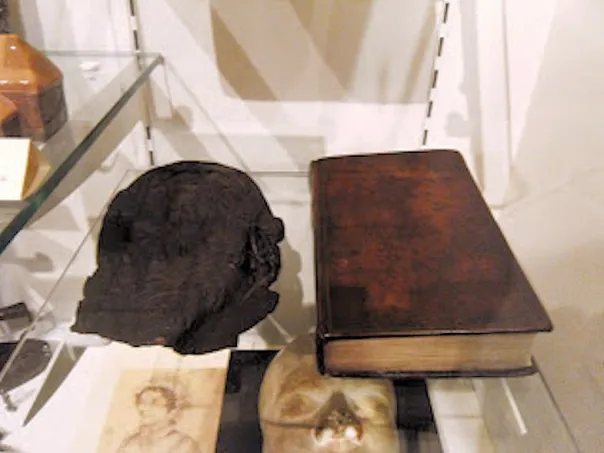
    (We can only hope that not too many people tried putting this one into practise, although the idea of human leather doesn't seem to have disturbed our ancestors as much as one might expect. Books continued to be intermittently bound in human skin well into the nineteenth century.)

    Plot seeds:
    • 'So what you need to do, right, is wait until he begins his big speech, and then pull his human-skin gloves off! His uncontrollable flatulence will finish his career on the spot!'
    Preserved scalp of the Red Barn Murderer, Richard Corder, and a book of his crimes bound in his skin. From 1828.

    Mummy: The crushed flesh of Ancient Egyptian mummies was believed to have many healing properties - so much so that demand for it soon outstripped supply. Egyptian corpse-merchants made up the shortfall first by substituting 'natural' mummies (the dried-out corpses of travellers killed in desert sandstorms) for the ancient kind, and then by just buying up as many bodies as they could, drying them out in giant ovens, and exporting them as 'mummies'. Paracelsian medicine maintained you could make a home-grown version just as good as an ancient one by taking the freshly-killed body of a young man who died by violence, leaving it out overnight, cutting it into strips, and macerating it in wine. So as well as moss-covered skulls, dead men's hands, human-skin gloves, crushed-up mummies, and pastes made from human blood and fat, the workshops of early modern doctors may also have contained shredded corpses in wine. For, y'know, medical reasons.

    Plot seeds:

    • 'Find me a genuine ancient mummy, with a pyramid and everything! Then crush it up so I can rub it on my injuries. You can keep the inevitable cursed gold for yourselves.'
    • PCs may kill a lot of people, but they probably don't carry giant urns of wine around on adventures with them. So for an extra pay-off, why not drag all those corpses back to the local wine-merchant and have them made into medicine? Let's just hope no-one asks any awkward questions about why you're dragging all these hacked-up corpses around...
    • With all these mummies being traded back and forth, how long can it be before an undead one gets mixed in with the rest, and wakes up just as it's being unloaded from the ship? Imagine how angry some ancient priest-king will be upon discovering he's narrowly avoided being ground up for medicinal purposes...
    • Some early modern doctors also broke into barrow mounds in search of ancient dead people to grind up into medicine. Think of all the furious barrow wights!

    The Black Doctors: Suspicion of the medical profession seems to have run deep in rural Scotland. There parents would warn their children of 'the Black Doctors', medical murderers who lurked around looking for potential victims. When they spotted a likely target they'd sneak up behind them and slap a black adhesive patch over their nose and mouth, suffocating them and preventing them from calling out, then drag them off to make healing broth from their bodies and bones. (Very similar stories circulated in early Victorian London, where medical murder-gangs were rumoured to garrote pedestrians and throw their bodies down through hidden hatches into ever-boiling cauldrons in the tunnels below.)

    Plot seeds: 

    • Hunt down the medical murder-crew preying on the local population! Then struggle with your conscience over what to do with all the cannibalistic healing broth you've just acquired from their hidden lair!
    • Actually, those suffocation-patches sound pretty handy for adventurers, too...

    Monday, 12 October 2020

    The White Tower: an edition-agnostic adventure for D&D

    I took an overdose of fin de siรจcle Gothic fiction and wrote this, more as a finger exercise than anything else. Put it in a hex somewhere near the sea.

    Advance warning: some of the themes addressed here are pretty heavy, even if they are approached rather obliquely, just as they are in the fiction that inspired it. Please use with appropriate care.

    The Tower: It stands on a hilltop, shining white in the distance, visible for miles around. The land around is thickly forested. No-one goes there now, though the forest is dotted with the overgrown ruins of farms and villages, showing that the hills were once densely inhabited. The woods have an evil reputation with the locals, who avoid the place, especially after dark.

    The Rumours: In the villages that cling to the riverside, the people are happy to talk about the tower on the hill, though never without first making signs to avert the attention of evil spirits. They say a sad old lord used to live alone there, until the day he rode along the sea cliffs the morning after a storm and found a beautiful girl cast up by the waves on the beach, more dead than alive and surrounded by broken timbers. He took her home, and she became his ward, and then his wife. She seemed to give him new joy in life, and one by one he called his old friends to live with them: a priest, a doctor, and an artist. Then one midsummer the whole household was found dead and dangling from the rafters - all save the lady, who had vanished without trace. After that nothing went right in the villages around the white tower. Soon the farms were all abandoned, and the forest came.

    The Woods: By day the woods are harmless enough, and in the spring and summer they are thick with wild roses. Often a woman can be heard singing in the distance, though no amount of searching will ever find her. By night travellers will repeatedly glimpse swaying, broken-necked figures hanging from the branches out of the corners of their eyes, though these disappear when looked at directly. When the wind blows through the woods by night, it carries the sounds of crashing waves, screaming men, and shattering timbers, as though a shipwreck was happening just over the hill.

    For each hour spent in the woods by night, there is a 1-in-3 chance of an encounter with a random ghost. Roll 1d6:

    1. Bianca, the maid, weeping uncontrollably as she dabs her eyes with an embroidered handkerchief, her broken neck jerking disturbingly with each heaving sob.
    2. Giuliano, the gardener, and Alberico, the doctor, locked in a feverish embrace, trying to kiss each other with heads that dangle from broken necks.
    3. Ortensia, the cook, dressed up in her best gown, roaming the woods and calling out: 'Lucia! Lucia!' Stiff coloured ribbons tied around her throat imperfectly conceal her broken neck.
    4. Jacopo, the chaplain, striding through the forests in his black soutane, his shattered neck almost, but not quite, held upright by his high and rigidly starched white collar. He holds a sealed letter out stiffly before him, the word Lucia just visible on the envelope. 
    5. Giustino, the artist, craning his broken neck and sketching feverishly with paper and charcoal at something only he can see. 
    6. Lord Orazio, brandishing a bleeding dagger, rushing through the night wild-eyed and howling: 'She is MINE! Mine only! Mine always! I found her! She belongs to ME!'
    If any attempt is made to interact with the ghosts, it will instantly become obvious that what seemed like human forms were nothing more than a trick of the moonlight, their voices merely the moaning of the wind.

    Approaching the Tower: One stumbles upon it suddenly, right in the middle of the wood. Its white stone walls are still strong and clean, untouched by overgrowth, in marked contrast to the condition of all the other ruins in the woods. Its wooden doors have rotted almost to nothing. The stables, servant's quarters, and other outbuildings are now mere heaps of mossy stone.

    • An immense serpent lazes on a rock nearby, huge and almost unkillable, covered in gorgeous, multicoloured scales. It will attack only in self-defence, but if any group of people try to enter the tower it will rear up and spit a stream of venom straight into the eyes of whichever of them has the lowest Charisma score. Unless dodged, this venom will cause permanent blindness unless treated with healing magic or washed away promptly with salt water and/or milk. (Any healers in the party will know this.) The snake can be distracted by giving it live prey to eat: the larger the animal, the longer it will spend eating it. A rabbit might buy you a minute, whereas eating and digesting a horse will occupy it for an entire day. 

    A Note on Ghosts: Unlike the ghosts in the forest, the ghosts in the tower are completely physical. (They are not zombies: the actual corpses of all these people are still mouldering in their graves.) Their pale bodies can be cut down with mundane weapons, although they do not bleed and are weirdly resistant to harm. If 'killed', they reform the following midnight unless the tower's enchantment has been undone. Unless otherwise noted, none of them can leave their respective rooms.

    A Note on Dreams: Anyone who attempts to sleep within the White Tower will be tormented by horrible nightmares of shipwrecks, serpents, stabbing daggers, strangling roses, hanging bodies, and staring eyes, and will wake up feeling more exhausted than they were when they first went to sleep. Sleeping under these conditions will not allow the recovery of lost hit points or spells.

    Ground Floor: The main doors lead into a great semi-circular room hung with faded scarlet tapestries depicting hunts, tournaments, and battles, with a grand flight of white stone stairs leading up. A doorway at the back leads to a warren of kitchens, one of which contains a trapdoor covering a rusted iron ladder leading down into darkness. The sound of a woman weeping echoes down from upstairs.

    First Floor: A single room dominated by a huge table and an immense fireplace. Seven frayed ropes hang from the rafters, swinging lazily back and forth even when there is no breeze. White stone stairs lead up to the second floor.

    • The ghost of Bianca, the maidservant, haunts this room, weeping endlessly as she tries to wash the bloodstained floorboards with her tears. Her labour is useless: scrub how she might, the stained timber remains as scarlet as ever. Her skin is pale and her neck is obviously broken. She clutches an elaborately embroidered handkerchief in her calloused hands.
    • If questioned, Bianca responds only with incoherent torrents of self-reproach: 'They made me! I'm sorry! I'm so sorry! I loved her so much! But they all forced me to! Oh, if only I had been stronger! Oh, this is all, all, all my fault!' 
    • Bianca has a knife hidden up her sleeve, and will fight to the death to avoid parting with her handkerchief, the one token she has left of Lucia's love. If she can be persuaded that giving the handkerchief to the PCs will help Lucia find peace, however, then she will hand it over, although not without kissing it several hundred times first.


    Second Floor: Three bedrooms branch off a central landing. A narrow flight of stone stairs continues upwards.

    Master Bedroom: This room belonged to Orazio and Lucia, and is still haunted by the ghost of Lord Orazio. Its walls are lined with bookcases, weighed down with ponderous legal and scholarly tomes, some of them of great value. From the open window, it is possible to smell (although not see) the sea. Behind a wooden screen, painted with images of sea birds, stands a huge white marble bath.

    • Orazio's ghost paces around the room on an endless patrol, his grey old head swinging alarmingly from side to side on its broken neck. In his hand he clutches his grandfather's dagger, still stained with Lucia's blood. From time to time he mutters: 'Lucia! Lucia!' and 'Faithless! Faithless!' under his breath. 
    • If he sees the PCs, Orazio will demand to know what they are doing in his house, and will ring the bell for the servants (who, obviously, do not come). He becomes agitated if anyone points out his unnatural condition, or that of the tower. If Lucia is mentioned, even obliquely, he accuses them of being her lovers and attacks in a frenzied rage. Any wounds he inflicts with his dagger, even the slightest scratch, will just keep bleeding and bleeding until proper medical attention is given or the victim dies.
    • Orazio's power is this: if he gives a direct order to a single PC, they must save or obey it to the best of their ability. Orazio can only give orders that conform to his understanding of gentlemanly behaviour: 'leave my house' or 'restrain this trespasser' are fine, but 'murder your friends' or 'slit your own throat' are right out. Anyone whom he has wounded with his dagger receives no save against this ability.
    • If the bath is filled with salt water (e.g. from the lake or the pit), then anyone bathing in it will regain half their lost hit points. Full immersion will also heal blindness caused by the serpent's venom or bleeding caused by Orazio's dagger. Its magic will function only once for each PC.

    Second Bedroom: 
    This room was occupied by Alberico, the doctor, and was the site of his illicit liaisons with the gardener, Giuliano, whose ghost still haunts the room. Its cluttered shelves and wardrobes are almost invisible beneath the masses of flowering rosebushes which grow across the walls, floor, and ceiling, filling the room with an overpowering floral scent, regardless of the time of day or year.
    • Giuliano's ghost lurks unseen amidst the rose bushes, which grow through and out of his beautiful, pale body. He cannot speak for the roses that grow from his mouth. He hungers for warmth, and nourishment, and life.
    • For every minute that PCs remain in the room, they must save or sink into a drowsy stupor, lulled by the scent of the roses. As they lie in this state, rose vines will stealthily curl around them and impale them with a hundred thorns, drawing off blood to feel Giuliano. The more blood he drinks, the more he will stir amidst the vines, making it easier for the PCs to spot him, and to see that he is clearly still too weak to break free from the roses that pin him to the walls. If attacked, he defends himself with clouds of soporific pollen, and with walls and waves of lashing thorns.
    • If Giuliano drinks more than two gallons of blood in a single day, he becomes strong enough to break free. (This much blood loss would kill two ordinary people, but spread between six it would just leave them feeling woozy and weak. Alternatively the PCs could feed him an animal from the forest, or the hairy thing from the pit under the house.) He can also be freed by cutting through the roses that bind him using either Orazio's dagger or Ortensia's cleaver. (If severed with normal blades, they regrow as fast as they are cut.) 
    • If freed, Giuliano will stagger upstairs to the Study, and seize Alberico in an urgent embrace. More rose-vines will erupt from both men's bodies, binding them tightly together, and soon there is nothing but a mass of roses to mark the place where they once stood. Cutting through them will reveal no trace of either man, and they will not reform the following midnight. With Giuliano gone, the roses in this room become normal flowers, and will promptly wither if out of season. 
    • A trunk under the bed contains Alberico's medical supplies, including plenty of bandages (which will be useful if anyone has been cut with Orazio's dagger), and bottles of saline solution (which are handy for washing the eyes of anyone hit by the venom of the serpent).

    Third Bedroom: This room was shared by the chaplain, Jacopo, and the artist, Giustino. It is easy to guess who slept where: one half of the room is hung with sombre colours, with a tiny shrine to a miserable-looking saint in one corner, while the other half is scattered with paints and half-finished clay models, with expensive clothes in extravagant fabrics flung heedlessly across the bed and over the backs of chairs. Giustino's clothes and Jacopo's holy icons could both be very valuable to the right buyer. Their ghosts are not here, haunting the chambers above.
    • Hidden under the pillow of Jacopo's bed is a silk bag containing a stash of passionate love letters addressed to Lucia by Jacopo, interspersed by terrible (but obviously heartfelt) attempts at erotic poetry. Each page has been torn neatly in half.

    Third Floor: This floor has the same layout as the one below, but instead of three bedrooms the central landing opens onto a library, a study, and a chapel. A set of spiral stairs, wound claustrophobically tight, twists upwards to the fourth floor.

    Library: This room is full of bookshelves and cabinets of curiosities, packed with trinkets from far-off lands, some of them of considerable value. A writing desk sits by the window.

    • One wall is dominated by a large painting of Lucia, signed by Giustino. It depicts her seated by an ornamental lake, surrounded by roses, with the White Tower itself clearly visible in the background. She holds an embroidered handkerchief - recognisably the same one used by Bianca - and looks very, very beautiful, if somewhat vacant. Anyone with an above-average Wisdom score will be able to tell at a glance that the painter was obviously in love with his subject.
    • On the desk is an open book, a bestiary of strange creatures from many lands. It has been opened to a page describing 'syrens, wicked spirits of the ocean, beauteous of body but void of soul, whose songs draw men to madness and destruction.'
    • In the locked drawer of the desk are legal papers drawn up by Orazio, petitioning a local (and now long-dead) magistrate for divorce from Lucia on the grounds of her 'infidelity and promiscuity', 'unnatural practises', and 'neglect of her marital duties'. The papers are complete, but have not been signed or sealed. 

    Study: This room smells strongly of poppies. It is haunted by the ghost of Alberico, the doctor, who fusses endlessly with his books and potions as he tries, uselessly, to come up with an adequate diagnosis of Lucia's nature and his own bizarre condition. As he works he takes regular gulps from the bottle of laudanum that rests on the table, using his free hand to physically hold his head up by the hair as he does so to allow himself to swallow despite his broken neck.

    • Alberico is extremely resistant to the idea that he is dead, and will come up with quite insanely convoluted 'rational medical explanations' to account for his situation. He will insist that he could leave this room if he wanted to, but that his work is much too urgent to wait. If confronted with irrefutable evidence that he is dead he will suffer a massive nervous breakdown, chug down the whole bottle of laudanum, and collapse in a narcotised stupor for 1d8 hours. When he wakes up he will carry on with his work as though nothing had happened.
    • More rational than the other ghosts, Alberico will freely admit to having plotted to murder Lucia. 'Quite a disruptive influence, she was. Threw the whole household out of order. A thoroughly abnormal type - something wrong with her nerves, no doubt. Everyone agreed by the end. Desperate cases require desperate solutions!' His memory of the event itself is blurry, but he remembers hearing Lucia singing 'a song that sounded like the sea', and seeing Lord Orazio plunge his grandfather's dagger into her chest in a desperate attempt to shut her up. 
    • Alberico's desk is covered in masses of case notes, documenting his fruitless attempts to diagnose Lucia's nature. He will happily allow the PCs to consult these, although he will not allow them to be removed. Anyone looking through the notes will notice that Alberico has idly sketched Giuliano's face dozens of times in the margins. Anyone who has seen Giuliano in the second bedroom will recognise the face as his, but if questioned Alberico will insist that the face is of 'no-one in particular. Just idle doodling, I'm afraid...'
    • Alberico will violently resist any attempts to meddle with or remove his case notes, and if the PCs persist he will grab a large bottle from a shelf and smash it open, releasing a buzzing cloud of furious insects whose stings induce rapid swelling and unbelievable, crippling pain. They are hard to fight with normal weapons, but smoke (e.g. from the second-floor fireplace) or any kind of strong air current (e.g. the wind on the roof) will soon disperse them. 
    • Alberico's power is this: during combat, he will look at a random PC each round, mutter a brief diagnosis of them based on their current behaviour (e.g. 'shouting too loudly - probably hysterical', or 'face looks flushed - probable heart condition'), and make a swift note in his pocket book. This diagnosis will then become the truth, causing those who fight against him to swiftly dissolve into a mass of physical and mental infirmities. (Note that Alberico can't use this power aggressively, by e.g. diagnosing someone with a fatal heart attack: he genuinely thinks he's just observing what's already there.) If Alberico is defeated, or his pocket-book is destroyed, these induced conditions disappear. 
    • If Alberico is reunited with Giuliano (see Second Bedroom, above), the PCs will be free to read and take his notes at their leisure.

    Chapel: This cold, severe-looking room is hung with icons depicting bleeding saints and martyrs, posed in various expressive attitudes of agony. The ghost of Father Jacopo, the chaplain, kneels in silent meditation before the altar. His bowed head makes his broken neck horribly obvious, making him look rather martyr-like himself. 

    • Jacopo's power is this: if anyone enters the chapel, Jacopo rises and turns his stern gaze upon them. The intruder will instantly become overcome with feelings of hysterical shame and self-loathing, and will subject themselves to increasingly extravagant forms of self-harm until they are physically pulled from the room, while Jacopo watches silently with an expression of mingled pity and contempt. 
    • If Jacopo is confronted with either the love letters from the third bedroom, or the erotic drawings of him from the studio, his composure disintegrates and his gaze loses all its power. He begins kicking up a storm of poltergeist activity, throwing the heavy bronze candlesticks around the room while howling about how Lucia bewitched him into vice and sin. 
    • If Jacopo is defeated, anyone examining the altar will discover the true object of his veneration: a golden reliquary containing a nude drawing of Lucia, stolen from Giustino's studio. The reliquary is beautifully engraved with patterns of flowers and vine leaves, and would be of great value to any church with a relic worth putting in it. 


    Fourth Floor: This wide-open, barely-furnished room was converted into Giustino's studio, on account of the brilliant light that shines in through its huge windows. It is littered with half-finished statues and paintings, and the walls are covered with layer upon layer of charcoal sketches drawn with a hasty, urgent hand. The older ones beneath are mostly of beautiful young men, but the newer sketches pinned on top of them are all of Lucia. A hidden folder in a locked drawer contains a sheaf of erotic sketches of Father Jacopo, obviously drawn from life. A flimsy-looking ladder leads up to a trapdoor on the roof.

    • The ghost of Giustino haunts this room, labouring endlessly at a clay sculpture of Lucia. He begins work each day at dawn, periodically breaking off his sculpting to consult his sketches, until at midnight he looks his sculpture over, realises his failure, and tears it down with a howl of anguish. He starts again the following morning.
    • If his work is interrupted, Giustino will become furious and order his unfinished statues to animate and attack. They are sad, clumsy, lumpen things, but there are quite a lot of them and they carry on fighting until they are smashed to pieces. 
    • Giustino's power is this: whenever he looks at a person, the way that he sees them will become the truth of them for as long as his gaze remains fixed upon them. Giustino's gaze is not false, exactly, but it tends to simplify people almost to the point of caricature: so a strong woman would remain strong while he looked at her, but would become almost incapable of anything other than feats of strength. In game terms, whomever he is currently looking at keeps their highest ability score and halves all the rest until he looks away.

    Roof: The wind blows strongly here, a continuous torrent of air that smells of salt and sounds like the roaring of the sea. PCs who don't tie themselves onto something risk being blown clean off the roof and falling sixty feet to the ground below. From up here the lake is clearly visible, sparkling like a clear blue jewel among the remains of what were once the tower's gardens.

    Basement: This crumbling subterranean warren of storerooms and wine cellars is the hunting ground of the ghost of Ortensia, the cook. Quite the maddest of the ghosts, she roams the cellars with her cleaver in her hand, snarling to herself. 

    • Upon seeing the PCs, Ortensia will mistake whichever of them has the highest Charisma score for Lucia (regardless of gender) and launch herself forwards to attack, howling a volley of misogynistic abuse - 'Whore! Bitch! Temptress! Slut!' - as she does so. 
    • As she 'dies', she will stare up pitifully at the PC she has mistaken for Lucia, and use her last breath to whimper brokenly: 'Why? Why choose her? Why couldn't it have been me?'
    • If the PC whom she has mistaken for Lucia shows her any kind of affection, she will throw her cleaver away and collapse into floods of helpless tears, apologising over and over again for her part in Lord Orazio's murder plan. Soon afterwards she will attempt to kill herself if not prevented.
    • One of the wine cellars contains a small fortune in rare wines, although without Ortensia's help it will take a thorough search to reveal it.

    Sub-Basement: Lord Orazio's grandfather, Giovanni, oversaw the construction of the White Tower and was buried down here, among its foundations. PCs who come down here will hear him tap-tap-tapping on the inside of his tomb with his bony fingers. If they dig him up, he will rear up in his ragged winding-sheet and begin clack-clack-clacking with his ghastly yellow jawbones. (Unlike the other inhabitants of the White Tower, Giovanni is very much a corpse, not a ghost, and he stays dead if destroyed.) By signs and gestures he will attempt to indicate his frustration with the current state of the tower, and his desire for its inhabitants to be put to rest. If asked how, he picks up a rock and scratches twelve words onto the wall: FREE THE GIRL FROM THE WOOD. FREE THE WOOD FROM THE GIRL. 

    Giovanni is nothing but a literal bag of bones, and would be no use in a fight either as an enemy or an ally. If the PCs free Lucia after digging him up, however, then as he collapses back into death he uses his last conscious moment to ensure that he falls pointing to a particular stone in the wall. PCs who remove this stone will find a stash of antique gold coins buried behind it, hidden by Giovanni to be used in his family's hour of need. 

    Under the Foundations: Beside Giovanni's grave is a deep, damp pit, descending down into the wet earth. It is inhabited by some awful scrambling creature with thin, hairy limbs and yellow gnashing teeth, which will come scrabbling from its hidden holes to cut ropes, douse lamps, and murder intruders. At the very bottom of the pit are three feet of salt water, a mass of hair and bones of indeterminate origin, and a rock on which someone with beautiful handwriting has scratched the words Still so very far above the sea. Hidden behind this rock is Lucia's wedding ring, which would bring quite a price if it was cleaned up a bit.

    The Lake: It is surrounded on all sides by masses of dense undergrowth, making it very difficult to find unless the PCs have either worked out its position relative to the tower using the painting in the library, or seen it directly from the roof. Here Lucia stumbled, singing and bleeding and dying, after Orazio's attempted murder. Sea nymph that she was, she merged herself with the water of the lake, and gradually with the water table of the whole forest. The lake is obviously freshwater, fed by hidden subterranean springs, and yet it tastes as salty as the sea. 

    Anyone who spends more than a few minutes by the lake will hear a woman's voice murmuring, softly: 'Give me back to myself'. 

    To undo Lucia's literal and metaphorical murder, any five of the following objects must be thrown into the lake:

    • Bianca's handkerchief.
    • The painting from the library.
    • The divorce papers from the library.
    • Lord Orazio's bloodstained dagger.
    • Alberico's case notes.
    • The drawing from Jacopo's reliquary.
    • Giustino's unfinished clay statue of Lucia.
    When one object is thrown in, the water in the lake begins to churn.
    When two objects are thrown in, the water in the lake takes on the colour of blood.
    When three objects are thrown in, the outline of a woman can be glimpsed below the surface, although anyone diving down finds only stones and weeds.
    When four objects are thrown in, Lucia's bleeding corpse can be seen lying at the bottom of the lake, very cold and very pale and very dead.
    When five objects are thrown in, Lucia's eyes snap open and she rises, dripping and shuddering, to the surface.

    The Rivals: If Bianca, Ortensia, Jacopo, Giustino, and/or Orazio are still 'alive' when Lucia rises from the water, they will instantly be aware of her resurrection and come rushing from the tower, screaming that she is theirs and theirs alone. If the PCs stand in their way, the ghosts will attack them furiously to get to Lucia: otherwise they will fight among each other until only one remains. Lucia will smile indulgently at her final 'suitor', and kiss them on the forehead, causing them to drop dead on the spot with a rapturous expression on their face. Then the serpent slithers over and eats them.

    Unbroken Wings: Once the suitors are dead, Lucia will call the serpent to her, and merge with it, becoming a vast, undulating sea snake with a woman's face. As she does so, her necklace and bracelets will snap and fall from her body. Her coral-red lips open, pouring forth a song that fills the forest with the sounds of the sea. Then she dives down into the lake and is never seen again.

    The left bracelet bears a green jewel. Anyone who wears it can breath water as though it was air.
    The right bracelet bears a blue jewel. Anyone who wears it can drink salt water as though it was fresh.
    The necklace bears a white jewel. Anyone who wears it will never be harmed by any sea creature except in self defence.


    Aftermath: With Lucia gone, the White Tower begins to crumble. Its unquiet ghosts dissipate. Decades catch up with it in a matter of months. Within a year it is nothing but a heap of tumbled stones.

    Once word spreads that the forests are no longer haunted, a distant relative of Lord Orazio will ride in and assert her ownership of the whole area. She visits the site of the tower, and takes a strange liking to the lake beside the ruins. Soon afterwards, she adopts a rose and serpent as the symbol of her house.

    For years afterwards, fisher-folk along the coast claim to sometimes hear a woman's voice singing over the waters, especially on the mornings after storms. But Lucia does not return. 
    Tuesday, 13 August 2019

    Gaslight and Shadow: urban folklore of the mid-nineteenth century

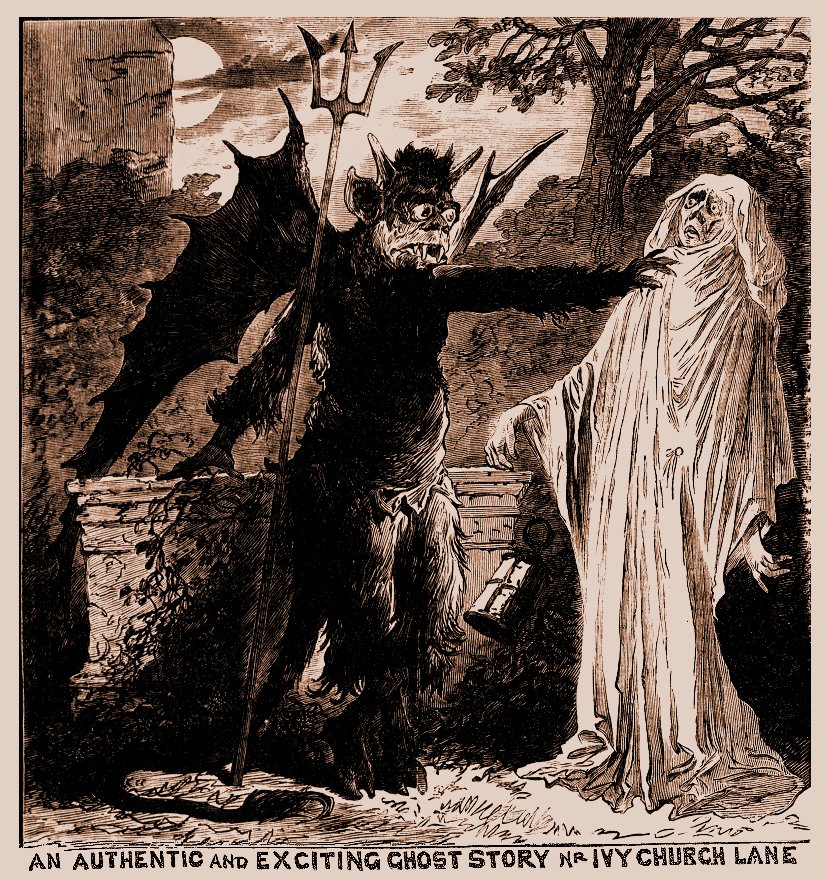
    All of these are authentic. Most are from Karl Bell's The Magical Imagination: Magic and Modernity in Urban England, though some come from other sources.


    Image result for spring heeled jack

    Cutting crosses into the backs of your ears will protect you from harm. Unfortunately it's very difficult to know when they've healed up. Get your friends to check them every day.

    The severed hand of a hanged man has healing properties. This is why the authorities always hand the corpses of executed criminals over to the doctors, rather than returning them to their families.

    The Book of Murder is an evil book that describes how the poor can and should be murdered by poison gas in order to reduce the surplus population. (Its official title is On the Possibility of Limiting Populousness, but if you refer to 'the book of murder' everyone will know what you mean.) Its author, a wicked clergyman known only as Marcus, roams the country in secret, murdering the children of the very poor with the connivance of the authorities. His Malthusiast followers could be coming to a slum near you any day now, armed with official warrants and barrels of poison gas.

    Lucky amulets affixed to the side of a stall or barrow will bring good fortune in business.

    A drunken man with a torn umbrella is the very luckiest customer you can have first thing in the morning. Tear the umbrella yourself if you have to.

    Graveyard soil and holy water can be used as all-purpose protections against bad luck and evil magic.

    Dragon's blood (red guam) can be burned to ensure the faithfulness of an absent lover. If they betray you, then mix more dragon's blood with brass pins and urine and bury the resulting mixture inside a glass jar, and they are sure to come to harm.

    Steel Jack is a monstrous ghost or demon who roams the city by night, wearing brass armour with clawed gauntlets. He can breathe fire, is impervious to bullets, and can take the shape of a bull or bear. He escapes by springing away over walls or rooftops once he has suitably terrified his victims, although sometimes he also pulls their hair out in bloody clumps or marks them with his horrible claws. Some speculate that he is actually a wicked aristocrat who is trying to scare people to death as part of a horrible wager with his equally wicked friends.

    Books of Fate can be used to tell fortunes and predict lucky and unlucky days. If you can read at all then you should own one - and if you can't, then ask someone else to read one for you. Only an idiot would attempt anything important without first consulting their Book of Fate.

    Cunning men and wise women can carry out divinations, cast spells to protect you against witchcraft, and help to locate stolen goods. Every community has at least one of them, and if you have been the victim of crime then they are much more trustworthy than the Detective Police, who are probably just looking for an excuse to have your family gassed by Marcus. Don't trust a cunning man who doesn't have a magic book, or a wise woman without a magic mirror.

    A boggart seer can help to protect your community against boggarts and evil fairies. If your town has boggarts but no boggart seer then you're going to be in trouble. You might be able to borrow one from another town in an emergency.

    Evil spirits can be driven out by an exorcism performed by a clergyman. If you're being troubled by evil spirits, demand an exorcism from your local vicar. If he objects, threaten to get one from a dissenting minister, instead. That usually brings them round.

    White pigeons tapping on windows are an omen of death. Someone within the household will die soon.

    Workhouses are always looking out for ways to kill the children entrusted to them, so that they can butcher their bodies and sell the meat for pies.

    Innkeepers sometimes rig their beds with spring-loaded blades, allowing them to murder and rob lone travellers by night. Always check your bed when travelling alone.

    Bread baked on Good Friday has healing powers.

    Nunneries are simply used as brothels by the Catholic clergy, who murder the resulting infants and bury the bodies in the grounds. Never allow your daughter to enter a nunnery.

    Doctors are infamous for viewing their poorer patients as opportunities to practise the latest surgical techniques, whether their surgeries are needed or not. If you value your internal organs then you should have as little to do with them as possible.

    Resurrection Men are grave robbers who secretly dig up the bodies of the recently dead in order to sell them to medical students. When they can't find enough fresh corpses they abduct and drown the living, instead. Everyone knows that the medical schools don't ask any questions.

    Mesmerists can heal both mind and body with their powers, but beware: some misuse their gifts to exploit, enslave, or sexually abuse their patients. Some cruel mesmerists even mesmerise their patients into believing that they are dead, or made of glass.

    Captain Swing is coming to burn down Parliament any day now. The day of reckoning approaches. Be ready.

    Folklorists are an extremely dangerous breed. They will listen to your ghost stories, and pretend to believe them, but as soon as your back is turned they will write them down and print them, and ghosts hate that more than anything. Never talk to a folklorist unless you want the wrath of the whole spirit world brought down upon you.

    Image result for spring heeled jack

    Wednesday, 24 July 2019

    How Walter Scott almost invented RPGs 200 years early

    I recently read Walter Scott's autobiography - an unfinished fragment that I found bundled in with my grandfather's edition of Lockhart's Life of Sir Walter Scott. Scott's fiction isn't much read these days: he wrote in an age that considered length to be a virtue in novels, and modern readers often find his works maddeningly slow as a result. But his influence is hard to overstate, and even today, when most people think of 'the Crusades' or 'the Middle Ages', what they imagine is likely to owe at least as much to Scott's novels as to actual medieval history. Fantasy fiction, in particular, owes an enormous debt to Scott, and to the fictional world of knights and kings and barons that he first popularised two hundred years ago. (The basic line of inheritance runs Walter Scott -> George MacDonald -> William Morris -> Lewis and Tolkien -> everyone else.) I was thus intrigued to discover that, as well as laying the groundwork for the subsequent invention of fantasy fiction, Scott seems to have come surprisingly close to inventing the RPG.

    Related image
    Scott as a young man, by Henry Raeburn.

    Scott suffered a childhood illness that left him lame in one leg, excluding him from participation in the ordinary sports of the day. Instead, like many physically infirm boys before and since, he immersed himself in reading, especially in old stories of chivalric adventure. His best friend, John Irving, shared his passion for such stories. Here's how Scott describes their favourite pastime:

    My greatest intimate, from the days of my school-tide, was Mr. John Irving, now a Writer to the Signet. We lived near each other, and by joint agreement were wont, each of us, to compose a romance for the other's amusement. These legends, in which the martial and the miraculous always predominated, we rehearsed to each other during our walks, which were usually directed to the most solitary spots about Arthur's Seat and Salisbury Crags. We naturally sought seclusion, for we were conscious no small degree of ridicule would have attended our amusement, if the nature of it had become known. Whole holidays were spent in this singular pastime, which continued for two or three years, and had, I believe, no small effect in directing the turn of my imagination to the chivalrous and romantic in poetry and prose.

    This is essentially the same social context from which innumerable D&D campaigns were born two centuries later: nerdy, socially awkward teenage boys sneaking off to tell one another interminable stories of war and magic and adventure, taking turns as narrators, riffing off one another's ideas, and spending entire holidays developing the larger-than-life exploits of the imaginary heroes they created together, all while hiding from their peers from fear of ridicule. (Yeah, I know, D&D is cool now. But it certainly wasn't when I was a kid.) But it gets better: Scott's health worsened, and he spent several months stuck at home. Here's how he passed the time:

    My only refuge was reading and playing at chess. To the romances and poetry, which I chiefly delighted in, I had always added the study of history, especially as connected with military events. I was encouraged in this latter study by a tolerable acquaintance with geography, and by the opportunities I had enjoyed while with Mr. MacFait to learn the meaning of the more ordinary terms of fortification. While, therefore, I lay in this dreary and silent solitude, I fell upon the resource of illustrating the battles I read of by the childish expedient of arranging shells, and seeds, and peebles [sic], so as to represent encountering armies. Diminutive cross-bows were contrived to mimic artillery, and with the assistance of a friendly carpenter I contrived to model a fortress, which, like that of Uncle Toby, represented whatever place happened to be uppermost in my imagination.
    Just as Scott and Irving's story-telling sounds as though it was only a character sheet away from D&D, so Scott's re-enactment of historical battles on the floor of his own bedroom sounds as though it was only a few dice away from wargaming. The pieces were, quite literally, all there: he'd even been playing chess, itself a gamified representation of the clash between two armies. All it would have taken was for Irving to drop round one day for a visit, and for one of them to have the idea of using Scott's seed-and-pebble armies to reenact a battle from their shared stories rather than a battle from history, and for the other to glance at the nearby chess board and suggest making the battle a game rather than a predetermined narrative, and bam: fantasy RPGs and tabletop wargaming would both have been born in the 1780s.

    But that's not what happened. Scott's health rallied, and his social skills improved, and he learned how to dress himself properly and stop being such a nerd all the time, and he ended up becoming a successful lawyer and novelist instead. The tiny crossbows and seashell armies and cooperative romance-writing were left behind - but not before they had instilled in him a fascination for tales of medieval adventure and daring-do that would lead him to write novels like Ivanhoe, The Monastery, and The Talisman. These novels became, in turn, the grandfathers of modern fantasy fiction, and thus the great-grandfathers of the modern fantasy RPG.

    What I found most interesting about these anecdotes was their familiarity. It's hardly a surprise to discover that bookish, socially awkward, and physically infirm teenage boys have always gravitated towards fantasies of power and magic and violence, and towards idealised figures of masculine heroism with extremely strict honour codes: that was as true of Scott in the 1780s as it was of me in the 1990s, and doubtless for all the same reasons. But until I read this autobiography I would have guessed that the specific form taken by these fantasies - the knights and castles and wizards and whatnot - were more historically local, a matter of grabbing onto whatever available cultural bric-a-brac happened to fit the specifications. I was thus somewhat surprised to discover that the causality actually ran the other way around, and modern adventure stories about knights and wizards were first popularised by a man who did so because he fell in love with them during his own days as a nerdy teenager in search of escapist fantasy.

    It couldn't have happened any earlier, within a cultural context in which the institutions of feudal chivalry was still held in deadly earnest: that culture first had to wax, and wane, and fall away, and become available for re-discovery and re-appropriation as a fantasy rather than a reality. Scott was a child of the Gothic revival, not of actual medieval Gothic culture. But Scott's autobiography suggests that once it was possible, at least part of its appeal stemmed from the fact that it was what we might now call 'gameable': much more easily adapted than, say, Classical mythology to improvised co-operative storytelling, or to refighting battles on your bedroom floor. And the much-remarked-upon dominance of medieval fantasy in RPGs and computer games - the fact that forms that could theoretically do anything keep gravitating back towards the same imaginative landscape of knights and wizards and castles that Scott half-excavated and half-created two hundred years ago - may have something to do with the fact that it was a landscape that was created for something very close to gaming in the first place.

    I mean, tell me this doesn't sound like a scene from a D&D scenario:

    "Lo, Warrior! now, the cross of red 
    Points to the grave of the mighty dead; 
    Within it burns a wonderous light, 
    To chase the spirits that love the night: 
    The lamp shall burn unquenchably, 
    Until the eternal doom shall be.' 
    Slow moved the Monk to the broad flag-stone, 
    Which the bloody cross was traced upon: 
    He pointed to a secret nook; 
    A bar from thence the warrior took; 
    And the Monk made a sign with his withered hand, 
    The grave's huge portal to expand. 

    With beating heart, to the task he went; 
    His sinewy frame o'er the grave-stone bent; 
    With bar of iron heaved amain, 
    Till the toil-drops fell from his brows like rain. 
    It was by dint of passing strength, 
    That he moved the massy stone at length. 
    I would you had been there to see 
    How the light broke forth so gloriously; 
    Streamed upward to the chancel roof, 
    And through the galleries far aloof! 
    No earthly flame blazed e'er so bright: 
    It shone like heaven's own blessed light; 
    And, issuing from the tomb, 
    Shewed the Monk's cowl, and visage pale; 
    Danced on the dark-brow'd Warrior's mail, 
    And kissed his waving plume. 

    Before their eyes the wizard lay, 
    As if he had not been dead a day; 
    His hoary beard in silver roll'd, 
    He seemed some seventy winter old; 
    A palmer's amice wrapped him round, 
    With a wrought Spanish baldric bound, 
    Like a pilgrim from beyond the sea; 
    His left hand held his Book of Might; 
    A silver cross was in his right; 
    The lamp was placed beside his knee: 
    High and majestic was his look, 
    At which the fellest fiends had shook; 
    And all unruffled was his face-- 
    They trusted his soul had gotten grace. 

    Friday, 14 June 2019

    All That Is Solid Melts Into Air: d100 encounters with onrushing modernity

    'We have fallen upon strange times', wrote Dickens in 1839, 'and live in days of constant shifting and changes.'

    Most fantasy worlds get by without ever really changing, apart from the odd cataclysm every couple of thousand years. It's all just kings and guys with swords, forever and ever and ever. Even if steampunk or clockpunk technology does exist, it's usually as a known quantity, something that's been around for long enough to be thoroughly integrated into the fabric of society.

    My current interest in the 1830s and 1840s emerges from their status as crisis decades, in which everything was changing very fast, and no-one really knew how to cope with it. They worked it out in the end, of course, for better and for worse. But for a couple of decades there, everyone from the paupers to the prime ministers were totally making everything up as they went along.

    Here's an Elfmaids and Octopi-style d100 encounter table suitable for any rapidly-industrialising city, mostly based on things that really happened in Britain between 1830 and 1850. Environments like this are full of rich pickings for chancers and opportunists. Your PCs should do just fine.

    Image result for pickwick papers

    1. First meeting of newly-founded learned association. Members are arriving from all over the country: they've been in correspondence for years, but most have never met each other face to face. Rich pickings for impostors.
    2. Labour dispute. Workers on strike outside newly-built factory. Industrialist haranguing them from a balcony, threatening to import starving labourers to replace them. No-one on either side knows how far to push their luck.
    3. Secret nocturnal trade union meeting. New members swear terrible oaths of loyalty amid flaming torches and grim icons of death and revolution. 
    4. Creaking carriages importing new machinery for use in manufactures. Working men look on balefully and mutter darkly about the consequences.
    5. Luddite riot. Unemployed and starving workers on the rampage, disguised with masks, blackened faces, and/or women's clothing, trying to smash as many machines as they can in order to raise the demand for labour.
    6. Enclosure act. Common lands are being fenced off and parcelled out to private owners in order to raise agricultural productivity. Local smallholders watch the fences rise with a mixture of anger and despair. 
    7. Monster meeting. Huge crowds of people assembled in fields to hear speeches by popular orators, rousing them to action. Armed yeomanry look on nervously and finger their sabres.
    8. Ragged band of rural labourers, deprived of their land by the enclosure acts, stumbling resentfully towards the city to join the ranks of the industrial proletariat.
    9. New police force splendid in shiny new uniforms, marching the streets with truncheons in hand, ready to keep the scum in line.
    10. Old police force, obsolete but not yet disbanded, shivering in their old watch-houses and predicting ruin to the state.
    11. Clandestine meeting of criminals thrown into panic by the operations of the new police force. All suspect one another of being police informers.
    12. Detective from newly-formed police detective unit following a trail of clues relating to a recent murder.
    13. Crowd gathered around a body that has recently washed ashore, with a gash on its head and bricks shoved into its pockets.
    14. Public execution by hanging. Swells watching from nearby windows through opera glasses. Pickpockets working crowds. 
    15. Quarantined city district hit by exotic new disease from foreign parts, now filled with death and misery.
    16. Land torn open for construction of exiting new sewer network, miles of tunnels being constructed, an entire subterranean world being born beneath the city streets.
    17. Gangs of sweating navvies cutting the way for a canal or railway, demolishing everything in their path.
    18. Furious legal dispute between railway proprietor and a property owner whose inconveniently-placed house is blocking the path of progress. Pickaxe-wielding navvies look on menacingly.
    19. Crowd of speculators trying to work out exactly how long to back the current railway boom for.
    20. Wild-eyed men roving the streets, selling shares in mostly-imaginary railway companies.
    21. Clanking parade of convicts stumbling off for transportation to the colonies.
    22. Band of escaped convicts returned illegally from transportation, furtive and terrified of being recognised.
    23. Band of government inspectors scornfully criticising an old prison, where chained prisoners languish in chaos and darkness and filth.
    24. Band of government inspectors rapturously praising a new prison, where masked prisoners are kept in total silence and solitude.
    25. Coach-load of hopelessly crazed inmates being transported from new prison to local asylum.
    26. Travelling mesmerist attracts crowds with his amazing displays of mind control and mesmeric healing.
    27. Ragged street preacher howls predictions of national woe to a receptive crowd.
    28. Gigantic new asylum under construction. Lead engineer fretting over the spiralling costs. Lead doctor worried that there still might not be enough beds.
    29. Drunken gentry out on the town, smashing lamps and beating up policemen.
    30. Team of mechanics installing new gas lighting on the streets.
    31. Shivering part-time prostitutes, ashamed but desperate, nervously propositioning passers-by.
    32. Sweatshop tailors, diseased and naked, one coat between ten, working frantically to fulfil the latest order for military uniforms.
    33. Huge new gin palace, just opened, all flaring gas lamps and shining mirrors, an instant hit with the locals.
    34. Impromptu penny theatre performing blood-and-thunder melodramas to a delighted crowd of small children. 
    35. Travelling freak show advertises dwarves, giants, and human skeletons.
    36. Grave robbers stealthily excavating the grave of a recently deceased freak on a special commission from a local doctor.
    37. Sauntering dandies with perfumed curls and exquisite swallow-tail coats, serenely ignoring the clamouring debt-collectors who pursue them from street to street.
    38. Wretched beggars wave amputated limbs, telling miserable tales of industrial accidents.
    39. Train-load of blood-spitting consumptives setting off to convalesce at the seaside. 
    40. Street stricken by strange new water-bourne diseases, probably nothing to do with the new factory that just opened upstream.
    41. Band of ex-officials, holders of ancient civic offices just dissolved by modernising government decree, sit around mournfully in their obsolete regalia, swapping tales of the epic civic banquets of the past.
    42. Popular novelist mobbed by admirers, all trying to persuade her to include their brilliant idea in her latest story.
    43. Cabmen competing to drive their fares the fastest, hurtling recklessly through the streets, people scattering in panic before them.
    44. Steamship of day-trippers setting off downriver with hampers of sandwiches and bottled ale, band playing on-deck, queasy passengers vomiting copiously over the sides. 
    45. Firework display over illuminated pleasure gardens by night. Lots of furtive assignations in the bushes.
    46. Crowds gathering to watch hot air balloon race between rival aerialists. 
    47. Recently-returned explorer delivering a public lecture, telling blood-curdling tales of his adventures among the savages.
    48. Recruiting sergeant looking out for likely lads to join the regiment, handing out drinks freely and telling mouth-watering stories about all the food and loot and women that a young soldier can get his hands on overseas. 
    49. Soldiers setting out for distant colonial war, resplendent in their shiny new uniforms.
    50. Soldiers returning from distant colonial war, sunburned and traumatised and ravaged by tropical diseases, twitching nervously at loud noises and looking around for something to kill out of force of habit.
    51. Celebrity criminal being carried to the gallows, surrounded by adoring crowds begging for locks of hair and straining to hear their last words.
    52. Menagerie of exotic animals, caged and miserable, on display to paying customers.
    53. Panic - an elephant, driven mad in captivity, has burst its bars and is now on the rampage. A band of men waving muskets follow in hot pursuit.
    54. In a low tavern, thieves plot a break-in on a nearby warehouse.
    55. Street vendor selling penny books with lurid woodcut illustrations to semi-literature customers.
    56. Newsboys hawk newspapers full of verbatim witness testimony from the latest aristocratic sex scandal. 
    57. 'Lion-hunting' society hostess on the lookout for celebrities to invite to her next soiree. She's got no-one lined up for next week yet and is getting frantic.
    58. The 'black guard': soot-covered street children, drunken and half-feral, roaming the street in mobs.
    59. A meeting between rival benevolent societies to discuss the best means of distributing charitable relief to the poor. The mood is growing less benevolent by the minute.
    60. Crowds mobbing a doctor's coach attempting to carry a man to the asylum, while the patient within screams that he is sane and being carried off against his will.
    61. Band of city traders on shooting excursion to the countryside, nervously eyeing their shotguns and hoping they don't shoot each other by accident.
    62. Seconds making secret preparations for a duel on an isolated patch of wasteland, checking the pistols, waiting for the surgeon, and keeping an eye out for the police. The principals will arrive any minute, horribly hung-over and desperately regretting their drunken challenges the previous night.
    63. Opium eaters stumbling around in a blissed-out haze, smiling meaninglessly at everyone.
    64. Meeting of a band of armchair detectives, determined to solve the latest crimes described in the daily newspapers.
    65. A man being dragged off to a debtor's prison while bailiffs carry off the furniture and possessions from his home, to be sold at auction. His wife and children sit, stunned with misery, in the street outside.
    66. A local election. Both candidates have spent lavishly on free beer for the electors, and everyone permitted to vote is now very, very drunk. Agents of one candidate are now circulating with the aim of tricking the befuddled voters into voting for the wrong man, or, failing that, of drinking themselves into unconsciousness and thus not being able to vote at all.
    67. Chimney-sweeps adorned with green branches, dancing and begging money for beer. 
    68. Bands of emigrants dragging their meagre possessions down to the docks, hoping to try their luck elsewhere. 
    69. A group of literary reviewers sit in the corner of a pub, whispering like conspirators, plotting how best to destroy a writer they have taken a dislike to in their review of her next book. 
    70. A group of actual conspirators sit in another corner, making grand but impractical plans for uprisings, rebellions, and assassinations.
    71. A hired carriage rolls by, on its way to present a grand petition to parliament. Watching crowds, sullen and mutinous, mutter about rioting if their demands are not met.
    72. Screaming match in the streets between legislators beholden to the agricultural and industrial interests. Each faction accused the other of bringing utter ruin to the nation. The mood is tense and a crowd is gathering fast.
    73. Huge new church under construction to spiritually regenerate the working classes. Already looms over the entire district like an omen of doom and the spire's still only half finished. The locals are terrified of it.
    74. Grand opening of new museum to display the treasures of empire, houses sacred art looted from five different continents, rumours of curses and hauntings probably nothing to worry about. 
    75. Scientific expedition just returned from distant shores, now being unloaded by crews of porters, disgorging an apparently endless stream of pickled marvels and monsters from its hold.
    76. Ambitious young doctor seeks volunteers for his latest experiments in surgery and anaesthesia, promises they're only sometimes mostly fatal and his technique is improving all the time.
    77. Band of ragged paupers seriously discussing whether they should spend the winter in the workhouse, or whether they'd be better off getting drunk and breaking some windows in the hope of getting sent to prison instead.
    78. Tombs of the famous dead being systematically broken open under the supervision of a noted phrenologist, who has received permission to carry out a comparative scientific study of their skulls.
    79. Travelling lecturer in chemistry amazes his audience with displays of electricity, explosions, blue flames, and similar wonders.
    80. Band of postmen from newly-instituted postage system roaming the city, attempting heroically to match the directions on the letters with the completely unsystematic geography of the city itself, which has never been mapped and lacks any agreed-upon system of street names or house numbers.
    81. Factory in a state of great upheaval, with everything being cleaned and all the most obviously sick and crippled workers being shoved out of sight in preparation for the first visit of a newly-formed government inspectorate on a fact-finding mission.
    82. Reclaimed drunkards addressing a temperance meeting with lurid stories of their previous debasement. Lots of hymn-singing and tea-drinking. Gangs of drunken roughs jeer and heckle from the sidelines.
    83. Grand opening of chapel founded by new religious movement. Much impassioned preaching, prophesying, and speaking in tongues. Fevered speculation among the faithful regarding the miraculous powers supposedly possessed by the sect's founder. Dark rumours that a plot is afoot to have her committed as a lunatic.
    84. Coachload of miserable children, unwanted or illegitimate, being carried off to a distant boarding school where they can be safely forgotten about. The more desperate among them are planning an escape.
    85. Gang of criminals planning to sabotage the new electric telegraph system, on the grounds that crime will be impossible once news of a crime can travel faster than the criminal who commits it.
    86. Giant new intercontinental steamship lying in drydock, in preparation for epoch-making intercontinental voyage. Lounging spectators make bets on how far it will get before sinking.
    87. Ashen-faced bankers stumbling from the exchange. There has been a crash, and ruin now awaits them and all who have banked with them unless some desperate expedient can be found. 
    88. Stage production of the life and death of a famous celebrity criminal, watched each night with rapt attention by a huge and adoring crowd, to the consternation of the authorities.
    89. Circle of spiritualists advertise weekly communions with the spirits of the dead, with much table-turning, spirit-rapping, apportation, and masses of ectoplasm. A glowering sceptic seeks volunteers to help him unmask their surely-fraudulent activities.
    90. Self-proclaimed genius preening himself in a salon, surrounded by female admirers, holding forth at length on how all true art must be produced without any consideration of profit or commerce. He writes a book a year for the popular press, the most recent of which came out last month and is already a bestseller. 
    91. Half-mad demagogue stirring up a crowd. He claims to be a nobleman deprived of his rightful heritage, who will lead the people to reclaim their rights and bring about a new age of justice. He's clearly a little unhinged, but there are plenty of people around who are desperate enough to listen.
    92. Formal but increasingly heated debate between two cliques of political economists about how best to reform the taxation system to reflect the realities of the new economy. Some important people are in the audience and the stakes are getting worryingly high.
    93. Swindler mercilessly fleecing middle-class snobs at a party by making spurious claims about his aristocratic connections. Some of the sharper ones suspect they're being played but don't have enough to prove anything... yet.
    94. Famous engineer surveying the city, making plans for grand new bridges, tunnels, streets, squares, embankments...
    95. Rookery of slums endlessly subdivided into smaller and smaller apartments, linked by an incomprehensible warren of back-alleys, a breeding-ground of filth, crime, and disease. 
    96. Surgeon holding public demonstration of 'bio-galvanic energy' by running electrical currents through the corpses of executed criminals in front of a paying audience. There is no way this can go wrong. 
    97. Street brawl between local workers and recent immigrants, who are widely blamed for pushing down the price of labour by inconsiderately being desperate enough to work for starvation wages.
    98. A dazzling display of the latest visual technologies: magic lantern shows, stage apparitions, transparencies, panoramas, and mechanical theatres. Some particularly gruesome ghost projections are sending small children into hysterics. 
    99. Well-meaning philosopher wearily explaining to a hostile crowd that giving charity to the poor is actively harmful, as it holds down the price of labour by preserving the surplus population.
    100. Girlish young queen on her way to her own coronation, watched by a sceptical crowd of loafing sandwich-eaters convinced that she'll never amount to anything and will be swiftly forgotten.
    Image result for nicholas nickleby illustrations