Showing posts with label Misc. setting stuff. Show all posts

Monday, 8 January 2018

Horse-hair and pine-needles spill from their frozen hearts

The other thing I managed to do over the Christmas vacation, aside from playing intermittently-disturbing games with my three-year-old son, was visiting the Scythians exhibition at the British Museum. Most of the items on display barely ever leave Russia, so it was an opportunity I really didn't want to miss.

One thing I learned from the exhibition was that many of the most famous examples of Scythian art were found in what was essentially a tomb-robbing gold rush in the late seventeenth and early eighteenth centuries. Buried in the frozen earth of the Altai mountains, many Scythian kings and chieftains had been preserved by the ice, along with all their grave goods, for millennia - until the locals discovered, by chance, that there were hauls of ancient gold buried up in the hills, some of which found its way back to the court of Peter the Great. Believing that the only proper place for such rarities was in his new cabinet of curiosities (which would one day form the basis of the original Hermitage collection), the tsar sent out archaeological expeditions to search for more of these ancient tombs, along with decrees that anyone finding Scythian gold would be richly rewarded if they handed it over to the tsar, and harshly punished if they attempted to keep it for themselves. Soon the golden treasures of the long-dead kings of Scythia were flowing north to St Petersburg, where they have largely remained ever since.

Related image

Lost tombs in the wilderness... preserved corpses... ancient treasures from forgotten civilisations... the whole set-up is absurdly D&D-friendly. The fact that it began at almost the exact historical moment that the ATWC setting is pegged to is just a gratuitous bonus.

So: for the last few years, there's been a new rumour travelling up and down the Great Road. They say that the distant Western Emperor, the ruler of all those hairy foreigners with guns who are currently carving up the taiga, has gone mad: that someone brought him a beautiful gold carving from some long-lost tomb, and he fell in love with it, and swore that he would not rest until he had gathered together all such treasures that still exist upon the earth. They say that he thinks of little else, now; that he sits all night long in his treasury, caressing the ancient faces of his golden stags and tigers and monsters, and dreaming of what new acquisitions his messengers may even now be carrying back to him across the endless steppe. Anyone who owns such items and is willing to sell them to the Western Emperor's agents can make a quick fortune. Anyone who owns such items and refuses to sell them is likely to suffer either a very precisely-targeted robbery or a premature death.

Related image

Who were they, these ancient goldsmiths, whose skillful workmanship has so bewitched the mind of the emperor, thousands of years after their own deaths? No-one knows: the steppe has devoured them, along with their name and their language and their history, just as it has so many peoples before and since. They lived long before the Wolf Khans, and left no script to be decoded: only scratched pictures of horses and chariots, and carved stone men standing in endless vigils on hillsides, with three diagonal lines cut where their faces should have been. Those who have seen the bodies which lie within their icy tombs call them the Frozen Ones, or the Tattooed Folk, or the Pale Riders. But there are few who can truthfully claim to have seen such sights - and fewer still who like to talk about it.

They built their tombs in the frozen earth, high up in the mountains; and there the ice has preserved them, age after age. Imagine a row of sturdy log cabins, lowered into pits, covered with mounds of earth, and left to freeze: that's what their royal tombs are like. Within lie the bodies of men, women, and horses, their skin dried and frozen into icy leather, their weapons and clothes and harness still intact despite the passage of so many centuries - but cold, all of it, so deathly, deathly cold. Sometimes the corpses are just corpses, and any daring hand can loot them, plundering all their valuables - their golden buckles and armbands, their bowls and brooches and earrings, and all those other precious things of which the Western Emperor dreams. Sometimes even their beautiful beaded clothes can be stripped from them, revealing the fantastical tattoos on their bare and frozen limbs, and their long-dead wearers will simply loll, and crack, and not resist. Sometimes a fortune in old gold can be pulled from the earth with almost no risk at all.

Sometimes. But sometimes not.

For sometimes they rise, these old ones, these pale riders. Sometimes they lift their ancient war-picks in anger against the intruders in their tombs. Sometimes would-be looters will find themselves impaled by volleys of millennia-old arrows, launched out of the subterranean darkness by icy fingers which have forgotten how to miss. Sometimes the adventurer who reaches down to take a golden buckle from some withered corpse will find their arms suddenly grasped by a dead man's hand. They never speak, these frozen guardians. If their bodies are cut open, horse-hair and pine-needles spill from their wounds instead of blood.

Related image

Here is a secret that no-one knows yet: the bizarre creatures depicted in the gold jewellery of the Pale Riders were not mythical or imaginary, but real monsters of the ancient steppe and taiga, which their heroes hunted to extinction in the dim and distant past. The preserved and frozen corpses of a few of them still stand in certain undiscovered tombs, buried as trophies with the great hunters who slew them. Such a specimen would be worth a fortune to any scholar or collector; but their mighty spirits do not rest easy, and if taken from the tombs of the mighty men and women who defeated them in life, their bodies are liable to reanimate as soon as they feel the wind and sun once more upon their faces.

Here is a another secret which no-one knows yet: although the Western Emperor isn't nearly as mad as the rumours claim, he is becoming increasingly obsessed with his collection, and his obsession is not an accident. The gold really is calling to him, calling in a voice that feels like snow and smells like hemp and horses. The more of these ancient treasures he brings together, the louder the voice becomes. He feels he can almost understand it, now. He can almost make out the words.

Surely, surely, just a few more pieces will suffice...

Image result for scythian tattoo british museum

  • Animated Pale Rider Corpse: AC 13 (frozen, leathery skin), 3 HD, AB +3, damage 1d6+1 (war pick) or 1d4+1 (claw), FORT 10, REF 13, WILL 10, morale 12. Each round, roll 1d3: on a 1, the corpse exhales a cloud of ice crystals onto any one target within melee range, who must then make a FORT save or take 1d6 cold damage and be at -1 to all rolls until properly warmed up. (Penalties from multiple freezings stack.) Take only 1 damage per hit from piercing attacks such as daggers, arrows, or bullets.
Leathery, pale-skinned corpses with tattooed limbs, these ancient warriors defend their tombs using the antique war-picks they were buried with: these weapons are fragile with age, however, and will break on an attack roll of 1 or 2. In life they were expert archers, but there is simply no way to preserve a compound bow for two thousand years in a useable state, so they have to rely on melee weapons instead. If anyone intrudes into their tomb carrying a bow, their first priority will be to kill that person and take it. A Pale Rider corpse with a functional bow shoots with AB +5 and +2 damage.

Image result for scythian gold
  • Monsters of the Ancient Taiga: AC 14 (agility and tough skin), 6 HD, AB +6, damage 1d8, 3 attacks per round (a combination of goring, biting, kicking, clawing, and trampling), FORT 8, REF 8, WILL 10, morale 8. 
These bizarre creatures resemble odd combinations of features from elk, wolves, lions, tigers, and predatory birds. One might have a lion's body, an eagle's head, and feet ending in hooves; another might have the body of a tiger, a wolf's muzzle, spreading many-tined antlers, and a lashing tail that ends in a snapping bird's head. All are huge and savage. They de-animate at once if the corpse of the hunter who originally killed them is brought into their presence, or if they can no longer feel the sun and wind on their skin.

Related image

  • The Ice Maiden, Witch-Queen of the Steppes: AC 15 (semi-corporeal body), 5/10 HD, AB +4, damage 1d10 (freezing touch), FORT 10, REF 10, WILL 8, morale 10. Each round, she can exhale a cloud of ice crystals onto any one target within melee range, who must then make a FORT save or take 1d6 cold damage and be at -1 to all rolls until properly warmed up. (Penalties from multiple freezings stack.) Takes half damage from non-magical attacks.
The Ice Maiden loved worked gold more than anything else, so much so that when she died a fraction of her spirit passed into each of the golden treasures that she loved the most, which were then divided among the various kings and chieftains of the Tattooed Folk. Once more than three of these are gathered together in any one place, their owner will begin to feel a nagging desire to own more; this desire will grow stronger the more such treasures are brought together, gradually reaching the level of an obsession. Once half of them have been collected, she will be able to manifest herself at will as an 5 HD spirit. Once all of them have been assembled, she can manifest at 10 HD, instead.

The Ice Maiden manifests as the ghostly figure of a woman in a high conical hat, her arms and legs covered in fantastical tattoos of taiga animals being devoured by predatory beasts and monsters. If she wills it these beasts can spring to life, uncoiling themselves from her limbs and dilating into full-size predators within seconds: each round, in lieu of attacking, she can summon one such creature, up to a maximum of four. These have the statistics of the Monsters of the Ancient Taiga, above, but they cannot act in the round in which they are summoned. They vanish instantly if she is defeated.

Once manifested, her first objective will be to regather all her original treasures, and her second will be to start hoarding together as much gold as possible. She will find modern cities extremely confusing, however, and if she manifests in such a city - the capital of the Western Emperor, for example - she will venture forth only at night, when it's quiet and there aren't too many people around. She speaks only her own long-extinct language, but is capable of basic telepathic communication with whoever owns her treasures, and can also be contacted like any other spirit through the use of shamanic trance rituals.

Killing the Ice Maiden banishes her for 1d100 days, but she will always return as long as her treasure collection is intact. The only ways to permanently get rid of her are to break up the collection, destroy more than half the treasures, or get every surviving treasure blessed by a man or woman of great holiness (which sends her spirit on to the afterlife). Alternatively, if all her treasures were taken to one place and buried, she would become a spirit of the land, who could be contacted and bargained with by shamans like any other. Her favour would bestow skill in metalwork, prowess in hunting, and resistance to cold, but - unsurprisingly - she would demand offerings of gold in return.
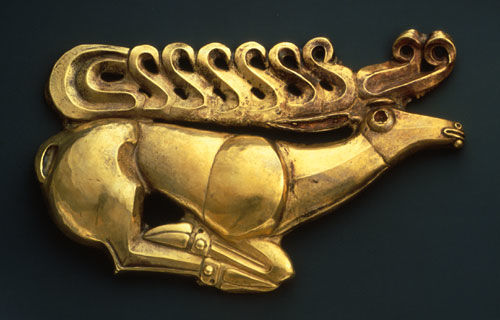
Image result for scythian gold

Monday, 18 December 2017

We dance for the spirits and yet they are not appeased.

These are Tsam dancers.

Only in Tibet...  Tibet

War God, dancing daemon wearing a traditional Tibetan Buddhist dance mask for the Tsam ritual dance, Ulan Bator or Ulaanbaatar, Mongolia, Asia

Tsam Dance at Ulaan Baator, Mongolia, 1920s. (British Museum)

(2) Likes | Tumblr

The Tsam or Cham ceremony is a ritual of Tibetan origin, in which masked performers enact symbolic dances in order to spiritually purify themselves and the surrounding environment. Like much of Tibetan Buddhism, it bears a strong resemblance to the indigenous shamanic traditions which were incorporated into local Buddhist practise: and it may have been this shamanic heritage which helped it to catch on in Mongolia, where Buddhist monks began performing Tsam dances of their own in the eighteenth century. To a population familiar with Tegriist shamanism, with its use of ritual masks and dances, it probably seemed logical that Buddhist clergy might also achieve their spiritual objectives by putting on masks and dancing: and the Mongolian Tsam rituals quickly became even more elaborate than their Tibetan originals.

The setting of ATWC is mostly pegged to the seventeenth century, which is before the flowering of Mongolian Tsam traditions: and in any case, I'm extremely wary of turning real religious ceremonies into gaming fodder. Still, I like the idea of the having something similar to the Tsam ritual - let's call it the Great Spirit Dance - as an exciting new ceremonial technique, knowledge of which is just starting to filter into the steppe khanates from some half-legendary mountain kingdom in the south. For the steppe peoples, the Great Spirit Dance is still something daring and experimental and dangerously foreign, which many people have heard of but which very few actually know how to carry out. As such, the performance of such dances is only likely to be attempted by the truly adventurous - or the truly desperate.

Here's how it's supposed to work: through ritual supplications, powerful spirits are drawn down into the masks, which become their temporary homes. The ritualists then don the masks and perform their ceremonial dances, symbolically enacting the cosmic order of the universe. The spirits inhabiting the dancers are reminded of their place within the cosmic system, and at the end of the dance they depart from the bodies of the ritualists in a state of harmonious contentment, meaning that the chances of them deciding to unleash plagues and famines and other disasters upon the people will be drastically reduced in the year to come. They might still do those things, of course: but if they do, it's likely to be because they have a good reason for it, rather than just because they woke up feeling spiteful that day.

Stunning 1920’s images of a Tsam Dance at Ulaanbaatar, Mongolia

Here's the harmless way to get it wrong: if you mess up the construction of the masks, or the initial ritual preparations, the spirits won't be called down into the performers. You can still do the dances, and if your human audience is paying attention to the symbolism they might even learn some useful religious lessons - but the spirits won't be influenced, because the spirits won't have turned up. As a result, they'll be no more or less likely to send a murrain on your cattle than they would be in any other year.

Here's the really dangerous way to get it wrong: if you get the ritual masks and preparations right, but then mess up the dance, then the spirits will arrive... but they won't leave. You've called them here, into your masks and your bodies, and you're dancing for them... but the dance isn't telling them anything, or at least not anything that makes proper sense. They get confused. They get frustrated. They won't let you stop dancing. They won't let you take the mask off. They want you to do it right.

Thus it sometimes happens that travellers on the steppe chance across a ragged band of dancers, arrayed in the tattered remains of once-fantastical costumes, leaping and stomping their way across the empty lands. Their huge, heavy masks sway and nod to the beat of inaudible music, and through their open mouths can be glimpsed the wild eyes of the dancers, spirit-ridden, gleaming, and crazed. They move in great wheeling circles, their feet tracing intricate mandalas across the featureless grasslands of the steppe. They never eat. They never sleep. They never stop.

Cham Dancer, Tibet

It's best to avoid them, which is easily done on horseback: they move faster than any man, but never in straight lines, so a horse will always outdistance them over time. But if they come upon you by surprise - if they burst upon your camp during the night, for example, for their dance continues in darkness just as it does in light - then almost anything could happen. To determine the disposition of the spirits, roll 1d6:

  1. The spirits want you to join the dance. They will each grab one dance-partner and whirl them away, carrying them off over the steppe for 2d20 hours before releasing them and pirouetting off. If resisted they will become forcible, first grabbing and grappling, then escalating to actual violence. They'll dance with unconscious bodies or lifeless corpses if they have to. 
  2. The spirits want musical accompaniment. For 1d6 hours, they demand that you play for them, with whatever instruments you have available: if no-one has any musical instruments, then they'll accept beatboxing and drumming on nearby objects instead. They're not picky about performance quality, but will grow agitated and violent if you can't keep the beat.
  3. The spirits want new bodies: these ones are becoming quite worn out. They will try to grab victims and force their masks over their heads, using whatever degree of force is necessary to do so. Anyone who has such a spirit-mask forced over their head must pass a WILL save each round or suffer spirit possession. The mask's previous wearer will be freed from the spirit's influence once the new victim has been possessed, but they will be in a terrible physical condition, and will die in 1d6 hours unless they receive immediate care. 
  4. The spirits want an audience. You have to sit and watch them for 2d12 hours, cheering and applauding whenever any of them does anything especially athletic: after this time is up, they bow and dance away. They will use force, and if necessary violence, to compel continued attention. 
  5. The spirits have questions, and they want you to answer them. The imperfect symbolism of their dance has puzzled them rather than placated them, and now they surge towards you, roaring out theological queries like challenges: 'What is the nature of heaven? What is the purpose of suffering? Of what essence are the Men of Bone and Iron? What is the true homeland of the soul?' If your answers are good enough to give them something to think about, they'll whirl away and dance around contemplatively in a circle for a while, giving you a chance to leave. (For these purposes, clever-sounding wordplay is just as good as something genuinely profound.) If they receive obviously unsatisfactory answers, or no answers at all, they will become frustrated and attack.
  6. The spirits believe they are engaged in a ceremonial re-enactment of some primordial battle... and that you are the enemy. They attack furiously, yelling out the names of antique war-gods as battle-cries, and forcing their luckless hosts to fight until they have been hacked to twitching pieces.
PCs confronted with such possessed individuals may try to free them by pulling their masks off, but these unfortunates are not so easily saved: while the spirit rides them, the mask is effectively their actual head, and cannot be removed by any means short of amputation. (The exception is if the spirits themselves will it - see 3, above.) Aside from killing them, there is only one way to end their possession, which is to identify what is wrong with their dance and then demonstrate to them how it should actually be completed: if this is accomplished, then the spirits will be satisfied and depart, and their hosts may yet be saved with the aid of prompt medical attention. (They will remember their possession only as a blurred and interminable dream.) For anyone other than a Spirit Dance expert, understanding the flaw in the dance's symbolism requires a 1d6 x 10 minutes of close observation, a specialised religious education, and successful Intelligence check; demonstrating what the correct version should look like requires a great sense of rhythm, 3d6 minutes of dancing, and a successful Dexterity check. Both are likely to be challenging under combat conditions.

  • Possessed Dancer: AC 15 (superhuman agility), 3 HD, AB +3, damage 1d4+3 (inhumanly strong kicks and punches) or grapple, FORT 8, REF 8, WILL 8, morale 12.  Possessed dancers are immune to all mortal magic, as well as to fear, exhaustion, and pain. They can never stop dancing for any reason until they are either cut to pieces or freed from the spirits that drive them. 


Joseph Rock - Skeleton dancer, Choni (Jone, 卓尼), 1925

Friday, 23 June 2017

The Language of the Fans: Ruby Fan Murder Harlots revisited

Zayasaikhan Sambuu (better known as Zaya), Mongolian artist, born in 1975

The achieve of, the mastery of the thing!
Brute beauty and valour and act, oh, air, pride, plume, here
Buckle! AND the fire that breaks from thee then, a billion
Times told lovelier, more dangerous, oh my chevalier!

- Gerard Manley Hopkins, 'The Windhover'

'If I could tell you what it meant, there would be no point in dancing it.' - Isadora Duncan.

On the face of it, it seems bizarre that a bunch of dancers with complicated fans should have risen to become major players in the criminal ecology of the Wicked City. Anyone with a gun or a dagger or a rope can be a murderer, and anyone with a body can be a prostitute, yet to become a Ruby Fan Murder Harlot requires exceptional natural athleticism and years of ruthlessly demanding training in a balletic art form that almost no-one even understands how to interpret any more, all so that they can graduate to a life of running brothels or cutting people up with bladed fans. It all seems so excessive. Wouldn't it be simpler just to recruit a bunch of ruthless kids with knives and forget about all the fancy dancing?

Such questions, while understandable, get the situation entirely backwards. Hard though it may be for their victims to believe, the arts of the Murder Harlots are not cultivated to assist them in the execution of their crimes. Instead, their criminal endeavours exist primarily so that they can safeguard the continuation of their art.

This is their secret: that for all their nihilistic bravado, the Murder Harlots really care about the art form of which they are the Wicked City's last remaining practitioners. No-one who wasn't genuinely in love with the expressive possibilities of dance and motion would ever put up with their gruelling training regimen, or the years of practise needed to mould a human body into something that makes the most extraordinary acrobatic feats look effortless, leaping and spinning through the air as though gravity was merely a suggestion. In their own slightly crazy way, the Murder Harlots are actually much more purely committed to their art than the Jewelled Fan Dancers from which they inherited their traditions. For the Jewelled Fan Dancers, their dances were valuable because they were understood to embody and communicate all kinds of high-minded philosophical and spiritual ideals about Order and Balance and Harmony and Self-Control. For the Murder Harlots, the dance is just the dance. It doesn't mean anything, or at least not anything so paltry that it can be put into words. It means itself. The clean and perfectly-executed snap of the body through space contains its own meanings and its own rewards. 


It says a very great deal about the cultural state of the Wicked City that the only way the Ruby Fan dancers have been able to survive as an institution is by reinventing themselves as high-class courtesans and contract killers; but then again, if their art didn't have the side-effect of making them potentially appealing as sexual partners and hired assassins, it probably wouldn't have survived at all, or at least not in anything resembling its original sophistication. The other fine arts within the city are in a sad condition: poetry has been censored into oblivion for all purposes other than propaganda, architecture is now used chiefly to create ever-more vulgar and ostentatious monuments for the rich and powerful, and aside from the bawdy folk-songs of the very poor, music is now chiefly heard accompanying the liturgy of the city's corrupt and oppressive state religion. Under such conditions, genuine creativity finds few outlets. On balance, the Ruby Fan gang have probably done better than most.

They perform for themselves, mostly. They'll take paid engagements if the price is right, but among the city's elite, the knowledge to truly appreciate their artistry was lost when the Wicked King purged the old aristocracy; when they're hired now, it's usually by some lecherous bureaucrat who wants them to 'send a bunch of good-looking boys to do one of those twirly dances', or something similarly crass. Or they will put on public shows for paying audiences, trading on some combination of the athleticisim, obscenity, and black humour for which they are famous; morbid pornographic farces which also happen to involve an awful lot of backflips. The audience usually thinks that the most important scene is the one where the main performer jumps up and down a lot and then pretends to have sex with a camel. Only the dancers are likely to recognise that the real heart of the show, the point of it, comes in some seemingly incidental fan-fluttering passage whose sheer virtuousic complexity will not even be noticed, let alone understood, by anyone other than themselves.

It takes seven years to master the Language of the Fans; a language which, they say, contains more subtlety of nuance and vigour of expression than any spoken tongue. You think they do that just so they can pass each other secret messages in crowded rooms?

Gackt-Shellfish Barrel Pattern Tomosode (formal kimono)

Among some of the Ruby Fan Murder Harlots, the nihilistic amorality for which the gang is famous verges on antinomian mysticism. Words are lies; categories are traps; moral judgements are laughable oversimplifications which should be held up to ridicule at every opportunity. The divisions between good and evil, sacred and profane, are meaningless: there is only action, and every action is purely and radiantly itself, and the only true meaning is that which inheres in the action perfectly executed, the curve of the arm through its arc, the smooth slice of hand or fan or blade through air or flesh. They wouldn't use those words, though. They'd say: 'The world's fucked, and you might as well laugh at it. But that's no excuse for not appreciating really good footwork.'

It would be easy, and dangerous, to romanticise the Murder Harlots. To focus on their outlaw glamour, and forget their causal cruelty: the weeping boys and girls exploited by their brothels, the innocent victims hacked down by their hired assassins, the unfortunate visitors to the city dragged off by the Secret Police after being tricked into making seditious statements for their amusement, the passers-by subjected to random bladed-fan-based mutilation just because a nearby Murder Harlot happened to be bored that afternoon. Many of them are very deeply damaged people, not least because of the gang's frankly abusive training methods; and their collective culture tolerates and encourages the expression of this damage in highly destructive ways, ensuring that they retain their reputation as mad, bad, and dangerous to know. They just also happen to encourage its expression through some rather wonderful fan-dancing. 


PCs whose first contact with the Murder Harlots comes through encounters with their victims are likely to write them off as depraved and irredeemable. A lot of them probably are. But any perceptive PC who gets a chance to witness one of their private performances, full of expressive motion and yearning gestures and eloquent, fluttering fans 'speaking' faster than the untrained eye can follow, may glimpse another part of the truth: that their violence and callousness exists mostly as a protective carapace, and that for at least some of them the things they dance aren't just the things they can't express in words, but the things that they don't dare to, even to each other. Even to themselves.

Help me.

Love me.

Fix me.

Forgive me.

So the question it comes down to is this: how well can you interpret the Language of the Fans?

Jeff Sun, Shen Yun lead dancer and silver medalist of this year's adult male division, portraying the loyal general from Romance of the Three Kingdoms.

Monday, 30 January 2017

The Three Thieves of the Triple Crown

Image result for persian crown

No-one remembers now who the Triple Crown was first made for. Some tyrant of the ancient world, perhaps: some forgotten king whose ruined cities have long since crumbled into mere grassy mounds beneath the steppe. Perhaps he hoped that the glory of the crown would ensure that his reign would never pass from the memory of men; but now, when people tell its story, the king who wore it is always the least significant part of the tale. There was a king. He died. He's not important any more. 

But his crown... ah, his crown was a wonder! Three crowns in one, a triumph of the goldsmith's and the lapidary's art, mingled with astral magic of a kind now vanished from the earth: circlets of solar gold, lunar silver, and glittering star-like gemstones, combined into a single diadem whose glory and radiance outshone all earthly things. When the king wore the Triple Crown, sunlight and moonlight blazed around his head, and his eyes were filled with stars, and even the mightiest of men and the fiercest of beasts did not dare to approach him. In the height of his pride, the king boasted that even death would be awed by its radiance; but in this he proved quite mistaken. He aged and died like other men, and after his death his children fell to squabbling over which of them would inherit it: and while they bickered and schemed against each other, three cunning thieves stole the Triple Crown from their treasury and vanished quite away. 

Image result for persian crown

The glory of the Triple Crown could not be hidden. It shone through every covering; and the thieves knew that they could not keep it long. They broke it into its three separate rings, and they each fled in different directions, making a solemn pact that if they escaped detection they would meet together at a secret place after a year and a day. But while the magic of each of the three rings, when combined, had served to counter the most baleful effects of the others, when broken apart their celestial influences burned without restraint. As the thieves fled, the crowns burned through their souls as the parchment is swallowed by the flame.
As the sun burns brightest of all the heavenly bodies, so the Sun Thief was the first to be consumed. Her soul combusted within her; her fingers became ten candles, her hair a bonfire, her tongue a lash of flame. Sunlight poured from her eyes, and those who met her gaze were stricken blind. She fled into the southern deserts, a roaring terror, a living fire which could not die or sleep; and the land around her hiding-place was blasted beyond the endurance of all living things. The second to be consumed was the Moon Thief: his soul collapsed into eclipse, his body warping with the changes of the moon. His flesh flowed like wax or water; he became a living shadow, a thing of silver glints in darkness, roaming the desolate northern coastlines with the ebb and flow of the tides. The last to be consumed was the Star Thief: his soul fragmented million-fold into hard blue starlight, and a thousand shining eyes opened across his body, eyes which saw now the present, and now the past, and now the things to come. Driven quite insane by his visions, he hid himself beneath the earth, muttering cryptic oracles into the dark. 

The stars are nothing if not regular in their progress, and when a year and a day had elapsed the Star Thief travelled by secret ways to the pre-arranged meeting place. But the Sun Thief and the Moon Thief did not come; not that year, nor the next year, nor any of the years that have followed. And so the crowns remain separated; and so the Three Thieves remain lost.

Image result for persian crown


* * *

The Triple Crown is an ATWC version of the 'set item you need to find all the bits of before you can use it properly', a la the Rod of Seven Parts. More to the point, they're an example of the kind of stuff I like to scatter around sandboxes and hexcrawls: encounters which, in isolation, just look like bits of random colour, but which have the potential to be more than the sum of their parts. Individually, the Three Thieves just provide fodder for weird encounters out in the wilderness; but if PCs go to the trouble of researching what they are, and tracking them all down, and finding ways to circumvent their various abilities, then they can potentially get their hands on a powerful relic of the ancient world, which might come in extremely handy when trying to overthrow the tyranny of the Wicked King. Concealing the fact you own the Triple Crown is pretty much impossible, however, as the Three Thieves found to their cost: so once you've got it, you'd better be ready to defend your claim on it against all comers!

(Alternatively, 'fetch me the Triple Crown' is the kind of apparently impossible task that someone might set as a test of devotion, or just to make people go away, like the Tsar's daughter who asks her suitors to bring her a flying ship in the Russian fairytale. If the person in question is sufficiently rich and powerful, they might ultimately subcontract the task out to the PCs...)

Image result for woman made of fire

The Sun Thief is easy to find, if one desires to do so: she roams the southern deserts, a pillar of living flame, blasting the sand around her to glass in the white-hot heat of her combusted soul. Her approach can be felt from miles away as a wave of heat in the air, and the desert tribes have long since learned to flee from her whenever she comes near. The lands in which she most often wanders have been burned to bare black rock and obsidian, so hot that no living thing can survive within them. To look upon her is instant blindness. To touch her is death by fire. 

Unless one can somehow attain complete immunity to heat, fire, and blindness, fighting the Sun Thief is clearly out of the question. But even in her current state, there might be ways to communicate with her: the Children of the Sun could act as messengers, as could the spirits of the desert; and if one knew which way she was likely to come then one could spell out messages for her on the land itself, in arrangements of imperishable stone. But her mind is on fire. What message could be powerful enough to reach her after all those centuries of flame?


Image result for shoggoth

Unlike the Sun Thief, the Moon Thief is not dangerous to approach: the difficulty in his case lies in finding him in the first place. He can take any shape he chooses, or no shape at all: and how does one track down a single shadow on a thousand-mile shoreline, or a single glint of moonlight on the surface of a vast and moonlit sea?

The most obvious way to find the Moon Thief is to consult an oracle, such as the Golden Lady or the spirits of the Island of Cairns; but there is another way. Some echo of the man he once was draws the Moon Thief to scenes of larceny and deceit. The tightly-knit, clannish communities of the northern taiga do not lend themselves to criminality, but thieves and tricksters who do attempt to ply their trade in his remote northern region often speak of finding themselves suddenly attended by an uncanny figure when they had thought themselves alone, a man or a beast of strange silver aspect that melts away into shadows the moment it is approached or addressed. Through the orchestration of such scenes it might be possible to lure the Moon Thief to a specific location, but his weird, metamorphic body is nearly impossible to imprison or to harm. You could talk to him. But what message could reach his lunacy-addled mind?

Image result for shoggoth

The one being who still remembers the Sun Thief and the Moon Thief as something other than the near-mindless monsters which they have become is the Star Thief. Moving as regularly as the stars in the heavens, he traces a vast, circular path across the world, moving sometimes across the surface and sometimes through the hidden underworlds beneath it, but always arriving punctually at their prearranged rendezvous site at intervals of exactly one year and one day. He doesn't walk very quickly, but he never stops: not for food, or sleep, or rest, or darkness, or any kind of weather or rough terrain. On the surface, in open country, a party on horseback could keep pace with him if they knew his route in advance, using each morning to cover the distance he travelled during the night; but in the underworld, even matching his pace for a single day would tax the most accomplished of cavers. He is utterly unremarkable to look at, a bent figure pacing wearily across the landscape, wrapped in layers of rags. A leper, perhaps, or a broken-down old beggar. Sometimes people give him alms, and receive weird, whispered oracles in return.

Beneath his rags (which cover every inch of his skin, including his entire face, although his hood is so deep that this will not be immediately apparent), the body of the Star Thief is composed almost entirely of eyes. If he is harmed or detained, he will wrench the rags from his face and expose a dozen or so of these eyes, all of them full of hard blue starlight; those they gaze upon will be filled with the terrible, inhuman knowledge of the stars, which usually results in several days of catatonia followed by several years of astrophobia. If he is injured, this terrible starlight will pour out of his wounds, engulfing everyone nearby during the minutes that it takes for his flesh to knit back together. Possibly a sufficient quantity of force could kill him outright, but no-one who's ever been exposed to the starlight within him has ever wanted to find out what would happen if all of it were to burst forth at once.

Related image
OH MY GOD IT'S FULL OF STARS

If approached non-violently, the Star Thief will not behave aggressively unless his journeys are actively impeded. Talking to him is difficult, because his shattered mind is a jumble of star-knowledge, filled with the events of the past, present and future which all learned men agree to be secretly written in the stars; but with a great deal of patience, and the right kind of crossword-puzzle mindset, all kinds of information could potentially be coaxed from him. If you followed him for long enough, through the deserts and the mountains and the monster-haunted underworlds, you might even learn his real name.

You might even learn the real names of the Sun Thief and the Moon Thief.

You might even learn which spot on the Star Thief's 366-day itinerary is the spot at which they were originally supposed to be reunited.

You might even be able to arrange events so that, the next time the Star Thief reached that point, he finally found the Sun Thief and the Moon Thief waiting for him, holding their circlets in their hands, ready to combine the three crowns into one and shed their burdens at last, crumbling into ancient ash and letting the winds of the steppe carry their mingled dust up into the sun, and the moon, and the stars.

And then, as the glorious mingled light of the Triple Crown burns once more across the steppe for the first time in a thousand years, your real problems would begin...

Image result for sun moon and stars persian

Sunday, 16 October 2016

'The resonant steam-eagles': A hex description from 1844

So, following my post on a dungeon description from 1843, here's a hex description from 1844...

There's a lady - an earl's daughter; she is proud and she is noble;
And she treads the crimson carpet, and she breathes the perfumed air;
And a kingly blood sends glances up her princely eye to trouble,
And the shadow of a monarch's crown, is softened in her hair.

She has halls and she has castles, and the resonant steam-eagles
Follow far on the directing of her floating dove-like hand -
With a thundrous vapour trailing, underneath the starry vigils,
So to mark upon the blasted heaven, the measure of her land.

- Elizabeth Barrett, 'Lady Geraldine's Courtship' (1844)

The borders of her land are marked upon the blasted heaven in thundrous vapour by steam-eagles. Don't tell me you can't get a hex out of that.

Image result for waterman crystal ball painting

Here's one, which could easily be fitted into ATWC somewhere...

This hex is the domain of Lady Geraldine (or Lady Shahnoza, if it's in a Central Asian context), an impeccably bred and languidly bored young noblewoman whose power is maintained by her ownership of a flight of steam-eagles: flying steam-powered automata passed down to her from her distant ancestors. They maintain a continuous patrol of her borders, roaring through the air in a rumble of smoke and steam, and leaving long vapour trails in the sky behind them. Anyone who intrudes upon her territories without an appointment will be set upon by giant robot eagles and driven back beyond the borders. The eagles will initially just scream and threaten, but if defied or resisted they will escalate rapidly to the use of lethal force. Each eagle has a 20' wingspan, and their steel beaks and talons are very sharp.

Protected from the outside world by the sleepless vigilance of her automata, Lady Geraldine spends most of her time lounging around and waiting for something interesting to happen. She has seven official residences - four halls and three castles - each set in an elaborately landscaped estate; one is in a forest, one is by a lake, one is on a hilltop, and so on. Every few weeks she gets bored of the one she's living in and decides to move to another: she travels on the back of her personal steam-eagle (which she rides expertly), and is followed over the next several days by a baggage train of servants on horseback and on foot, bringing with them the extensive range of luxury goods which her aristocratic existence requires. The people of the surrounding area are taxed heavily in coin and coal for the privilege of her protection; they are deeply divided on whether the guardianship of the steam-eagles is worth the price demanded of them, but the question is ultimately moot, as the eagles won't let them leave. Only specially-appointed merchants are permitted to travel in and out of Lady Geraldine's domains, and they must keep rigorously to their assigned timetables in order to avoid an unfortunate run-in with their giant metal protectors.

Lady Geraldine herself is not a particularly cruel or evil person, but she's never known a time when she didn't have an army of steam-powered murder-birds waiting to kill anyone she points at, and this fact has rather warped her personality. She has an extremely high opinion of her own superior worth; she is not accustomed to being defied or disagreed with, and she takes criticism or rejection very badly. At the same time, however, a lifetime of never being challenged has left her a prey to ennui. The safe way to visit her domain is to apply well in advance, pay whatever toll she demands of you, keep your heads down, and agree with everything she says. More ambitious visitors could potentially earn lavish rewards by bringing her new ideas and experiences, things that might relieve her boredom and give her something more stimulating to do than just fret over the proper matching of perfumes and carpets; but any such novelties will need to be introduced with extraordinary tact, and without any hint of criticism of her current lifestyle or beliefs. Lady Geraldine's rooms have very large windows, and the steam-eagles are always perched just outside them, waiting for her order to strike.

Image result for steel eagle

Tuesday, 13 September 2016

The sable gold of the taiga: adventures in the early modern fur trade

To everyone except the indigenous peoples who actually lived there, early modern Siberia was about as uninviting as places got: a vast and pathless wilderness of bogs, forests, and tundra which stretched away endlessly to the east of the Ural mountains. For the Russians of the period, the nightmarish months-long journey over the Urals and into the taiga, replete with opportunities for being mauled by bears, mutilated by frostbite, or wandering the forests in circles until you starved to death, was made worthwhile by just one thing - a small, furry thing, about two feet long. The sable.

Image result for sable
It may be cute, but your PCs will kill it anyway once they find out what its pelt is worth.

Being smooth, lustrous, and absurdly difficult to get hold of, high-quality Siberian sable furs commanded extremely high prices among the nobility of Persia, China, and Europe. In the Middle Ages, being unable to access Siberia themselves, the Russians had to trade for them with Komi middlemen in the Kingdom of Perm; but the last prince of Perm was deposed by the Russians in 1505, the Russian conquest of the Sibir Khanate from 1580-98 removed the last rival power in the region, and in 1597 the Russian explorer Artemy Babinov charted a new path over the Ural Mountains that allowed much more direct access to Siberia. Over the years that followed, Russian labourers hacked their way through the taiga, gradually changing the Babinov Route from a line on a map into a physical reality on the ground: a road, dotted with Russian forts, along which Russian hunters and fur traders could travel directly into the sable-rich Siberian forests of the east.

The seventeenth-century Siberian fur trade strikes me as being extremely fruitful terrain for gaming, partly because of its many similarities with another setting which almost all players are already going to be familiar with: the American Old West. In each case you have a rising power (Russia / America) pushing beyond its traditional borders to the (east / west) and into new territory, in search of a highly valuable, highly portable luxury good (furs / gold). In each case, obtaining this resource is extremely hazardous: the terrain is hostile and borderline impassable in places, and new infrastructure (roads / railways) are required to open it up for economic exploitation. In each case, there's an indigenous population (native Siberian / native American) who are less than thrilled about all these weird white people turning up in their territories with their guns and their bibles and their interesting new infectious diseases, leading to the construction of a network of forts manned by highly mobile cavalry forces (Cossacks / US cavalry) who are capable of inflicting reprisals on any native groups that step out of line. 

Image result for indigenous siberian hunter 1700
Indigenous Siberian hunter, c. 1700.

It's often been remarked that, in many ways, D&D really resembles a Western much more than it resembles medieval Europe. Small communities separated by vast wildernesses; dangerous landscapes roamed by large predators; high levels of tolerance for 'adventurers' and similar social misfits; central authority weak or distant, and probably represented only by the occasional Keep on the Borderlands: all this sounds a lot more like the Old West than, say, thirteenth-century France. In many ways, early modern Siberia (or a fantasy analogue thereof) provides a happy medium between the two. PCs can try their hand at fur trapping, or fur stealing, or hire on as guards to protect someone else's fur stash from raiders or opportunist thieves; they can get mixed up in the regular bouts of violence between the indigenous peoples and the Cossacks who are trying to extort valuable furs out of them at gunpoint; they can map out new paths through the taiga and sell them to the tsar for a fortune; they can get sentenced to convict labour building a road through some godforsaken forest somewhere and have to work out how to escape without getting eaten by bears. Just resist the temptation to replace either the Russians or the indigenous Siberians with non-human races and you should be fine.

The big difference between this and the Old West is the reduced sense of inevitability. The whole mythology of the Western is pervaded by an awareness that the Old West is only ever a transitional moment in history; at the end of the story the cowboy rides west, into the sunset, and in his wake come the railroads and the banks and the lawmen and the big mining companies, turning the mythic Frontier into just another chunk of America. Manifest Destiny marches on: the outlaws or the Apaches can win individual battles, but ultimately they cannot win the war. (I've never studied the actual history, so I've no idea to what extent this is just self-congratulatory fantasy masquerading as historical inevitability, but it's certainly how it's usually presented in the fiction.) But the situation in seventeenth-century Siberia was rather less one-sided: early modern Russia was a ramshackle autocracy rather than a modern industrial state, and its priority was to extract valuable resources from Siberia, not to settle and absorb it. If your PCs decide to ally with a local tribe and stand up to Russian pressure, then if they can make enough of a nuisance of themselves the Cossacks will probably just give up and ride a few hundred miles on in search of someone easier to intimidate. They're adventurers hoping to get rich quick (just like your PCs!), not ideologues out to Tame The Wilderness And Make It Safe For Civilization. One look at a Siberian bog would be enough to convince anyone that that was a terrible idea.

Image result for siberian swamp
Have fun civilizing this!

In ATWC, the fur trade is still in its earliest stages. The taiga is gradually being penetrated by strange men from the west, with big beards and big mustaches and really, really big guns. They come in search of furs, and they build forts and roads in lands where no-one has ever built anything more permanent than a yurt before. They make great quest-givers, great trading partners, and great enemies - if I ever did an ATWC monster manual, then 'hairy foreigners with guns' would definitely be one of the entries - but their roads are narrow, and the taiga is immense. For now, at least, they are a curiosity rather than an existential threat.

But they have big plans, and big maps, and they say that their day will come.

Image result for cossacks siberia

Monday, 2 May 2016

The Reborn


This is a companion-piece to my last post on clockpunk undead. That was all about installing clockwork components, and clockwork brains, into animated flesh. This post deals with the opposite: grafting living brains into clockwork bodies.

Among the wealthier urban classes in ATWC, the use of clockwork prostheses to replace lost limbs is relatively commonplace. Lose a hand in a duel? Get a clockwork replacement. Both legs blown off in a freak gunnery accident? You'll be running around on shiny bronze feet in no time! Having to wind them up all the time is a pain, of course; but it's much better than the alternative. Given this, it's not that surprising that when they see a loved one dying of stomach cancer, or lung disease, or whatever, their minds immediately turn to clockwork alternatives. Can't we replace those as well, they ask their doctors? Can't we just replace the whole thing?

At this point, their doctors usually start trying to let them down gently. (Golden Ones are very good at this.) Yes, some amazing work is being done with brass lungs and clockwork-powered hearts these days, and, yes, some of the Steel Aspirants have replaced truly shocking amounts of their own torsos with mechanical substitutes; but turning grandpa into a brain-in-a-jar controlling a clockwork body requires a level of expertise in both medicine and clockworking which is out of reach for all but the truly astronomically wealthy.  Then there are the adjustment issues; it can take years to learn how to operate a robotic body via mental manipulation of the clockwork computer connected to your brain, and even then most people never get very good at it. Would grandpa really want you to waste his entire fortune just so that he could spend a few more years in a semi-functional robot body, silently weeping with frustration as he bumps into the wall of his bedroom yet again?

But there are two factors which ensure that the technology to transplant human brains into clockwork bodies is still used from time to time. The first is that the bodies, once built, are reusable; so a family which has already gone to the trouble of buying a clockwork body for grandpa, complete with brain-jar, might well keep it around after his final death, ready to be used by grandma or auntie or whichever elder of the family is the next to fall mortally ill. The second is that psychics, who have a lifetime of experience at manipulating objects with their minds, find the transition to clockwork bodies very much easier than other people: so if grandpa is part of one of the Mindblade orders, or an Adept of the Diamond Mind, then his telekinetic powers may well reduce the adjustment period he needs to learn to use his new body from years to days. A number of the most prosperous Diamond Mind schools even transfer their ailing senior tutors into clockwork bodies as a matter of course, viewing it simply as an efficient means of ensuring that their students are able to benefit from their teaching expertise for as long as possible.

Alchemical golem miniature, made by WizKids.

These, then, are the Reborn: clockwork automata with the brains of mostly-dead humans instead of clockwork computers inside their skulls, controlling their mechanical bodies via complex Logician implants which connect directly to their gearwork. (Some psychic Reborn opt to dispense with the implants and simply control their bodies directly via telekinesis.) Keeping a human brain alive in a vat of nutrients requires the attentions of an expert doctor, such as a Golden One or one of the Serpent Folk, of at least 5th level; this doctor must spend at least 30 minutes per day checking and adjusting the balance of fluids and the level of electrical conductivity in the brain-jar, or risk irreversible brain damage. (For each day in which this 'check-up' is missed, roll 1d6; the Reborn loses this many points of Intelligence, Wisdom, and Charisma, and if any are reduced to 0 then they die. Going back to their normal medical routines will restore lost points at a rate of 1 per day, but the Reborn must pass a FORT save or lose 1d3 points of each stat permanently.) Their clockwork body and logician implants also need to be maintained and repaired if damaged, which means that they or their attendant must have a Tech Rating of at least 5. (If they're a psychic who didn't bother with the implants, then Tech 4 will suffice.) Their bodies cost no more than any other clockwork body would, but the implants which connect them to their brains are staggeringly expensive. If you have to ask how much they cost, you definitely can't afford it.

Aside from this, Reborn follow all the same rules as Brass Men. Normally it takes them 1d6 years to get used to operating their new bodies, although for psychic characters this is reduced to a mere 1d20 days; psychic Reborn also have the option of winding themselves up using their own telekinetic powers, allowing them to operate indefinitely without any need of fuel. As long as they receive proper medical and mechanical upkeep, they can survive for up to (1d10 + half their Constitution score) years before finally suffering irreversible degradation of their brain tissues and sliding into final senility and death.

Rumours persist of a special alchemical formula which allows the brains of the Reborn to survive indefinitely inside their jars, even without medical upkeep. These same rumours usually also claim that the Wicked King had this procedure used on him when he grew old, and that he now lives on as an immortal evil brain inside a giant bronze murder-robot somewhere near the top of the King's Tower. Hopefully that bit, at least, is completely untrue.

File:EnclaveRobobrain.png

Wednesday, 27 April 2016

Clockpunk Undead

Victoriana Clockwork Zombie by ScottPurdy
Image by Scott Purdy.

The fundamental fact about clockwork machinery is that it needs to be wound up before it will do anything. It doesn't have to be wound by hand: you can use wind power, or water power, or steam power to turn the key and wind the spring, and the presence of ubiquitous coal-powered 'autowinders' in ATWC basically exist as an excuse for PCs to surround themselves with clockwork technology without having to spend their whole lives winding the damn things: instead they can just say: 'I take off my clockwork legs, throw some coal in the autowinder, and go to sleep.' But you need to wind them with something. They don't just run by magic.

They can, however, run by zombie.

They might not be the brightest or toughest of the undead, but even the humblest zombie is basically a perpetual motion machine. It never needs to eat. It never needs to sleep. It can crank a handle, or walk a treadmill, for weeks or months or years on end. It can't actually work forever: eventually simple friction will wear its fingers to the bone, or reduce its feet to stumps, and after a few centuries you'll just be left with a dessicated zombie uselessly waving the stub of its arm at the wheel it's supposed to be turning, or a legless corpse helplessly flopping beside a treadmill that it no longer has the power to move. But they can work for a very long time.

Traditional D&D undead are something I've deliberately left out of ATWC so far, partly because they're not a good fit for the mythology - the living dead of Central Asian folklore are ravenous horrors like the Hortlak, not servile drudges - and partly because I'm wary of adding a source of effectively 'free' energy to a clockpunk setting. But there's no reason that a few of them shouldn't exist here and there, created by odd little wizard cults, or by crazy Dahakans, or by the creepy aristocratic Bone Witches of the Wicked City; and when they do, then combining them with clockwork is the next logical step. Or logical by the standards of the kind of people who spend their spare time turning corpses into zombies, at any rate.

So here are some clockpunk undead.

Image by redblackstripe.

Corpse Puppets: These are zombies animated with a combination of necromancy and clockwork technology; the kind of thing you might expect a novice necromancer to create, using clockwork to work around the limitations of their black magic. An animated corpse is fitted with a clockwork exoskeleton which helps to move it around, giving its movements greater force than they might otherwise possess; clockwork machinery may also be used as a substitute for missing body parts, replacing lost limbs or rotted joints. Whenever it's not doing anything else, the corpse puppet winds up its own clockwork, ensuring that it's ready to lurch into action the next time it's called upon. Because the necromancy which animates them is so weak, corpse puppets are usually unable to do much more than flop about helplessly if someone disables their clockwork machinery.


  • Corpse Puppet: AC 13 (leathery flesh and metal bars), 2 HD, AB 0, clumsy smash (1d6+1 damage), FORT 13, REF 16, WILL N/A, morale N/A. Tech difficulty: O0 M1 R2 C2.

Augmented Zombie: Whereas the Corpse Puppet uses clockwork technology to make up for the weakness of the necromancy that animates it, the Augmented takes an already fully-functional zombie and enhances its abilities through the addition of clockwork prostheses. There's no need to worry about the zombie dying during surgery, so the only limit is really the skill and resources of the builder: one might add extra clockwork limbs, replace arms with guns or fingers with blades, graft clockwork wings onto a zombie's shoulder-blades, and so on. Like corpse puppets, the augmented can wind their own clockwork parts during their own downtime, so fuel is a non-issue; they will normally need regular maintenance, however, as their zombified brains are hopelessly inadequate to the task of maintaining anything except the very simplest of clockwork machinery.


  • Basic Augmented Zombie: AC 16 (armour plating), 2 HD, AB +1, gun arm (1d8 damage, 3 rounds to reload) or finger blades (1d6+1 damage), FORT 13, REF 16, WILL N/A, morale N/A. Tech difficulty: O0 M1 R2 C3.
  • Advanced Augmented Zombie: AC 16 (armour plating), 3 HD, AB +2, 2 gun arms (1d8 damage, 3 rounds to reload) or 2 clockwork arms with pop-out claws (1d6+2 damage), FORT 12, REF 14, WILL N/A, morale N/A. Clockwork wings allow it to fly in short 'hops'. Tech difficulty: O2 M3 R3 C4.


Image from some Pathfinder thing or other.


Brainbox Zombies: These are basically what you get if you take the clockwork brain of a Brass Man and connect it to the sinews of an animated corpse rather than the gears of a clockwork body. (The top and back of the zombie's head are usually removed in order to make room for the bulky clockwork brain in its reinforced metal casing: thus the name.) The result is a zombified body controlled by a human-level clockwork intelligence, and thus vastly more capable of independent thought and action than any ordinary undead. Many brainbox zombies are also fitted with additional augmentations, and/or covered in armour plating: building a clockwork brain of this sophistication is neither easy nor cheap, and their creators will usually be keen to safeguard their investments! Unlike regular augmented zombies, brainbox zombies are quite capable of maintaining their own clockwork prostheses.


  • Brainbox Zombie: AC 16 (armour plating), 2 HD, AB +2, gun arm (1d8 damage, 3 rounds to reload) or finger blades (1d6+1 damage), FORT 13, REF 14, WILL 14, morale 7. Tech difficulty (body): O0 M1 R2 C3. Tech difficulty (brain): OM N/A, R5, C5. (NB: The brainbox zombie has a Tech Rating of 2, allowing it to operate, maintain, and repair its own body indefinitely.)

Necro-Mecha:
The pinnacle of the clockworking necromancer's art. Take a mech, but instead of a pilot, insert a zombie with its limbs welded directly to the controls: then weld the hatch shut. Replace the boiler with a bunch of zombies on a treadmill, with orders to never stop walking unless the mainspring is fully wound: then seal them inside. The result is, effectively, a fully-automated mech which obeys your orders, never needs fuel, doesn't need to worry about overheating, and cannot be boarded; all you need to do is maintain the machinery in decent working order. Necro-tanks are also completely possible.


  • Necro-Mech: AC 22 (reinforced mech armour), HD 10, AB 0, giant sword (1d12+6 damage, ignores 4 points of physical AC) or swivel gun (2d8 damage, ignores 4 points of physical AC, 4 rounds to reload), FORT 5, REF 12, WILL N/A, morale N/A, immune to missile fire from weapons smaller than a swivel gun. Tech difficulty: O2 M2 R3 C4.

Thursday, 17 March 2016

Bone Witches of the Cold Desert

Frozen corpse of a Bactrian camel, Gobi desert, Mongolia. Image from BBC Natural History.

Of all the regions through which the Great Road passes, this is perhaps the harshest. The desert burns by day and freezes by night: the dunes glitter with frost in the moonlight, and in winter the sand is covered with drifts of snow. The wind flings mingled sand and ice into the faces of travellers as they trudge across the desert, their garments crusted with frost; greenery is scarce, and horses and camels must forage on needle grass as best they can. The clans who inhabit the Cold Desert must combine all the hardihood of both the steppe and desert peoples, enduring heat and cold, hunger and thirst, jealously guarding knowledge of the scant and secret pastures upon which their livestock depend. The boldest of them ride fearsome Storm Worms into battle; and when the traders come they guide these great beasts up to the edges of the caravans, demanding bribes in exchange for keeping their monstrous mounts at a safe distance. Faced with these twenty-foot horrors, their bodies crackling with electricity, most caravans are happy to pass over a tribute of strong drink and warm clothing in order to keep the beasts at bay.

So life in the Cold Desert is possible, albeit demanding; but the land is constantly offering up proofs that it truly belongs to the dead. As the sands are blown back and forth by wind and storm, they expose the bones of great beasts jutting from the rocks, the remains of long-dead monsters from some previous age of the world; fossilised rib-cages a man could sleep in, vertebrae one could use as stepping-stones, gigantic reptilian heads, and limbs ending in murderous claws. An unseen presence broods over these ancient bones of stone: the spirits of the Cold Desert seem to take a special interest in the places where they lie, and indeed some speculate that the spirits of this desolate region are none other than the ghosts of the great beasts themselves, eternally watching over the wasteland which became their tomb. The Cold Desert tribes conduct all their most sacred rites under the gaze of these fossilised monsters, and revere them as the guardian spirits of the land.

Fossil skull excavated in the Gobi desert. (Source here.)

Given their ritual significance, it is held to be an act of extreme impiety to damage or desecrate these fossilised remains. Some greedy souls do so anyway, in order to sell them to passing caravans, as they command high prices among the scholars of far-off cities; but many experienced caravan-masters refuse to have anything to do with this trade in fossils, as more often than not the spirits of the land seem to object to it, heaping all manner of misfortunes upon those who dare to carry their bones away. Rarer and more dangerous are those individuals who seek the bones not for enrichment, but for personal power, seeking to claim the spiritual energies which lurk within them for themselves. Known as Bone Witches, these men and women practise a corrupt form of shamanism, using the fossils in their possession to compel the spirits which inhabit them to do their bidding. The Cold Desert tribes hate and fear Bone Witches, hunting them down and feeding them to the Storm Worms whenever they get a chance; but in the Wicked City the practise flourishes amongst those wealthy enough to afford the ancient fossils it requires, and a few Cobweb families have even financed their own expeditions into the depths of the Cold Desert in order to bring back as rich a haul of such skeletons as possible.

The Flaming Cliffs in the Gobi Desert, famous for their fossils.
Most Bone Witches are taught their unholy craft by another Bone Witch, but if one is a shaman already then it is possible to teach oneself the basics given a decent supply of fossil bones to study over the course of (20 - your Wisdom score) months. From this point forwards, any fossilised bones of dinosaurs and megafauna you manage to retrieve from the Cold Desert (and maybe a few other places elsewhere in the world) may be tapped as sources of power. After spending 24 hours meditating on such a fossil (during which your spirit beats the spirit within it into submission), you may use it as if it was a magical item, as follows:

  • Fossilised bone wielded as club or staff: Counts as a +2 weapon.
  • Fossilised dinosaur tooth or claw wielded as dagger: Counts as a +3 weapon.
  • Fossilised bones glued to the sides of a bow or gun: Counts as a +1 weapon.
  • Fossilised bones used as thrown weapons: Grant +2 to-hit and inflict 1d8 base damage.
  • Fossilised bones stitched to fur or leather armour: Counts as +2 armour.
  • Fossilised bones glued to a shield like the spokes of a wheel: Counts as a +1 shield.
  • Fossilised tooth worn as an amulet: Grants +1 to all saves.
  • Fossilised skull worn as a helmet: Grants +3 to all saves.
  • Fossilised dinosaur egg bound to body and worn over heart: Grants +2 HP per level, which are lost immediately if the egg is removed. (This may prove fatal if you're already wounded.)
  • Almost-complete fossil skeleton: If a Bone Witch is lucky enough to be able to excavate a fossil skeleton with its skull, spine, and limbs all mostly intact, then after binding it to them in meditation they may animate it and force it to do their bidding. They must fuel this process with their own life-energy, however; animating a man-sized or smaller skeleton costs 1 HP per day, animating a horse-sized skeleton cost 1 HP per hour, animating an elephant-sized skeleton (e.g. a woolly mammoth) costs 1 HP per minute, and animating anything larger than this costs 1 HP per round. Skeletons thus animated may act as mounts, fighters, or beasts of burden, but cannot communicate in any way. The Bone Witch may cause them to de-animate at will. 

Only Bone Witches may benefit from these items: for anyone else, they are just so many useless chunks of fossilised bone. Wearing or wielding them around Cold Desert clansmen is a good way of getting yourself fed to the Storm Worms.

Saturday, 12 March 2016

War Masks of the Wolf Khans

Persian 15th century mask from the Persian Exhibition in Poland.:

I've written before about how the Eurasian steppe eats history. Nations lie lightly upon it, crossing the plains like wind or shadows, leaving few traces: and even when they do build cities or monuments, it only takes a few generations of neglect to reduce them to a handful of grassy mounds scattered across a million square miles of wilderness, difficult to find even if one happens to know where to look. The once-great Confederacy of the Cuman and Kipchak Khans, known to the West simply as Cumania, is a case in point. For more than three hundred years they ruled an empire the size of Western Europe, stretching from Hungary to the shores of the Irtysh River; but then the Mongols rode west and, well, everyone knows what happened to people who tried to get in the way of the Mongols. Soon there was very little left to show that Cumania had ever existed at all.

Like many Central Asian peoples, the Cumanians revered wolves - 'Wolf' was a title of honour amongst them - and so, in ATWC, I'm simply going to call the fallen empire based on them the Realm of the Wolf Khans. Every D&D setting needs a great lost empire, and they fill this niche nicely: everywhere you go was probably ruled by the Wolf Khans, once, until a newer and hungrier empire tore them down. Where did this ancient tomb complex come from? The Wolf Khans probably built it. Why is there a ruined city out in the middle of nowhere? One of the Wolf Khans probably used it as his court. Why are we going into this insanely dangerous dungeon? In order to find the war mask of one of the Wolf Khans. You do want his war mask, don't you?

You see, the Cumanians wore masks into battle.

Replica Kiptschakischer mask helmet from the 13th century, Archaeological Museum Krakow.:
Modern replica of a 13th-century Kipchak helmet with war-mask.

In ATWC, these masks are the one thing about the Wolf Khans which everyone still remembers. Everyone other than scholars might be very unclear about where they came from and which language they spoke and whether they were good kings or bad kings; but everyone knows that they wore masks, and that these masks contributed to their prowess in battle. The secret of making them was lost when the Wolf Khans fell (although it is speculated that powerful spirit-pacts were involved), and an intact war-mask which once belonged to a Khan or to one of his Wolves can now command very high prices.

The simplest of these were soldier's war-masks, which the Wolf Khans mass-manufactured by the thousand. These look pretty much like the mask in the image above, and so many of them were made that they're not that uncommon, even today; they're the kind of thing you might find being worn by a prosperous mercenary captain or bandit chief. They fill the wearer with wolfish agility and ferocity in battle, granting them +1 to-hit and damage. Long-term usage tends to leave the wearer with a strong craving for a meal of raw, red meat.

Reconstruction of the Polovtsian warrior (Cuman/Kipchak) - The first half of the XIII century. Materials burial in Kovalam, South Kiev region.:
Cumanian warrior in 13th century wargear. Note the mask.

Much rarer, and much more valuable, are the officer's war-masks, which resemble more elaborate and decorative versions of the war-masks used by common soldiers. Officers were less expendable than the men they led, so their masks were also provided with defensive enchantments; they grant a +1 bonus to-hit and damage, just like the soldier's masks, but also grant a +1 bonus to AC and all saves. They are much prized by steppe chieftains and other individuals of high net worth who must, none the less, occasionally expose themselves to the rigours of battle.

Kipchak "face mask" helmet:
Another Kipchak helmet with war-mask. Note the crazy moustaches.

Rarer still, and worth a small fortune, are the war-masks of the Khan's Wolves. 'Wolf' was a title bestowed by the Khans upon their greatest war-leaders and champions, and upon their most faithful bodyguards and companions; their masks were suitably magnificent, decorated with silver and gold, and forged with stern and majestic expressions to inspire reverence amongst their followers and strike fear into their enemies. These have all the same effects as officer's war-masks, but they also grant +1 morale to any soldiers personally led by the wearer, and impose a -1 penalty to the morale of all enemies able to see its terrible steel visage. Anyone who wears one for any length of time will find themselves responding to challenges with growls and staredowns, and gains a quite unnerving ability to emit blood-curdling howls, audible for miles across the steppe.

MAGNIFICENT RARE IRANIAN HELMET MASK SILVER WITH GOLD ISLAMIC CALLIGRAPHY:
This one's actually Iranian, but you get the general idea.

Rarest and most precious of all were the war masks of the Khans themselves. Only twenty-three of these were ever made, one for each reigning Wolf Khan; each was buried with its wearer, and as the Wolf Khans, like most steppe kings, took great pains to keep the locations of their tombs secret, most have never been found since. Each is worth a king's ransom, for as well as all the abilities of a Wolf's mask, the war-masks of the khans blessed their wearers with the ability enter a trance state in which they could perceive and communicate with the world of spirits at will; furthermore, all but the mightiest spirits seem to regard their wearers with respect bordering on awe, and always offer them advantageous terms on spirit bargains. Before he vanished into his tower, the Wicked King often wore a mask which at least looked very much like the war-mask of one of the Wolf Khans, and possibly its powers helped him to establish his reign over the Wicked City. Then again, perhaps he just wanted people to believe that he could command the spirits at will...

One final note: the Wolf Khans, like the historical Cumanians, took it for granted that whenever a great man was buried, his most trusted lieutenant would commit ritual suicide in order to accompany him into the afterlife. So, along with the inevitable balbals, anyone planning to rob one of their royal tombs had better be ready to take on one hell of an undead guardian first...

Kipchak/Cuman warrior: