Thursday, 23 July 2015

The Cobweb Continued: Random Tower Generation Table

A random tower in the Cobweb will be 1d20+8 floors high, and will be connected by bridges, walkways, rope pulleys, and message wires to 1d4+1 other nearby towers. The family that lives in it will have 3d6 members, attended by 1d8x10 servants, guards, live-in lovers, and assorted hangers-on. To quickly determine what sort of family owns any given tower, roll 2d10 on the table below.

(NB: Because the 2d10 roll produces a bell-curve of possibilities, the most common options are placed in the middle of the list rather than at the extremes.)

Random Cobweb Tower Table

2: Abandoned. Roll 1d4 to find out why: 1 = structurally unsound, 2 = cursed, 3= haunted, 4 = tied up in a complex legal battle. In the meantime it's been taken over by nests of vagrants, animals, criminals, and possibly even escaped monsters. Tread carefully.

3: Puppets. This appears to be a regular noble family, but real power in the household lies with an ambitious servant who has accumulated so much influence over the family (and so much dirt on them) that they now run the whole place, using the wealth and power of their employers as they see fit. The family resent them bitterly, and would dearly love to be rid of their 'servant' if a safe way could be found to dispose of them. The servant knows that they are playing a very dangerous game, and is quite willing to kill to protect their own position.

4: Paranoids. The inhabitants of this tower have become convinced that all the other families are plotting against them. They never go out, sabotage all the walkways leading to their tower, and have filled their home with traps and guards and very large, very vicious dogs. 1d100% of their paranoid suspicions are actually completely true.

5: Cultists. This family are all members of some kind of creepy cult; maybe they worship the Wicked King, maybe something even stranger and scarier. Large areas of their tower are closed off to non-initiates, and the family disappear into them for several hours a day to perform strange rituals and other unsavoury activities. If you can convince them that you're a true believer then they might be a valuable source of occult knowledge - but, then again, they might just be crazy.

6: Social climbers. This family are convinced that they are destined for greatness, and spend all their time plotting how to increase their wealth, power, and influence. They have links with many other important families, and with the ministries in the King's Tower. They are totally unscrupulous in their methods, and are loyal to no-one but each other. They will happily betray their city to outsiders if they think that they, personally, might benefit from the fall-out.

7: Rakehells. The wealth of this family has fallen into the hands of its irresponsible younger members, who now spend all their time drinking, fucking, and taking drugs. They consider themselves totally above the law (which they are), and will horribly mistreat ordinary people unfortunate enough to cross their paths. Despite their recklessness they have no intention of doing anything to endanger their good fortune, and are not nearly as stupid as they seem.

8: Socialites. This family are social butterflies, constantly fluttering from one engagement to another. They're only home if they're hosting a party; otherwise they will inevitably be out, drinking or dancing or banqueting at some other tower. They're very well-connected, and a fantastic source of malicious gossip. Always looking for interesting new friends. Tend to push boring people out of windows.

9: Criminal merchant family. Obtained their wealth by methods that will not bear even the slightest examination. They put on an unconvincing charade of being upstanding citizens, but basically they behave like gangsters (which they are). Extremely rich, but ignorant and vulgar, favouring huge, ugly items of jewellery covered in diamonds and gold. Completely ruthless in the defence of their interests.

10: Merchant family. Enormously wealthy. Fantastically exploitative. Money is their only claim to status, so they spend it like water: they all wear the most expensive clothes, the most lavish jewellery, and the most fabulously impractical shoes. Secretly nurse a massive inferiority complex towards the nobility, and long to acquire a noble title of their own through grant or marriage.

11: Minor nobility. Desperately status-conscious; arrogant and overbearing to their inferiors, grovelly and obsequious to their superiors. Sticklers for ceremony. Constantly on the look-out for advantageous marriages. Secretly hate everyone who outranks them.

12: Impoverished nobility. Clinging frantically to their status symbols even as they slide deeper into debt in an unsustainable attempt to support a now totally inappropriate high-class lifestyle. All the best clothes and food are saved for visits, in order to keep up appearances; at home they live in filth and rags. Willing to grasp at any opportunity to repair their waning fortunes.

13: Military family. Wear elaborate dress uniforms, and insist on tight discipline from their guards and servants. Carry ceremonial swords and know how to use them. Their besetting vices are drink, gambling, and casual gratuitous violence, but anyone who proves that they can take a punch, hold their drink, and tell a decent war story may be able to earn their respect.

14: Clerical family. They derive their wealth and status from the church, but they're cynics and hypocrites, viewing their clerical 'vocations' as nothing but a convenient source of money and power. Capable of putting on a decent show of piety when it suits their purposes. Language is their weapon and they use it like true virtuosi, tying their opponents in logical and rhetorical knots. Everyone else regards them as devious, conniving little shits, but is forced to put up with them for form's sake.

15: High nobility. Believe themselves to be naturally superior to pretty much everyone. Totally infuriating to deal with. So important that they can afford to ignore the rules of normal etiquette, much to the frustration of the minor nobility. Every room is stuffed with priceless heirlooms. Go everywhere surrounded by swarms of servants and hangers-on.

16: Decadents. This is what the rakehells might become if they survive to middle age. Bored by mundane indulgences, this family spends its time and money on the most rare and unusual pleasures: exotic drugs, fine wines, gourmet food, and weird sex. They will pay handsomely for new experiences with which to excite their jaded appetites.

17: Collectors. This family devotes its wealth and power to the collection of rare, valuable, and beautiful things: rare books, works of art, antiques, exotic slaves and animals, and so on. Whole floors of the tower itself are devoted to showing off their possessions, museum-style. This is mostly for show, but some of them are quite obsessive about it, and will offer bribes or favours to anyone who can help to plug particularly hard-to-fill gaps in their collections. 

18: Blackmailers. This family are hoarders of incriminating information on other households. They know who's sleeping with who, who's secretly selling off the family jewellery, and where the bodies are buried, and they use this knowledge to gain leverage over other families. Everyone else would love for them to have a series of unfortunate accidents, but they don't dare move against them for fear of their darkest secrets being made public. They will pay high prices for especially juicy secrets.

19: Occultists. This family is devoted to the pursuit of arcane knowledge: magic, alchemy, spirit communication, and so on. The tower is full of libraries, laboratories, and ritual chambers, and strange-coloured lights shine out of its highest windows at night. The doors to some of the rooms are nailed shut. All this magical study has left the family themselves a bit out of touch with reality, and they are regarded as being decidedly odd by their neighbours. They may or may not possess incredible magical powers.

20: Crazies. Too many generations of inbreeding have wrecked this family; its members suffer from a spectacular range of hereditary insanities, and are frequently deformed as well. Their servants are just as inbred as they are, and serve them with a feverish devotion that is not always matched by their actual competence. Each member of the family has turned their own section of the tower into a reflection of their own lunatic obsessions, whatever those happen to be. They're real old nobility, though, so people have to keep inviting them to parties, no matter how bizarre their behaviour is and how uncomfortable they make everyone else.

I might do a 'random Cobweb walkway encounter table' at some point, too...

Wednesday, 22 July 2015

Districts of the Wicked City 2: The Cobweb

So, after that lengthy digression about clockwork robots and talking animals, I should probably get back to the Wicked City itself, shouldn't I?

* * *

As mentioned in a previous post, at the heart of the Wicked City is the King's Tower, which is kind of like the Burj Khalifa and kind of like the Tower of Babel and kind of like one of those nightmares which just goes on and on and on forever, given physical form in the shape of a tower so high that no-one knows where (or if) it actually ends. It is, at the very least, well over a thousand feet high. Given the limited engineering technology available, there's no way it should be able to remain standing. It stays up anyway.

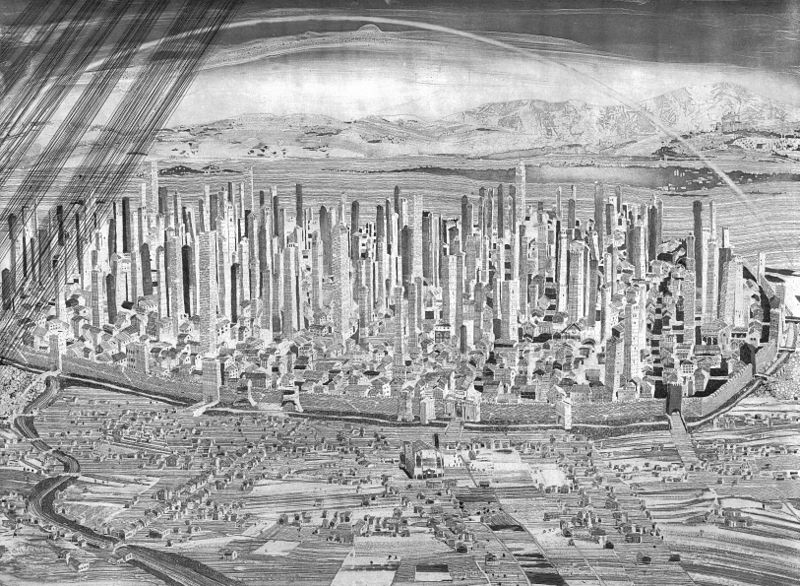
When the Wicked King built his tower, his various henchmen immediately started building towers of their own, in imitation of his example. Theirs, of course, were more mundane affairs, no more than two or three hundred feet high; but there were a lot of them, a thick, bristling forest of them, clustering around the base of the King's Tower itself. Travelling up and down through all that vertical space was slow and laborious, so the tower-builders had walkways constructed to link one tower to another, and elaborate systems of rope and winches to permit objects to be moved from one tower to the next. Gradually a great web of these connections grew up, connecting each tower to all the adjacent towers, and the innermost ring of towers to the Tower of the King; a tangle of ropes and wires and bridges and catwalks which chokes the air, blocking out the sunlight from the teeming streets below. The people of the Wicked City refer to it as the Cobweb.

This is 12th century Bologna, at the height of the city's tower-building craze. Just imagine one massive tower right in the middle and you're pretty much there.

The Cobweb is home to the Wicked City's elite. Not its government officials - they, for their sins, live and work in the upper floors of the King's Tower itself - but its nobility, its rich merchants, its military officers, its crimelords, and the senior clergy of its quite awesomely corrupt state religion. Each tower houses a different family, who travel back and forth from tower to tower across the Cobweb in order to hatch plots, conduct torrid love affairs, and engage in assorted acts of hedonistic debauchery with members of other high-ranking clans. Many of them go whole years without ever setting foot on the ground.

If they did, though, they'd see that the streets between the towers look like this.
After so many years spent stewing in its own corruption, the Cobweb has become a miniature world of vice and intrigue. By day the elite of the Wicked City stroll out along its walkways, fantastically dressed, to visit and gossip and snipe and preen in one another's company; by night, spies and thieves and occasionally even assassins clamber along the ropelines, sneaking into other towers to try to win some kind of social or political advantage for their employers at the expense of their current rivals. The nobility maintain a constant facade of civility at all times, but they all seem to hate each other, and their interactions are characterised by a continual background hum of barely-concealed jealousy and spite. Think of Jacobean tragedies crossed with the nastier bits of Jane Austen novels (but with more casual murder and drug abuse), and you probably won't go far wrong. 

And they all dress like this because of course they do.
A talented thief, spy, or poisoner can make a fortune in the Cobweb, but their lives are precarious: their employers view them as utterly disposable, and will not hesitate to have them thrown out of the nearest window the moment they become a liability. (Pedestrians in the district have become used to dodging the occasional falling body as it plummets, screaming, from the sky.) For those who oppose the Wicked King, however, the Cobweb offers a different kind of opportunity. By moving from tower to tower, either by stealth or with the connivance of their inhabitants, it would be possible for a team of infiltrators to traverse the heart of the city without once encountering the soldiers and agents of the Wicked King who swarm below; and from the innermost towers, there are walkways which connect with the King's Tower more than thirty levels up. The members of the Cobweb families are debauched and eccentric, but they are mostly not insane; they can be seduced or blackmailed, bribed or threatened - possibly even genuinely befriended, if one could manage to break through their shell of violence and cynicism to reach the human being inside. If one were, hypothetically, looking to reach the upper levels of the King's Tower, then it would probably be a much better idea to make an alliance with one of the Cobweb families than to try to sneak or fight through 30+ levels of the Tower itself! 

Tuesday, 21 July 2015

More Talking Animals: Wolves and Birds (playable classes, natch)

Talking Wolf: You must have at least Dexterity 9 to play a talking wolf. Please try to keep the howling noises to a minimum. Game information is as follows:
  • You gain 1d8 HP per level.
  • You gain a to-hit bonus to melee attacks equal to your level. Your teeth and claws inflict 1d6 damage per attack.
  • You gain a +1 bonus to FORT and REF saves.
  • You have a natural base AC of 12, due to your natural agility and your thick fur. If you wear a harness of leather and metal over this, your AC rises to 15. You will need someone else to put your armour on and off, though, because you have no hands.
  • You can learn any language after listening to it for (20-Intelligence) days. You can also talk to other canines (including dogs, who don't tend to like you very much).
  • Your senses of smell and hearing are much more sensitive than those of a human. If any human could possibly smell or hear something, you detect it automatically. You are very good at tracking your prey by its scent.
  • You have no hands, and are thus incapable of fine manipulation of objects. You cannot operate machinery, use any form of weapon or shield, or use any tool that cannot be gripped in your teeth.
  • You can run twice as fast as a human - fast enough to keep up with a horse - although not for very long.
  • You are instinctively able to hijack the dominance hierarchy natural to all canines, imposing yourself as pack alpha. By spending a few nights in any area inhabited by wolves, wild or stray dogs, or similar canines, you can swiftly assemble a pack of followers, up to a maximum number equal to your level plus your Charisma bonus. These dogs or wolves have AC 12, 5 HP, +1 to hit in melee, and deal 1d6 damage per attack; they will follow you loyally, scout for you, fight in your defence, and so on, but they will not throw their lives away on your behalf. They have a base morale of 7. 

Sometimes the Wise Folk agree to disagree.

Talking Bird (hawks, owls, ravens, etc): First off, you're enormous: albatross-sized or bigger. Your wingspan in feet is equal to the average of your Strength and Constitution scores. (You're still recognisably a member of your bird species, though - just a freakishly huge one.) Game information is as follows:
  • You gain 1d4 HP per level.
  • You gain a to-hit bonus to melee attacks equal to half your level, rounded up. Your beak and talons inflict 1d4 damage per attack.
  • Your natural agility and feathers grant you a base AC of 11. You cannot wear armour.
  • You can fly, moving far faster than a horse can run. Your top speed, when flapping frantically, is about four times human running speed. You can cover hundreds of miles in a single day.
  • You have amazing vision. Anything a human could possibly spot, you notice automatically, with no need for a roll. You can see movement at distances where no human could perceive them without a telescope.
  • You have no hands, and are thus incapable of fine manipulation of objects. You cannot operate machinery, use any form of weapon or shield, or use any tool that cannot be gripped in your talons. You can drop grenades on people, though. 
  • You can learn any language after listening to it for (20-Intelligence) days. You can also talk to other birds (of all species): they are generally well-disposed towards you, and will scout and spy for you upon request, but will not risk their own lives.
  • You can carry as many items as a human of the same strength score, but cannot fly unless unencumbered.
  • In moments of great need, you may call all the birds of the air to aid you. (This only works if you are in an environment which actually has a local bird population.) At your command they will go full-on Alfred Hitchcock on your chosen target, who for the next 1d6 rounds will be the centre of a blinding, flapping, stabbing cloud of birds. If they pass a FORT save they may continue to act (at a -4 penalty); if they fail the save they can do nothing except blunder about screaming and flailing for the duration. Either way, they take 1d3 damage per round (reduced to 1 per round if they're wearing a breastplate or heavier armour). You can also ask the birds to do anything else that a huge swarm of birds could logically accomplish. You may use this ability once per day at level one, and twice per day at level five or higher. 

Monday, 20 July 2015

Foes of the Wicked City 3: The Wise Folk (AKA 'Rules for Playing Talking Animals')

The Vocabulary Bears from Oglaf. (Warning: usually NSFW)
Anyone who's read many Russian folktales will know that once you get deep enough into the forest, you'll start running into animals who know how to speak. Birds first, usually; then bears, fish, foxes, wolves. They're not unfriendly, but they have limited tolerance for human meddling. The deepwoods belong to them, not to mankind.

Anyone who's read much romantic fantasy will know that it features talking animals all over the damn place. Talking bears, talking cats, talking wolves, talking horses. Spirit animals. Wizard's familiars. They act as guardians and advisers and companions, often truer and more faithful than any human.

Thus: the Wise Folk.

The Wise Folk are the intelligent, talking animals who live deep in the northern taiga. Their gift is rare, and does not breed true, with their offspring only a little more likely to possess it than any other animal of the region. This doesn't much bother them, as they can communicate with other animals of their species just fine, and consider them to possess full sentience: they happily mate with non-Wise animals, and value their non-Wise children just as much as those who have inherited their talent for speech. They rapidly learn any language to which they are exposed; usually they will know the language of the local tribesfolk, and use it to communicate amongst themselves, but if foreign travellers pass through the region then any Wise Folk who eavesdrop upon them will pick up enough of their language to communicate (albeit with some very funny accents) in (20-Intelligence) days.

For the most part, the Wise Folk keep very much to themselves. They live as other animals do, although they tend to be bigger, stronger, and longer-lived; they mostly keep to their own kind, though they do sometimes talk to one another. (The Wise Folk regard each other as honourary members of the same species: a Wise fox will not eat a Wise bird, although he won't hesitate to eat that bird's non-Wise chicks.) They usually pretend to be ordinary animals when around humans, silently listening in on their conversations, the better to thwart whatever designs these irritating bipeds may have on the inhabitants of the deepwoods. From time to time, however, a curious or sentimental Wise beast will take a liking to some human wanderer, and befriend them; sometimes they will even follow them out of the taiga, eager to see the wide world beyond. Such travellers are very, very rare, but not quite unheard-of: most people know that it is at least possible that they might one day encounter, say, a talking bear, even if the vast majority never actually will.

The Wise Folk have heard of the Wicked City, and they do not like what they hear. Something like this has happened before, they say: a war, a tyrant, a city without a name. The people of that city grew so hungry and greedy and desperate that they ate the spring, the summer, and the autumn, one after another, like courses at a banquet: and then only the winter was left, a winter that lasted for thousands of years. Humans have forgotten, but the Wise Folk remember. They have no wish to see it happen again.

If things get much worse, some of them may have to start taking matters into their own paws...

Talking Bears: To play a talking bear, you must have Strength and Constitution 15 or higher, because come on: bears! Game information is as follows:
  • You gain 1d12 HP per level.
  • You gain a to-hit bonus to melee attacks equal to your level. Your huge claws inflict 1d8 damage per attack.
  • You gain a +2 bonus to FORT saves.
  • You have a natural base AC of 13, due to your thick layers of muscle, hide, and fur. If you wear a light harness of leather and metal over this, your AC rises to 16; if you wear heavy metal barding, it rises to 19. You will need someone else to put your armour on and off, though, because you have no opposable thumbs.
  • You can learn any language after listening to it for (20-Intelligence) days. You can also talk to other bears.
  • Your sense of smell is about two thousand times more sensitive than that of a human. You can recognise anything from its scent. You can follow the faintest scent-trails for days.
  • You have no opposable thumbs, and are thus incapable of fine manipulation of objects. You cannot operate machinery, use any form of weapon or shield, or use any tool more complex than a big stick.
  • You are huge, heavy, and enormously strong: capable of smashing light wooden buildings and furniture to splinters, and doing serious damage to heavier ones. A man-sized character could ride you. A swivel gun could be mounted on your back. (You couldn't fire it, though.) You can smash anything that a bear should be able to smash, with no roll required. 
  • You can run twice as fast as a human - fast enough to keep up with a galloping horse - although not for very long.
  • You can carry four times as many objects as a human with the same strength score.
I'm still betting on the bear.
Talking Tiger: To play a talking (Siberian) tiger, you must have Strength, Dexterity, and Constitution 13 or higher. Game information is as follows:
  • You gain 1d10 HP per level.
  • You gain a to-hit bonus to melee attacks equal to your level. Your teeth and claws inflict 1d8 damage per attack.
  • You gain a +2 bonus to REF saves.
  • You have a natural base AC of 12, due to your natural agility and your thick fur. If you wear a light harness of leather and metal over this, your AC rises to 15; if you wear heavy metal barding, it rises to 18. You will need someone else to put your armour on and off, though, because you have no hands.
  • You can learn any language after listening to it for (20-Intelligence) days. You can also talk to other felines (including house cats, who are terrified of you).
  • Your senses of smell and hearing are much more sensitive than those of a human, and are capable of tracking by scent. If any human could possibly smell or hear something, you detect it automatically.
  • You are amazingly stealthy, and never make any sound unless you choose to. If you pounce on an unaware victim, you gain a +4 bonus to hit and inflict an extra 1d6 damage for that attack only. 
  • You have no hands, and are thus incapable of fine manipulation of objects. You cannot operate machinery, use any form of weapon or shield, or use any tool that cannot be gripped in your teeth.
  • You are big enough to ride, although an encumbered or armoured rider will be very tiring for you to carry. (An unarmoured woman would be fine, though.)
  • You can run four times as fast as a human - fast enough to outrun a horse - although only in short bursts.
  • You can carry twice as many objects as a human with the same strength score.
More talking animals to follow...

    Clockpunk tech in your campaign

    In the last few posts, I've described the kind of clockwork technology which litters the setting of ATWC. But what's the point of it? Why bother putting such tech into a campaign at all?

    'Why am I even here? Couldn't they have just used an orc or something?' (Image by Sillof)

    One answer is that clockwork technology serves as a powerful symbol of a certain stage in history, and a certain sort of civilisation. Steam technology is huge, thumping, powerful: it tells the viewer, in no uncertain terms, that the past is over and is never coming back. Clockwork technology is precise, elegant, intricate: it implies a world of craftsmen and virtuosi, rather than one of factory labourers and urban blight. Its existence implies a society of great sophistication and knowledge, but not necessarily of overwhelming power, and this fits in very well with ATWC's model of gleaming cities set amidst fearsome wastelands. Once you have steam power, and especially once you have railroads, the balance of power shifts too far towards the urban.

    In terms of the actual role such tech can play in a campaign, this can be broken down into a few categories:

    1: Set Dressing

    This is the main purpose of the more low-level clockwork tech. Mentioning a military officer consulting his pocket watch, or a servant scurrying around a merchant's garden to wind up all the clockwork songbirds sitting in the trees, is a great way to efficiently communicate the wealth and sophistication of the setting. It also serves as a good way to remind players that this isn't just Generic Fantasyland, keeping everything sharp and vivid and strange. If the PCs then go on to find a way to turn the watch or the clockwork songbirds to their advantage, then so much the better!

    2: A Resource for Players

    Much of the low- to mid-level technology has obvious uses to PCs. A small yaga makes a great mobile base of operations; a peppergrinder gun is a good weapon for a technologically-minded character, and a set of clockwork wings makes it possible for PCs to reach and explore places that might otherwise be entirely inaccessible. There's no reason to be stingy about allowing PCs access to this sort of technology, and its existence will, again, help their adventures to stand out a little from the normal sub-medieval fantasy which D&D usually defaults to.

    3: A Chance for Scholars to Show Off

    Being the Guy Who Knows Stuff is great, but it can also be pretty passive; you encounter something, the GM tells you what you know about it, you relay that knowledge to the rest of the party. Of course, a clever scholar will find plenty of more active ways to employ their knowledge, but being clever all the time is hard work. Tech ratings give scholars an obvious way to get stuck into the action: reprogramming clockwork robots, reactivating ancient mechanical defence systems, piloting weird clockwork vehicles, and so on. It gives them an excuse to be front-and-centre, rather than just hiding at the back wishing they'd stayed at university...

    4: A Source of Mindless Enemies

    Due to its romantic fantasy leanings, ATWC is pretty short on Designated Baddies who exist only so that the PCs can butcher them. Pretty much no-one in the setting (except, maybe, the Wicked King) is Just Plain Evil; even the maddest and cruellest inhabitants of the Wicked City are more victims of their environment than anything else. Sometimes, though, even the most philosophical of gaming groups are going to just want to hit something: and even the most morally scrupulous PCs probably won't get too upset about smashing up waves of mindless wind-up clockwork soldiers.

    5: A Source of 'Puzzle' Encounters

    High-level clockwork tech is very powerful, but also very limited. Putting the PCs up against enemies in Steam Knight armour, or a mech, or a tank, can thus make for a great encounter: brute force approaches are likely to fail horribly, but there are lots of ways for PCs to play on the weaknesses of their enemies and come out feeling very pleased with themselves indeed. Mechs can be tripped; Steam Knights can be overheated; tanks can be lured into difficult terrain, or simply evaded until their springs run down. The best thing about these sorts of victories is that they're legitimate: they're a logical result of the limitations of the technology itself, rather a matter of the GM painting some kind of artificial 'weak spot' on the enemy and then winking meaningfully at the players until they work out to start hitting it there for massive damage. All you need to do is mention how slow this seemingly invincible death-machine is, how clumsy, how ponderous, how desperately close to overheating, and the PCs will be able to work the rest out for themselves. And then steal it from their defeated enemies.

    Which leads to...

    6: A Chance For the PCs to Drive Around in a Fucking Tank

    Or a mech. Or a huge fuck-off Yaga with a cannon on the roof. There's no need to worry about this being 'overpowered': such vehicles can't be taken into cities, dungeons, or even the rougher sort of wilderness, and they eat so much coal that they're never going to be a really practical long-term choice of transportation technology. But for a while, before they have to abandon it because you can't drive a tank up a mountain or because the Lost City of the Dead is woefully short on places to refuel your giant mech, they're going to feel absolutely awesome - especially when they drive it back to that huge monster they had to run away from earlier and shoot it to bits with swivel guns. Indulge them in this, and the tank will soon be a beloved member of the party, embroiling the PCs in all kinds of further adventures and complications...

    Wednesday, 15 July 2015

    Clockwork Marvels 4: High-level clockwork technology

    This is the kind of technology you'll mostly find only amongst serious gear-heads: the Brass Men, the Steam Knights, the Steel Aspirants, cultists of the Cogwheel Sage, and so on. Universities will often have a few bits of advanced clockwork lying around as well. All this stuff is extremely expensive to build, and usually extremely expensive to maintain, as well.

    I haven't bothered with stats for the war machines at this level, because they don't really operate on the same scale as PCs: they're obstacles to be circumvented, not enemies to be beaten down. If it comes to a fight, just assume that they are almost always stronger than you, tougher than you, slower than you, clumsier than you, and very close to overheating.


    Name
    Operate (O)
    Maintain (M)
    Repair (R)
    Construct (C)


    Clockwork soldier (10'+)
    2
    3
    4
    5
    Medium mech (3-man)
    3
    3
    4
    5
    Gyrocopter
    3
    4
    4
    5
    Logician implants
    3
    4
    4
    5
    Brass man (brain)
    N/A
    N/A
    5
    5
    Large mech (4-man)
    4
    4
    5
    5
    Large tank (7-man)
    4
    4
    5
    5
    Clockwork soldier (20'+)
    3
    4
    5
    6
    Clockwork soldier (30'+)
    4
    5
    6
    8
    Wonders of the Ancient World
    5+
    6+
    8+
    10+

    Giant clockwork soldier. Image by Izzy.

    Clockwork Beast or Soldier (10', 20', 30'): People sometimes build really, really big mechanical monsters. Most of the truly huge ones are ancient, left over from the unimaginable conflicts of the Age of Wonders, and now either non-operational or reduced to serving as beasts of burden for nomad mechanics who have at least managed to get the legs working again; but it's not entirely unknown for an ambitious king to commission a 10' or 20' clockwork giant or dragon to lay waste his enemies. The only thing more fearsome than their destructive power are their fuel requirements. As with smaller clockwork creatures, instructions must be issued to them in the form of code.

    Medium Mech (3-man): A big, boxy robot, 15' tall or so, with a crew of three sitting inside its chest: one controls the legs (one lever in each hand), and the other two control one arm each. Good teamwork is essential if you want your mech to avoid overbalancing and toppling over. Immune to almost everything except cannon fire and tripwires.

    Helicopter, from Da Vinci's notebooks.
    Gyrocopter: This is an ultra-lightweight gyrocopter with seats for either one or two passengers (who will have to spend the entire flight pedalling to keep the thing running) and pretty much nothing else. Thrust is provided by a clockwork-powered propeller. Permits smoother flights than the clunky flapping of clockwork wings, and while the pilot will need both hands to steer, the second passenger has both hands free and can fire guns, drop bombs, send messages, carry out emergency in-flight repairs, and so on. 

    Logician Implants: A mass of clockwork calculating engines installed into the side of the user's skull, allowing them to perform incredible feats of calculation in moments. Logician implants turn their wearers into veritable calculating machines, able to process enormous amounts of numerical data with superhuman speed. Kings and rich merchants usually don't get such implants for themselves - sawing a chunk out of your skull and bolting a clockwork engine box onto it is a pretty radical step - but they love to employ advisers and accountants who have!

    (NB: I acknowledge that the idea of interfacing a clockwork computer with a human brain is pretty silly, even by the standards of ATWC. Feel free not to use these if they push your suspension of disbelief too hard.)

    Brass Man Brain: The clockwork brains of the Brass Men are miracles of craftsmanship. The Brass Men themselves have an intuitive understanding of how to put them together, and gain a +1 bonus to their technology rating for this purpose only. They are made from tens of thousands of incredibly fine pieces of clockwork, and a whole caravan of Brass Men will often save up for years in order to afford the components needed to create a few more of their kind; the cost of new bodies is virtually insignificant compared to the cost of new clockwork brains. Once finished, these brains are stored in heavily armoured casings, and often survive intact even when the bodies which house them are almost completely destroyed. Tampering with the clockwork of a Brass Man's brain will mess with their memories and personality; if you don't know exactly what you're doing, it'll probably affect them in roughly the same way that a clumsy lobotomy would affect a human.

    Large Mech (5-man): Like the medium mech, but even bigger - usually about 20' high, with a cannon mounted on its shoulders. Has two extra crewmen: one gunner to fire the cannon, and one fireman/engineer to feed its insatiable hunger for coal. Almost unstoppable except by heavy cannon-fire. You should probably just run away.

    Large Tank (7-man): A big, heavily-armoured metal box on wheels, with a cannon sticking out of the front (or, more rarely, mounted on the roof) and usually a swivel-gun on each side, crewed by a driver, four gunners, one fireman/engineer, and one all-purpose dogsbody. Invulnerable to pretty much everything except cannon-fire and people pouring oil in through the cooling pipes. In theory they should rule the battlefield; in practise, though, people just ride around them. Useful for spearheading assaults on castles. Don't even try powering it by hand.

    Wonders of the Ancient World: This is a catch-all category for the clockwork miracles of earlier ages, created by long-dead artificers and now found only in greater or lesser states of disrepair. It includes things like the Wisdom Engines (giant bronze heads containing clockwork supercomputers, supposedly capable of deducing the answer to any question if given enough time to think) and the God Soldiers (enormous clockwork warriors and mobile fortresses, 100' high or more, capable of wrecking entire cities). The communities that live around such relics often manage to keep some of their simpler sub-systems operational: so a settlement built around the wreck of a God Soldier might lovingly maintain a couple of its weapons systems to defend their homes with. More complex operation and repairs of such wonders can be attempted only by the greatest of artificers.

    Tuesday, 14 July 2015

    Clockwork Marvels 3: Mid-level clockwork technology

    Clockwork tech, continued. This is the sort of stuff you might see in larger cities. No-one except a mechanic would take it into more rural areas, because if it broke down out there none of the locals would have the tools or expertise to repair it.

    All of this stuff is very expensive. 


    Name
    Operate (O)
    Maintain (M)
    Repair (R)
    Construct (C)


    Clockroach
    N/A
    N/A
    3
    4
    Medium tank (4-man)
    1
    2
    3
    4
    Brass man (body)
    N/A
    N/A
    3
    4
    Large Yaga
    1
    3
    3
    4
    Steam Knight armour
    2
    2
    2
    4
    Clockwork wings
    2
    2
    3
    4
    Small mech (1 man)
    2
    2
    3
    4
    Clockwork soldier (man-sized) or clockwork beast
    2
    3
    3
    4

    Clockroach: These clockwork pests are used by the Brass Folk to punish communities which cheat or mistreat them; the Brass Men seem to endure their ill-treatment patiently, but the next night they will depart and leave a swarm of clockroaches in their wake. Each is a fist-sized metal insect with sharp, cutting jaws, dexterous little claws, and folding metal wings which let them fly, whirring, through the air. By day they scuttle into holes and raise small hidden fans: whenever the wind blows, the fans turn, winding the clockroach's main spring. By night, if they have enough power, they scuttle out looking for any kind of metal, which they cut into pieces with their jaws and assemble into more clockroaches. They are not difficult to destroy (AC 14, 1 HP), but no metal object will be safe nearby for as long as even one survives.

    Medium Tank (4-man): A long, lumbering metal coffin of a machine, 6' wide and 10' long, clanking along on two rows of wheels, and usually with a couple of swivel guns mounted on the roof. The crew is one driver, two gunners, and one engineer. Its heavy armour plating will need a cannon to penetrate; the gunners only have their heads and upper bodies protruding above the roof, granting them +4 AC from cover. The bad news is that it's hot, slow, useless on uneven ground, eats coal by the bucketful, and breaks down constantly. More often used as a semi-mobile fortified gun emplacement than as an actual vehicle. If you run out of coal, the four cranks must be turned for three hours each to allow it to run for an hour.

    Brass Man (Body): This is the difficulty of making a whole new body for a Brass Man which has suffered extensive damage. (Individual arms and legs use the clockwork limb difficulties.) Useless without a clockwork brain. Some particularly brave or accident-prone brass men have been through ten or twelve different bodies in their lifetimes, their companions salvaging their armoured brain-case from the wreckage of each in turn and implanting it into a new body as required.

    Large Yaga: A walking metal box, 15' on a side and subdivided internally into two levels, stomping along on enormous 10' clockwork legs. This is about as large as yagas get; at this size, a whole family can live in one, with their worldly goods either stashed within or tied in bales to the outside. Often have a swivel gun or a cannon mounted on the roof. The thick metal walls are proof against musket-fire, but a swivel gun has a 50% chance of penetrating and a cannon certainly will. The legs (each AC 16, 30 HP, immune to missile weapons smaller than a swivel gun) are still the most vulnerable part. Fuel requirements make it totally impractical to wind by hand. Don't run out of fuel.


    I've stolen like half of these ideas from Dragonmech. Why not steal the art as well?
    Steam Knight Armour: An enormously bulky suit of heavy armour, far too heavy for anyone to wear and move in unaided. (Someone with Strength 18 could slowly creak around in it.) Its movements are assisted by a powerful clockwork mechanism, which allow even someone of normal strength to wear it provided they understand how to operate its fairly complex controls. Wearing Steam Knight armour gives the wearer an effective Strength of 20 (+5 melee to-hit and damage), AC 20, and immunity to missile weapons smaller than a swivel gun, but it is very slow: they cannot move faster than a walking pace, and can fight only with huge, clumsy swings, which impose a -5 penalty on melee and ranged to-hit rolls. (The strength of the suit makes up for this in melee.) Reloading guns takes twice as long as usual due to the clumsiness of the amour's fingers, and bows cannot be used at all: they'd just snap in your hands. Most Steam Knights carry swivel guns, relying on the weight of their armour to soak up the recoil. Requires one hour's winding (by hand or autowinder) for each hour's use. Actually wearing the armour while the autowinder is running is a good way to get cooked alive.

    Clockwork Wings: Folded, these metal-and-leather wings effectively form a very heavy cloak: they provide +3 AC from behind, and count as two items for encumbrance purposes. Unfolded, they have a 12' wingspan, and permit a lightly-burdened human to clumsily flap from place to place. Both hands are necessary to operate the controls. Requires four hours winding (by hand or autowinder) for each hour's use.

    Small Mech (1-man): A 10' humanoid walker, operated by a single pilot, who controls one arm with each arm and one leg with each leg. The mech inflicts 1d8+6 melee damage with its enormous fists or 1d12+6 with a huge weapon, but is clumsy enough that it grants no to-hit bonus in melee despite its enormous strength. It could fire a swivel-gun one-handed, at a -6 to-hit penalty, but would have no way of reloading it afterwards. AC 20, 40 HP, immune to missile weapons smaller than a swivel gun. Requires six hours of winding per hour of operation if you run out of coal.


    Clockwork Beast or Soldier: These are the simplest 'free-willed' automata, with clockwork brains capable of responding dynamically to a limited range of situations rather than just repeating the same routine over and over again. Possible varieties include clockwork workers (able to perform a limited range of menial tasks on request), clockwork soldiers (able to fire and reload muskets at a designated target - melee is rather beyond them), and clockwork beasts (able to roam around and attack intruders, mauling them with metal claws). They cannot understand language: new orders must be given in code. Winding times and fuel requirements vary based on size.