Thursday, 7 April 2016

The Island of Cairns

From somewhere
a traveller is approaching,
he has reindeers without antlers,
reindeer-bulls without antlers...
This is Vaygach Island, in the Arctic Ocean.


It's about the same size as Long Island in the US, but almost no-one lives there: it's too cold, too bleak, too bare. There are no trees. There is no shelter. Back in the Soviet period, the Russians tried to run a mine there, using conscript labour from the Siberian gulags. It wasn't a success.

Vaygach is regarded as a holy site by the Nenets people of northern Siberia. For centuries, they came here to raise idols and offer up sacrifices to the great spirits, Num and Nga, a dualistic pairing of sky-god and underworld-god comparable to that of Tengri and Erlik further south. They were reindeer herders. They painted the idols with the blood of slaughtered reindeer. They raised piles of stone and wood, Arctic equivalents of the Ovoo cairns of Mongolia, and placed the skulls of the sacrificed reindeer on top of them. Thus the spirits were appeased.


Vaigach Today -- Nenets
A Nenets idol is returned to its original home on Vaygach Island. Photo by Tomasz Kizny.

Like most of Siberia's indigenous peoples, the Nenets suffered badly during the twentieth century. The Soviets disapproved of their nomadic lifestyle, and forced them to move with the times: settle in one place, learn Russian, practise collectivised agriculture. Today their southern cousins, the Forest Nenets, are in a very bad way; there are only a couple of thousand of them left, their language is dying out, their songs and traditions have mostly been forgotten. But the tundra Nenets, the ancestral keepers of Vaygach Island, still manage to maintain some kind of continuity with the past.
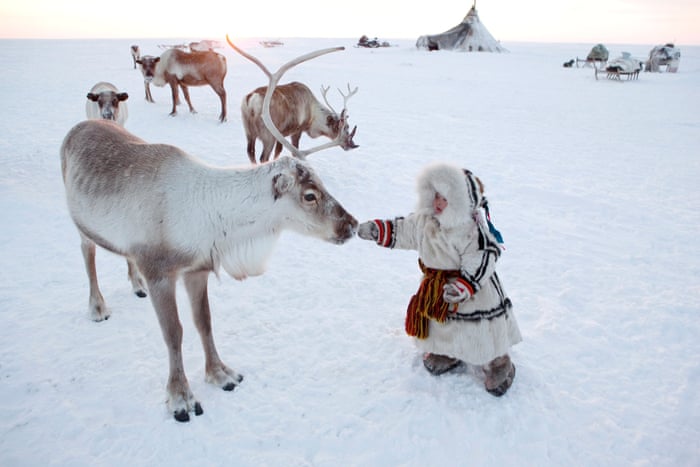
Nenets toddler with reindeer. Her family's reindeer-skin tent can be seen in the background. Photo by Bryan Alexander.

So: far, far to the north of the Wicked City, beyond the steppe, beyond the taiga, beyond the tundra, there is a frozen sea. In that sea is an island; and on that island are many cairns and no houses, many idols and no trees. The cairns and the idols are maintained by the Reindeer People, who drive their herds across the tundra, but even they don't actually live on it. No-one lives on it. It's too holy for that.

On the Island of Cairns, the world of spirits presses very, very close to the world of men. Here, anyone, even a non-shaman, may communicate with the spirits simply by killing an animal, pouring its blood over an idol, putting its skull on a cairn, and then stating their message or request. Do this, and the spirits will heed you; and if they want to answer you then they will come to meet you in person, stepping out from the shadow of a cairn or an idol in the form of a man, or a woman, or a great wild beast. They seem to regard the island as a kind of antechamber to the spirit world, within which it is proper for them to give due audience to those who come to seek them; and even the most hostile and unreasonable of spirits can usually be counted upon to give its supplicants a decent hearing if invoked amongst the cairns of the frozen sea. They may still refuse to give their aid, or demand completely exorbitant offerings in exchange for their assistance, but at least they'll hear you out.

"Zemblien". Allain Manesson Mallet, Description de l'Univers, t. 1, Paris, Denys Thierry, 1683.:
17th century engraving of Nenets hunters. Note the idols in the background.

The Reindeer People say that the spirits are not the only inhabitants of the island. They say that there is a secret race of dwarves, white-skinned and furtive, inhabiting caves beneath the surface; that these dwarves are great magicians who ride across the sea on clouds, singing the fish out of the water and up into their nimble, pale little hands. They say that sometimes, in the depths of winter, huge men like giants come riding across the frozen sea on sleds drawn by great white reindeer without antlers. If you wish to communicate with the dwarves, or with the giants, you must leave offerings for them out on the cairns, and state your message or request with all the courtesy that you can muster. You won't see them, but they will be watching. They will be there.

Magical though they may be, the dwarves and the giants still need to eat, and food is scarce on the shores of the Frozen Sea. Sometimes there are tensions. Sometimes they and the Reindeer People come to blows; and when they do, it's usually the Reindeer People who get the best of it, because unnatural stature and magical powers are no match for having a whole clan of kinsmen backing you up. If you kill a giant or a dwarf, though, it is very, very important that you take their body back to the Island, and build a new cairn over it. Doing anything else invites the most terrible bad luck.

Nenets carvings, made from reindeer antlers, depicting the white dwarves of the Arctic.

Due to their long-term saturation with the energies of the spirit world, the bones, stones, and wood of the island's cairns and idols possess considerable magical power. The merest pebble from such a cairn, worn threaded on a string around the neck as a good luck charm, is worth a +1 bonus to saving throws; wearing a bear or reindeer skull taken from a cairn as a helmet grants protection from misfortune while travelling, while arrowheads made from the antlers of reindeer skulls placed on such cairns, or from the bones of giants or dwarves buried below them, seem almost never to miss, granting a +4 bonus on to-hit rolls. But to plunder the cairns is to risk the wrath of the spirits. Who would dare commit such impious deeds?

Surely only the agents of the Wicked City...

Vaygach Island, Вайга́ч, Vaygach) - Google Search:

Tuesday, 5 April 2016

New B/X class: the Orc

Another in my ongoing series of 'B/X monster classes written while I should be working.' Essay marking is really boring, OK?

I was always a bit frustrated by half-orcs being the default PC race option: if I want to play an orc I should be able to play a bloody orc! You don't see people playing half-dwarves, do you?

(Yes, I know there were rules for half-dwarves in Dark Sun. But everyone in that just played half-giants and insect people and psychic cannibal jungle halflings, so the point still stands.)

So here's a B/X-compatible orc class. Like the dwarf, it's basically a fighter with some minor additional rules for flavour purposes. Have fun hitting people with axes!


B/X Class: The Orc

To-Hit, Hit Dice, Saves: All as per Fighter.

Weapons and Armour: Orcs can use any weapons, but are not proficient with any armour heavier than chainmail.

Experience Per Level: As per Dwarf.

Nocturnal: Orcs can see perfectly in the dark, but bright light pains them. When in bright sunlight, or close to a bright source of light, they suffer -1 to-hit until they can get back into the darkness.

Ritual Cannibalism: Whenever an orc eats the heart of a creature it has personally killed in battle, it gains a number of HP equal to the HD of the dead creature. (Note that eating a heart takes at least a couple of minutes, even for an orc!)

Orc Rage! Orcs get angry really, really easily. Whenever something happens to anger you (e.g. being insulted, being frustrated, being betrayed, etc) you may declare you are going to enter a battle rage. While raging you fight with no heed for your own personal safety: you gain a +1 bonus to-hit and damage, and a +4 bonus to saves against fear effects, but suffer a -2 penalty to AC. Your rage ends when the being(s) that provoked it are defeated, or after a number of minutes equal to your level, whichever comes sooner.

Speak Loudly and Carry a Big Axe: Orcs love huge, impractical, poorly-balanced weaponry. Given a few hours and a heap of scrap metal, you can modify any two-handed weapon to be even bigger, heavier, and spikier than it was before. The resulting weapon is the kind of thing that no-one except an orc would ever consider using, but your combination of brute strength and raw enthusiasm means that in your hands it becomes a lethal if clumsy weapon, inflicting +1 damage at the cost of a -1 penalty to-hit. 

A brief public service announcement

There's a piece on sexual harassment in gaming culture doing the rounds right now. It's called "Tabletop Gaming Has A White Male Terrorism Problem", which is a regrettably clickbait-esque title, but it's a sad and eloquent account of one woman's experiences with sexual harassment and sexual assault in circles associated with tabletop gaming.

I don't want this blog to get dragged into the mire which is gender politics on the internet, but I will say this: if you're ever in a game, or a store, or a convention at which a woman (or a man, come to that) is complaining of sexual harassment or assault, please take it seriously. Get the organisers involved. Get the authorities involved. If you are the organiser, then do everything in your power to get to the bottom of it. It might often feel as though there's nothing you can do. It might often be true that there's nothing you can do. It might even ultimately turn out to be a false accusation. But the simple act of taking these things seriously, of treating them as though they matter rather than just being something to be shrugged off with a muttered comment about boys being boys, actually does a whole lot of good, both for the individuals concerned and for the surrounding culture as a whole.

We now return you to your regularly scheduled OSR D&D weirdness.

Sunday, 3 April 2016

The Kergeden, or Siberian Unicorn

You all saw the news report at the end of March, right? Elasmotherium sibiricum, previously thought to have died out in the middle of the Ionian Stage of the Pleistocene Epoch about 350,000 years ago, actually seems to have survived in what is now Kazakhstan until about 27,000 BC, which in evolutionary terms is pretty much yesterday. That means they lived alongside humans. People probably met them. People probably ate them. That's probably why there aren't any of them left today.

They looked like this. Probably.

Given how late populations of woolly mammoth and woolly rhinoceros survived in Siberia in the real world, I've just kinda assumed that they're still around in ATWC, being domesticated and ridden by nomadic clans in the depths of the Deep Taiga. After this, the Siberian Unicorn - or 'Kergeden', to use the Turkic word for 'unicorn' or 'rhino', which is presumably what the people of the area would call them if they were actually still alive - is totally getting added to the list. The only unicorns that exist in the setting are now 7' tall, 15' long, shaggy-coated monsters with a horn the length of a sword.

They are rare, of course. They are so rare that many people believe them to be mythical. But in a few remote areas of the steppe and taiga, the kergeden still live: huge, ill-tempered beasts, fearsomely strong, with great horns on their heads easily long and strong and sharp enough to impale a grown man right through. No ordinary man or woman can ride one, and they disdain domestication: but something in their fierce natures makes them warm to the bravest and hardiest of warriors, and to these and these only will they submit themselves as mounts. Folklore says that they can smell both courage and fear, and that if their rider should ever disgrace them by some act of cowardice, the kergeden will immediately toss them up into the air and attempt to catch them on their horn, goring them to death in order to wipe out the dishonour of allowing themselves to be ridden by such a dastard soul.

Or maybe they looked like this? No-one actually knows how big their horns were...

In game terms, kergeden are mounts for higher-level characters. It's not enough to be a generally courageous person: only when your bravery has been proven in the face of severe adversity, not just once but many times, will the kergeden allow you to use it as a mount. (You also have to be a highly skilled rider and animal handler, of course: but as I've mentioned before, I take for granted that all ATWC PCs will fit that description.) This doesn't mean screaming and charging all the time, no matter the odds, which all the steppe peoples recognise is the mark of a stupid warrior rather than a brave one - these are the people whose signature battle tactic was the false retreat, after all - but it does mean that whenever things got rough, your focus must always have been on achieving your objectives as best you could rather than on saving your own skin. Anyone whose record of courage under fire has been less than exemplary can expect to be gored to death instead. Because it is widely known that only the bravest of warriors may ride such a beast, actually doing so will grant you a +1 reaction bonus from anyone who cares about martial prestige: this includes just about all steppe peoples, and most inhabitants of the desert and taiga, as well.

The kergeden eats lots and lots and lots of grass. Trying to ride them into the desert is probably a bad idea unless you have a lot of fodder.

  • Kergeden: AC 14 (very thick, tough hide) or AC 20 (hide plus metal barding), 7 HD, AB +4, gore and trample (1d8+4 damage), FORT 6, REF 10, WILL 7, morale 9. Inflicts double damage when charging. Anyone charged by a kargeden must make a morale roll to hold their ground; if they do, even if its charge attack misses, then they must make a REF save or take 2d6 damage from being smashed and trampled underfoot.

Thursday, 31 March 2016

New B/X Class: the Deep One Hybrid

Everyone wants to be a Deep One really! Swim all day, pray to Cthulhu all night, study forbidden secrets from before time, live forever, maybe run your own cult... What's not to like?

All together, now: Ph'nglui mglw'nafh Cthulhu R'lyeh wgah'nagl fhtagn...

(I promise my next post will actually be about Central Asia again!)

Deep One Hybrid, from Pathfinder Bestiary 5.


B/X Class: The Deep One Hybrid

To-Hit, Hit Dice, Saves, Weapons and Armour: All as per Fighter.

Experience Per Level: As per Magic-User.

Natural Swimmer: At level 1, you can swim at the same speed you can move on land, and hold your breath for a number of minutes equal to your Constitution score. You have webbed feet.

Water Breather: At level 2, gills open on the sides of your neck. You can now breathe freely underwater.

Innsmouth Look: At level 3, your eyes become huge and bulging. You can now see perfectly even in very low light (although not in total darkness).

Teeth and Claws: At level 4, your teeth become long and sharp, and your hands warp into claws. You can do 1d4 damage in melee even when unarmed.

Oceanic Adaptation: At level 5, your skin becomes rough and scaly, and your body bulks out with the masses of blubber and muscle required for existence in the ocean depths. You gain +1 AC, and inflict +1 damage in melee due to your increased bulk and strength. By this point you look like a total freak, and may want to consider investing in some very big hats and coats.

Blessing of Hydra and Dagon: From level 6 onwards, you gain spell-casting abilities equal to those of a Cleric of half your level, rounded down. (You don't gain any other cleric abilities: just the spells.)

Lord of the Seas: At level 7, you gain the ability to command the creatures of the swamps and seas. This functions as per the Chaotic cleric ability Command Undead, except it applies to aquatic and amphibious creatures instead of undead. This ability does work on intelligent creatures such as Bullywugs, but they get a save vs. spells to resist it.

Command the Formless Spawn: At level 8, your Lord of the Sea ability also allows you to command unintelligent slime and ooze monsters. 

Call the Cult: At level 9, you intuitively reach out through your dreams to nearby unstable individuals, calling them together to form a cult of which you are the leader. Over the next few weeks, 3d6 crazy people (a mixture of 1st-level fighters, thieves, and magic-users) will arrive, and serve you with fanatical loyalty. Whenever one dies, an equally crazy replacement will turn up 1d3 weeks later. Each time you go up another level you gain another 1d6 cultists.

The Sea is Calling: At level 10, you hear a song in your dreams that calls you to a holy place in a sunken city at the bottom of the sea. If you follow it, and complete the hazardous journey successfully, you undergo a final metamorphosis in which you shed the last remnants of your humanity. You cease to age, become immune to disease, and will live forever unless killed by violence.

Image by Dan Moore

Tuesday, 29 March 2016

Sir Gawain Goes Hexcrawling


I was preparing an extract from the 14th-century chivalric romance Sir Gawain and the Green Knight for a class the other day when I suddenly realised that it's basically a description of a rather aimless D&D hexcrawl. Gawain is on a quest for the Green Chapel, but he doesn't know where it is except that it's 'somewhere in the wilderness of Wirral'; so all he can do is blunder about from hex to hex, fighting monsters and having random encounters, until finally he's reduced to praying for outright divine intervention. He even sleeps in his armour like a proper D&D character!

Here's the text. Original Middle English on the left. My (painfully literal) translation on the right. 

Middle English Text
Literal Modern Translation
He made non abode,
Bot wyȝtly went hys way;
Mony wylsum way he rode,
Þe bok as I herde say.

He made no stop,
But manfully went on his way;
Many tiresome paths he rode,
As I have heard the book say.

Now ridez þis renk þurȝ þe ryalme of Logres,
Sir Gauan, on Godez halue, þaȝ hym no gomen þoȝt.
Oft leudlez alone he lengez on nyȝtez
Þer he fonde noȝt hym byfore þe fare þat he lyked.
Hade he no fere bot his fole bi frythez and   dounez,
Ne no gome bot God bi gate wyth to karp,
Til þat he neȝed ful neghe into þe Norþe Walez.
Now rides this hero through the realm of Logres,
Sir Gawain, on God’s behalf, though he thought it no game.
Often alone and friendless he lodged at nights
There he found not before him the fare that he liked.
He had no friend but his foal by forests and downs,
And no-one but God to talk with on the way,
Until he had almost come into North Wales.
Alle þe iles of Anglesay on lyft half he haldez,
And farez ouer þe fordez by þe forlondez,
Ouer at þe Holy Hede, til he hade eft bonk
In þe wyldrenesse of Wyrale; wonde þer bot lyte
Þat auþer God oþer gome wyth goud hert louied.
And ay he frayned, as he ferde, at frekez þat he met,
If þay hade herde any karp of a knyȝt grene,
In any grounde þeraboute, of þe grene chapel;
And al nykked hym wyth nay, þat neuer in her lyue
Þay seȝe neuer no segge þat watz of suche hwez
of grene.
All the isles of Anglesey he kept on his left side
And fared over the fords by the forelands
Over at Holy Head, until he had landed
In the wilderness of Wirral; there very few lived
That loved either God or man with good heart.
 And always as he fared, he asked the people that he met
If they had heard any talk of a green knight
Or of the green chapel in any place thereabout; 
And all replied that, no, never in their lives
Had they ever seen a man of such a hue
Of green.
Þe knyȝt tok gates straunge
In mony a bonk vnbene,
His cher ful oft con chaunge
Þat chapel er he myȝt sene.
The knight took strange roads
On many a rough bank
His mood often changed
Before he saw that chapel.

Mony klyf he ouerclambe in contrayez straunge,
Fer floten fro his frendez fremedly he rydez.
At vche warþe oþer water þer þe wyȝe passed
He fonde a foo hym byfore, bot ferly hit were,
And þat so foule and so felle þat feȝt hym byhode.
So mony meruayl bi mount þer þe mon fyndez,
Hit were to tore for to telle of þe tenþe dole.
Sumwhyle wyth wormez he werrez, and with wolues als,
Sumwhyle wyth wodwos, þat woned in þe knarrez,
Boþe wyth bullez and berez, and borez oþerquyle,
And etaynez, þat hym anelede of þe heȝe felle;
Many cliffs he climbed over in strange countries,
Far asunder from his friends, lonely he rode.
At each ford or water where the hero passed 
It was strange if he found not a foe before him, 
And that so foul and fell that he was forced to fight.
So many marvels in the mountains there the man found,
It would be tedious to tell of the tenth part.
Sometimes with serpents he warred, and sometimes with wolves,
Sometimes with wild men, that lived in the cliffs,
Both with bulls and bears, and at other times with boars,
And giants, that assailed him from the high fells;
Nade he ben duȝty and dryȝe, and Dryȝtyn had serued,
Douteles he hade ben ded and dreped ful ofte.
For werre wrathed hym not so much þat wynter nas wors,
When þe colde cler water fro þe cloudez schadde,
And fres er hit falle myȝt to þe fale erþe;
Ner slayn wyth þe slete he sleped in his yrnes
Mo nyȝtez þen innoghe in naked rokkez,
Þer as claterande fro þe crest þe colde borne rennez,
And henged heȝe ouer his hede in hard iisse-ikkles.
Þus in peryl and payne and plytes ful harde
Bi contray cayrez þis knyȝt, tyl Krystmasse euen,
al one;
Had he not been doughty and stern, and served God,
Doubtless he would often have been dead and slain.
But war tried him not so much that winter was not worse,
When the cold clear water fell from the clouds, 
And froze before it could fall to the earth.
Nearly slain by the sleet he slept in his irons
More nights than enough on naked rocks,
Where the cold burn ran clattering from the crest,
And hung high over his head in hard icicles.
Thus in peril and pain and plights full hard
Through the country wanders this knight, until Christmas eve,
Alone;

Þe knyȝt wel þat tyde
To Mary made his mone,
Þat ho hym red to ryde
And wysse hym to sum wone.
The knight well that tide
To Mary made his plea,
That she would direct his riding
And lead him to some home.


(Spoiler: She does! And that's when the real adventure begins...)

Monday, 28 March 2016

Condensation in action: from 600-page AP to 3-page hexcrawl!

So, after moaning about the tendency of Pathfinder Adventure Paths towards massive and needless bloat, I'm going to give an example of what I think they are good for. I've just finished skimming my way through the 600 pages of the Kingmaker adventure path, which is Paizo's attempt at doing a sandbox: they don't do it very well, with railroad tracks laid down all over the place, but as usual there's some good material scattered through them here and there. I reckon that if you cut all the fiction, the railroaded plot arcs, the interminable stat blocks, the poorly-thought-through mass battle and domain management rules, the needlessly huge map, and all the boring encounters, it's possible to cut those 600 pages down into a pretty good 3-page hexcrawl set in a single decent-sized forest. 

So here it is. All the encounters are adapted from Pathfinder's Kingmaker Adventure Path, by Hitchcock, McCreary, Vaughan, Spicer, Nelson, and Pett. The hexmap is my own work. Feel free to borrow any or all of it for your own campaigns!


Kingmaker Rewrite

Hook: The PCs have been sent by the king to explore the monster-haunted forests on the southern edge of his kingdom. If they can find some resources worth exploiting and clear out the worst of the monsters, he's promised to grant them a fief in the area as a reward.

Hexes are 6 miles across. * denotes the presence of a treasure hoard at this location. ** denotes the presence of a major hoard.

0000: An inn run by a middle-aged couple, currently being squeezed by the bandits at 0100. They offer a reward to anyone who can drive the bandits off.

0001: A nest of tiny (1' high) evil fairies living in tunnels under a huge old tree. They're at war with the kobolds at 0002, and have stolen their holy statue.

0002*: An abandoned silver mine inhabited by a tribe of kobolds, who believe that their tribal gods will destroy them unless they can get their idol back from 0001. There are growing tensions between the tribe's chief and their 'shaman' - actually a gnome wizard who was accidentally polymorphed into a kobold, and is now trying to destroy the tribe from within. If the kobolds were cleared out the mine could easily be made profitable again.

0003: This grove is the home of a friendly dryad and her satyr lover.

0004*: A ruined and overgrown temple, guarded by a huge bear. The bear is possessed by the insane spirit of the temple's last priest, and thus defends the place with all the intelligence of a (crazy) human.

0005: Hunting ground of a 'scythe tree', an intelligent, evil magic tree which wanders around impaling people with its sharp branches. The dryad at 0003 would love to see it destroyed.

0006: Ruined abbey haunted by the ghost of a mad rose gardener. He fell in love with a water nymph and trapped her in a water clock, hoping that she would one day agree to marry him; she didn't, and they're both still there. She knows the location of a powerful magic sword which is hidden nearby.

0100: A camp of bandits preying on passing travellers. Their leader is a slightly crazy young woman with a hatchet and a very dark sense of humour. They answer to the bandit lord at 0102.

0101: A radish field tended by the kobolds at 0002, who can often be found in the field, gorging themselves silly.

0102**: A ramshackle fort inhabited by bandits. The bandit lord is usually drunk, and almost never removes his enchanted helmet, which is carved in the shape of a stag's head. His lieutenant is sick of outlaw life and will betray him if given half a chance. The bandit lord's father, once cruel and abusive but now elderly and infirm, is kept locked in the basement; he knows druidic magic, and serves as the group's healer. The ground around the fort was once a burial ground for the unclean dead, and only the bandits know which parts are safe to walk through: just blundering about is a great way to get eaten by zombies.

0103: The home of an even madder hermit, the younger brother of the one from 0301, who lives there with his pet lynx. He has the portrait of their mother, but won't give it up without a fight.

0104: An overgrown statue of an ancient god of the hunt. If cleared and consecrated by a cleric, it will bestow a blessing upon anyone who offers up a sacrifice to it.

0107*: A witch whose house is surrounded by magical, animated thorns, tended by mutated three-armed giants.

0202: A camp of loggers cutting down valuable timber, currently plagued by misfortune due to the meddling of the nixie at 0203 and trying to work up the courage to go and kill her.

0203: The lair of a nixie, who has taken a dim view of the loggers wrecking her home and is using her magic to interfere with their work. She is protected by two charmed loggers.

0204: A small lake inhabited by giant frogs.

0205*: An ancient barrow-mound, still haunted by a barrow-wight. Within, carved stone faces breathe out black mist upon intruders, sapping the life-force of the living.

0301: The lair of a mad hermit. He likes to be left alone, but would very much like to retrieve the portrait of his mother stolen by his brother after their final argument years ago. (His brother lives in 0103.) He is something of an alchemist, and offers payment in potions.

0303: Frog-man village. Their leader has been charmed by the naga at 0503, and is trying to persuade them to take bloody action against the human settlers.

0304: Swamp haunted by bog mummies, the fallen priests of some ancient witch goddess.

0401**: A small fort surrounded by a meager settlement. The lord of the fort has recently taken a new mistress, much to the displeasure of his wife, who has just invited her brother – a powerful wizard – to stay with them as a long-term guest. The lord's best warrior has recently gone missing. (He’s being held captive by the witches at 0502.)

0402: A woman, the last survivor of her smuggling gang, is camping out here by the river. The rest were hanged by the lord of the fort in 0800 and she is eager for revenge.

0403: The lair of a solitary frog-man, exiled from the village at 0303 after making an unsuccessful challenge for leadership. Would welcome new friends.

0404*: Haunted tower on an island. At night, ghosts flicker around its fallen walls in the form of glowing balls of light.

0406: A dream from another world presses closely against this reality, here, manifesting as nightmares, hallucinations, and glimpses of immense black wings that blog out the sky. Spending too long here is a good way to go crazy.

0407**: A great serpent curls around the base of this ruined manor. Inside it, time is unreliable; mirrors reflect people who aren't present, and it's full of voices from people who haven't been there for years, or won't arrive for years to come. Some rooms seem newly-furnished, while others appear thousands of years old. A staff of ghosts act as servants and guards. Six eyeless nymphs roam the corridors, weeping tears of blood from empty sockets. The queen of the house is a mad nymph sorceress who visits nearby people in dreams, leaving them with locks of her hair that drive them to deeds of madness and passion and grief. The sword from 0006 is made from her own rejected heart, and possesses great power when wielded against her.

0502*: The tomb of an ancient hero, converted into a makeshift shrine by a coven of three witches. They have abducted a local warrior and are using a combination of magic, the influence of the hero's intelligent sword, and old-fashioned brainwashing to persuade him that he is actually the hero reborn, come to help them reclaim the land for their horrible old religion.

0503*: Lair of a vicious swamp-dwelling naga. She has charmed the leader of the frog-men at 0303, and if she is killed (or persuaded to release him from her spell) then he and his tribe will become much less aggressive.

0504: Tribe of lizard-men who worship the ghosts at 0404, believing (incorrectly) that they are the spirits of their ancestors.

0505*: Cave inhabited by a gang of ettercap. Webbed up among their victims are the remains of a prospector, with a map showing the location of the gold deposits in 0606.

0603: A wandering giant, usually drunk, looking for berries suitable for making moonshine with.

0606: The rocks here contain substantial deposits of gold ore, although only an expert or a dwarf would be likely to notice it while just passing through.

0700: There was a bridge here, but the bandits from 0102 burned it down and drowned the bridge-keeper after stealing his accumulated toll-money. Now if anyone rings the bell, his waterlogged corpse comes shambling out of the water. Only killing the bandit lord in 0102 and throwing his body into the river will put his soul to rest.

0702: Small village in a clearing. The villagers are secretly cultists of the ancient witch-gods, and maintain a hidden shrine beneath the headman’s house.

0705*: Valley full of gigantic, ancient grave markers, eroded to the point of illegibility. It is protected by a zombie cyclops, preserved by ancient magic, whose badly-decayed mind is tormented with fragmentary memories of some kind of ancient cyclops empire which may or may not have actually existed.

0706*: A huge troll lairs in a ruinous house with his six black saber-toothed tigers. Severed heads hang by their hair from spikes around his home, candles flickering in their mouths and eyes. He seeks a human bride.

0800*: A fort, the base of a minor frontier lord. If the PCs look like they're actually close to establishing a viable claim in the area he'll invite them to a tournament at his fort, and use their absence as an opportunity to send his soldiers to seize all their holdings.

0901: A herd of wild horses, led by an intelligent talking magical horse, once the steed of a dead druid.

0903: An abandoned village, with tracks leading south.

0904**: The tomb of an ancient undead cyclops wizard, recently awakened by an incautious treasure-hunter from the village at 0903. He's enchanted all the villagers and led them down into his tomb, where he's eating the brain of one villager a day in order to absorb their memories and learn more about this strange modern world he's woken up in.

0906: A 30' tombstone engraved with tens of thousands of names, guarded by an immense four-armed giant and surrounded by perpetual snowfall regardless of the season.