I recently picked up
Shadows Over Vathak for free in an online sale (summary: a perfectly good two-page setting document mercilessly stretched out into an interminably lengthy setting sourcebook), and it got me thinking about, well,
ideas...
Imagine this situation: you're running a game of D&D, and your players arrive in a new place - a tavern, a market, whatever - and you happen to mention that one of the people hanging around the place is a dwarf. This dwarf has no special significance: you just came up with him on the spur of the moment, as the kind of person who might be in a place like this in D&D-land. But one of the PCs latches onto him. She asks questions about him. She goes over and talks to him. She wants to know what a dwarf like him is doing in a place like this.
At this point, you might have any number of brilliant ideas about how to work this dwarf into your campaign. But even if you don't, there are three options which are
always available to you.
Option one is
the path of least resistance. 'His name is, um, Dain Steelbeard. He's a blacksmith. He's short and muscular and he has a massive beard. He's in town to buy, um, mining equipment for his clan, who operate an iron mine up in the hills.' Anyone with even the most basic knowledge of traditional fantasy can come up with this stuff
ad nauseam. It's boring and cliched, but it'll do until something more interesting comes along.
 |
| If he isn't called Dain Steelbeard, I bet someone else in his clan is... |
Option two is
the path of free-association. 'His name is, um, Ronald Cakeman. He's a cat trainer who travels the land in search of designer shoes. His beard is dyed bright green and he's wearing a bowler hat. He's embroiled in a sordid bisexual love triangle with a centaur and a harpy and his sorrows have driven him to drink. And he rides around town on a yak.' Coming up with stuff like this is easy because it is
meaningless random bullshit. It's more fun and colourful than yet another beer-loving, axe-swinging dwarf with a bad Scottish accent, but it's also more disruptive and less likely to cohere with the rest of the setting. Too much reliance on this sort of free association will quickly turn your game into surrealist nonsense.
Option three is
the path of filler. 'His name is Dain the, um, Corpulent. He's really fat. He has bright green eyes and he works as a carpenter, repairing the local mill. And he hates mice.' This is the kind of stuff you can get off any one of a thousand 'random NPC traits' tables. Random detail about occupation. Random detail about appearance. Random detail about personality. Just enough to distinguish him from the next dwarf, but nothing that's actually particularly meaningful or interesting. After all, why should your players
care that he has bright green eyes?
Now, there are all kinds of other, better
things you might do with him as well, but these three options are always available as a kind of baseline minimum. You can
always fall back on cliches or invent random nonsense or string together plausible but irrelevant details until they accumulate into something resembling a (rather boring) person. They are the most basic implements in the GM's toolbox.
I think it thus follows that, if an RPG supplement is worth reading (let alone
buying), it has to give you
more than that. The contents need to be something
better than you could come up with, unaided, simply by following cliches and/or random madlibbing and/or coming up with irrelevant filler. Otherwise, how have they improved your game?
I say this because quite a lot of them
don't. Like, they'll detail an orc tribe, in enormous detail... and it will all be
exactly what you would expect from the words 'orc tribe'. They'll be fierce and warlike and brutal and love violence and live in a cave and have a thuggish chief who likes throwing his weight around and a creepy shaman who's always demanding more sacrifices and
you could have thought of all that yourself. It boils down to 'this orc tribe is a tribe of orcs who look like orcs and think like orcs and act like orcs and fight like orcs'. Sometimes entire
campaign settings will be like this, spending hundreds and hundreds of pages telling you that, yes, the not-Vikings sail around in longships and raid coastal settlements and the not-Egyptians build giant monuments to their dead Pharaohs and all the other stuff that you could have guessed just from being given the most basic overview of the world. There's no
added value.
 |
| Orcs who are angry violent savages? And fight with axes? My mind! It is blown! |
Or else they'll take the filler route, and just fill their word-count with irrelevant detail. The headman of this village is tall and old and cheerful. The headman of that village has a long black beard and drinks too much. Maybe this isn't exactly what you would have come up with if you were inventing these NPCs out of whole cloth on the spur of the moment... but the chances are that if you had just made something up on the spot, then whatever you
did come up with, possibly with the help of a random table or two, would have been
just as good. What's the point of writing things down in full detail when a single 'random NPC quirks' table could have done the same job a hundred times over?
So this is where RPG books come in. They give you
better material to work with. They are full of examples where the author added one more idea, and that idea was
really good.
Slumbering Ursine Dunes, for example, gave me neanderthal Cave Dwarves with flint hammers and stone-and-metal Robo-Dwarves with robotronic eyes and evil space elves who talk and dress like Ming the Merciless, and since reading it I have had
that many more options available to me when thinking about what the random elves or dwarves hanging around my games might be like - options which aren't just the same old cliches, and which are likely to be much more powerfully imagined and conceptually coherent than whatever randomness I might ad-lib on the spur of the moment. Most RPG supplements, even pretty dull ones, will have at least one or two such ideas buried somewhere within them. But the really good ones will have stuff like this on
almost every page.
This is what I think of as 'conceptual density', and it is, bar nothing, the single thing that I look for most in RPG materials. A weak book will take one moderately interesting idea - 'What if a bunch of kobolds started worshipping Cthulhu?' - and eke it out over ten, or twenty, or thirty pages, filling in all the gaps with either cliche material (kobolds doing either generic kobold stuff, generic Cthulhu cultist stuff, or a mixture of the two) or with the kind of random details which are no better or worse than the stuff you could have come up with on the spot. A good book will use that one idea as a kind of basket into which it proceeds to stuff
as many other new ideas as possible. Think of the sheer number of ideas packed into, say,
Qelong: war-torn fantasy Cambodia
and animated stupas
and a river which is a Naga
and it's stirring in its sleep and its dreams are warping people into monsters
and a magical device is leaking arcane radiation into the water
and it collects in people's hands
and the villagers cut people's hands off to be safe
and those hands then animate and crawl around the countryside strangling people
and and and and...
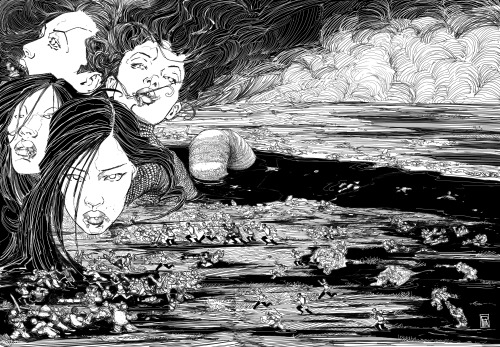 |
| and and and it's all going to fucking kill you, but at least getting eaten by a miles-long snake-river-goddess with four heads will be original... |
I guess what I'm getting at is that, quite a lot of the time, I feel that a lot of the content in RPG supplements - especially adventure modules - is superfluous. 'Trolls raid nearby settlements, capturing villagers to sacrifice in an ancient stone circle in the hope of awakening their ancient monster-god' is a decent enough basis for an adventure. But if everything that follows is just pretty much exactly what your reader would have expected based on that description - trolls acting exactly like trolls normally do, villagers being cliched fantasy villagers, the monster-god being a gribbly tentacle beast straight out of Cthulhu Central Casting, and so on - then you might as well have left it as a one-line adventure prompt rather than writing a whole module about it. The extra page-count should be justified by its
content: it should be full of stuff that is, on average,
better than most people are going to be able to come up with on the spot.
My favourite RPG supplements are the ones in which the page count corresponds to the number of
actual ideas, and thus maintain a very high level of conceptual density. One or two ideas in one or two pages is fine. Dozens of ideas in dozens of pages is fine. But a handful of ideas stretched out over dozens or hundreds of pages,
Shadows Over Vathak style, is just wasting everyone's time.
Probably coming next: behemoth
Pathfinder mega-campaign
Rise of the Runelords distilled down into a single blog post!