Sunday, 9 June 2019

So close and yet so far: the story of Mutant Chronicles

I mentioned back in December that, after incautiously writing one too many posts about Warhammer, I'd taken up miniature painting. In order to feed my growing miniature habit, I took to scouring ebay for cheap miniature bundles. And that's where I came across Mutant Chronicles.

I'd never heard of Mutant Chronicles before, but I quite liked the figures, whose cartoonish sculpts were perfectly suited to my limited painting abilities. So I looked into it a bit further... and was mildly astonished by what I found. Those of you who are already familiar with the Mutant Chronicles franchise should feel free to skip the next two paragraphs.

Related image

So: back in 1982, the Swedish RPG company Target Games produced a fantasy RPG called Drakar och Demoner, which I'd kinda heard of. In 1991 they published the famous Gnostic horror RPG Kult, which impressed me enormously when I read the English edition back in 1999 or thereabouts. What I hadn't known was that in 1984 they also released a Gamma World style post-apocalyptic RPG called Mutant, which morphed over the course of four editions into a dystopian post-apocalyptic horror SF RPG called Mutant Chronicles, which shared some setting elements with Kult, and was published in 1993. This game took off like a rocket, and was swiftly followed by the miniatures boardgames Siege of the Citadel (1993), Blood Berets (1993), and Fury of the Clansmen (1994), the collectable card games Doomtrooper (1995) and Dark Eden (1997), a computer game (Doom Troopers, 1995), and a miniatures wargame (Warzone, 1996). The success of Mutant Chronicles was so great that Target rebooted Drakar och Demoner in 1994, giving it a more fantasy-horror themed setting to match the Mutant Chronicles tone, and in 1997 launched a tie-in fantasy miniatures wargame, Chronopia. 

Here's the pitch: megacorporations take over the world. Then they colonise the solar system. Then they strip-mine Earth of all its resources, evacuate everyone they think will be useful, and leave everyone else to choke in the smog. Then they accidentally awaken some Evil Space Demons who have escaped into their gameline from Kult. The demons take over all their computers and nearly kill everyone, but the corporations manage to shove them back inside their box with the help of some magical space Catholics called The Brotherhood. Then they spend hundreds of years fighting each other in a state of enforced technological stagnation, because everyone knows that computers are the tools of the Space Demons, while the poisoned ruins of Earth are gradually repopulated by an assortment of post-apocalyptic weirdos. Then the Space Demons break back out again, and a variety of ultra-macho ethnic stereotypes - Scottish berserkers, Japanese samurai, efficiency-obsessed Germans, and Americans in cowboy hats - must unite to save humanity from the mutant zombie horror-monsters of the Dark Legion.

Image result for mutant chronicles rpg
It all looks like this. All the time.
Flush with cash from the success of Mutant Chronicles, Target Games rapidly expanded their operations into the US, UK, and Ireland. They bought out the miniature company Heartbreaker Hobbies and Games in 1997, and for six years - 1993 to 1998 - they were a serious competitor to Games Workshop. GW had Warhammer: Target had Chronopia. GW had 40K: Target had Warzone. GW had Heroquest: Target had Siege of the Citadel. But as so often happens when a company expands too fast, Target didn't have the financial reserves needed to soak up losses and reverses, and waning sales in 1998 led almost instantly to bankruptcy in 1999. Luckily for them, in amidst all the Mutant Chronicles excitement, Target had also produced a modest little turn-based historical strategy computer game called Svea Rike (1997): and when the remnants of Target Games reformed as Paradox, its first project was an expanded version of Svea Rike called Europa Universalis (2000). The rest is history, and today Paradox has carved out a strong and apparently much more sustainable niche as a creator of such acclaimed grand strategy computer games as Crusader Kings 2 (2012), Europa Universalis 4 (2013), and Stellaris (2016).

For Paradox today, Mutant Chronicles probably seems like an embarrassing episode from their corporate adolescence. The games still have a fanbase, but subsequent efforts to revive them have been dogged by failure and misfortune. Excelsior Games relaunched Chronopia in 2002 and Warzone in 2004, but both games swiftly folded. Then Fantasy Flight Games tried to relaunch Warzone again in 2008 as a 'collectable miniatures game' featuring 54mm prepainted miniatures, which went down like a lead balloon. Prodos Games relaunched it again in 2013 as Warzone Resurrection, which stumbled along for a few years before getting mired in legal disputes and finally ceasing production for good in 2018. The 2008 Mutant Chronicles movie, which somehow featured both Ron Perlman (!) and John Malkovich (!!!), ended up with a rating of 18% on Rotten Tomatoes. Mophidius held a kickstarter in 2014 to launch a third edition of the RPG: the sourcebooks promised in the kickstarter were dutifully produced between 2015 and 2017, but the game seems to have been pretty much dead on arrival, and Mophidius is now selling off their remaining stock at steep discounts. A  2016 kickstarter for a 2nd edition of the Siege of the Citadel boardgame raised $600,000: it was supposed to ship in 2017, but has been plagued by fulfilment issues, and most backers still haven't received their games. And yet, despite these repeated disappointments, the franchise just refuses to die. It's as though Warhammer 40,000 had a weird little brother who was (a) undead and (b) Swedish.

Mutant Chronicles is supposedly set more than a thousand years in the future, but the truth is that this is a franchise in which it is forever 1996. It's absolutely crammed with everything that teenage boys thought was cool in the mid-1990s: ninjas, samurai, cyborgs, zombies, Scottish highlanders (Rob Roy and Braveheart came out in 1995), corporate assassins, spec. ops. commandos, mutants, giant swords, giant guns, holy warriors, Judge Dredd, the Terminator, John Rambo, and Mad Max. This is a world where everyone thinks it's totally reasonable to refer to your elite super-soldiers as Doomtroopers, and where the average pauldron is at least twice the size of its wearer's head. No-one could accuse it of being subtle, but I do understand the appeal: the sheer wild-eyed enthusiasm of it all is infectious. The fact that I actually was a teenage boy in 1996 probably also helps.

Related image

Huge chunks of Mutant Chronicles were clearly ripped off from 40K. The pivotal event in history of both settings is a duel between the magical messiah of the Space Catholics (Cardinal Durand / The Emperor) and the evil warlord of the Space Demons (Algeroth / Horus). In both, a space-age civilisation discovers cosmic evils that force them into a state of technological stagnation. Humanity's best hope against the space demons is an order of sacred warriors with Roman Catholic Gothic aesthetics and lots of power armour. The space demons are split into different factions, led by entities who embody the forces of corruption (Ilian / Slaanesh), destruction (Algeroth / Khorne), pestilence (Demnogonis / Nurgle), deceit (Semai / Tzeench), and insanity (Muawijhe / chaos in general). The settings are characerised by black-and-grey morality, and dominated by oppressive societies riddled with heretical cults that secretly serve the space demons. There are chainswords. There are mutants. And there are some truly enormous shoulderpads.

I feel that it would be somewhat hypocritical to complain about this, given the extent of 40K's own debts to earlier SF media like Nemesis the Warlock and Dune. But the similarities between the two also call attention to their differences. 40K, for better or worse, has changed a lot over the years: 40K in 1987 was very different to 40K in 1996, and hugely different to 40K in 2019. But Mutant Chronicles still seems to be as 90s-tastic today as it was back in the actual 1990s, still trading on memories of endless summer holidays spent listening to Slayer and reading 2000AD. 

Like 40K, Mutant Chronicles trades heavily on the strength of its imagery. Does it make much sense for girls with chainswords and power-armoured dudes in Pickelhauben to team up against frothing Scottish Highlanders and WW1 trench infantry IN SPAAACE? Not really, but it sure looks cool when they do! It features a lot of good, iconic designs, especially of armoured infantry, and I'm sure that much of the franchise's longevity is based on the sheer affection that many old Warzone players clearly feel for their squads of Imperial Trenchers, or Venusian Rangers, or Lutheran Fusiliers. But while its range of imagery is wide, it isn't deep. It draws on many different sources of iconography - feudal Japan, WW1 Europe, the Vietnam War - but at the end of the day, it's still mostly just Macho Men and Macho Women with Guns. It's fun and vivid and pulpy, but everything feels a bit two-dimensional, with no attempt to present, say, the Mishima Mega-Corporation as anything other than a heap of early 1990s Japanese stereotypes, or the Dark Legion as anything more than a gibbering horde of space demons who want to murder everything just because they can. The sense that I sometimes get with the best 40K stuff - that all this really means something, and that what we're seeing is just the protruding edge of something far bigger and older and sadder - never really comes across, at least to me.

Image result for mutant chronicles brotherhood
Everyone just keep shooting, OK?
What I think that the contrasting fates of Warzone and 40K demonstrate are that imagery, energy, and machismo can only get you so far, even in the world of SF wargames. I don't think for a moment that most fans of 40K like it for the ideas, but the fact that it has ideas must surely be connected to its ongoing survival and success. The familiar techno-Gothic iconography of 40K means things: it communicates something complex and powerful about the spiritual kinship between dehumanising systems of advanced technology and archaic systems of violence and control. It's flexible enough that it can be used to tell all kinds of different stories from all kinds of ideological perspectives, from anarchistic satires about the awfulness of imperialism to quasi-Fascist parables about the need for strong leaders and the dangers of tolerating dissent, and as such it's been able to continue connecting with new waves of gamers, artists, and designers for more than thirty years. I think you'd struggle to do anything of the sort with Warzone, which only really seems to be set up to tell stories about how one bunch of dudes shot another bunch of dudes and looked really awesome while they were doing it, and which never seems to have been able to attract a new audience to make up for the decline of its original fanbase in the late 1990s.

They do look really awesome, though. And that turns out to be able to get you a really long way. Just not, it would seem, quite far enough.

Related image

Monday, 3 June 2019

Miniature painting: the adventure continues

Last September, after incautiously writing too many blog posts about Warhammer Fantasy Roleplay, I took up miniature painting. I posted about it in December, providing images of all the crudely painted figures that I'd completed to date. Five months on, I'm still at it, although my pace has slowed somewhat. This post is an update on what I've been painting since.

I'm still very much a beginner, as will be obvious from the images below. I'm only just starting to experiment with things like basing figures or painting human eyes. I'm painting figures pretty much at random, just in order to experiment with different things - big models, small models, cloth, skin, armour, hair, scales - and my focus is still on quantity rather than quality. But I'm improving. Slowly. I think.

Here are the models I've done so far this year. Click the pictures for bigger images.

More miniatures from Castle Ravenloft and The Legend of Drizzt:


THE CHORUS LINE OF THE DAMNED.
Some chunky old elves from Chronopia: 


Some Arab warriors from somewhere or other:


An angel.


A sprue of female paladins from Shieldwolf miniatures:


Some 1:72 (20mm) elves, as an experiment in working on a smaller scale:


Some GW skinks and Frostgrave snakemen:


A bunch of fantasy henchmen and irregulars:


Some random historical figures:


Painting these guys was an oddly intimate experience. As my brush tenderly caressed their athletic buttocks, I suddenly realised why there was such a big market for cheesecake female miniatures.
Some dark elf spearmen:


Some old Warzone miniatures:


I FINALLY WORKED OUT HOW TO DO EYES!


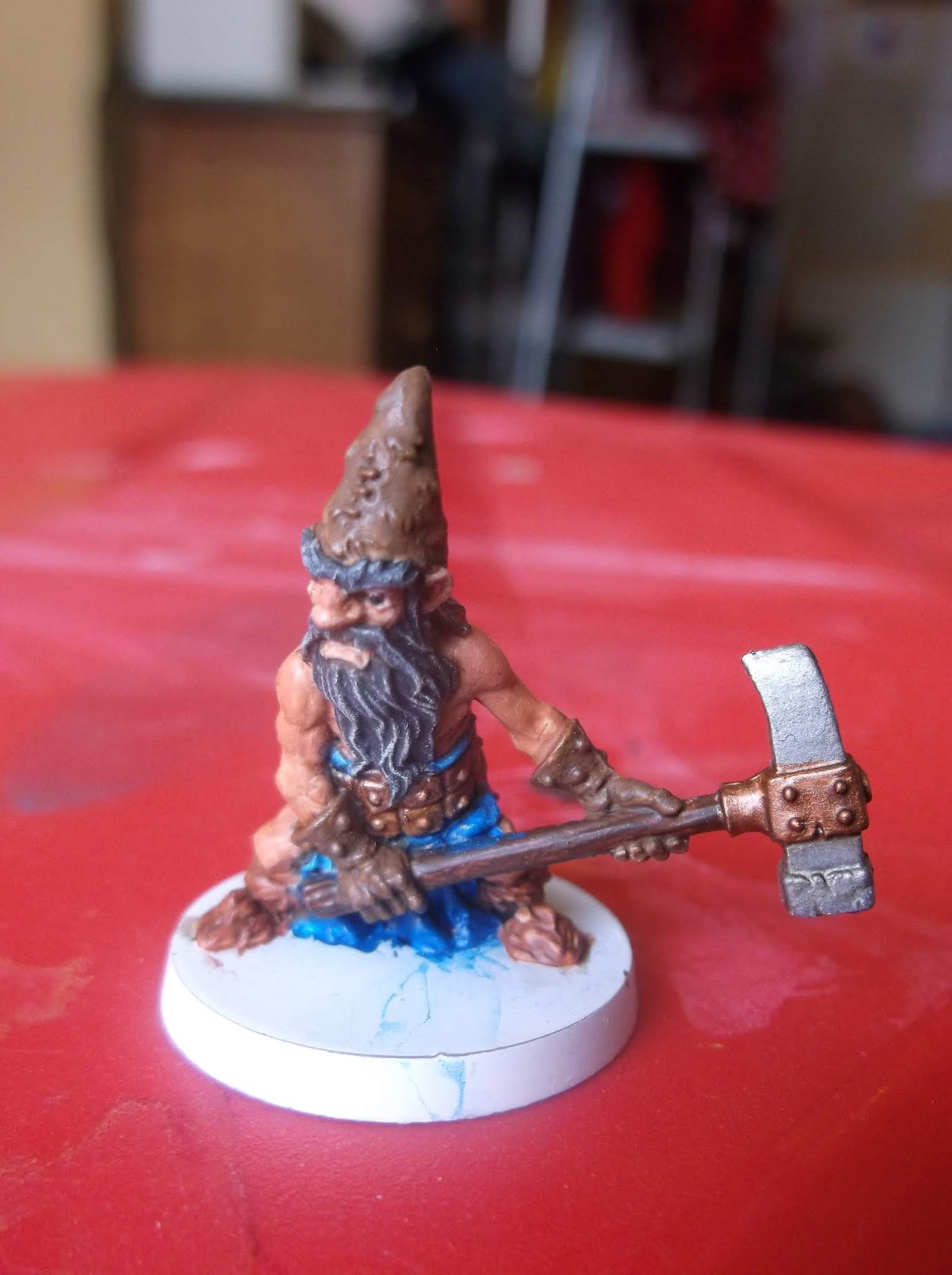
And a dwarf.


So that's where I've got to. Current projects include finally finishing the board game miniatures, painting up a bunch of other Warzone figures (Brotherhood, Bauhaus, and Lutherans), doing some more Celts (some of whom will be wearing trousers this time), and completing a squad of Mantic orcs who have been sitting on my shelf, half-finished, for about six months. So expect another update in, like, November or thereabouts...

Friday, 31 May 2019

The Automaton Police Office

I found this today and thought it was too good not to share.


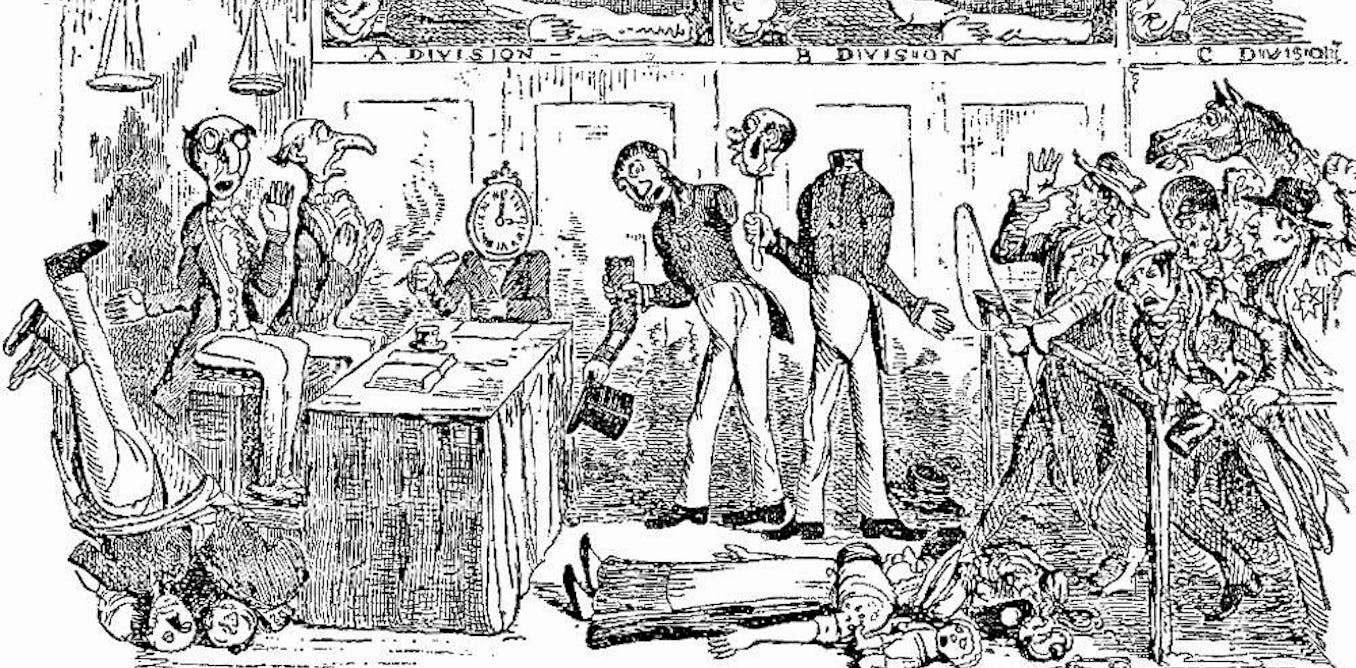
This illustration, captioned Automaton Police Office and the Real Offenders, appeared in Bentley's Miscellany in 1838, as part of a satire by Charles Dickens entitled 'Full Report of the Second Meeting of the Mudfog Association for the Advancement of Everything'. The Association, naturally, is full of fools and lunatics making stupid proposals, but this one really stands out.

The problem, one of the associates explains, is that young gentlemen are causing lots of problems and damage through reckless driving, drunken rampages, beating up policemen, and so on. His solution is to build a giant park, ten miles long by four miles wide, with a tall wall around it. Inside will be empty fields and streets, specially maintained for such gentlemen to ride around smashing things up without causing any problems to the rest of us. There would be wide pavements for them to drive their carriages down, and, for added authenticity, pedestrians were to be hired from the local workhouses, implicitly to give them something to crash into.

So far, so Swiftian - but then Dickens adds a distinctive machine-age twist. In order to give the gentlemen something to beat up, these streets would be roamed by robot policemen. Their job would be to ineffectually attempt to arrest the gentlemen, in order to give them a chance to 'display their prowess' by smashing them to pieces. Once they were sufficiently tired out, the police robots - however mangled - would escort them to a fake police station for a lie down, where they would be 'tried' in the morning by robotic magistrates who were pre-programmed to say things like 'I am sorry to see gentlemen in such a situation' and 'I fear that the policeman was intoxicated'. It would also 'be furnished with an inclined plane, for the convenience of any nobleman or gentleman who might wish to bring in his horse as a witness.'

(This is the scene pictured above: the gentlemen rowdies are on the right, accompanied by the horse that they have brought in as a witness for the defence. The robotic police whom they have smashed up stand in the middle, giving evidence to the robot magistrates on the left, and to a secretarial automaton with a clock for a head. More broken robots lie in the corner in the far left, while fresh police robots lie in alcoves in the wall at the back, labelled 'A Division', 'B Division', and 'C Division', ready for fresh deployment.)

This is all so gameable it barely needs alteration. High walls surrounding a crumbling Potemkin city, built as a playground for the idle rich of a fallen civilisation. Malfunctioning clockwork automata in ancient police uniforms try to arrest anyone disturbing the peace, persisting even after their bodies are smashed to pieces - but all that they do with the people they catch is drag them into sham courtrooms, where robot magistrates find them innocent regardless of the evidence against them. Maybe a cargo-cult society descended from local paupers, convinced that it is very very important for them to spend several hours a day wandering the empty streets in case somebody wants to drive a coach into them. Armies of robotic enforcers lying dormant and rusting in alcoves, waiting to be wound up and sent marching into action. And witness stands for horses.

You could even go for a Westworld style set-up where the whole thing was brought down by a malfunctioning automaton who developed enough intelligence to start resenting getting his head kicked off every night, only to see his tormentors pardoned every morning. Hell, maybe he's still out there, lurking in a corner of the park, his lair stacked high with all the jewelled canes, gold snuff boxes, diamond rings, and other treasures that he looted from the idle rich during his brief but effective reign of terror...

Tuesday, 28 May 2019

Dissecting the frog: Team Tsathogga in retrospect

My long-running B/X D&D campaign ended this week, after three years, 70-odd sessions, and about 200 hours of actual play. It's the second-longest campaign I've ever run, beaten only by my old secondary school AD&D game, and the first that I've run on strict old-school principles. For the most part it was enormously successful: both I and my players had a huge amount of fun, and we've come away from the campaign with a treasure trove of scenes and characters that I'm sure I'll remember forever, or at least until I succumb to permanent senility. The Glasstown job. The salvation of QelongThat time the PCs tried to fool a snake-man by putting on an improvised radio playAdopting a dungeon full of skeleton death cultists. Inventing the giant projectile maggot vomiting zombie vampire toad. And more, so many more, that never made it into any of the actual play write-ups... the old sticky arm trick. The time Sophie pretended to be a noblewoman cursed with contagious amnesia. The insane fake legend of Anthrax and Judacus, which just kept getting more complicated as the campaign went on. It's been a really, really good campaign.

The terrible Wall-Eyed Frog, dread symbol of Team Tsathogga. Awful Latin also became one of their trademarks.

I found it an enormously liberating game to run. I had a world in my head, and the PCs ran around it messing things up. There was no need for 'plot' or 'story' or 'balance' or 'structure'. I didn't need to worry about problems or obstacles having preplanned solutions: I just laid out whatever made sense in context, and let the PCs figure out their own way of dealing with it. If an antagonist was much to weak or much too strong for the PCs, then so be it. If the dice said that someone lived or died, then so it was. If the PCs made friends with everyone in the dungeon instead of fighting anyone - and that happened repeatedly - then that was just what happened to happen. I was usually able to do all the 'planning' needed for each game in the half hour it took me to get to that week's session. After this, I think I'd really struggle to go back to a rule- or plot-heavy game like some of the ones I've played in the past.

All this said, however, there are some things that I think I could have done better, or should have done differently. So here's my list of lessons learned.

1: What you gain in breadth, you lose in depth

I started this campaign during my first gust of enthusiasm for oldschool D&D, which I embraced with the zeal of a new convert. What's the absolute opposite of a pre-scripted railroad? A game where you can go anywhere and do anything! The game-world sprawled endlessly in every direction, and I was absolutely committed to letting the PCs go wherever they liked. If, at any point, they simply abandoned whatever they were doing and lurched off in a random direction, I would be ready for them. (This came in handy after the whole skeleton adoption business, when that's pretty much exactly what happened.)

Over the course of the game, the PCs roamed back and forth across an entire continent's worth of geography. But the flip-side was that many of the places they visited were pretty sketched in. They lacked the dense specificity of the game's more thoroughly detailed areas, like Qelong, or the Purple Islands, or the underworld beneath Bright Meadows. I'm still absolutely committed to the idea of a free-roaming campaign: but next time I run one, I think I'll try to keep it much more geographically contained, allowing each region to be explored in much greater detail, and ensuring that everything is close enough to connect to and impact upon everything else.

2: NPC development takes work

The game featured a lot of NPCs, but there were relatively few who I felt really came to life. Titus the necromancer did, with his corpse obsession and his doomed romances and his horrible chewed-up face. Bat-Man Ron, with his combination of intelligence and naivety and his tragi-comic aspirations to be the saviour of his people. Vaud, with his passion for freedom and his total lack of volume control. Maybe Hallgerd, with her cheerfully amoral mercantilism. Maybe Elder Amelia, with her endless catalogue of secrets. Maybe Sophie's dim-witted college friend, Becky. Maybe Grick, Grak, and Gruk, the party's comedy goblin sidekicks. And maybe Sad King Nath.

But for every NPC who came to life in play, there were dozens who never really managed to be anything more than plot functions with a few mannerisms attached. Captain Matthew, who loyally ferried the PCs around the world for years on end, might as well have just been a 'map loading' screen with some stock art of a sea captain on it. Dara, the refugee Qelongese novice who introduced the golden lotus flower to the Purple Islands: what was her deal? What about Vem the huntress, who became queen of her people? Titus's ex-wife, Zenobia? The archivist of the tunnel-dwellers? We knew what they did. But who were they?

In many ways, this was a side-effect of point 1. After every scene, I always asked the players what they wanted to do next, and the answer was never 'have a heartfelt chat with Captain Matthew about how he really feels': it was always about moving onto the next item on the agenda. The NPCs who were able to become actual characters were the ones whose personalities were able to emerge through action: everyone else just faded into the background. In future, I can see that I'll need to be much more proactive about staging scenes of character interaction if most NPCs are to end up as anything more than placeholders. Much broader characterisation would probably also help.

3: B/X characters change fast (and change genres)

By the standards of modern D&D, character advancement in this campaign was glacially slow: the characters started at level 0, and seventy-odd sessions later they were levels 7-8. But their accumulation of power didn't feel slow to me. It felt like a massive accumulating snowball that increasingly threatened to crush anything in its path.

I'd say that the game went through three distinct phases. At levels 0-3, the PCs were desperately fragile, perpetual underdogs who had to rely on stealth, trickery, diplomacy, and rank cowardice. At levels 4-5 they started to feel like fantasy heroes, able to wade into battle in the knowledge that they had enough hit points and healing magic to see them through most situations. By levels 6-8 they were starting to feel superheroic, characters who had largely outgrown the world around them, able to resolve most situations through brute force. They became positively reckless, trusting to their spell lists, hit point pools, and saving throws to see them through all but the very worst of disasters. What fear can a man with a knife inspire in a woman with 51 hit points?

I didn't begrudge them their strength. They earned it, and they paid for it, and their road to power was strewn with the bodies of the PCs who didn't make it. But after the desperate striving of the first six levels or so, the high-level stuff felt a bit like a kind of extended epilogue or victory lap - especially given the complete freedom that the PCs possessed to travel the world, and thus to pick their battles, allowing them to smash through situations like a wrecking ball when their lower-level selves would have had to spend months patiently building solutions. They were never invulnerable, and threats like the marsh giants, the Ghost Drummers, Hild the blood-witch, and the robotic guardian of the Pools of Life still managed to give them a run for their money. But if I was going to do this again, I think I'd be more proactive about building in dynamic high-level threats that would move against the PCs once they attained a sufficient level of power, thus compelling them to more frequently pick on somebody their own size.

4: Caster vs. non-caster balance is tricky

Something that I didn't foresee, but probably should have, was that the kind of free-roaming, player-led game that I was aiming for, coupled with the Vancian spell-slot system of B/X D&D, would hand a massive advantage to spell-casting characters. D&D is balanced around dungeon environments, with the assumption that each delve is going to be a brutal battle of attrition, and spell slots a scarce and treasured resource. But with the PCs usually free to move at will, free to pick their battles, and free to choose when to strike and when to retreat, situations in which they were forced to have two or more 'encounters' in a single day were the exception rather than the rule. This, in turn, didn't matter much when the casters only had two or three spells each: but by level 5 or so there was often little to stop the PCs scouting a situation, retreating, preparing a specialised spell payload, resolving the situation in a blaze of magic, retreating again, using another full day's worth of spells to heal from the previous encounter, and then moving forwards fully restored and ready for the next challenge.

Under these circumstances, the advantages that non-casters would normally possess - resilience, combat skill, non-magical skill sets - were increasingly sidelined. Your attack bonus doesn't matter when the mage can alpha strike your enemies into goo on the first round, and being sneaky and charming isn't worth much when the wizards can just load up on Invisibility and Charm Person spells. By the end of the campaign, the party were in the habit of 'charm nuking' high-value targets by hitting them with ten or more Charm Person spells in quick succession, thus virtually guaranteeing success regardless of the target's saving throws. The fact that one of the fighters had Charisma 18, which had frequently been a lifesaver at the start of the campaign, became a virtual irrelevance by the end.

In this game, we dodged the problem by giving everyone two characters, usually one caster and one non-caster: a solution not dissimilar to the 'grogs and magi' set-up from Ars Magica. But I do feel that I should have done more to encourage some level of parity, partly by giving the players less ability to control the tempo of the situations in which they found themselves (although I'm wary of reducing this too much), and partly by giving more powers to the poor old fighters besides just escalating hit points. One quick and dirty fix that I'm considering is to let each fighter pick a new area of noncombat competency every time they go up a level, so that by level 8 or so they're less 'meat-shield' than 'Batman', although mastering entire new fields of knowledge every few months does rather strain my disbelief. The real solution is probably just to use more dungeons.

5: Structure, or the lack thereof

This was a campaign which deliberately, and indeed defiantly, lacked any kind of overarching structure. There was no 'main plot'. Nobody had a 'character arc'. It didn't build towards any kind of epic climax. It was just a bunch of stuff that happened, and then kept on happening, and then stopped.

In a lot of ways, I absolutely loved that. I have become so tired of 'epic' and 'awesome' finales, of scenes in which everyone gets together for One Last Battle, of heroes and villains punching each other on the edges of exploding buildings or erupting volcanoes, of scenes in which The Fate of The Universe Rests On Just One Man, of characters completing their Emotional Journeys and then dying tragic but emotionally satisfying deaths. I have become increasingly interested in raggedness, incompleteness, and incoherence, because the stories that we make and the victories that we achieve seem to me to be much more meaningful when there's no hand of destiny moving in the background, forcing them to occur. The adventures of the PCs, much like most people's real lives, was just a series of events that happened to happen. It didn't add up to anything more than the sum of its parts.

But there are drawbacks to that level of shapelessness, too. The two main threads running through the campaign were the discovery of the secret history of the world, and the demon / snakeman threat, and over the course of the campaign each of them got... maybe three-quarters resolved? As a result, the end of the campaign felt very arbitrary, like a TV show that suddenly got cancelled in mid-season, rather than like the logical end-point of the story of these characters, who would surely have wanted to continue uncovering the truth about their world instead of just randomly flying off into the sunset. But given the shapelessness of the campaign, playing all the way through to a full resolution of both strands would have taken years. 

I think the lesson learned here is to either go all-in with player-led hexcrawling, with no stories or structures whatsoever beyond those that the players choose to build for themselves, or have the Big Story tied to something dynamic, making it possible to force a resolution whenever the campaign nears its end. I did enjoy the whole campaign, and in many ways I felt that its anticlimactic non-ending was absolutely perfect. But part of me is still kinda frustrated that the players never got to finish figuring out their world's secret history, and that the sealed door beneath Bright Meadows remained stubbornly shut from the first session all the way to the last.

Image result for sci fi spaceship door
What did it conceeeeeal?

Anyway. It's been fun. It's been more than fun. It's been glorious and hilarious and utterly unforgettable, and easily one of the highlights of my gaming career to date. Thanks to all the oldschool writers and bloggers whose ideas I stole, whose advice I followed, and whose adventure modules I took apart for raw materials. A massive thank you to all my players, past and present, for coming up with more demented plans than you could shake a giant projectile maggot vomiting zombie vampire toad at. Shine on, you crazy diamonds. So long and thanks for all the beer.

Or, as the goblins would say...

Blood for the Frog God!

Image result for tsathogga

Wednesday, 22 May 2019

Condensation in Action 7: Skull and Shackles

Someone requested this at some point. Skull and Shackles is a pirate-themed campaign, which, like most Pathfinder APs, combines some good ideas and compelling imagery with heinous railroading, endless trash fights, filler dungeons, and miscellaneous bloat. I've tried to condense it down to something short and open enough to be useful. Previous 'Condensation in Action' posts can be found here:

Kingmaker
Rise of the Runelords
Curse of the Crimson Throne
Council of Thieves
Cults of the Sundered Kingdoms
Iron Gods

All Pathfinder adventure paths are railroads, but this one is ridiculous. At one point the PCs have to persuade a bunch of pirates to make them Free Captains - but if they fail, then the pirate king appoints them anyway, because The Plot Must Go On. At another point they have to win a race against another pirate ship - but if they lose then the other ship is disqualified, so they win by default, because The Plot Must Go On. Sometimes the adventure just outright tells you not to let your PCs do things, as with this gem:

'Although Caulky knows where the Wormwood is berthed, you should discourage the PCs from visiting their former ship, as both Harrigan and the Wormwood have more roles to play, both later in this adventure and in the Adventure Path.'

'Discourage' them? How, exactly? By having rocks fall on them every time they approach the ship? By just informing them point-blank that they're not allowed to interact with the Wormwood until later in the adventure, because otherwise it might derail The Plot? 'You've all been press-ganged into serving on a pirate ship' is a great way to start a campaign, but from that point on everything is on rails. You will lead a mutiny and take over your ship, you will use that ship to become pirate captains, you will take over an old fort to use as a base, you will find and follow a treasure map, and so on. The idea that the PCs might want to do something else - anything else - is given very short shrift indeed.

So, in line with the principles laid out here, I've ditched all that, and just turned it into raw materials for a pirate-themed sandbox. Enjoy.


(NB: This map is not to scale: it's just intended to give a sense of the relative bearings of each location. The islands are much smaller than this, and the seas between them are much, much bigger.)

Background: This hexcrawl describes a remote archipelago of lawless islands, long a haven to pirates, who sail out from its hidden harbours to prey upon shipping in the sea lanes beyond. The islands are rugged and heavily forested, and the surrounding seas are full of treacherous reefs, which has so far prevented the isles from being scoured clear of pirates by the fleets of the surrounding nations. The pirates often fight among themselves, but recognise the notional authority of their elected chief, the 'Hurricane King', and will rally behind him in the face of a real emergency. A nearby seafaring nation has become sick of all this piracy, and has sent spies and agents (see 0603 and 0605) to soften them up for a naval attack (see 1009).

The Hurricane King is appointed by a council of leading pirates, the Free Captains. In theory, once appointed, the decisions of the Hurricane King are final, with the Free Captains merely serving as his advisers. In practise, a Hurricane King who loses the support of the Free Captains is unlikely to reign much longer.

The current Hurricane King is Kerdak Bonefist (see 0407). The current Free Captains are Isabella Locke (0109), Milksop Morton (0806), The Master of the Gales (0708), Avimar Sorrinash (0605), Barracuda Aiger (0605), Arronax Endymion (0605), and Barnabas Harrigan (0603). Membership of the council is much more a matter of de facto power than de jure legitimacy, so any PC who owns their own ship and performs suitably piratical feats of daring-do is likely to be raised to the status of Free Captain sooner or later.

Hook: If this is the start of a new campaign, then you could have the PCs begin as unfortunates press-ganged into service aboard the Wormwood (see 0505), who would then have to plot escape or mutiny. Alternatively, just begin with the PCs arriving at Port Peril (0605) looking for adventure. There's plenty of it about.

0102: Sinew-twined, scrimshawed skeletons are erected at intervals along the shoreline, here, as a warning to all who approach. In these flooded caves dwell a tribe of grindylows, shark-toothed aquatic goblins who have a mass of writhing octopus tentacles instead of legs. The grindylows steal sailors from the decks of passing ships by night, dragging them down into their caves to drown and eat. Their caverns are full of masses of choking seaweed concealing lines of hidden, floating riphooks. Their queen spends most of her time doting on her blooded son, the Whale, a gigantic grindylow who has never stopped growing, and is now much too large to leave the cavern which serves as his mother's throne room. She has accumulated considerable treasure over the years.

Image result for pathfinder grindylow
A grindylow.

0103: Amidst these rocks the lone survivor from the shipwreck at 0202 eked out many lonely years, before finally contracting ghoul fever from the mosquitoes. He hanged himself when he felt himself starting to transform, but this did not stop his corpse from animating as a ghoul. Now he dangles, apparently dead and inanimate, from the roof of his ruined stockade, but his corpse will come to life and lash out savagely at anyone who comes within swinging distance. During his life he made many hunting expeditions against the ghouls who were once his shipmates, and his stockade is ringed with a circle of rotting ghoul heads on stakes - these are all filled with flies and mosquitoes infected with ghoul fever, which will burst out of them in stinging swarms if disturbed. He also managed to salvage most of the valuables from the shipwreck, which now lie buried beneath the dirt floor of his stockade.

0106: These seas are haunted by the ghost of Whalebone Pilk, a cruel whaler who led his crew to their deaths at sea. Ships that pass through this region often glimpse a ghostly ship that emerges from the sea, sailing against the wind, or hear the tolling of a ship's bell. Those that linger too long are attacked by Pilk himself: his ship rises straight out of the water beside the unfortunate vessel, and brine zombies come lurching aboard under the cover of darkness, seeking to grab the living, drag them onto their own vessel, strip them down for blubber, and behead them in front of their ship's bell. (The skulls of hundreds of previous victims litter the hold.) Pilk himself can suck the air from the lungs of his victims from several feet away. The ship's bell tolls continuously throughout these assaults: it is the locus of the haunting, and destroying it ends the curse and sends Pilk and his crew instantly back into the depths from which they came. Otherwise the curse will never end until the zombie crew have claimed their thousandth skull, at which point they will turn on Pilk, render his fat into oil, and sail their ship straight down to hell. Currently they're on six hundred and forty-three. Pilk is an infamous terror of the seas, and anyone who can prove that they have set him to rest will win great prestige with the pirates of Port Peril (0605).

0109: This island is surrounded by vast expanses of open sea, making it very difficult to locate without a map. Here, concealed in a secluded harbour, can often be found the Thresher, the ship of Isabella 'Inkskin' Locke, a pirate captain of some renown. Isabella suffered horribly at the hands of the ship's previous captain, a cruel man who knocked the teeth from her head and disfigured her body with crude tattoos. When the map to a legendary pirate treasure fell into his hands, he had a copy of it tattooed between her shoulders; but when he tried to follow the map, however, he ended up being killed by the sahuagin at 0209. Glad to be rid of her tormentor, Isabella entered into an alliance with the sahuagin king, and now acts as his eyes among the humans. She even had a new set of fanged false teeth made in imitation of theirs.

When it's not here at harbour, the Thresher roams far and wide, serving the increasingly mad objectives of the sahuagin. (A band of them always swim alongside it in secret, and aid Isabella in her attacks on merchant ships and other targets.) In particular, it's only a matter of time before it participates in an attack on the fort at 0802. Her ship is also a regular visitor to Port Peril (0605). The chart tattooed between Isabella's shoulders is now the only surviving map that shows the location of this island, so defeating, tricking, or befriending her is likely to be the only way of locating it.

Image result for skull and shackles isabella
Isabella Locke.

0202: Years ago, a ship was wrecked here, carrying a pack of captive ghouls in a cage in the hold. The crash broke open the cage, and the ghouls proceeded to infect and kill all the surviving crewmen except one, who escaped into the uplands. (See 0103.) These ghouls now live in a large, rotting tent in the swamps, painted with lurid faces, and creep forth at night in their tattered finery in search of prey. Half-eaten human body parts dangle from the surrounding trees. The local mosquitoes have also become carriers of ghoul fever, making this swamp an extremely dangerous place in which to spend any length of time.

0204: On this forlorn island stands a lone black tower, sacred to Dagon, demon lord of the seas. Years ago, it served as the stronghold of a terrible cult, until a coalition of pirate captains banded together to destroy them. The cultists retreated into the tower, the pirates pursued them, and no-one on either side ever came out. Everyone has avoided the place ever since.

The tower's ground floor is flooded, and infested with flesh-eating eels. On the upper levels, ivory statues of drowned men vomit up rivers of cursed water to drown intruders, and roaming beasts like great masses of animate intestines prowl mindlessly, searching for victims. Unintelligible whispers arise from holes in the black rock. The last survivor of the cult, now transformed into a grotesque and bloated monster, lurks at the bottom of the tower, surrounded by the bones of her victims and treasures carved from coral and whalebone. The most valuable treasure of all here is a powerful magical sword, Aiger's Kiss, which was wielded by one of the pirates who came to destroy the cultists, and still lies clutched in her bony hand today. Her son, 'Barracuda' Aiger (see 0506) would very much like it back, but has never been brave enough to come looking for it himself.

0207: Here, beneath the waves, lies the wreck of a legendary pirate ship, the Brine Banshee. Famous for its speed, it outran every ship that tried to catch it, only to finally sink when an angry dragon turtle attacked it from below. There is nothing to mark its resting place, and PCs are extremely unlikely to find it without the Ring of the Iron Skull (see 0806) and the shinbone of its captain, Vargus Brack (see 0708). They will also obviously need some way of travelling beneath the water.

Near the wreck lives an eccentric merman outcast named Ormandar, who will come with his brood of pet sharks to investigate any attempt to locate or disturb the shipwreck. If the PCs can ally with him, he could be persuaded to explore the wreck on their behalf, perhaps in exchange for sufficient quantities of fresh meat for himself and his sharks. If antagonised, he will unleash his pets on any divers.

The broken wreck itself lies on the seabed. Brack went down with his ship, and his skeleton, easily recognisable from its wooden leg, is still lashed to the wheel. There's not much treasure in the hold, but the ship's wheel itself bears a powerful enchantment, which greatly increases the speed and manoeuvrability of any ship to which it is attached. (This was the secret of the Brine Banshee's success.)

0209: This island is extremely remote, and almost impossible to find without the aid of the map tattooed on Isabella Locke's back. (See 0109.) As well as giving the location of the island, the map also shows a skull with a golden tooth, and what might be either a rising or a setting sun. When seen from the south by the light of dawn, the rocky coast of this part of the island does look a bit like a skull, and a heap of iron pyrite in a cave even gives it the look of having a gold tooth. This cave is where a legendary pirate once buried his treasure - but it's not there any more, because it was seized by a tribe of sahuagin when they claimed these caverns as their lair. They also found an ancient stone throne, built ages before by the same cyclopses who built the city at 0501, which their chief, Krell-Ort, claimed as his own. Unfortunately for them (and a lot of other people), the ancient magics of the throne warped his mind, filling him with messianic self-belief and dreams of conquest. Now his minions roam the archipelago, sinking ships and attacking settlements as the first stage in his (completely impractical) plan to claim all these islands as his own. In this he is aided by Isabella Locke (see 0109), who scouts out potential targets for him, and sometimes even joins in his attacks.

The king's current objective is claiming the necklace in the fort at 0802 - the twin of the one he found in the buried treasure - which he has coveted ever since Isabella told him about it. He believes that if he can obtain it, it will be an omen that his conquests are fated to succeed.

The treasure that was buried in these caves, and subsequently claimed by the sahuagin, is legendary among the pirates of the archipelago, and finding it would bring great renown (and, of course, great wealth) to its discoverers.

0401: On this shore stands the crumbling ruins of an ancient castle, built on a superhuman scale by cyclopses in ages past. (See 0501.) It shows signs of recent renovation and even more recent destruction. A few years back a pirate mage named Bikendi Otongu seized it for use as his base camp, from which he hoped to sally out and obtain the enchanted crystal at 0501, but he and his men had barely got the place fitted up when the cyclopses attacked and killed them all. Now their ghosts haunt the fort, reenacting the events of their death each night. The one survivor was Bikendi's disappointing apprentice Ederleigh Baines, who still cowers within the ruin, too scared of the cyclopses to leave. Being haunted by his dead master and comrades has driven him quite insane with trauma, fear, and guilt, and he is now a paranoid wreck, his hideaway ringed with improvised magical traps. If coaxed back into a semblance of reason he can describe the crystal that his dead master sought, and express the (correct) belief that Bikendi's ghost will never rest until it has the crystal. He will also mention that Bikendi discovered the location of some kind of sunken treasure nearby, but revealed it to no-one before his death.

If the crystal from 0501 is brought to the fort after dark and presented to Bikendi's ghost, he and his men will seize it and carry it away into the afterlife, ending the haunting. As payment, the departing ghost will flip over a loose paving stone, beneath which is hidden a detailed map showing the location of the sunken shrine at 0402.

Image result for skull and shackles bikendi
Bikendi's ghost.

0402: This was once part of the same island as 0401, tipped into the sea by a great earthquake thousands of years in the past. When Bikendi Otongu (see 0401) came to the island he detected powerful magic beneath the water, and soon located a sunken temple beneath the waves, although the giant shark that now inhabits it dissuaded him from investigating further. PCs might locate the temple either with Bikendi's map (see 0401), or just by randomly casting Detect Magic spells, as it's only about 100' underwater. If the shark can somehow be killed or evaded, a small fortune in ancient gold and gems can be looted from the flooded ruins.

0407: On this rocky island stands the fortress of Kerdak Bonefist, the Hurricane King. (The castle comes with the job.) Always paranoid about a potential coup, Kerdak paid a wizard to build a cannon golem to protect him: an iron golem with cannons for arms, which is always on watch for attacking ships. His lieutenants are secretly weresharks. The only person he truly trusts is Powderkeg, his loyal powder monkey, who throws bombs with remarkable accuracy and will defend his master to the last.

0408: In this cave lies an enormous heap of bloody bones, resembling those of a slaughtered whale. In fact these are the bones of a dragon slain by a previous Hurricane King, and bound to obey whomever currently holds the title. If the bones are disturbed, or the castle attacked, then this skeleton dragon will rise, wreathed in crackling electricity, to fight again. It cannot fly, but it can swim, filling the water around it with electrical death.

0410: This island is the home of a miserable band of shipwrecked mariners, survivors of attacks by the vampires at 0510. Corpses bob face-down in the water around the coast: these are actually ghouls, who attack if anyone comes too close. The ghouls would have eaten all the survivors long ago were it not for the power of an enchanted spring up in the hills, which keeps the undead at bay. Unable to safely travel more than a mile from the spring, the survivors are desperate for rescue, and will light signal fires to alert any passing ships to their presence.

0501: Huge steps are carved into the side of these hills, ascending to the shattered ruins of a city built on a gigantic scale. Here, among the broken relics of their ancestors, live most of the remaining cyclopses who inhabit this island, their attention now wholly devoted to the pressing problem of finding enough food to ward off famine. Their most sacred site is a mostly-intact temple, in which an ancient undead cyclops still stands in eternal vigilance over an enchanted crystal of great value and power, the Immortal Dreamstone. The cyclopses will fight frantically to protect this crystal, but might be persuaded to exchange it for some kind of permanent solution to their food supply problems.

0502: Along the coast here stand huge one-eyed statues, carved from ancient stone. Their eye sockets are empty: once they held jewels, but these were all looted long ago, giving the isle its current name of The Island of Empty Eyes. An advanced race of cyclopses once dwelt here, and the shattered remnants of their population still inhabit the island, though they have depleted its ecology so severely over the centuries that even the small number who remain are now on the brink of famine. They live by herding and butchering herbivorous dinosaurs, and by sailing out in crude ships for fishing and whaling. They have ample experience of people arriving to try to pillage what little remains of their heritage, and view outsiders with intense mistrust.

0505: Here the good ship Wormwood rides at anchor, looking for unfortunate souls to press-gang. Its thuggish master, Mr Plugg, is a minion of the pirate lord Barnabas Harrigan (see 0603): his crew was depleted in a recent battle, and he needs more hands before he can resume his raiding. Among his recent victims is Sandara Quinn, a self-appointed priestess of the sea goddess who maintains a ramshackle shrine on the harbourfront at Port Peril (see 0605): she's popular with the locals, who believe that her blessing brings them good luck at sea, and returning her would win the PCs a lot of goodwill. Plugg keeps order with the help of his 'pet', a simple-minded brute named Owlbear Hartshorn, who is mostly kept imprisoned below decks. Hartshorn is a lumbering giant of a man, rendered brutal by years of mistreatment, but easily won over by any kind of kindness or sympathy.

Image result for skull and shackles quinn
Sandara Quinn.

0506: Here stands a temple of surprising size and grandeur, sacred to the goddess of the sea. The local pirates are a superstitious bunch, and the priests aren't picky about where all these bloodstained doubloons are coming from, as long as the donations keep flowing in. Recently they ordered a particularly lavish golden idol, but it never arrived, much to their distress. (It was stolen by the wreckers at 1004.) They can provide a description of the route that the ship carrying it was supposed to take, and will offer both money and information in exchange for its return.

0510: This remote island is plagued by a feral band of aquatic vampires, who waylay ships, turn their crews into ghouls, break their masts, and drag them into a vast cavern as floating trophies. This cavern is now crammed with floating wrecks, and contains all kinds of long-lost ships and forgotten treasures.

0603: On this island stands the fort of Barnabas Harrigan, a pirate captain famous for his brutality. His island is guarded by a trained sea serpent, and a band of sea trolls serve him as shock troops provided he keeps them well fed. In the blood-stained dungeons of his fort a band of masked cultists have taken up residence at his invitation: they revere a horrible god of pain, and keep their victims inside coffin-shaped cages, wound around with hooked chains. (Anyone liberated from this awful place will be desperately, pathetically loyal to their deliverers.) Harrigan chafes under the rule of the Hurricane King, and is secretly in league with Druvalia Thrune (see 1009): he has promised to help her conquer the isles by sending pilots to help her fleet steer through the reefs, and by murdering the Master of the Gales (see 0708) just before her attack, thus robbing the pirates of their two greatest advantages. In return, she has sworn to make him governor of the isles, and to permit him to rule them as he sees fit (i.e. horribly). Unless his treachery is detected before Druvalia makes her move, this plan will probably succeed.

Image result for skull and shackles harrigan
Barnabas Harrigan. Yarr.

0605: Here, guarded by treacherous reefs and rocks, lies the pirate stronghold of Port Peril. Three Free Captains currently make this lawless town their home: Avimar Sorrinash, 'Barracuda' Aiger, and Arronax Endymion. Avimar is a werewolf, whose raids are notable for their savage ferocity. Arronax is a disgraced nobleman, hailing from the same nation as Druvalia Thrune (see 1009), who still maintains a pretence of aristocratic gentility despite the violence of his trade. Aiger is a successful pirate in his own right, but lives in the shadow of his legendary mother, who vanished in the assault on the black tower years ago. (See 0204.) He dresses in lavish and flamboyant fashions as though attempting to persuade everyone that he really is the kind of pirate lord he so desperately wants to be. He longs to reclaim his mother's legendary sword, but has never been brave enough to enter the black tower in search of it. If the PCs obtain it, he will try anything - bribes, threats, theft, violence - to get it from them.

All the Free Captains are frequent visitors to Port Peril, as is the Hurricane King himself. They and their crews are fiercely competitive, and are forever getting involved in brawls, gambling matches, drinking contests, and similar. (The exception is the Master of Gales from 0708, who holds himself soggily and morosely aloof.) The most serious escalation is for one captain to challenge another to a race around the island, as trying to navigate its rocks and reefs at speed can easily result in sinking ships and drowning men.

Port Peril is currently in a state of high alert, as word has reached the pirates that Druvalia Thrune and her fleet will be sailing to crush them any day now. As the port relies on its reefs for defence, there is much anxiety about the possibility of spies and traitors in their midst who might be willing to lead Druvalia's fleet to their doorstep. Given his nationality, Arronax Endymion and his crew are particular targets for mistrust - a mistrust that the real traitor, Barnabas Harrigan, does everything he can to foster. (See 0603.)

Druvalia does indeed have a spy network in the town, which is organised by an alchemist named Zarskia Galembar, who is tasked with informing Druvalia and Harrigan when the time is right to strike. The priests in 0506 have noticed Zarskia engaging in some pretty suspicious meetings on their temple grounds, but she's a major donor of theirs so they won't mention this unless the PCs have already earned their trust by, say, bringing them the idol at 1004. Jaymiss Keft (see 0708) also has his suspicions about her, as she's repeatedly come to Drenchport asking questions about the movements of the Master of the Gales, but he's so terrified of her that he will share this information only in exchange for something he truly values, like more of Vargus Brack's bones. (See 0207.) If cornered, Zarskia will gulp down a bottle of mutagen, hulk out, and try to rampage her way to freedom. PCs who can expose her and her spy network, probably incriminating Barnabas Harrigan in the process, will earn the gratitude of the Hurricane King.

0608: Amidst these miserable swamps stands a flooded crypt, the grave of four pirate captains who mutinied against the first Hurricane King. Their barnacled corpses will rise to attack anyone who intrudes within it. The locals give the place an extremely wide berth.

0708: On this soggy island stands the town of Drenchport, which is ruled by mysterious and ancient druid, the Master of the Gales. (It's not clear whether the constant storms attracted him, or whether he's the one who brought all the storms, but either way it rains all the damn time.) His animal companion is a giant squid, which prowls the waters around the island. The Master is a very hands-off ruler, who cares very little about what is done by the people of Drenchport provided they leave him alone. He is allied with the pirates of Port Peril (0605), because their presence ensures that these islands remain largely unsettled and beyond the reach of the law, which is just the way he prefers them. If Port Peril was seriously threatened he would summon winds and storms to throw its enemies into disarray.

Until about a decade ago, Drenchport was the home of a legendary one-legged pirate captain named Vargus Brack, whose ship, the Brine Banshee, was famous for its uncanny speed. Brack's exploits, and his mysterious disappearance several years ago, are still a frequent topic of conversation in the town. An eccentric scrimshaw artist called Jaymiss Keft owns Brack's scrimshawed tibia bone, which he is extremely proud of. With the aid of the the Ring of the Iron Skull (see 0806), this bone could be used to discover the wreck of the Brine Banshee at 0207.

0802: On this island stands a small fort, once the stronghold of a now-dead captain, and now maintained by his widow, 'Lady' Agasta Smythe. A small fishing village has grown up around it. Agasta wears a necklace of tinted platinum, gifted to her by her dead husband: it caught the eye of Isabella Locke (see 0109) on her last visit to the island, as it is the twin of another such necklace in Krell-Ort's treasure horde (see 0209). Krell-Ort is determined to obtain it, believing it to be a sacred treasure of the deep, and his sahuagin agents are currently prowling around the island. Already they have been responsible for several dissapearences, which have thrown the locals into a state of panic, and it's only a matter of time before they and Isabella assault the fort in earnest.

0806: This island serves as the base of the infamous pirate captain 'Milksop' Morton and his ship, the Screaming Satyr. The ship is so named because of its huge, outsized figurehead, carved in the shape of a screaming satyr holding a ballista-sized crossbow. Morton is a wizard, who has enchanted this figurehead to allow it to animate. When he attacks a ship, the figurehead comes to life, shoots a massive bolt with a chain attached into the side of the target vessel, and then reels it in with its massive wooden arms. Morton demands a toll from all he meets in exchange for allowing them to pass unmolested. He is an amoral opportunist, and is not above attacking his fellow pirates if he thinks he can get away with it.

Among Morton's possessions is the Ring of the Iron Skull, which bears a unique enchantment: anyone who holds part of a dead body while wearing it will always be aware of the location of the rest of the body. Morton uses it as a navigational aid: he has bones taken from cemeteries in various different ports, and uses the ring to ensure that he always knows where his ship is in relation to each of them. In combination with the shinbone of Vargus Brack (see 0708), the ring could be used to locate the wreck of the Brine Banshee (see 0207).

1004: This island lies on the edge of the sea lanes, and is sometimes resorted to by ships seeking to refresh their stocks of food and water. It has recently become the lair of a gang of ruthless wreckers led by a cruel illusionist, who uses illusion magic to conceal the treacherous rocks beyond the bay, causing ships to founder and their crews to drown in the surf. Among their recent victims was a ship carrying a golden idol to the temple at 0506, which would very much like to get it back.

1009: At this port the fleet of Druvalia Thrune rides at anchor, ready to sail forth to subdue the pirates of the archipelago as soon as Zarskia gives the word. (See 0605.) Druvalia is an admiral from a kingdom that has long suffered from the depredations of the pirates: she has staked her reputation on crushing Port Peril, and has no intention of returning home empty-handed. However, she is aware that the rocks and reefs - not to mention the storms of the Master of the Gales (0708) - give the pirates a major advantage in defending their homes, and she thus hopes to take the islands by treachery, with the aid of Barnabas Harrigan (see 0603) and Zarskia Galembar. If these plans fall through, however, she will just attack Port Peril and hope for the best. Her fleet is greatly superior in size and strength to anything that the pirates can scrape together, but the rocks and reefs and winds are likely to be more than capable of evening the odds.

Image result for skull and shackles druvalia
Druvalia Thrune.