Thursday, 8 September 2016

OSR aesthetics of ruin

First off: I know that trying to make generalisations about the OSR as a whole is a fool's errand, and that what I'm actually talking about is less 'the OSR' and more 'that cluster of OSR writers whose works are loosely grouped together by shared connections to Lamentations of the Flame Princess and to each other'. That would make for a rubbish blog post title, though; and I don't think I'd be saying anything too contentious if I was to observe that the group of writers in question have been responsible for a lot of the most high-profile OSR work in recent years. The people I have in mind include (without in any sense being limited to) the likes of Zak S, Gus L, Arnold K, Patrick Stuart, Scrap Princess, Dave McGrogan, Rafael Chandler, Chris Tamm, James Raggi, Zzarchov Kowolski, Bryce Lynch (whose reviews, at this stage, constitute a highly influential body of OSR writing in their own right), James Maliszewski, Patrick Wetmore, Geoffrey McKinney, Clint Krause, Mateo Diaz Torres, Dunkley Halton, Chris McDowall, P. Crespy, and Matthew Finch. And probably a bunch of others whose names are slipping my mind just now.

Each of these writers has a very strong personal voice; but, as I've mentioned before, they also have a strong body of shared aesthetics. One could be boringly reductive and describe it as 'weird science-fantasy horror', but the patterns of imagery which recur throughout their works are actually a good deal more specific than that. More specifically, one of the things which links a lot of them together is a shared interest in the aesthetics of ruin.

Jupiter Pluvius
'Jupiter Pluvius', by Joseph Gandy.

Ruins, of course, are central to D&D, and always have been. The original dragon in the original dungeon was Smaug in The Hobbit, who lived in a ruined Dwarven city, and 'it's an ancient ruin' has always been the go-to explanation for why the holy D&D trinity of vast underground complexes, dangerous monsters, and valuable treasure should all be found in the same place. (The basic pitch for many D&D adventures is essentially 'imagine if the Tomb of Tutankhamun had a hundred rooms and half of them were full of killer monsters.') But the ruined-ness of such settings isn't always given much attention; often, the ruin just acts as an excuse for having a dungeon out in the middle of nowhere, with everything and everyone inside it being in a basically non-ruinous condition. The traps are functional. The treasure has retained its full value. The magic items still work. The monsters are in tip-top fighting condition. Even the walls and ceilings are usually in pretty good shape.

In the works of many OSR writers, though, I've noticed that ruin  tends to be something which operates on every level: not just in the boringly literal form of physically ruined buildings, but also biological ruins (decaying corpses, malfunctioning ecosystems, unstable mutations, degenerate bloodlines), social ruins (fallen empires, disintegrating social orders, lost knowledge, dying traditions), moral ruins (madness, perversion, fanaticism, corruption), and so on. Their works are full of broken machines that no longer function, lost knowledge which no-one understands, degenerate clans sinking into feral barbarism, once-brilliant minds declining into madness, and scavengers living among the corpses of giants. Their preferred fauna are vermin and scavengers: frogs, snakes, rats, toads, insects, and spiders. Their preferred flora are usually mushrooms and fungi. Frequently-used motifs include rust, cannibalism, insanity, mutation, disintegration, mutilation, and biological decay. Rather than a perfectly healthy tribe of orcs practicing perfectly functional evil magic, their ruin-settings are more likely to be inhabited by clans of mad and degenerate morlocks practicing weird semi-functional cargo-cult sorcery based on badly-misunderstood fragments of ancient knowledge that they found scratched onto the dungeon walls. They don't just live in ruins: they have ruined bodies, ruined minds, ruined societies, and sometimes even ruined souls, as well.

Image result for piranesi carceri
Print from Piranesi's 'Carceri'.

Over and over again, these writers cast the PCs as tiny figures wandering a world of dead and dying titans, stumbling amidst the wreckage of mighty forces they do not understand. (In fact, this could pretty much serve as the plot summary of every LotFP adventure I've ever read.) Whether they're delving into Stuart's Deep Carbon Observatory or Wetmore's Anomalous Subsurface Environment, navigating Gus L's HMS Apollyon or Chandler's Slaughtergrid or McKinney's Carcosa, trying not to die in Crespy's Castle Gargantua or on the slopes of Raggi's Deathfrost Mountain or just about anywhere in Arnold K's Centerra, they are going to be out of their depth and know it. But this is almost never because they're going up against a superior force operating at its full potential; instead, they're usually picking their way through the ruins of something so vast and powerful that even the random flailings of its last malfunctioning machines (or the dwarfish and degenerate descendants of its guard beasts, or the fragmentary and corrupted remnants of its arcane lore) are quite capable of smashing them to bits.

(Look, for example, at the layers of ruination built into the Dragon Hole dungeon that Arnold K is writing right now. A ruined reservoir complex once built to pump water into space, now inhabited by the remnants of a family of dragons, all of whom are insane. Each dragon served by a cult of brainwashed lunatics. The dragon's lair full of broken weapons and crippled would-be dragonslayers. The rotting corpse of their mother at the very bottom. The ruin goes all the way down. Gus L's adventures are even clearer examples of the same thing.)

Image result for Beksiński
Untitled image by Zdzisław Beksiński. If you don't already know his work, you should.

Andy Bartlett was onto something when, back in 2013, he wrote about the Old School as having a 'pathetic aesthetic' - using 'pathetic' in the old sense of the word, as something capable of arousing feelings of pity or pathos in its audience. But that's only half of it. The fear and vulnerability of its protagonists - and of many of its antagonists, come to that - can and should arouse pathos, although it can also be played for comedy value. But the immense mismatch between their fragile, mortal lives and their huge and ancient surroundings also inspires feelings of awe and grandeur: the aesthetic which used to be known as 'the sublime'. A man bleeding to death in a gutter is pathetic. A man bleeding to death in a gutter in the middle of a pre-human city of mile-high spires combines pathos with sublimity.

(The technical term for the deliberately incongruous combination of sublime and non-sublime elements was 'the grotesque', which is an aesthetic that the OSR also gets a lot of mileage out of. But there's a difference between an aesthetic which deliberately jumbles up high and low elements and an aesthetic which simply places them both on the same stage in order to call attention to the vast disparity between them.)

This 'pathetic sublime' has become a bit of a trademark of much contemporary OSR writing, to the point where it takes a moment to recognise that it's actually a bit counter-intuitive. Real people don't get a choice about whether to encounter a civilisation at its height rather than as an ancient ruin, but authors and GMs do: and if the premise of your set-up is 'something huge once happened here', then why isn't that the focus of the scenario? Why not use a sublime sublime, rather than a pathetic one, and make the PCs as the equals of the world they encounter, mighty men in a mighty age, rather than dwarfish outsiders creeping fearfully through its wreckage? Take something like Gus L's (very good) adventure The Dread Machine. It casts the PCs as adventurers exploring an ancient site which has been stricken with no less than three layers of ruination: the ruin of the empire that built it, the subsequent ruin of the religion that brought that empire down, and the more recent ruin of most of the creatures which once defended it. Why start there, three crashes down the line, rather than having the original baddies up and running in all their evil glory, and the PCs being the Sublime Epic Heroes whose job it is to try to take them down?
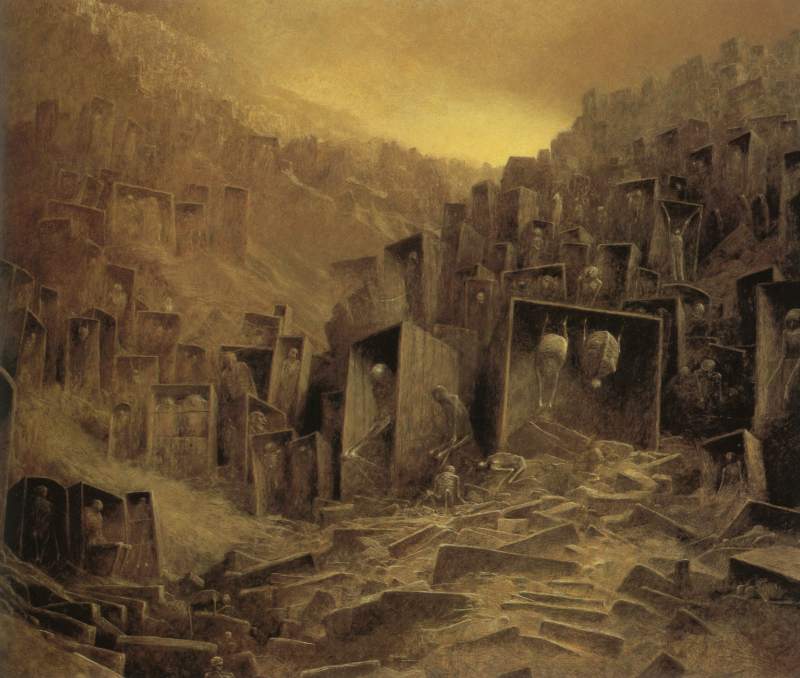
Image result for Beksiński
More Beksiński.

Here's where I think it becomes more than just coincidence. Quite apart from their preference for lower power levels, OSR game styles tend to be very open, giving PCs as much liberty as possible to run around an environment and explore it in whatever wildly self-destructive ways they can dream up; but that openness requires and implies a certain set of absences. If PCs can run around the inside of a giant machine pulling levers to see what happens - and they should be able to, because that stuff is classic - then that implies that whoever first built this amazing machine, with all the technological and organisational prowess which its size and complexity implies, is no longer around to stop them. If they can rove from place to place, butchering or befriending the occupants of each area as the whim takes them, then that implies the absence of any kind of overarching authority able to control the movements of this gang of freakish desperadoes. Well-maintained social order is the enemy of free-wheeling adventure, and so the more ruined everything is, the more freedom PCs will have to run around inside it.

(Note that this is much less true of the 'scripted combat encounter' model of play that became the norm in the 3rd and 4th edition eras, where 'break into the fort and fight your way through an escalating series of set-piece battles as the defenders desperately try to repel your invasion' would have been a completely legitimate scenario design. In fact, for adventures like that, too much ruination might well get in the way: you don't want PCs circumventing combat encounters by climbing through the holes in the walls or manipulating the superstitions of the Morlocks, after all...)

Image result for vampire hunter d twilight castle
'Twilight Castle', from Vampire Hunter D.

I guess what I'm getting at here is that the more wrecked things are, the more open they are to free-form adventure. Malfunctioning AIs, senile liches, mad and delusional immortals, glitching magical security systems... all of these things are open to manipulation in a way that their fully-functional counterparts wouldn't be. Sane and organised beings are going to react rationally, efficiently, and collectively to an intrusion into their territory, which tends to short-circuit adventures; but if they're weird and superstitious and crazy then they can react in much more varied and interesting ways - a possibility which the classic module B4 The Lost City employs to great effect. The World-Shaking Magic of the Ancients probably isn't much use to you in your game: either it actually turns out to be not that much more powerful than anything else, in which case it's going to be a massive disappointment, or it really does have world-shaking power, in which case letting it be used either by or against the PCs is likely to end the campaign. But the fragmentary and poorly-understood remnants of the World-Shaking Magic of the Ancients are great - and precisely because of their ruinous condition, they can be given non-game-ruining effects without actually reducing the mystique of the Ancients themselves. No matter how fantastical something may be, familiarity will breed contempt: but only ever encountering things in fragments prevents them from ever becoming fully known and defined, which is great both for atmosphere and for actually enabling the kind of exploratory gaming which most OSR games are set up to facilitate.

I don't think this is the only reason why ruin is such a prevalent motif in OSR writing. Part of it comes from the rules: if you're a 1st-level character with three hit points exploring a mysterious underworld with dragons and demons in it, then a certain sense of being dwarfed by the world around you is inevitable. Part of it comes from the fascination with horror, which is a genre that was literally born out of people's feelings of discomfort with the ruins of the past. (There's a reason for all those ruined abbeys in early Gothic novels.) A lot of it is inherited from 1920s and 1930s weird fiction writers like Howard and Lovecraft, who were trying to get to grips with the new vistas of 'deep history' revealed by the science and archaeology of the period. But I think the reason that it survives as a design principle, rather than just as an aesthetic choice, is because it actually works for the desired mode of play. 'Five guys take on a fully-garrisoned temple (or castle, or lab, or whatever)' is always going to be either a heist or a commando raid. But 'five guys take on a ruined temple'... Now that can be an actual adventure!


Thursday, 1 September 2016

Twenty Dartmoor legends for The Coach of Bones

The Lych Way (oil on linen-backed map)
'Lych Way', by Ethan Pennell

From Central Asia to South-West England... People really seem to like the idea of The Coach of Bones, so I think I'm actually going to try to write it at some point. (If James Raggi doesn't want it, I can always just put it up for free on the blog.) To do that, though, I'm going to need to do a whole lot of research into Devonshire folklore first.

Here's a start: a bunch of local legends from Dartmoor which strike me as the sort of things that could easily be slotted into a D&D game. Feel free to borrow them for your own games the next time the PCs find themselves in some remote moorland village...

(If anyone's interested, most of these come from the second, expanded edition of Ruth St Leger-Gordon's Witchcraft and Folklore of Dartmoor, which was published in 1972.)

Image result for childe's hunter dartmoor
  1. Each night, Lady Howard's ghost rides from Tavistock to Okehampton Castle in a coach of bones. The coach is drawn by four black horses and accompanied by a bloodhound. Sometimes she takes the form of a huge black dog with a single burning eye in the middle of its forehead.
  2. Many parts of the moor are haunted by black phantom dogs, believed to be the ghosts of the sinful dead.
  3. A horned huntsman named Dewer rides across the moors with his pack of demonic 'Wish Hounds' on stormy nights, hunting unfortunate travellers and the souls of the unbaptised. They are most often found in the vicinity of Wistman's Wood.
  4. Between the Ancient Tenements of the Forest of Dartmoor and the church at Lydford lies the Lych Way, along which the corpses of those who died on the moors were once carried for burial. (When the winter made the road impassible, the residents of the Ancient Tenements were said to preserve their dead in salt or brine until spring.) Ghostly processions of mourners carrying corpses can still be seen along the length of the path at night. 
  5. According to local legend, Sir Francis Drake was able to transform himself into a seagull in order to do battle with evil spirits.
  6. The pixies of the moors love to lead travellers astray into bogs and mists. Those who are 'pixy-led' can clear their heads of enchantment by drinking the waters of Fice's Well. 
  7. Some of the sheep, cows, and ponies on Dartmoor are not what they appear to be. No-one's sure what they are, but an experienced hand can sense them by instinct. Such creatures look like animals, but are actually something else, and must not on any account be rounded up with the rest of the herd or flock: otherwise, disaster is sure to follow.
  8. After being hanged for sheep-stealing, the spirit of Binjy Gayer, five times mayor of Okehampton, was banished to the pool at Cranmere. He's not alone in there; the spirits of other malefactors have been bound into the pool over the years, and their sighs and wails may be heard there on stormy nights.
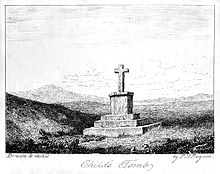
  9. At the tomb of Childe the Hunter, a medieval nobleman who froze to death on Dartmoor, bands of ghostly monks may sometimes be seen searching for his corpse.
  10. Something lives beneath the surface of Bradmere pool, and its influence makes all those who gaze too long upon the pool want to throw themselves into the water.
  11. The River Dart demands the death by drowning of at least one person each year. ('Dart, Dart, wants a heart.')
  12. At dusk, a moaning voice may be heard over Crazywell Pool, announcing the name of the next person who will die in the district.
  13. On a stone bridge over the Blackaton Brook, the sound of ancient phantom battles may sometimes be heard. 
  14. An old bridge over the River Bovey is haunted by an amorphous creature with long waving arms, which chases travellers by night. 
  15. A murder was once committed at Bloody Corner in Drewsteignton; and now, every year on the anniversary of the crime, a stream of blood trickles out from beneath the cottage door and into the road outside.
  16. There is a phantom cottage in Haytor, which can sometimes be seen from a distance but can never actually be located. 
  17. A supernatural white bird appears to each member of the Oxenham family of South Tawton shortly before their death.
  18. A great wealth of gold lies at the bottom of the Roman Mine at Challacombe Down, watched over by an ancient raven which is said to be the same one which accompanied Noah on the Ark. Any who descend the mineshaft to search for the treasure will have their ropes cut by knife-wielding arms reaching out of the walls, which presumably belong to the evil spirits that dwell there. Their broken bodies will be found laid out on the heather the following morning.
  19. When walking on Great Hound Tor, some people experience sudden surges of inexplicable dread. Those that ascend it alone sometimes come back down it in a state of trance, speaking in ancient Hebrew.
  20. Wicked Squire Cabell is buried outside Buckfastleigh church, with a large slab of stone across his grave to ensure that he can't get out of it. His ghostly hounds may be heard by night baying for him along the road outside.
Image result for dartmoor lady howard

Tuesday, 30 August 2016

Monsters from Central Asian Mythology 11: Zilant, The Dragon of Kazan

This is the flag of the city of Kazan, in the Republic of Tartarstan.

Image result for kazan flag

That crowned snake with the red wings and the chicken legs is Zilant, the famous Dragon of Kazan. According to legend, the hill on which Kazan now stands was originally infested with giant, poisonous serpents, the king of which was a monstrous dragon-serpent. The Khan of the Tatars was able to get rid of the snakes by covering the hill with straw, waiting for the snakes to slither into it, and then setting fire to it, burning them alive; but Zilant escaped into the Qaban Lakes, and then...

...well, then it depends which version of the legend you prefer. Some say it preyed on the people, and they worshipped it out of fear. Others say it became the ruler of a magical underwater kingdom beneath the surface of the lakes. Or that it had a change of heart and became the benevolent protector of the people, the White Serpent, defender of Kazan and adviser to heroes. Or that a great hero killed it with a poisoned spear. For gaming purposes it doesn't really matter. The first part of the legend provides quite enough to work with.

Image result for zilant statue
Statue of Zilant, in Kazan, Russia.

In ATWC, the more magical roles of the Kazan Dragon are already covered by spirits, which can choose to look like snakes or dragons if they feel like it; so dragons proper can play a more physical role. They resemble snakes rather than lizards; huge, coiling beasts, a hundred feet long or more, big enough to swallow a grown man whole. Some have wings, or multiple heads, or claws. They are kings among the serpents; all normal snakes will serve and obey them, and the longer that such snakes spend in their service, the larger and more poisonous they will grow. Eventually the land around a dragon's lair will become an uninhabitable nightmare of venomous, slithering death. 

The dragons mostly dwell in remote parts of the wilderness, beneath the trees of the deep taiga or by the sides of near-bottomless lakes out on the steppe. Their appetites are formidable, and anything sheep-sized or larger that comes near their territory is likely to be devoured, humans very much included. They are intelligent, and able to talk the languages of both snakes and men, but they are seldom interested in anything that humans have to say. People give them a very wide berth; and those that must travel close to a Zilant lair bring ample livestock with them, offering the luckless beasts up as sacrifices in order to distract the dragon while they make their escape. 

Image result for zilant

For the most part, such dragons are simple obstacles to be evaded. (If you have to fight them, fight dirty. Even an army won't bring down a hundred-foot serpent backed up by several thousand giant poisonous snakes.) Being immortal, however, they often acquire a surprising range of knowledge; they may not be very interested in talking to humans, but they do talk to snakes, and their scaly heads store all the secrets that generations of serpents have whispered to them over the centuries. It's enormously difficult for them to see humans as anything other than food, but a fast-talking serpent man might be able to persuade a Zilant to treat it as an honourary snake, and brass men are so obviously inedible that they should be safe unless they do something to rouse the dragon's ire. Talking to a Zilant is never going to be anything other than a terrifying experience, but for the seeker of truly esoteric knowledge, sometimes there may be no other way...

Ivashko too walked and walked, and met the three-headed dragon; The Three Kingdoms - Myths and Legends of Russia by Aleksandr Afana’ev, 2009:


  • Zilant: AC 18 (iron-hard hide), 20 HD, AB +10, bite (4d6 damage + poison), FORT 3, REF 10, WILL 8, morale 10. Anyone bitten by a Zilant must pass a FORT save or die from poison 1d6 hours later. They may command normal and giant serpents at will; such snakes serve them with perfect loyalty, and will fight fearlessly (morale 12) upon their behalf if ordered to do so. (Serpent folk given an order by a Zilant may resist by passing a WILL save.) If the Zilant has extra heads, it gains that many additional attacks each round.


  • Zilant Serpents: AC 13 (thick scales), 2 HD, AB +2, bite (1d6 damage + poison), FORT 12, REF 12, WILL 15, morale 7 (12 while obeying a Zilant's commands). This is what ordinary snakes will turn into after serving a Zilant for a few years. They possess near-human intelligence, but cannot speak (except to the Zilant and to each other). Anyone bitten by a Zilant serpent must pass a FORT save or take an additional 2d6 damage after 1d6 minutes.
  • Tuesday, 23 August 2016

    The Devil Strahd

    No posts for a while because I've been on holiday in Devon. In Teignmouth you can still touch the cannon-balls embedded in the walls from when the French burned the place in 1690. Sadly the whole incident comes a bit too late for me to use it in The Coach of Bones...

    Anyway. My employer has given me a bunch of Amazon vouchers in lieu of some actual money (presumably as part of some complicated tax dodge), so after reading Bryce's surprisingly positive review of the D&D5 adventure book Curse of Strahd I decided to buy a copy. It's tediously overwritten, terribly organised, and weirdly obsessed with treating every location like a dungeon even when there's no reason why it would be used like that in actual play: if I was a D&D5 NPC, my write-up would consist of a single short paragraph about me, followed by a three-page room-by-room description of my house. ('The understairs cupboard contains a vacuum cleaner, a broom, and a stepladder. They have no value as treasure.') But among all the pointless read-aloud text and mind-numbing descriptions of empty rooms there really is a lot of good material in this book, even if it can never quite decide how far into horror-fantasy it's actually prepared to go. Vampire spawn crawling along the ceilings. Animated scarecrows with rusty knife-blades for fingers and heaps of dead ravens stuffed inside their chests. The vestiges of the dead gods of hate entombed in slabs of enchanted amber, watched over by a senile lich so ancient that he has forgotten his own name. There's something there, y'know?


    For me personally, though, the biggest weakness of the book is Strahd himself. I get that they're trying to evoke the classics, and that the whole thing is supposed to feel like a Hammer Horror movie in D&D, but it's all played so straight that I have trouble imagining many players being able to take the whole thing seriously. Frightened villagers. Looming castles. Wolves and bats and undead brides. An evil vampire lord wearing an evil vampire cape while sitting on an evil vampire throne. How much of that would your players sit through before they started doing crappy Bela Lugosi impressions? Twenty minutes? Ten? Five? I absolutely loved the mad druids worshipping Strahd as a dark spirit of the land, but come on... a giant wicker man with fangs and a cape? How is anyone supposed to find something like that scary instead of comic?

    I think there's a simple alternative, though, and it's one that's hinted at within the book itself. The people of Strahd's domain don't really know what his deal is: they just know that 'the devil Strahd' has been up in his castle for pretty much forever, and believe that he had been placed in their land as punishment for some forgotten sin committed by their ancestors. So instead of making him a straightforward Dracula knock-off, why not draw on all that? Embrace the strangeness and the indeterminacy of it all. Give him his mystery back again.

    How's this for an alternative set-up: instead of having Strahd openly riding around Barovia in a big vampire coach that looks it was stolen from Christopher Lee in 1968, make him a dark legend, something that people whisper about but never actually see. What lives in Castle Ravenloft? No-one knows. Something horrible. Something that creeps out by night to prey upon the people of the land. Vampires and zombies and wolves and witches do its bidding, but it is not any of these; it is something older and stranger, the embodiment of the land's collective damnation crammed into a human shape. How was the land damned? No-one knows. It coincided with the deaths of the Von Zarovich family - but correlation is not causation, is it? Various NPCs can still have theories about it - that the thing in Castle Ravenloft is their old lord, that he's become a demon, that he's become a vampire, that he's a black magician, that he could be redeemed if only he was united with his one true love, whatever - but there doesn't need to be any rush to confirm any of them. Even Strahd himself may not really understand what he now is, or how his powers work, or what (if anything) may ultimately be able to kill him. All that the adventure actually needs to function is some kind of brooding evil at Castle Ravenloft's heart; and given that Strahd is, frankly, kind of a loser, I'm inclined to think that the more his mystery is kept intact, the better.

    I mean look at this guy. Honestly. This is your arch-villain?

    I guess this ties back to a more general point about information management in horror games. Keeping your players completely in the dark is frustrating for everyone; but the more you reveal, the more you risk an 'oh, is that all?' reaction from the players. To these ends, it's probably worth distinguishing between functional information (what is going on and what can be done about it) and explanatory information (the reason these things are happening, the process by which this situation originally came to occur). The former needs to be something that the PCs can figure out; but the latter will often benefit from being left partly (although not completely) undefined, because the more thoroughly it's explained, the more its power will be diminished. This is especially true of things like zombies and vampires, which have experienced so much pop-culture over-exposure that they have lost almost all the symbolic power which they might once have possessed. ('He's just some stupid vampire? And to think I was worried he might be something scary!') There is a lot to like in Curse of Strahd, and I'm sure I'll be raiding it for my own use at some point. But for a horror story, it does rather over-explain things; and I think Strahd's nature, history, and motivations could all benefit from being made just a bit more shadowy. 

    Wednesday, 10 August 2016

    James Raggi Should Totally Hire Me...

    ...because I have a brilliant idea for a Lamentations of the Flame Princess adventure.

    Lamentations has done a whole series of adventures set in seventeenth-century England: No Salvation for Witches, Death Love Doom, Forgive Us, England Upturn'd, and The Squid, the Cabal, and the Old Man. I've not read them all, but I think I'm right in saying that they are all set in the eastern part of England, which is over-populated and flat and boring. Everyone knows that D&D adventures should be set in hills and forests and mineshafts instead.

    SO:


    The setting is Devon in the autumn of 1685. The Duke of Monmouth's rebellion against King James II has just ended in bloody ruin at the Battle of Sedgemoor; in reprisal, Judge Jeffreys is riding from town to town with his judicial murder roadshow, the Bloody Assizes, and mass executions of actual and suspected rebels follow in his wake. The Second Tangier Regiment has been unleashed upon the civilian population. The hacked-off limbs of quartered traitors, painted with tar to preserve them, now stand impaled on pikes in the market squares of miserable Devonshire villages. Corpses dangle from the trees and hang in clusters from the gibbets, their chains clinking in the wind.

    Into this chaotic situation stumble the PCs, lured by stories of ancient treasure hidden in the Devon hills. From the Doone Gate in Exmoor, where a clan of cannibal bandits guard the entrance to a hidden valley, to the wilds of Dartmoor, where the ghost of Lady Howard rides over the hillsides in her coach of bones, they will hunt among Druidic megaliths and the secret stashes of Sir Francis Drake while trying very hard not to get executed for being in the wrong place at totally the wrong time. But they're not the only ones looking for the treasure, and the infamous commander of the Tangier Regiment, Colonel Kirke, has send a team of his most merciless minions out to follow the trail on his behalf. Will the PCs find gold and power among the hills of Devonshire? Or will they, like the Duke of Monmouth, end their careers under Jack Ketch's axeblade up on Tower Hill?


    The Coach of Bones: coming probably-never from Lamentations of the Flame Princess. Pirates, witches, ghosts, cannibals, magic, treasure, standing stones, large-scale violence, lame 'Captain Kirk' jokes... this one's got it all!

    Monday, 8 August 2016

    Denizens of the Wicked City 10: Clockwork beasts (AKA 'My new character will be DOCTOR CLOCKTOPUS!')

    Clockwork frog by ClockworkFrog.

    I have a clockwork robot character class. I have a talking animal character class. The next step seems pretty damn obvious.

    Not all of the Brass Folk are built in humanoid shape, although most are. But sometimes someone installs a Brass Man brain in a different body: the body of a Bronze Horse, for example, or the body of a Mechanical Messenger Monkey, creating a clockwork robot with human-level intelligence housed inside a non-human body. Even weirder custom jobs are possible: mechanical dogs, mechanical octopi, mechanical insects... whatever you can tinker up, really. The more conservative Brass Folk disapprove of such experimentation, insisting that the Cogwheel Sage gave them human shapes for a reason, and that each new generation should imitate her prototypes as closely as possible; but many others, especially those whose association with the Steel Aspirants has given them a rather freewheeling approach to radical body modification, take a more liberal attitude. If a given Brass Man or Woman decides they wants their 'child' to be a giant mechanical frog, what business is that of anyone else?

    So here are the rules for playing them.

    All Clockwork Beasts have the following traits:
    • You gain a bonus to all your to-hit rolls equal to your level.
    • You gain 1d8 hit points per level (except large clockwork beasts - see below).
    • The whirring and clanking of your heavy brass body makes a hell of a lot of noise. Your enemies are never surprised, and you always fail any attempts to move silently.
    • You do not need to eat, drink, or sleep, and you are immune to poison and disease. 
    • You need winding up in order to function. All clockwork beasts have steam-powered auto-winders, normally built directly into their bodies at a point where they can easily reach it with their paws or mouths; when fed a supply of wood or coal, these auto-winders will spin rapidly, turning the beast's key in the process. They must sit still during the winding, or else they risk damaging their delicate internal machinery. One hour's auto-winding will power three hours of activity. If fuel for it is unavailable, the key may be turned by hand, but doing this takes six times as long, is amazingly boring, and risks causing strain injuries. For obvious reasons, they cannot wind themselves up.
    • When you have been wound for a number of hours equal to your Constitution score (thus permitting three times your Constitution score in hours of continuous activity), your main-spring is fully wound and further winding has no effect. If you reach the end of your 'powered' time without having a chance to rewind, you can stumble on for one extra hour, getting slower and slower: you have -4 Dexterity and Strength during this time. At the end of this extra hour, you shut down entirely until rewound. 
    • Your paws (or tentacles, or whatever) can be unscrewed and replaced with a pair of  human-like clockwork hands which you carry with you, allowing you to perform tasks requiring opposable thumbs. Unscrewing one paw and replacing it with a hand (or vice versa) takes five minutes. (This is to ensure that the clockwork beast can eventually build itself clockwork 'offspring', if it so desires. Building a beast without access to hands would be like deliberately sterilising your child at birth.) 
    • You do not feel pain. Normal healing does not help you, but as long as you have your hands on you can repair yourself when damaged, regaining 1 HP per day for field repairs carried out on the march, and 3 HP per day for a day spent doing nothing else. These numbers each rise by 1 if there is someone with a technology bonus of 3 or higher around to lend a hand. 
    • If you are reduced to 0 HP, you are too badly damaged to be repaired in the field, but with the right tools and expertise you can still be repaired in a well-equipped workshop, and will retain your memories and personality unless your clockwork brain has also been damaged or destroyed. 


    Large clockwork beasts (e.g. clockwork lions, clockwork bears, clockwork horses, etc) have the following additional traits:
    • You must have a strength and constitution of at least 12 to play a large clockwork beast.
    • You cannot use weapons or armour, but you have a natural AC of 15, and inflict 1d8 damage with your huge, heavy claws. (You can have a gun built into your body, but unless you have your hands on you'll need someone else to reload it.)
    • You gain 1d10 hit points per level instead of 1d8.
    • You are huge, heavy, and enormously strong: capable of smashing light wooden buildings and furniture to splinters, and doing serious damage to heavier ones. A man-sized character could ride you. A swivel gun could be mounted on your back. (You couldn't fire it, though.) You can smash anything that a large metal animal should be able to smash, with no roll required. 
    • You can carry four times as many objects as a human with the same strength score.
    • You gain a +1 bonus to technology rolls.
    Smaller clockwork beasts (e.g. clockwork wolves, giant clockwork rats or mice, etc) have the following additional traits:
    • You cannot use weapons or armour, but you have a natural AC of 14, and inflict 1d6 damage with your metal teeth and/or claws. (You can have a gun built into your body, but unless you have your hands on you'll need someone else to reload it.)
    • You can run twice as fast as a human, although doing this unwinds your spring at double normal speed. (If you are a clockwork frog or similar amphibious design, this is replaced by an ability to swim at double normal speed.)
    • You gain a +1 bonus to REF saves.
    • You gain a bonus to technology rolls equal to half your level, rounded up.

    Clockwork insects (e.g. clockwork spiders, giant clockroaches, etc) have the following additional traits:
    • You cannot use weapons or armour, but you have a natural AC of 13, and inflict 1d4 damage with your metal fangs. (You can have a gun built into your body, but unless you have your hands on you'll need someone else to reload it.)
    • Your legs end in sharp metal hooks, allowing you to climb along walls or ceilings as easily as the floor. 
    • You gain a +2 bonus to REF saves.
    • Once per day per level, you can use your bite to inject a dose of corrosive venom, inflicting an extra 2d6 damage (FORT save for half).
    • You gain a bonus to technology rolls equal to half your level, rounded up.

    Clocktopus by Westfalia miniatures.

    Clockwork octopi have the following additional traits:
    • You cannot use armour, but you have a natural AC of 14, and inflict 1d6 damage with your metal tentacles. You can also use these tentacles to wield melee weapons and/or shields, but you cannot make a weapon attack and a tentacle attack in the same round.  (You can have a gun built into your body, but unless you have your hands on you'll need someone else to reload it.)
    • You can swim twice as fast as a human, although doing this unwinds your spring at double normal speed. You can also climb just about anything that will support your weight.
    • In an emergency you can just flip out and start thrashing your metal tentacles around randomly. Everyone within 5' of you must make a REF save or take 1d6 damage, and any fragile inanimate objects nearby will be smashed to pieces. 
    • You gain a +1 bonus to technology rolls.

    Friday, 5 August 2016

    History and anachronism in RPGs

    Portrait Of A Safavid Nobleman, 17th c (agha khan museum):

    According to my original post on the setting, ATWC is based on 'early modern Central Asia'. I'm pretty bad at restricting myself to Central Asia proper, as posts based on places like Azerbaijan and Vaygach Island and Yakutia will demonstrate; but what about the early modern period? Exactly which period of Central Asia's history is ATWC supposed to be based on, anyway?

    This question has about three different answers. The overall technology level, clockwork robots and airships aside, is pegged to the end of the 17th century, but this doesn't match up with the implied political landscape: by 1700 Siberia and Mongolia had mostly been conquered by Russia and China, respectively, whereas ATWC presents the various steppe khans and taiga clans as still being independent. So the political setup is closer to Central Asia in 1600; but this, in turn, fails to match up with the fact that ATWC presents the Great Road as still being the primary artery of trade between the east and west, whereas by 1600 the real world Silk Road was in steep decline, rendered largely obsolete by the opening of direct maritime trade routes between Europe and Asia. The Great Road in ATWC is closer to the Silk Road in its late-medieval heyday, during the period of Mongol rule; but that doesn't match up with either the political or the technological contexts. In practise, then, ATWC is self-consciously and aggressively anachronistic in its use of Central Asian history. It's not as bad as a lot of D&D settings, which will happily place an ancient Celtic druid, a Viking warrior, and a swashbuckler from Renaissance Florence alongside one another as citizens of states which are described as medieval monarchies, but actually seem to function like eighteenth-century nation-states with twenty-first century moral norms. But it's not great, either.

    Of course, ATWC isn't set on Earth; it's set on an unnamed world whose history has been mangled by untold centuries of magical meddling and the unwise large-scale production of clockwork murder robots, so it's not exactly surprising that the details don't quite sync up. It's inhabited by talking bears and people made of solidified sunlight and people with clockwork computers stapled to their brains, so strict historical realism is obviously not its highest priority. At the same time, however, it is attempting to evoke a certain time and place, however vaguely defined; my descriptions of the setting as 'early modern' and 'Central Asian' may be imprecise, but they are not (I hope) completely meaningless. So where does one draw the line?

    Turkish Warrior Woman:

    I've been gaming long enough to know that the number of players willing to absorb large quantities of information about campaign settings, whether historical or imaginary, is vanishingly (and probably mercifully) small. If much of the world of ATWC is rather vague, full of imprecise markers like 'the steppe khanates' rather than specific lists of polities, it's because, in my experience, that's all most players will ever want or need from a setting; they'll say 'Oh, yeah, those Mongol guys' and take it from there. Try to talk to them about Mongols and Oirats and Buryats and their eyes will glaze over, and at the end of it all they'll still just be thinking of them all as 'those Mongol guys'. At the same time, though, unless you're playing in a deliberately absurdist style, I think that most players want a world which at least feels as though it makes sense. Suspension of disbelief is a subtle thing, which operates largely at an intuitive level, and one advantage of drawing upon history is that it gives you a set-up which you know could exist, because it did exist. Maybe no-one at your gaming table has the kind of specialised historical knowledge to know why certain kinds of state formation accompanied certain forms of technological development: but they will know that knights and castles go together, and games can and should take advantage of that.

    Then there's the issue of player expectations: roleplaying is a collaborative exercise, and that means that the game-world which matters is always the one that develops, in play, through the shared understanding of all participants about the fictional world their characters inhabit, rather than the one that sits in the GM's notebooks. Very often different players will have slightly different interpretations of this shared world, and that's OK; but if they have very different interpretations about how the world around the PCs is likely to react to, say, casual acts of questionably-justified violence, then that's likely to cause problems in play. Having a stable historical reference point gives players and GM alike some kind of shared basis upon which to build their expectations. You don't have to be a professional historian to know that a setting modelled on Dark Ages Finland is going to place different restrictions on what PCs can get away with than a setting modelled on 1930s New York.

    I'd suggest, then, that unless you're group is actually serious about using RPGs as a way to explore historically accurate settings - which is something I've heard legends about, but never actually seen - then anachronism really only becomes an issue at the point where it generates confusion for the players. Put the PCs in an ancient Rome knock-off, and they pretty much know where they stand: there are legions, gladiators, slaves, orators in togas, temples to different gods, probably an emperor, and so on. Put them in a Victorian London knock-off, and they'll likewise have some idea what to expect: there are guns, policemen, factories, workhouses, newspapers, probably some kind of monarchy, etc. Tell them 'it's basically ancient Rome but with robots' and they'll deal with it, because they'll understand that the robot centurions, robot vestals, robot gladiators and so on are subsumed into the general ancient-Roman-ness of the setting, their presence not really disrupting the basic assumptions shared between players and GM about how the fictional world generally works. But a city which aggressively mixes up elements of Ancient Rome and Victorian London is going to leave them confused and off-balance, never sure how they should be responding to situations or how situations are likely to respond to them: and unless that confusion is something you're actually aiming for, that's probably not a good thing.

    Pun Lun - Two Chinese Soldiers:

    What does the early-modern-ness of ATWC actually mean? It means that PCs have flintlock weapons. It means they drink coffee when they're tired and gulp down laudanum when they're in pain. It means they read printed books and navigate with the aid of dry magnetic compasses and use spyglasses to check what's raising that distant dust-cloud out there on the steppe. All of those things create expectations in the minds of players. They might be fuzzy on the details, but they'll know that their musket-wielding, coffee-swigging PCs don't belong to the same world as Genghis Khan. Some of this knowledge will be explicit, but a lot of it will be implicit, a generalised sense of the kind of world which those things imply, and of the kind of lives their PCs are likely to be able to live within it. Anachronisms which don't interfere with that are probably fine; but anachronisms which do interfere with it really need to add something worth having to the setting in order to earn their keep.

    This is why I've tried to make sure that the more aggressively anachronistic parts of ATWC - the walking houses, the mecha, the Brass Men, and so on - are all subordinated to the general early-modern-ness of the setting. This world is not industrial: its clockpunk technology is all the work of individual artificers tinkering away in workshops, personal and artisanal rather than standardised and mass-produced. The walking houses get used in the same way as any other form of caravan. The mecha are simply ultra-heavy infantry in some despot's army somewhere. The Brass Men are basically just another ethnic minority who happen to be made of metal and gears. As a result, they hopefully add colour (and robots) without confusing the overall sense of what kind of world this is, and what kind of things tend to happen in it.

    That way, if and when you bring in real anachronism, Expedition to the Barrier Peaks style, it'll have the impact it deserves!