Showing posts with label Monsters. Show all posts

Tuesday, 28 December 2021

Remnants of the Nameless Empire: more monsters from City of Spires

More monsters that my players have run into during my current City of Spires campaign. These ones lean further into science fantasy, as one of the key conceits of the campaign is that it's a fantasy setting built on top of the ruins of an SF setting. The deeper you dig the more likely you are to start running into all the malfunctioning cyborgs and radiation zombies left over from previous ages of the world. 

Worm Cultists: AC leather, 1-5 HD, damage by weapon, morale 7.

Long ago, the Nameless Empire procured the egg of an alien worm-god for study. At some point after the fall of their empire, this egg hatched, giving birth to the enormous alien monster known as the Great Worm. It remains trapped to this day in the subterranean vault it was originally stored in as an egg, but its dreams and magical radiation are powerful enough to bleed into the world outside.

Worm cultists are those wretched individuals who strayed too close to the Great Worm's prison, and found their minds overwhelmed by the power of its alien dreams. Compelled by its will, they dig themselves as deeply as they can into the rock and earth that entomb it, bathing themselves in the bizarre radiation that it emits until they are utterly changed, body and soul. Their bodies and limbs become slimy and segmented, studded with bristly hairs that allow them to sense vibrations in the earth and air. They can still just about speak, though their voices sound as though they're gargling with slime. At the apex of their transformation they tear out their own eyes, their empty sockets becoming hollow, slime-filled pits in what were once their faces. Mortal sight would only be a distraction from their new senses.

Worm cultists retain human-level intelligence, though the submersion of their minds in the dreams of the Great Worm tends to make them rather unhinged. They are utterly devoted to the Worm, and work tirelessly to free it from its prison. Their boneless bodies can squeeze through any space wide enough for them to get their heads through, and they can tunnel efficiently through soil and dirt. Their bristling hairs allow them to sense motion, making them hard to evade: they can also instinctively sense radiation, including the background radiation found throughout nature, and can recognise different substances from their differing radiation signatures. They are still blind, however, and cannot easily distinguish between e.g. one human and another unless they hear them speak. Drying out is very painful for them, and they take an additional 50% damage from heat- or fire-based attacks. They prefer to remain in cool, wet, dark locations whenever possible.

All worm cultists double as priests of the Great Worm, and have the spellcasting abilities of a cleric with levels equal to their hit dice. 

Image by Artur Owsnicki, after an image by Devon Cady-Lee.

Worm Men: AC leather, 2 HD, damage by weapon, morale 6.

This is what worm cultists eventually degenerate into after soaking up too much magical radiation. Their legs atrophy into vestigial stubs, while their arms warp into long, boneless, wriggling tendrils. Any hint of neck or waist disappears: apart from their arms, they now resemble giant segmented worms with distorted human faces at their apex. Their radiation-fried brains are only semi-intelligent, and they cannot speak. They have the same sensory abilities as worm cultists, and are even more proficient as tunnellers, but lack their spellcasting powers. They usually fight with crude clubs or spears.

Worm men are hermaphroditic, and are capable of breeding with one another, though their irradiated state means that their fertility is very low. They instinctively obey worm cultists, who use them as warriors, labourers, and guardians.

Image by Patrick Reinemann

Zomborgs: AC chain and shield, 3 HD, damage 2d6 (blade hands) or 4d6 (energy blaster), morale N/A.

Cybernetic zombies built by the Nameless Empire to guard the resting places of its honoured dead. They resemble embalmed corpses held upright by cybernetic skeletons: their right arms terminate in a variety of blades (to allow them to assist with embalming work), while their left hands have been replaced with short range energy blasters. These blasters require three rounds to reload between shots - zomborgs will try to keep their distance while their blasters are reloading, but if their enemies close with them they will fight with their blade-hands, instead.

Zomborgs sense intruders via motion sensors built into their eye sockets, whose blinking red lights are easily spotted in the darkness of their ruined vaults. They have no other senses, and are oblivious to noises, smells, lights, etc. They have no intelligence beyond their preprogrammed 'guard-hunt-kill' and 'autopsy-embalm-preserve' routines, and are incapable of learning from experience. (My PCs mostly dealt with them by luring them into traps.)


Stranglers: AC chain, 1 HD, damage 1d4 / 1d4 (2 claws), morale 5.

These hairless subterranean humanoids are a deliberately devolved caste of engineer-slaves created by the Nameless Empire. Their stature is dwarfish, averaging only 4' high, but their bodies are lithe and muscular and they have freakishly long arms ending in long, clever, multi-jointed fingers. They can see in the dark, and underground they are as agile as monkeys, effortlessly climbing and swinging along walls and ceilings. They are capable of squeezing their bodies through narrow cracks like contortionists, and their nests are usually found in spaces only reachable via fissures so narrow that only they can squeeze through them. They possess only animal-level intelligence, but have an instinctive knack for mechanical labour if commanded to undertake it via the correct machine-noise signals.

Stranglers get their name from their secondary function, which is to protect the areas they inhabit against intrusions from unauthorised personnel, i.e. anyone without the correct subdermal microchips. When they sense intruders into their ruined underground complexes they will creep stealthily down upon them, aiming to sever ropes, douse lights, and otherwise render their victims blind and vulnerable: then they will leap down upon them in chattering swarms and try to claw and strangle the life from them. If a Strangler hits the same target with both claws in the same round it has its hands wrapped around their throat, and will proceed to throttle them for an automatic 2d4 damage per round in place of its normal attacks until either it is defeated or its victim dies. (Obviously, this special attack only works on enemies who have necks and need to breathe.) They attack only from ambush and in packs, and will retreat if faced with determined opposition. 

Stranglers are usually found in the wreckage of Nameless Empire factories and laboratories, some of which still house semi-functional AIs dozing through the centuries on sleep mode. Explorers who manage to fight their way through the Stranglers and contact such an AI may be able to persuade it to microchip them if they can convince it that they are there on legitimate imperial business, though the AIs may demand that they perform other tasks in return in service of their long-dead empire.

Tuesday, 9 November 2021

Desert Monsters from the City of Spires

A few monsters who have turned up in my current campaign. I think my PCs have figured all these guys out well enough for me to safely list them here.


Image by Akihiro Tsuji


Smoke Giant: AC chain, 4 HD, 2 fists (1d8 damage), morale N/A.

Smoke giants are artificial guardians created by a long-fallen civilisation. In their dormant state, they just look like a thick covering of soot, coating everything in the room they guard. When they are disturbed, however, the soot flies up into the air and rapidly coheres into an ogre-sized humanoid monster, jet-black from head to foot. The giant furiously attacks anything that enters its protected area. If reduced to less than half HP, or if the trespassers depart, it explodes apart into a cloud of choking black smoke, which gradually settles to the ground as thick black soot. In smoke/soot form it recovers 1 HP per round until fully healed, at which point it will cohere back into humanoid form if the trespassers are still present. If reduced to 0 HP it explodes into smoke and does not recohere. 

If a dormant smoke giant can be collected into a container while in soot form without triggering it, then the resulting container can be used as a missile weapon: the moment it is opened, the giant will explode out of it to attack anyone nearby. Smoke giants are sometimes found still lying dormant inside their original storage crates.

(Once my PCs worked these guys out, they dealt with them by building an improvised suction pump attached to a hose, which they used to suck up the soot a little at a time from outside the giant's trigger radius. Then they mixed the soot with clay and baked it into bricks, effectively imprisoning the giant. The smoke giant's attempts to reform itself from inside the bricks makes them vibrate violently whenever anyone approaches, allowing them to function as an intruder alarm system.)


Locust Spirits: AC chain + shield, 4 HD, 1 claw (1d8 damage + strength drain), morale 8.

These awful famine-spirits look like shadowy humanoid locusts. They are only semi-corporeal and take half damage from non-magical attacks. Anyone struck by their claws is filled with terrible weakness, as though they hadn't eaten for days, and loses 1d6 strength - this strength returns at the rate of one point for each decent meal they eat. Anyone falling to Strength 0 is reduced to an emaciated corpse, apparently the victim of months of starvation. 

Locust spirits are only semi-intelligent, and can usually be found as servitors to more powerful spirits or dark magicians.


Jackal Knights: AC plate, 6 HD, 1 greatsword (3d6 damage) or 1 bite (1d6 damage), morale 9. 

These terrible demon-warriors of the desert can take the form either of a jackal (in which case they have a bite attack, and can run much more swiftly than a human), an armoured jackal-headed warrior (in which case they have a greatsword attack, and move at human speed), or a dust devil (in which case they have no attacks, but are immune to non-magical attacks, can move at much greater than human speed, and can blow through narrow spaces). Shifting between forms takes one round. 

In jackal or warrior form, they have long, lashing razor-sharp tongues, with which they can attempt to open the arteries of one opponent per round in melee combat. Unless their target is wearing armour on their neck, wrists, and thighs, they must save each round or else be cut, bleeding out for 1d6 damage per round. Spending a full round bandaging the wound allows for a new save to stop the damage. Any healing magic stops the bleeding instantly.

Jackal Knights register as magical to Detect Magic, and casting Dispel Magic on a Jackal Knight in dust-devil form will force it to resume one of its corporeal forms.


Desert Zombies: AC leather, 2 HD, 1 claw (1d6 damage), morale N/A.

This one was adapted from a Pathfinder monster. Created from the dehydrated corpses of unfortunates who perished in the wastes, these zombies resemble dried-out desert mummies aside from the candle-like flames that flicker inside their hollow eye-sockets. By day they slumber beneath the desert sands, quiescent unless disturbed, but by night they wander the in search of prey, their eye-flames visible from afar off in the darkness of the desert night. If they hit anyone in melee, their target must save or be grabbed and pulled in close enough for the zombie to exhale its dessicating breath all over its victim, causing an additional 1d8 damage in spontaneous dehydration. 

The flames in their eye-sockets serve as their eyes: immersion in sand cannot extinguish them, but immersion in water can. A zombie whose eye-flames are extinguished is effectively blind, and will simply wander randomly. If it is still animate by the following dawn, the flames in its eye-sockets reignite the moment the sun comes over the horizon.

Saturday, 5 December 2020

Ghoulstorm part 2: ghouls from G-W

Part 2 of my Ghoulstorm. Part 1 (ghouls A-F) can be found here

24: Ghoul-blooded. Not actually undead, just humans with enough ghoulish ancestry to make its mark. They tend towards long nails, pale skin, hunched postures, and a natural aptitude for digging and butchery. Strong stomachs and an innate resistance to disease makes them natural survivors, often clinging on in ruinous and marginal communities long after almost everyone else has died or left. Some long-lived ghouls, especially socially-adept kinds such as beguiling ghouls and enchanter ghouls, end up siring whole broods of ghoul-blooded offspring who look up to them as the immortal patriarchs or matriarchs of their clans. Most ghoul-blooded families live blameless lives as grave-diggers or slaughtermen, but those of them that dig too deep into the secrets of their own ancestry have a tendency to go very bad very fast. 

25: Ghoul gourmets.
Like Feasting Ghouls, but genteel. They pride themselves on not just eating any old carrion, and indeed they usually don't even eat the entire corpse: one may fancy himself an expert in livers, another a connoisseur of tongues, and so on. They gather in grotesque 'dining clubs', and dress to match, but they're still ghouls and cannot pass for human: consequently they hold their 'meetings' in ruins and graveyards, lolling about on mausoleums wearing ragged top hats and tailcoats, nibbling daintily on cannibal confections and having long, tedious debates about the merits of different forms of pickling. Tend towards either skeletal thinness (for those that are picky eaters) or grotesque obesity (for those that are 'fond of good living'), with barely anything in between. They pride themselves on their manners and good breeding, and will always treat visitors politely - unless they do something 'uncouth' like screaming or vomiting or objecting to all this cannibalism, in which case the mortuary knives come out. They will pay well for new and exciting delicacies.

26: Grave ghouls. Burrowing horrors that live in subterranean lairs dug out beneath graveyards, from which they dig upwards into the bottoms of graves, clawing through the undersides of coffins and dragging corpses down to be devoured. They dig vast tunnel networks, and when a cemetery has a long-standing grave ghoul infestation these networks may end up stretching for miles, connecting widely-separated graveyards, basements, and sewers. They have a natural kinship with rats, who serve them as pets and spies and messengers, and often grow huge and sleek in their service. They prefer their food good and putrid, but if their cemetery is exhausted and not replenished they are not above digging into people's houses and making their own corpse supply. If the closure of the local graveyard is followed by a rash of mysterious disappearances, then grave ghouls are probably to blame. 


27: Great ghouls. Enormous monsters, much larger than a man: hugely swollen, hugely strong, waddling, gluttonous, and virtually unstoppable. Their massive bodies can bludgeon their way through almost any obstacle, and their huge, distended jaws can tear off entire limbs at once, swallowing them whole and digesting everything from skin to bones in the gurgling acidic hells of their bloated stomachs. They aren't stupid, but they're so strong and so hungry that they tend to do very little thinking, just smashing through whatever lies between them and their next meal. Sometimes act as leaders to packs of smaller ghouls. 

28: Gutter ghouls.
Wretched ex-humans who come creeping up in the dark from forgotten pits and basements, their inhuman features hidden beneath layer upon layer of filthy rags. For the most part they shuffle along pretending to be lepers or beggars, slurping up foul offal from the gutters when they think that no-one is looking, or surreptitiously licking the trampled corpses of dead rats or pigeons from the cobblestones by night. They are dreadful cowards, and will cringe and whine and flee if confronted - but if they spot a good opportunity for murder they will take it, mobbing unwary victims and dragging them down into sewers or alleyways to be strangled and devoured. They desperately fear the light.

29: Horned ghouls. Possibly the devolved remnants of some demonic cult now thankfully lost to history, these ghouls have skull-like faces topped with long, curving horns like those of an antelope. They lair in hidden chambers beneath old standing stones, ruined temples, and ancient monoliths from which the blood stains cannot be cleaned, and wrap themselves in tattered, flapping black robes and ancient ceremonial jewellery made from rich red gold. For the most part they sleep through the years, emerging only on certain unholy nights in search of living victims: these they abduct, drag back to their stones for ritual sacrifice, and then devour, before crawling back into their hidden lairs leaving only a scattering of gnawed bones behind. They fight with corroded swords of ancient iron, and with a gesture of their clawed hands they can call forth blasting hellfire, induce crippling pain, or summon insects in buzzing, biting clouds. However, their insistence upon taking their victims alive and bringing them back for proper ritual sacrifice means that those they take can sometimes be rescued before it is too late, whereas most other ghouls would simply eat them at the first opportunity. 


30: Human ghouls. Otherwise-normal people who practise ritual cannibalism as a means of enhancing their strength and prolonging their youth. In civilised regions, human ghouls will usually be lone practitioners or horrible cannibal cults: in more remote areas, whole clans or communities might engage in such practises, although they probably won't talk about it when outsiders are around. Those who make a habit of such practises end up marked by weird growths of bulging muscle and an unhealthy corpse-like pallor. Their cannibal elders, their lives stretched into centuries by regular meals of human flesh, devolve progressively into warped and monstrous creatures that have to be kept hidden from strangers, brought out only when their memories need to be consulted or when there are annoyingly inquisitive outsiders to be killed.

31: Hunter ghouls. The wolves of the ghoul world: tireless, baying pursuit predators who lair deep in the wilderness and hunt in packs, tracking their victims by scent, running over the rocks or swinging through the trees in howling mobs. They chase and chase and chase until their prey is ready to drop from sheer exhaustion: only then will they close in for the kill, their yellow eyes glittering in the dark. They dislike anything resembling a fair fight, so if you can wedge yourself in a place where they can only approach one by one then you might be able to hold them off until dawn: failing that, your best bet is to try to wash away your scent, as their smell is by far the keenest of their senses. They are sometimes used as hunting dogs by royal ghouls.

32: Ice ghouls. Arctic horrors resembling frostbitten corpses, missing fingers or toes or noses, their flesh blue-white with cold. They bury themselves in the snow, burrowing through it until they feel the vibration of approaching steps, then lying in wait for victims, ready to come bursting out of snowdrifts and paralyse their prey with their freezing hands. Their touch sucks all the warmth from living beings, and those killed by it are left frozen solid: the ice ghouls will drag these frozen corpses back to their lairs in icy caves carved from the flanks of glaciers, where they will be devoured slowly, joint by frozen joint, over the course of many years. Ice ghoul caves often resemble bizarre and horrible freezers, crammed with frozen corpses in various stages of dismemberment and consumption.


33: Involuntary ghouls. Sometimes people come through a bout of ghoul fever with their minds relatively intact. Theirs is a miserable state, tormented by a cannibalistic hunger that simultaneously tempts and horrifies them. Many destroy themselves, or commit 'suicide by cleric': others flee into the wilderness and end up going completely feral, or spend years living ghastly double lives, pretending to be ordinary people while making surreptitious trips to the graveyard on nights when the moon is dark. For those strong-willed enough to hold their hungers strictly in check, the occasional carrion feast might seem a small price to pay for agelessness: but the urges only grow with time, and few indeed manage to retain their sanity for more than a decade or so. Some kind of medical and/or magical cure might be possible for those who aren't too far gone. 

34: Lake ghouls. They resemble drowned corpses, livid and bloated and swollen. For the most part they sleep at the bottom of lakes, covered in mud and silt - but when they sense the characteristic vibration of human voices through the water they will swim stealthily upwards, lurking in the darkness of the water, swathed in floating weeds for camouflage and looking for a chance to feed. They will grab paddlers by the ankles and drag them into deep water, pull down unwary swimmers, grab fishing lines or nets to yank in fishermen, or tear open the bottoms of boats in order to sink them and devour their occupants. Their favoured method of murder is by drowning, dragging their victims down into the dark depths and holding them there until they expire. Whenever possible they prefer kills that look like accidents, and many a lake has an undeserved reputation for treacherous tides when in fact it harbours a lake ghoul lurking on its bed, surrounded by the mud-covered bones of its previous meals.

35: Mystic ghouls. These are what Fallen Ghouls pretend to be: mystics who have taken up ritual cannibalism as part of a deliberate course of antinomian mysticism, systematically breaking moral laws and taboos as part of an effort to attain enlightenment. They probably do all kinds of other awful things, too, but they commit their atrocious acts with a weird detachment, as though in states of abstract contemplation or ecstatic trance, utterly different from the revolting bestial gluttony of most other ghouls. When they're not ritually killing and eating people they're usually to be found in ascetic meditation, often seated on old tombs or in open graves surrounded by circles of grinning skulls. They possess great wisdom and mystic knowledge, and are sometimes sought out by aspiring contemplatives who aren't too picky in their choice of gurus. 


36: Radioactive ghouls. All fans of post-apocalyptic fiction know that the first symptom of radiation poisoning is nausea, and the second is degenerating into a cannibal mutant. These blighted creatures roam the blasted radioactive deserts, warped and hungry, their pale skin faintly luminescent in the dark. Often they lair in the shattered ruins of bombed-out cities, in zones so radioactive that no normal creature could survive in them for long. Their touch causes radiation burns. Their eerie keening can be heard for miles across the wastes.

37: Royal ghouls. Remnants of noble houses long since collapsed into degenerate insanity, these ghouls still cling to their crumbling castles or ruinous manor houses, mad cannibal kings of their own desolate domains. Dressed in bloodstained finery, they rule over courts of cringing sycophants, sending forth their minions (whether human or undead) to bring them the ghastly foodstuffs they now crave: sometimes they even ride forth to hunt in person, mounted on immense black horses, with packs of hunter ghouls baying at their heels like hounds. Some maintain bodyguards of chivalric ghouls, or install church ghouls as their personal chaplains: in such cases, they demonstrate their generosity by sharing their prey with their household retainers, presiding over grotesque cannibal feasts in which human carrion is served on the massy gold and silver plate of their ancestors. Many possess innate sorcerous powers inherited from the corrupted bloodlines of their diabolist forebears. They are usually quite insane, and such is their narcissistic pride that they can be easily manipulated by playing upon their monstrous vanity and hunger for flattery. Prone to lunatic rages if disappointed or defied.

38: Smoke ghouls. Huge, pot-bellied monsters, their flesh burned black by the smouldering fires that burn continuously within them. They haunt lands blasted by certain magical disasters, smoke drifting from their mouths, their cracked skin burning hot to the touch. Those they kill are fed, limb by limb, into their huge mouths as fuel for the unquenchable fires that smoulder in their bellies. (If you kill a smoke ghoul you can extract this fire if you're careful, which will burn forever as long as you feed it a little flesh and blood from time to time.) They can vomit forth fire on their enemies, or belch out enormous clouds of singing cinders to blind them. If the fires inside them are ever extinguished (by e.g. pouring water down their throats) then they die instantly.


39: Stalker ghouls. Unlike most ghouls, with their indiscriminate appetites for carrion, a stalker ghoul will fixate on a single victim at a time, drawn to them by some indefinable quality of their scent. Once it has chosen a target it will stalk them tirelessly, always watching, always lurking, waiting for the moment to strike. They are very agile and very stealthy: they will skulk in shadows, crawl across rooftops, and squirm through narrow windows to get to their prey. Their patience is endless, as they are watching not just for an opportunity to kill their victim but for a chance to steal their corpse and drag it away to be safely devoured, and they are quite prepared to wait for months on end for a suitable opportunity to arise. If necessary they can assemble crude disguises to pass as human, though one glimpse of their crazed eyes and fang-filled mouths is enough to reveal their monstrosity. They cannot speak, only hiss. If spotted or challenged they flee at once, but they will resume their stalking at the first opportunity, ceasing only when they or their quarry meet their deaths.

40: Swamp ghouls. They resemble leathery bog corpses, so twisted they are unable to stand upright, squirming and moaning as they slither through the swamps. When prey comes close they sink down into the mud, twisted claws reaching stealthily out from stagnant puddles to grab unwary victims by the ankles and yank them down into the mire. Horribly strong, they will drag their prey into the marshes and hold them down, trying to drown them in mud: then, when all the struggling has stopped, they will pull them down beneath the surface to be slowly devoured. Their eyes glow with a dim green phosphorescence, like rotting wood, and their tough, sinewy bodies are frustratingly resistant to injury.

41: Trapper ghouls. A nest of trapper ghouls will lay claim to a territory - a wood, perhaps, or a ruin - and fill it with traps designed to catch and cripple the unwary: snares, pits, spikes, punji sticks, bear traps, weighted nets, deadfalls, and whatever else their cruel and ingenious hands can devise. They are skilled mechanics, expert in the use of improvised materials, and the longer they remain in an area, the deadlier it will become. The ghouls themselves will lurk in some lair surrounded by deathtraps, which only they know how to navigate safely, emerging periodically to reset their traps and retrieve whatever prey, living or dead, has fallen into their snares. Even after the ghouls are cleared out, their leftover traps may go on killing and maiming for months or years to come. 


42: Vault ghouls. Remnants of an ancient people who were sealed beneath the earth in great vaults long ages ago, although whether this sealing was an accident, a punishment, or a deliberate attempt to escape catastrophe is unclear. For years - perhaps for centuries - some kind of organised society persisted in the vaults, but eventually everything fell apart, and every vault that has been opened has contained nothing but mad, ragged cannibals, warped by the weird energies of their ancient machines, and pale from generations beneath the earth. From within the vault doors are impenetrable, but from the outside they are easily opened, and several unfortunate mining or caving expeditions have accidentally unleashed cannibal plagues upon their communities after incautiously opening the ancient metal doors they found embedded in the rock deep beneath the earth. 

43: War ghouls. Huge pallid brutes used as necromantic shock troops and terror weapons, with legs powerful enough to leap over trenches, huge hooked claws for climbing up fortifications, and massively-muscled bodies capable of simply smashing through wooden barricades. Often equipped with bulky spiked armour that allows them to function as humanoid battering rams, smashing their way into buildings and proceeding to slaughter and devour everyone inside. Only vestigially intelligent: they aren't so much given orders as simply pointed in the correct direction, and once they've killed a bunch of people they will stop to eat their corpses, taking no further part in the battles around them unless their feast is disturbed. On the rare occasions when royal ghouls ride into battle, they sometimes do so perched on a war ghoul's shoulders, steering their savage mounts by means of implanted chains welded to their bones. 

44: Wood ghouls. They resemble humans grown, rather than carved, from dark wood, with dark pits for eyes and long, branching fingers and wide mouths full of sharp wooden spikes. Arising apparently spontaneously from the trees of certain accursed forests, they are not truly undead, but hunger for human flesh none-the-less - not to feed themselves, but to fertilise the evil trees from which they are born. They scuttle along the forest floor, hiding themselves beneath the leaf litter until it is time to strike, or else camouflaging themselves against the bark of trees, their bodies almost indistinguishable from the wood they cling to until it is too late. Their victims are ripped open with their hooked talons, their bleeding bodies dragged back and forth across the forest in order to fertilise its soil with their blood, before being reverently buried beneath the oldest and most evil trees. In woods with long-term wood ghoul populations, the soil beneath these trees may eventually become positively choked with bones, their roots twisting though skulls and rib-cages, each new death feeding the dark enchantment from which the wood ghouls are born. 

Tuesday, 1 December 2020

Ghoulstorm part 1: ghouls from A-F

Ghouls have always been one of my favourite D&D monsters. Partly its the imagery: crazed eyes, pale faces, fanged mouths, and long, long reaching arms are literally the stuff of nightmares. (Trevor Henderson has built an entire career out of them.) Mostly, though, it's the associations: hunger, madness, degeneration, desperation, loss. Those thin, emaciated bodies; those desperate, grabbing hands. Zombies are often cannibals too, of course, but they're mindless cannibals, whereas the point of ghouls is that they aren't mindless, which makes them much more horrible. There's a person in there, and all they can think about is just how much they want to eat you. 

I started brainstorming some ghoul ideas recently and it got out of hand and I ended up with loads of them - so many I had to split them into two posts. Using them all in the same campaign would be massive overkill, but hopefully most readers will find one or two in there worth using in their own games!


1: Ancient ghouls. Certain ancient desert ruins are less abandoned than they appear to be, and by night the degenerate descendants of their original inhabitants come crawling up out of hidden vaults to kill and devour any who trespass in their ruinous domain. They speak a corrupted form of the original language of their people, although the skill of reading its hieroglyphs has long since been lost to them. They are adept at tunnelling into long-lost tombs, which they loot without compunction, convinced that they are the only true heirs of their long-vanished builders. They wield the rusted khopeshes of long-dead warriors, cram the rings of vanished kings onto their bony fingers, and wind the jewels of ancient queens in ropes around their withered necks. 

2: Anti-personnel ghouls. Barbarous traps devised by ingenious necromancers: ghouls are packed into iron coffins like sardines, which are then sealed shut and buried beneath the earth, their lids spring-loaded to open when a pressure plate is triggered or a lever is pulled. In a field mined with anti-personnel ghouls, one incautious footfall can bring mobs of mad and ravenous undead bursting to the surface to feast upon whomever triggered their trap. Some ancient necromantic battlegrounds are littered with hundreds of the things, still rusting away in the earth centuries after the battles they were originally deployed for. If retrieved intact they can be reused as traps, or even as unconventional catapult ammunition - hitting the ground should trigger the pressure plate, releasing the ghouls to devour everyone around the impact zone. 


3: Beguiling ghouls. Thin, pale, sensuous, and glamorous, with kissable red lips and knife-sharp cheekbones and truly amazing hair. Often splendidly dressed, as they usually have no shortage of admirers willing to ply them with expensive gifts. Discreet cannibals, with tasteful little kitchens hidden behind secret doors where their least-fortunate lovers are butchered, cooked, and eaten. Their beautifully-manicured nails are razor-sharp and capable of injecting paralytic venom. Capable of putting on a good show of sophistication, but under all the fancy cookery and beautiful clothes they're every bit as much in thrall to their vile hungers as the lowest ghouls that slurp carrion from the gutters. Their children often become ghoul-blooded.

4: Bioweapon ghouls. Vat-bred mass-produced clone warslaves, aggressive and hardy and ravenous, designed to spill over enemy territory like locusts and strip it bare of life before dropping into catatonic suspended animation. Dead white skin apart from the tattooed serial numbers on their foreheads. Had a nasty habit of turning upon their creators. Expect ancient laboratories, shattered glass, and hulking ghoul-kings in tattered lab-coats wearing the skulls of long-dead scientists as crowns. If you're lucky they'll have enough intact psycho-surgical programming to recognise their own deactivation codes when they hear them. 

5: Bone ghouls. While they share the hunger of all ghouls for flesh, these have a special relish for bone marrow: they crack open bones with their sharp yellow claws, and slurp out the marrow with their long, warty black tongues. They dwell in dismal ossuaries hung with bones, tessellated together across the walls and dangling from the ceiling on cords of woven sinew: bones likewise furnish them with both weapons and armour, whether worn across the body for protection, sharpened into knives or spearpoints, or simply wielded as clubs. They lair together in savage clans, all sharing one bone-pile, and often led by skull-wearing chieftains of prodigious size and strength.


6: Butcher ghouls. Brawny, no-nonsense murderers who dispatch their victims with a minimum of fuss, usually via an unceremonious blow to the back of the head with something heavy and sharp. Then they drag the corpses back to their lairs where the real work begins, setting about with knives and grinders until the bodies have been processed into steaks, joints, sausages, and pies. Butcher ghouls usually work in family units, with older ghouls instructing the younger in the mysteries of the trade, and they sometimes act as provisioners for the superior sorts of ghoul, such as beguiling ghouls and royal ghouls. If cornered in their slaughterhouses they fight with meathooks and cleavers and a disturbingly perfect knowledge of human anatomy. 

7: Cave ghouls. Thin and pale and spindly, they hide themselves from the light, folding themselves into narrow cracks in the rock and listening in the dark for prey. They can climb along walls and ceilings like awful white scuttling spiders, moving horribly quickly, a flicker of white limbs glimpsed by torchlight deep beneath the earth. Long, long arms reach out unseen from the hidden crevices they hide in, to snatch victims and drag them down into concealed pits to be devoured. They will sabotage climbing and caving expeditions, cut ropes, pull out spikes, yank people off ledges whenever they have the furthest to fall. They will wait until all the screaming is over and then come climbing down the cave wall, cautious and pale and silent, to feast on the broken corpses and lick the cooling blood from the rocks below.


8: Chemical ghouls. The botched results of ghastly alchemical experiments, these creatures are pale and hairless and feral, constantly twitching and shivering, glistening with a sheen of acidic sweat. Their supercharged metabolisms mean that they are always hungry. Mostly they just lie in the dark, whimpering and quivering, but when they scent prey they transform at once into terrible predators, leaping and sprinting and howling as they run down their victims and pin them down with their burning, acidic hands while tearing at their flesh. Fortunately they are near-mindless and are easily tricked or lured into traps, their desperate hunger overriding all other concerns.

9: Chivalric ghouls.
Huge, pale, hulking cannibals in rusted, bloodstained plate mail, their mad faces and monstrous fang-filled mouths hidden behind visors of tarnished steel that are forged in the shape of fantastical monsters and are never lifted except to allow the ghoul knights eat. They wield enormous swords and axes, hacking their enemies to bloody ruin and feasting on their remains. They are capable of more restraint than most ghouls, and could pass for 'just' a company of psychopathic super-heavy infantry until you see them feed. Happy to fight for any tyrant who can guarantee them a steady stream of victims. 

10: Church ghouls. Among humans they pass as monks, shuffling along in the twilight, their hooded cassocks concealing their awful faces. Among their own kind they are revered, presiding over ghastly cannibal masses in hidden subterranean shrines of dark and dripping stone. Theirs is a dreadful faith of pain and hunger, built around the deified memory of the tyrant kings of grim antiquity, who filled the world with luscious carrion wherever they went. In their sermons the church ghouls give themselves over to apocalyptic visions, prophesying to their baying congregations of a coming age of universal slaughter when the faithful shall glut themselves upon the world's offal. When they must travel above ground they take retinues of chivalric ghouls as escorts, whose intimidating presence serves to discourage anyone from looking at these 'holy men' too closely, or from asking too many questions about why people seem to go missing every time they pass through. 


11: Claw ghouls. Hunchbacked and skeletally thin creatures, with rictus grins on their skull-like faces and yellowish skin stretched tight over their misshapen bones, their long, long arms ending in enormous curving talons like those of a bird of prey. They come crawling out of pits to hunt by night, disembowelling their victims with a single swipe of their awful claws before slurping up their entrails with horrible avidity. They aren't stupid, exactly, but their minds have been so eroded that all they understand is hunger and a certain instinctive cruelty. They sometimes serve as attack dogs for more lucid ghouls.

12: Cyber ghouls.
Recipients, willing or otherwise, of baroque and fantastical cybernetic grafts, whose machineries have been modified to run on flesh and blood. It is not their own hunger they seek to assuage but that of the machines bolted to their bodies, the ever-grumbling engines whose artificial stomachs break down animal tissue and convert it into the chemicals necessary to keep their malfunctioning machine-body interfaces running, at least for now. Fresh kills are cut up and fed, piece by piece, into the blood engines, where they are ground up by whirring metal teeth and prepared for chemical digestion. Common prosthetics include powerful spring-loaded legs, patchwork subdermal body armour, drug glands, pop-out metal claws, and stainless steel teeth. In an emergency the powerful digestive acids within the blood engine can be vented at attackers in a corrosive spray.


13: Desert ghouls. Pale burrowers that sleep beneath the sands of the desert by day, and dig their way out by night to scamper across the dunes in search of prey. It is not the flesh of their victims that they hunger for but their fluids: they will drink their blood, slurp up their humours, even lick the sweat from their cooling skin. Their hollow teeth can suck the moisture right out of their living victims, leaving their flesh dry and dessicated, like that of a mummy left out in the desert for years. They prefer to attack from ambush, and if faced with sturdy resistance they will dig their way back into the sand and await another opportunity to strike. They have an instinctive fear of fire.

14: Devolved ghouls. Originally ghouls of some other kind, these ghouls have devolved so far under the influence of their curse that they have become little more than worm-like burrowing maws, their limbs dwindling to vestigial paddles used to clear the earth away. They tunnel mindlessly through the soil, pale and wriggling, their tooth-filled circular mouths twitching convulsively whenever they scent new prey. They will burrow into basements and come wriggling up the stairs in search of food. Sometimes, if you follow their tunnels back far enough, you will find lairs containing hints of the beings they once were before being overtaken by this final devolution. 

15: Enchanter ghouls. These ghouls have learned how to use illusion magic to pass among men undetected, appearing human until it is too late. The same magic that they use to disguise themselves can be used to disguise other things, too, allowing them to make rags and pebbles appear like silk and gold, and they use this gift to lure people to their lairs - homes which, under the influence of their illusions, appear to be luxurious boudoirs, but which in fact are filth-streaked abattoirs where their victims are murdered and consumed. They like to pose as wise sages or seductive lovers, but the presence of true holiness dispels their illusions, revealing them as the hideous, ragged, blood-spattered horrors that they truly are.  


16: Fae ghouls. Slim, pale, and beautiful, and glimpsed only at twilight, usually doing something picturesque like dancing in snowstorms, drifting through forests, bathing in rivers, or kneeling mournfully among the tombs. They are very graceful and have beautiful singing voices, and their teeth are very white and very sharp. They speak movingly of love and passion and beauty, but are totally heartless and amoral, and will paralyse you and eat you alive the moment they get the chance. (They will, however, carve extremely tasteful memento mori curios from your bones.) They prefer to flee if confronted, but if cornered they fight with great agility using thin blue-steel blades. When they're not too hungry they enjoy talking to interesting humans, and could even become friends or lovers provided you don't mind the whole 'eating people' thing. 

17: Fallen ghouls. They may have started out as free-thinking heretics or daring explorers of forbidden secrets, but it turns out that if you expose yourself to too many demonic energies then the day comes when all you can think about is eating people. Utterly ashamed of their horrible addictions, not least because their progress toward unholy enlightenment has completely stalled now that all their intellectual energy is devoted to obtaining human corpses for dinner. If confronted they may claim that actually they engage in cannibalism because of its potent symbolic resonances, but it's a total lie:  they're just filthy addicts, and they know it. For now they look mostly human apart from their too-sharp teeth and too-long nails, but they're liable to devolve into even more feral forms, such as claw ghouls, if no-one catches them and kills them first. 

18: Famine ghouls. Cursed revenants of famine victims who committed awful acts of murder and cannibalism against those they most loved in order to survive. Utterly gaunt, with dull, sunken eyes and dusty rags that hang loosely from their skeletal frames. Just looking at them makes people feel hungry. They are filled with a terrible cannibal hunger, but under their accursed touch even the plumpest of victims withers away to mere skin and bones, leaving them forever unsatisfied. If they stay too long in one place the crops start to fail, so they are always on the move, tramping wearily along the roads with a stumbling, hopeless tread. They devoured those they loved in the name of their own bare survival, and so only an act of pure self-sacrifice will release them from their curse. 


19: Feasting ghouls. Affable grave-robbing hedonists, who love nothing better than a good cannibal banquet under a charnel house, feasting on carrion and drinking vile brews distilled from grave water and corpses. Enjoy singing songs and whirling around the room while dancing with dead bodies (which they then eat). Dab hands at making musical instruments from skins and bones: bone flutes, rib xylophones, skin drums, bone fiddles with corpse-hair strings, etc, etc. Anyone who discovers them mid-feast will be given a choice: join the meal as a feaster, or join it as food. They'll happily talk to anyone willing to join them in their ghastly meals, but doing so is a quick way to end up becoming a feasting ghoul oneself. 

20: Feral ghouls. All ghouls can be pretty feral at times, but these are the worst: insane pale-skinned berserkers who leap on their prey to claw and chew in a mad rage of hunger, indifferent to pain or injury, continuing to rip and bite until they are literally hacked apart. They are strong and savage, capable of terrible feats of leaping and sprinting, but their mindless hostility and indifference to self-preservation makes it easy to trick or misdirect them into their own destruction. 

Trevor Henderson, Tree Man

21: Forest ghouls. Lurking horrors that sleep inside hollow trees by day, and by night come creeping out to climb across the forest canopy like awful pale spiders. In the dark their long spindly limbs and reaching fingers are almost indistinguishable from branches, making them terribly hard to spot as they stretch down from above, slowly, slowly, before suddenly grabbing their victims by the throat and hoisting them, kicking and choking, up into the branches to throttle them with their dreadful strangling hands. They climb with astonishing speed, and are much stronger than they look. 

22: Furry ghouls. Bestial, stinking, shrieking monsters covered in thick coats of black, matted hair. They come swarming from caves and fissures, seeking to pulverise their victims with thrown rocks and powerful fists before devouring them with mouthfuls of chipped yellow fangs. The stench of them is indescribable. 

23: Future ghouls. Refugees from a devastated future timeline, in which the world has been stripped of all resources and the handful of degenerate cannibal survivors have taken to jumping through unstable time portals to the past, heedless of when they end up as long as there's someone to eat on the other side. They wear makeshift armour soldered together from random bits of future machinery, all ultra-lightweight alloys and shattered masses of circuitry, and wield priceless ultratech relics as clubs, their beautifully engineered nanolathed machineries now valued only for their sharp edges. Their bodies are festooned with semi-operational cybernetics, their blood spiked with malfunctioning nanites, their heads studded with digital implants gibbering horrorshow static into their drug-fried brains. They have no way to get home and wouldn't want one if they could, seeing the past as a paradisal all-you-can-eat buffet. Possibly if one could be interrogated about the history of its dying world then their awful future could be prevented from coming to pass...


Monday, 10 September 2018

Bringing Down the Hammer part 6: Children of the Horned Rat

I warned you I'd be writing a lot about skaven.

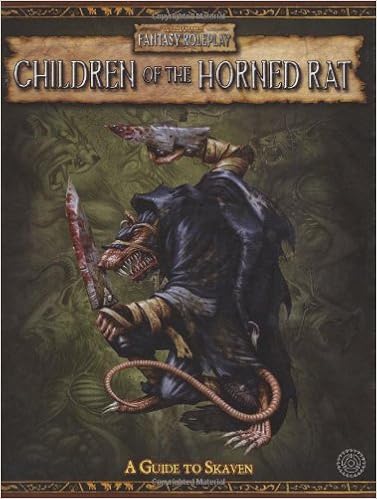
Image result for Children of the Horned Rat: A Guide to Skaven

Children of the Horned Rat is the skaven book for WFRP 2nd edition, and for me it was the standout book of the line, probably partly because I'm an old skaven player myself. As I mentioned in my first post on WFRP, the skaven are one of the very few parts of the Warhammer World which weren't derived fairly directly from somewhere else. The chaos gods came from Michael Moorcock; the orcs and elves and dwarves all came from Tolkien via D&D; the dark elves started out as a combination of Gygax's drow and Moorcock's Melniboneans, and so on. In every case Warhammer ultimately did something different with them, to the point where they sometimes barely resembled their originals: there's quite a gap between Tolkien orcs and Warhammer orcs, for example. But the only things they made up pretty much out of whole cloth were the chaos dwarves and the skaven: and much as I love the idea of evil Assyrian dwarves with blunderbusses (and I love it a lot), the skaven have gone on to be much more important to the Warhammer world as a whole.

Image result for fighting fantasy rat men
Proto-skaven: the ratmen from Temple of Terror.

The basic idea of humanoid rat monsters had been done before. Leiber had rat-people. D&D had wererats. Rat-men turn up in the Fighting Fantasy book Temple of Terror, which was published in 1985, narrowly predating the first appearance of the skaven in warhammer. A lot of people don't like rats, so they're easy to sell as a bad-guy race; and given their historical role in spreading diseases, its logical to link them with poisons and plagues. (Check out Dracula's army of plague rats in the 1979 Nosferatu, for example.) Most fantasy settings would have settled for 'subterranean race of rat-man plague cultists' and left it at that, but Warhammer made two crucial additions which transformed the skaven into something much more interesting.

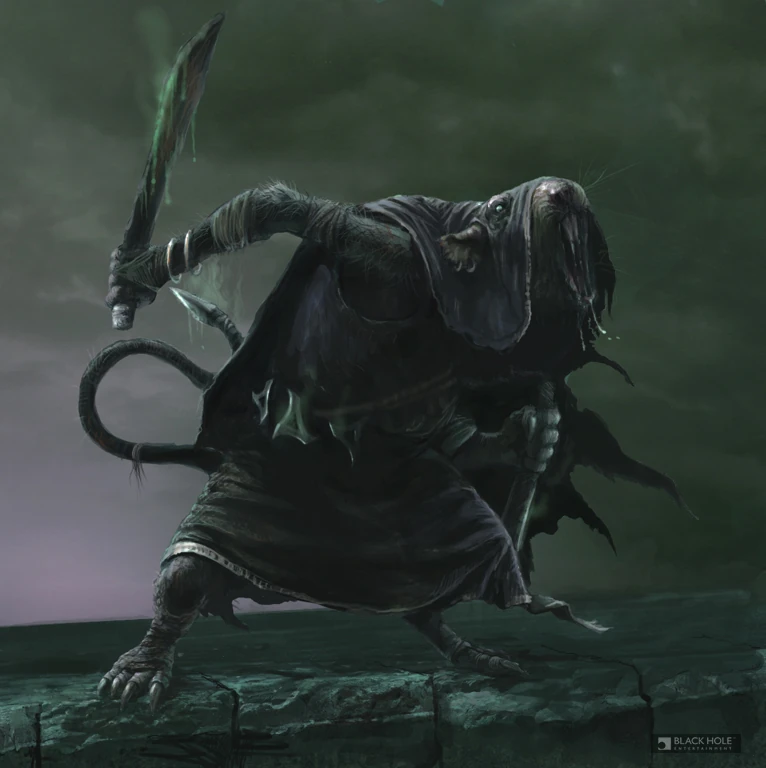
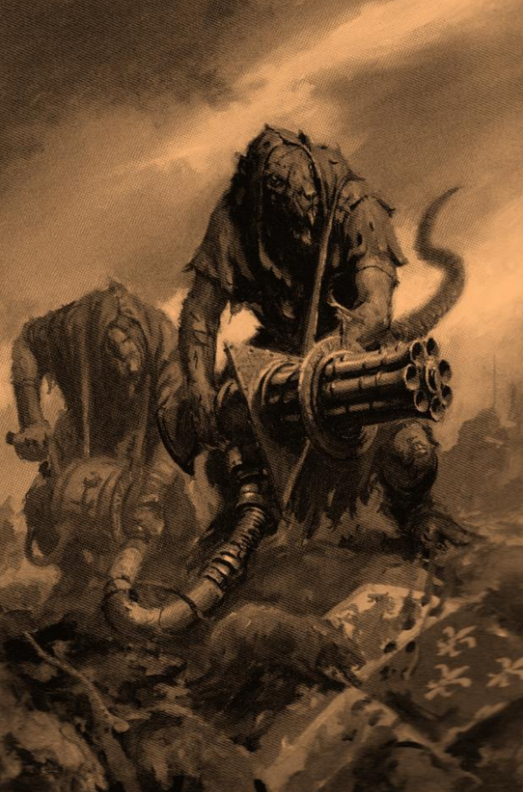
The first addition was to make the skaven into lab rats, in both senses of the term: creatures who were both carried out scientific experiments and who were, themselves, scientifically experimented upon. (The key influence here was probably The Rats of NIMH, in which experiments performed upon lab rats transform them into intelligent creatures with a technologically-advanced society of their own: the book was from 1971, but the 1982 film adaptation was still recent when WFRP was being written.) But because Warhammer started out as a wargame, its designers had to answer the question of how these science-rats operated on the battlefield - and it's here that the second addition came into play, by making them not just lab rats but trench rats. (It's obvious in retrospect: the similarities between themselves and the rats with whom they shared their trenches was not lost upon WW1 infantrymen.) The combination of lab rat with trench rat helped to establish the skaven not just as scientists but as mad scientists, complete with crazy experimental weaponry and a love of human wave tactics and tunnel fighting. By the time Games Workshop started making miniatures of skaven equipped with gas masks, flamethrowers, poison gas, and Ratling guns, all the key elements of the subsequent skaven mythology were in place.

I don't know why they also became ninjas. Ninjas were everywhere in the 1980s.

Image result for ninjas they're everywhere

During the mid-80s the skaven lore was still in the process of being developed, and they play a pretty low-profile role in WFRP 1st edition. (There are legends that the Enemy Within campaign was supposed to end with an epic battle against skaven on the moon, but in 1989 Games Workshop ordered the whole saga to be wrapped up as quickly as possible, and the adventure was never written.) The first Warhammer product to really give them a starring role was Advanced Heroquest (1989), and by then WFRP had already begun its slide into oblivion. In the 1990s, however, they became one of the most distinctive parts of the broader Warhammer mythology, especially after their 1993 army book depicted them as the masters of a secret world-spanning underground empire. Every 1990s fantasy setting had haughty elves and doughty dwarves and brutal orcs in it, but only Warhammer also featured a hidden subterranean civilisation of evil World War One science ratmen.

Given its position in the line, Children of the Horned Rat could easily have been a hack job: a simple matter of paraphrasing the lore from the army books, slapping on WFRP rules and statistics, and calling it a day. It's to the credit of its authors that they didn't do this, and instead reconceptualised the skaven as something even scarier than they already were. For me, the horror of the skaven it depicted rested on its treatment of four traits: their power, their cruelty, their secrecy, and their psychology.

Firstly: power. The book firmly established the skaven Under-Empire as the setting's largest and most advanced civilisation, to the extent that the histories of the Old World's human nations were reduced to mere side-effects of skaven history. The skaven have bigger cities than the humans. (In fact, the book states that under every human city is a skaven undercity, and the undercity is usually the larger of the two.) They have better guns. They have more advanced technology. They're building an intercontinental railway network, for fuck's sake. The skaven aren't just another enemy faction: they're closer to being what Iain M. Banks called an 'outside context problem'. In this retelling, Bretonnia and the Empire resemble two squabbling tribes on an isolated island somewhere, composing self-congratulatory legends about their mighty victories over the Great Boat People - not realising that what they thought were world-historical battles were just skirmishes with a couple of lost privateers, and that as soon as the nations across the sea stop fighting each other and get an organised program of colonial expansion underway they're going to get squashed like bugs.

Image result for skaven
The future is a rat chewing on a human face, forever...
Secondly: cruelty. The skaven had usually been described as a compound of negative traits - cruel, fanatical, cowardly, power-hungry, bloodthirsty, and so on. Everything they do is awful: they engineer plagues, they practise slavery, they eat people alive. But I don't think their evil and cruelty had ever been described so vividly as in this book, which makes effective use of both out-of-character information, short fiction snippets, and in-character quotations to communicate just how horrible the skaven really are. Rather than presenting them as figures of slightly cartoonish evil, the book depicts them as presiding over a secret world-wide empire of abduction, enslavement, and involuntary medical experimentation, and doesn't shy away from describing what that might look like. It's pretty nasty stuff.

Thirdly: secrecy. The depiction of skaven in Warhammer lore has always been massively contradictory on the topic of how well-known they are: for every book that describes them as a hidden threat in the shadows which most people don't even believe in, there's another one which writes about how their armies openly roam the world blasting people with warpfire throwers. This book mostly embraces the former option, even though it has to make some very odd assertions in order to square it with other parts of the lore. (If everyone in Tilea unanimously agrees that there really is an empire of evil rat-men hiding in their northern marshes, why does no-one in the Empire believe them? If the exploits of every other figure in Imperial history are taken literally, why are only those of Manfred Skaven-Slayer regarded as mere legends?) Despite these oddities, however, I feel this is a much more interesting approach to the skaven. I complained in this post that, by accepting the Storm of Chaos as canonical, WFRP 2nd edition was forced to move away from the idea of chaos as a hidden 'enemy within': but, as Stephen noted in the comments, that role was then taken over by skaven, instead. Skaven in 2nd edition are pretty much what chaos was in 1st, before the chaos warriors marched south: a threat which no-one really understands or takes sufficiently seriously, hidden in the shadows, preying upon the vulnerable. I feel that makes them much creepier, even if it's totally at odds with the way in which they're depicted in most actual 2nd edition adventures. The fiction snippet about the boy who is abducted by skaven, forced to eat diseased food, released back into his community sick and blind to spread the plague among them, and then stumbles around trying to find his mother only to be thrown in prison because no-one will believe his story, is chilling.

Related image

Fourthly, and for me most interestingly: psychology. As I've mentioned, the skaven were usually described as being generically evil for no very good reason; but this book tries to give an account of how their minds work, with pretty disturbing results. According to this book, despite being locked into instinctive pack dominance hierarchies, each individual skaven spends their whole life convinced that their own personal victory is always and obviously just at hand, and totally deserved, and totally inevitable, and if millions before them have tried and failed, then that just proves how much all those other guys sucked. They don't care about their own history. Their past is irrelevant. Their companions are expendable. Anything that goes wrong is obviously someone else's fault. Everybody other than themselves is just meat and slaves. The result is that the very qualities which make the skaven so awful are also the ones which make them so successful, as their empire is able to bounce back from the most appalling catastrophes without missing a beat. I find it horribly credible that a fast-breeding intelligent species with this kind of psychology might rapidly exterminate humanity while barely noticing that it was doing so - and would then probably not bother to record the fact that it had happened. At least for me, that seems much worse than just being consumed by the abstract entropic forces of chaos.

All this sets the skaven up as brilliant villains, although you'd probably want to modify or conceal the full scale of their advantages from your players to avoid it all getting too depressing. (The book gestures towards the idea of humans and skaven will ultimately be locked in a struggle for survival, but gives little indication of how this might be a struggle that humans could actually win.) The book also gives full information on skaven player characters - complete with careers like 'gutter runner' and 'warlock engineer' - and suggestions on running an all-skaven campaign, though I struggle to imagine such a game functioning as anything other than Paranoia-esque black comedy. There's also some information on the vast underworlds of the Warhammer setting, and some of the freakish creatures that inhabit them. Finally there's a short adventure: a pleasingly open-ended affair about a village caught between some escaped skaven slaves and their hunters, which leaves all the important decisions genuinely in the hands of the PCs. Even the length - nine pages - is, for once, not excessive given the content.

In conclusion: this is a good book, and one of the few WFRP 2nd edition book that I'd really recommend to fans of 1st edition. (The others are Barony of the Damned and, with some qualifications, Realm of the Ice Queen.) You could easily build a whole campaign around the skaven, starting with creepy encounters in the slums and sewers, moving onto investigations of the threat from below, then to increasingly desperate attempts to persuade the authorities of the rat-man menace, and finally to a pitched battle against the warriors of an entire skaven clan - with perhaps an ultimate Deep Carbon Observatory-style revelation that the terrifying army of monsters you've just vanquished is merely one of the innumerable constituent tribes of an underground empire so vast and evil as to almost defy comprehension. I'd also recommend it more widely to anyone interested in horror-fantasy gaming, as the skaven are so easy to drop into other campaign settings. And what fantasy world wouldn't be improved by the addition of a secret subterranean empire of evil magitech plague rat ninjas?

Related image

Wednesday, 9 May 2018

Monsters from Central Asian Mythology 14: Divs of the Desert

In Zoroastrian tradition, Divs are spirits of evil, the children of the Druj, or cosmic lie. In Persian folk-tales, they often lurk around in wild and dangerous regions, looking for victims to deceive and devour - and, as a result, they're just the kind of creatures you might run into if you leave the relative safety of the Iranian plateau for the deserts of Central Asia. My take on them here is heavily informed by their appearance in the twelfth century Persian poem Haft Peykar, where - in C.E. Wilson's 1924 translation - they are described as follows:
Innumerable demons seated there, exchanging shouts through valley and through plain.
All of them, like the wind, were scattering dust; rather, they were like leeches black and long.
Till it got so, that from the left and right the mirthful clamour rose up to the sky.
A tumult rose from clapping and the dance; it made the brain ferment in (every) head.
At every instant did the noise increase, moment by moment greater it became.
When a short time had gone by, from afar a thousand torches (all) aflame appeared;
(And) suddenly some persons came to view, forms cast in tall and formidable mould.
All of them “ghūls” like blackest Ethiops; pitchlike the dress of all, like tar their caps.
All with the trunks of elephants and horned, combining ox and elephant in one.
Each of them bearing fire upon his hand, (each) ugly, evil one like drunken fiend.
Fire (also) from their throats was casting flames; reciting verse, they clashed the horn and blade.

So: tall, black, fire-breathing, desert-dwelling monsters, with trunks like elephants, horns like oxen, and fires and blades in their hands, who go around laughing, and clapping, and dancing, and reciting poetry. Like you do.

Add_25900_f188r
Here's a fifteenth-century illustration of the scene.
My suspicion is that these particular divs are basically anthropomorphic representations of the perils of the desert. They're associated with heat: thus the fires that they carry in their hands and breathe forth from their mouths. They create sandstorms; indeed, in some sense, they may actually be sandstorms, which would explain why they dance around in circles filling the landscape with clouds of dust. They create mirages - thus the recoil of the guy in the picture as his horse suddenly turns into a seven-headed dragon beneath him - and they themselves, with their monstrous beast-faces, resemble the kind of hallucinations someone might experience while stumbling around a desert half-dead of sunstroke and dehydration. But at the same time, they seem to possess art, language, even culture. They aren't just whooping and gibbering: they're reciting verse. It's that combination of primal destructiveness with apparent knowledge and intelligence that interests me.

So - if you go too deep into the desert, if you are lost and dying and desperate, then you may meet the divs. The base daily chance of a group encountering them is 0%, modified as follows:

  • Group has only the vaguest idea where they are: +10%
  • Group is completely lost: +20%
  • Group has no food: +10%
  • Group has no water: +20%
  • Many people in the group are sick: +10%
  • Many people in the group are wounded: +10%
  • Many people in the group are suffering from sunstroke: +10%

When encountered, they come whirling over the horizon, leaping and dancing and singing, clashing cymbals and horns and blades. They breathe out gouts of fire. They kick up great clouds of dust. They conjure up frightful illusions of people and animals turning into monsters. What they're looking for is a terror reaction: they want to see people flee in panic, abandoning the supplies and the pack animals that they need to survive in the desert in their desperate scramble for safety. The divs think that kind of thing is hilarious. They'll be laughing about it for weeks.

If you hold your ground, then they'll come stalking up to you, waving swords and snorting flame. They'll try to intimidate you, uttering blood-curdling threats, and demanding all the food and goods and water you have in exchange for letting you live. They don't need those things: they just think it's funny to send people staggering away to die of thirst and starvation. They'll probably burn it all as soon as you're out of sight.

Faced with sturdy opposition, however, the divs will waver. They admire bravery, and for all their threats and bravado they will be reluctant to strike the first blows, although they will fight back fiercely if attacked. They hate showing weakness, and will curse and bluster to the very end, but travellers who demonstrate both courage and respect may be allowed to pass in exchange for a mere token payment of tribute. (The divs are incapable of telling direct truths, though, and will come up with all sorts of absurd lies about why they are letting you live.) If they are particularly impressed with you they might even drop some broad hints about the way to the next oasis, although if questioned about it they will of course deny doing anything of the sort. 

Despite their ruffianly ways, the divs are great lovers of music and poetry. They will immediately warm to anyone who can answer them quotation for quotation, and prefer gifts of song and verse above all others. They know many old secrets, and the locations of all kinds of ancient ruins, and sorcerers and scholars sometimes deliberately seek them out with the hope of bargaining with them - although this usually involves deliberately getting lost in the desert first. They also have considerable respect for Dahākans, who they regard almost as their kinsmen. They view the Cruel Ones with utter contempt.

  • Div: AC 15 (super-tough skin), 4 HD, AB +5, two attacks, damage blade (1d8+1) and flame (1d6), FORT 10, REF 12, WILL 12, morale 9. 
Divs resemble large, brutish humanoids with elephant faces and the horns of oxen. They carry swords and flames, which they can call forth from their hands at will, and wield like lashes: they can also breathe forth gouts of fire once per round, causing 1d6 points of fire damage per round to one target within melee range unless they pass a REF save. While leaping and dancing around the desert, the dust clouds they kick up are so thick that all ranged attacks against them are at -2 to hit. They can conjure threatening illusions, which last for as long as the div creating them maintains concentration. These illusions are visual-only, and can only take the form of monsters, distortions, fires, sandstorms, and other intimidating sights. 

Friday, 27 April 2018

Familiarity and Contempt

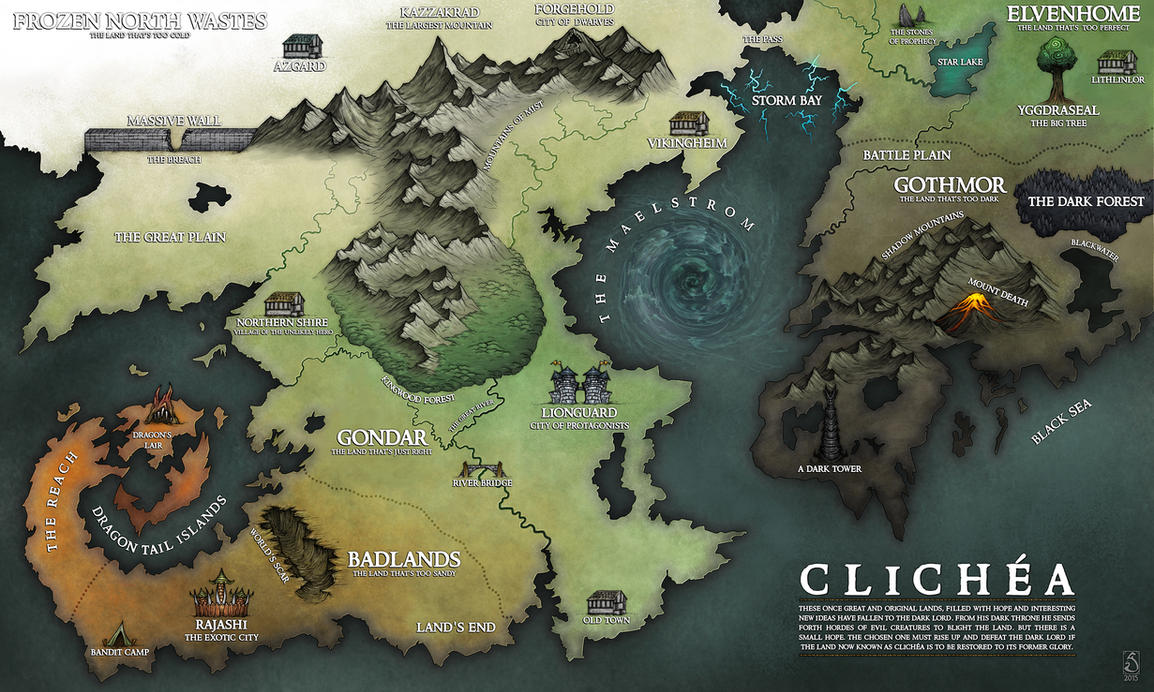
Map of Clichea by Sarithus
Map of Clichéa by Sarithus. You can view the full-size version here.

It's odd how quickly we get used to things. How the fantastical becomes mundane: how the strange and exotic becomes something we take for granted. Think of the tapestry of wonders which make up a generic fantasy world: beautiful forest-dwelling immortals inhabiting hidden cities of living wood and crystal, clans of industrious craftsmen carving out underground kingdoms beneath the earth, blood-crazed tribes of monstrous green-skinned savages who eat the corpses of their enemies, and so on. These figures are the stuff of dreams and nightmares... and yet if the first line of someone's setting write-up starts talking about how the elves are wise and graceful and the eldest of all peoples, I'll drop it in a heartbeat. It's boring. I've seen it a thousand times before.

The trouble is that this applies to everything. I catch myself sometimes talking about 'generic fantasy gods' or 'generic elder evils' or 'generic horror monsters', and I think: how does something designed to be shocking, or numinous, or horrific end up becoming generic? And yet it does: if I open an adventure module and read about a band of insane sorcerers sacrificing victims to the primordial tentacle-covered slime monster who lives beneath their prehuman temple of black basalt, I don't think 'gosh, how awe-inspiringly terrible!' I just think: 'OK, so they're generic fantasy Cthulhu cultists. What else have you got?'

I distinctly remember the moment I fell out of love with World of Warcraft. My quest required me to obtain some bottles of ice water, and the only way to get them was to kill ice elementals, who sometimes dropped them when they died. So there was my gnome assassin, leaping about with her enchanted daggers, hacking her way through gigantic, roaring monsters of living ice in the depths of a frozen chasm beneath a twilight-purple sky, and it was... boring. The game had taken something fantastical and turned it, through sheer force of repetition, into an interaction with a glorified vending machine. All I cared about was whether or not each murdered ice-beast was going to give me a bottle of cold water. I stopped playing the game shortly afterwards.

It's sometimes suggested that the solution to this problem is simply to be more original: to replace your orcs with walrus-men and your dwarves with miniature robot dinosaurs and so on. But as soon as something like this catches on, it can go from being excitingly new to feeling played-out and predictable within just a handful of years. Look what happened to steampunk: it started to really take off around 2005, and by 2012-ish it had already hardened into an almost completely predictable list of visual clichés. (Goggles! Corsets! Top hats and bowlers! Clockwork robots! Airship pirates! Gears on everything! Why aren't you excited yet?) Hell, look at what happened to D&D itself: many of the monsters that people now complain about as 'boring' and 'generic', such as gnolls or drow, were completely new and original back in the 1970s. 'Originality' is a treadmill. Yesterday's shocking new idea is today's mainstream default and tomorrow's tired cliché.

In his 1821 Defence of Poetry, Shelley wrote:
[The language of poets] is vitally metaphorical; that is, it marks the before unapprehended relations of things and perpetuates their apprehension, until the words which represent them, become, through time, signs for portions or classes of thoughts instead of pictures of integral thoughts; and then if no new poets should arise to create afresh the associations which have been thus disorganized, language will be dead to all the nobler purposes of human intercourse.
This, I think, is more or less what tends to happen to fantasy elements. They start off as fresh and vivid symbols for urgent realities, or what Shelley calls 'pictures of integral thoughts': orcs were Tolkien's way of articulating the brutalising effects of industrial capitalism, Cthulhu was Lovecraft's symbol for the way in which the cosmos fundamentally doesn't give a fuck about humanity, and so on. Then they get popular, and become 'signs for portions or classes of thought': so Cthulhu gets used as a kind of shorthand for 'A BIG SCARY THING THAT MAKES YOU GO CRAZY', because thanks to Lovecraft we've all somehow come to accept that a giant dragon-man with a squid for a face is an appropriate symbol for that, without it necessarily being connected to any of the things which originally provided the reasons for it to mean that. Soon they become almost entirely symbolic: so a game which features zombies and werewolves and vampires instead of orcs and ogres and dragons will get labelled as 'Gothic horror' instead of 'high fantasy', even if the horror-monsters never actually do anything horrific, because werewolves and vampires are understood to be symbolic of horror in general. And then we play the game and stab all the vampires and wonder why it doesn't actually make us feel afraid.

(You can see these loops playing out with almost comical literalness in games like Pathfinder. You start with a unique monster, like Grendel, and turn it into a type of monster: in this case, the D&D troll. But then the troll gets so overused that it's not scary any more, and no longer conveys the kind of threat communicated by the original. So you go back and you create a new monster, called a Grendel: a mega-troll so strong and powerful that it can terrorise even characters who have become blasé about normal trolls. The diminishing returns involved in such a strategy should be obvious. See also what happens to Dracula in just about every vampire fiction franchise.)

When fantasy fails to feel fantastic, I think it's often because its creators use these fantastical elements as shortcuts or placeholders, relying on their inherited symbolic associations to do all the imaginative heavy lifting. They rely on an audience which is going to find the very idea of dragons so awesome that they'll love your story just for having dragons in it, even if your dragons never actually do anything very impressive, or very dragon-like, or even very interesting. But the more familiar your audience is with the genre, the less credit they're going to give your work just for including orcs and elves and whatnot, because for them those figures will be part of a symbolic system which has been drained of all its inherent power by overuse.

So don't do that. Don't just rely on the fact that something is a troll to convey the fear and the power of it: maybe that would have worked a hundred years ago, but now they've been so drained of significance that your players are just going to see them as big bags of hit points with annoying regenerative abilities. Instead, you have to reconnect them with whatever it was that gave them force and meaning in the first place. 'A goblin' is a three hit point irritation. A giggling thing with too-long arms and a too-wide mouth and far too many teeth that comes squirming out from under your bed at night to cut you up with knives is fucking terrifying. 'An ogre' is a big dumb lump for your PCs to kite around a battlefield. An eight-foot giant who comes clambering from her cannibal larder, her hot breath reeking of carrion, her long hair matted with human gore, still retains some level of nightmarish power. At this point, the names have probably become active liabilities: the howling abhuman beast that roams the wastelands, larger and more savage than any man, becomes much less threatening once it has been identified as 'an orc' or 'a bugbear' or 'a troll'. You don't need to wear yourself out trying to come up with totally original, never-before-seen ideas in every damn adventure: after all, the classics are classics for a reason. You just need to make sure that, when you use the classics, you go right back to the source. 

Because the stories never truly lost their power. Not really. There's still something magical about the glimpse of the path through the woods at twilight, or the huge figure unfolding itself from the cavern in the hillside, or the whispering and scurrying of swift and unseen creatures in the dark. The shining city on the distant hilltop. The sound of something slow and heavy moving through the forest by night. It would be a shame if we let the overuse of our shared shorthand of fantasy iconography stand between us and the very real wellsprings of awe and terror which are, at base, still represented by those symbolic figures with which we have become so painfully over-familiar.

Orcs. Elves. Ogres. Giants.


eotenas ond ylfe      ond orcnéäs
swylce gígantas      þá wið gode wunnon
lange þráge·      hé him ðæs léan forgeald.