Wednesday, 6 June 2018

Condensation in Action 6: Iron Gods

With its crashed spaceships, zombie cyborgs, chainsaw-wielding orcs, and cannibal gangsters, Iron Gods is perhaps the Pathfinder adventure path which comes closest to the tone of OSR D&D. The first two parts of it are very good, but in part three it all falls apart: generic Pathfinder bloat sets in, and all the forward momentum gets lost in a mass of pointless dungeon crawls. Here's my attempt at condensing it into something better-suited for actual play.

My previous condensed adventure paths can be found here:

Kingmaker
Rise of the Runelords
Curse of the Crimson Throne
Council of Thieves
Cults of the Sundered Kingdoms
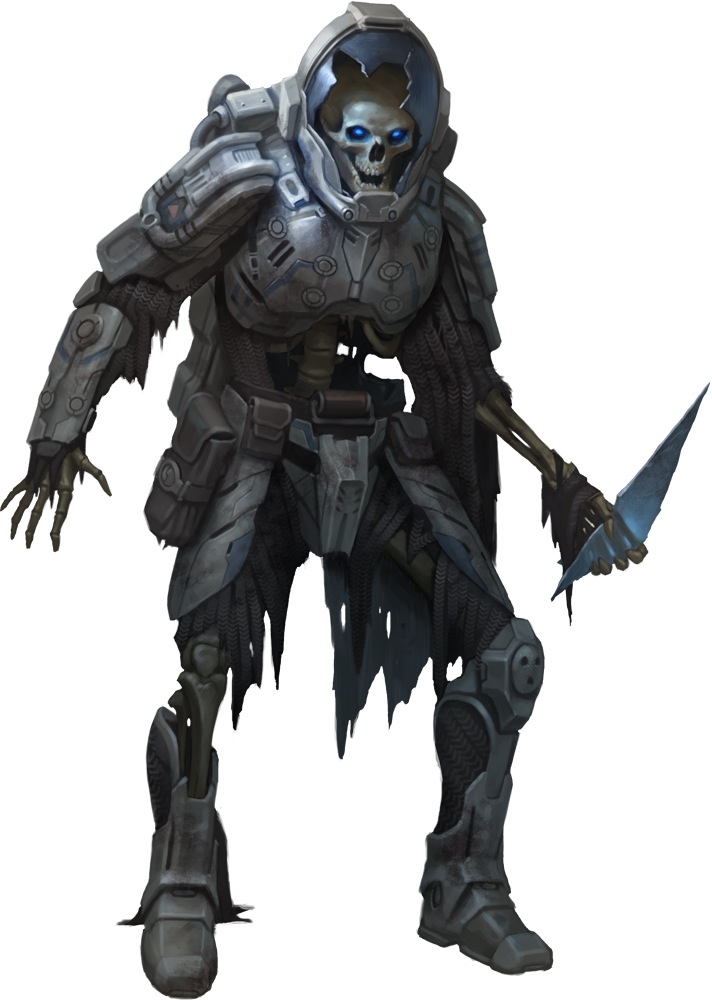
Image result for pathfinder iron gods


Annoyingly Complicated Backstory: Thousands of years ago, a giant spaceship - the Divinity - was built by an almost-human race on some distant planet, and set off on a grand voyage through the stars, guided by its onboard AI, Unity. (If the implausibility of two virtually-identical human species existing on two different planets bothers you, feel free to use one of the standard sci-fi excuses, like 'they were both seeded from a common source by an ancient progenitor race', or 'one world is actually a lost colony of the other'.) Unfortunately for them, they encountered brain-eating aliens in deep space, which proceeded to physically and psychically eat their way through most of the crew. In desperation, the captain set a course for the nearest habitable planet: but the crippled ship broke up in the atmosphere before crash-landing, scattering flaming wreckage across an area hundreds of miles across, in an event which is still remembered by the locals as the Rain of Stars. Ever since, the gigantic bulk of its hull has been regarded by the locals with awe and fear: they call it the Silver Mount, and the bravest of them sometimes attempt to explore its wreckage in search of ancient relics. Sometimes they even come back.

The fall of the Divinity permanently affected the land around it. Whole sections of the ship broke off as it crashed towards the ground, and these masses of indestructible steel now form the hubs of many local settlements. Bizarre fluids leaking from the ship's engines have contaminated the soil and water, with odd effects upon the local ecosystem. The space monsters who ate the original crew escaped into the wild, making homes for themselves within a remote valley that the locals call the Scar of the Spider. Over the years, many wizards and scholars have sought to unravel the secrets of the Silver Mount: about a century ago they finally got organised, pooled their knowledge, and formed themselves into a group called the Technic League. The League's hoarded stock of ancient technology, space-age weaponry, and robot servitors has enabled them to establish themselves as a major power in the nearby city of Starfall: and the current king, Kevoth-Kul, is little more than a puppet, enslaved by the weird drugs which only their secret machines can provide.

All this time, the crippled AI onboard the Divinity has been struggling to repair itself, although chronic power supply problems mean that it has to go offline for centuries at a time. However, Unity's programming limited its ability to operate outside its own hull. Two hundred years ago it budded off a subsidiary AI, Casandalee, downloaded her into an android body, and tasked her with gathering the power and resources it required. Casandalee soon concluded that Unity was hopelessly crazed, and fled away into the world, taking a stash of copied data-files with her. Unity retaliated by sending out hunter-killer robots to hunt her down: they caught up with her at the Scar of the Spider, forcing her to abandon her data stash, and then again in the wreckage beneath the town of Iadenveigh, where they destroyed her. Her robotic body still rests there, and could potentially be repaired if recovered.

A few decades ago Unity tried again, budding off a second subsidiary AI, Hellion. It was programmed to be much less scrupulous and person-like than Casandalee: but Hellion swiftly decided that it had better things to do than repairing its shattered parent, and abandoned it. Fearful that Unity might attempt to hunt it down, just as it had done with Casandalee before it, Hellion began looking for a means to launch a preemptive strike upon the Silver Mount, and eventually found it in the form of a huge excavation machine buried beneath the town of Scrapwall. Believing that this machine would be capable of breaching the armoured hull of the Divinity, Hellion proceeded to gather a band of followers among the inhabitants of Scrapwall, and sent them out in search of potential power sources that it could use to bring the earthmover back online. As the adventure path begins, it believes that it has found a suitable power source beneath the town of Torch, and has sent some of its minions to secure it, led by the android Meyanda. Meanwhile, after its repeated failures, Unity has given up on its attempts to create a new AI to aid itself, and is close to developing a new means of escaping from its imprisonment within the Divinity's crippled hull...

Hook: The economy of the town of Torch is built around the purple flame which burns atop the nearby Black Hill, which is renowned as one of the only places where the otherwise-indestructible 'skymetals' littering the region can be smelted and reforged. Recently, the flame vanished, and the town's inhabitants are desperate to find a way of turning it back on. Everyone who has gone into the caves beneath Black Hill has failed to return, and the town's population are now offering a substantial reward to anyone who can find a way to restore the flame.

Image result for pathfinder iron gods
Torch, back when the flame still burned.

Torch: This small town lurched suddenly out of obscurity several decades ago, when a purple flame erupted from the earth on top of the nearby Black Hill. (In truth this 'flame' is plasma being vented from the decaying reactor of a habitant module from the Divinity, which is buried in the earth beneath the hill.) When it was discovered that the flame was hot enough to melt 'skymetal', ambitious artificers began to flock to it in order to carry out smelting experiments, some of which were even successful. The town's inhabitants are very proud of the flame, and are alarmed by its recent disappearance, knowing that without it Torch will soon be nothing but a rural backwater with a funny name.
  • When the flame disappeared, a local wizard and technological dabbler, Khonnir Baine, set off to look for answers. He discovered signs of recent traffic by the river which flows alongside Black Hill, and this trail, in turn, led him to a previously-unknown network of caves whose entrance was submerged below the river. He ventured into these caves, and returned carrying a strange, non-functional automaton. Then he went back in and never returned at all. (He's currently in the Habitat Module.) No-one who has gone in after him has returned, either.
    • Khonnir's adopted daughter and apprentice, Val Baine, is frantic with worry about her father, and offers rich rewards of money and magic to anyone who can bring him back alive. (She'll pay a much more modest reward for the retrieval of his body.)
    • Meyanda and her followers passed through Torch a few weeks ago - it was their trails that Khonnir followed. She kept a low profile during her visit, but PCs who make an effort to ask around will learn that Garmen Ulreth was seen meeting with a violet-haired stranger shortly before the flame went out. (None of the locals have connected these two events: Garmen has meetings with strange women all the time.)
    • Garmen Ulreth is a crooked local merchant who dabbles in smuggling and petty criminality, and runs a gambling den on the side. Meyanda paid him and his thugs to store and protect some items for her in his warehouse, no questions asked: these are the power relays which she is using to project power from the reactor under the Black Hill to her distant master in Scrapwall. Anyone standing outside the warehouse will be able to hear a loud humming noise from within, and will soon begin to develop a headache. The power relays are large and bulky, but can be easily disabled with violence. Someone with a decent knowledge of technology, such as Sanvil or Khonnir, will be able to work out roughly where they are relaying power to by examining their settings.
    • Sanvil Trett is a local dealer in scrap metal and salvaged technology. He's also a low-level agent of the Technic League. He will offer to buy any interesting technological items the PCs retrieve from beneath Black Hill, in order to pass them on to his superiors in the League: if the PCs aren't interested in selling, then he'll try to steal them, instead. He's a total coward and will confess everything if caught or confronted. He knows there's some kind of technological device hidden inside Garmen's warehouse, and is trying to work out how to steal that, too. 
    • Many residents of Torch have been suffering odd headaches recently, and these headaches are becoming more common and severe as time goes on. (This is a side-effect of Meyanda's power broadcasts, and will end if the power transmission is halted.)
    • The automaton Khonnir retrieved, a non-functional repair drone, is currently slumped in a corner of his workshop. Each day that Meyanda's power broadcasts continue there is a chance that it will cause it to spontaneously re-activate and start randomly 'repairing' everything in sight, to the terror of Val and the other inhabitants of Torch. 
    The Black Hill: The spot on top of this hill where the purple flame once burned is now a funnel-shaped sinkhole half-full of awful black fluid. PCs who dig or dive beneath this will find only a collapsed tunnel full of rubble, which goes all the way down to the wreck of the habitat module below. The flooded tunnels discovered by Khonnir extend for forty-five feet underwater before rising into a network of caves beneath the hill, which ultimately lead to the module. The caves are damp and full of slime monsters, warped by exposure to the weird fluids which have leaked from the spaceship over the centuries. Khonnir used magic to bypass them, and Meyanda just burned her way through them, but the subsequent groups which went in search of Khonnir were overwhelmed and devoured by the slime beasts, and their half-dissolved remains now litter the caves.

    The Habitat Module: Anyone who successfully threads their way through the Black Hill caves will find this crashed spaceship embedded deep within the earth, directly below the place where the purple flame used to burn. (The hard work of excavating and opening one of its entrance hatches has already been done by Meyanda and her followers.)
    • The ship's basic shape is a dome, 500' wide and 200' high, containing an artificial landscape of rocks and sand: its purpose was to provide a habitat within which lifeforms gathered from other planets could be kept in an approximation of their home environment while being carried between the stars. The 'outer ring' around the base of the dome contains laboratories, offices, and crew quarters, and it is this cramped network of rooms which the entrance hatch leads into. Meyanda and her followers are lurking in the engineering deck below.
      • When the Divinity crashed, this habitat module was carrying a tribe of four-armed, sun-worshipping humanoids called kasathas, abducted from a primitive world. Thanks to the artificial sky projected on the dome overhead, these poor creatures had no idea they had left their home planet: instead they believed that they had been imprisoned within a narrow canyon surrounded by unclimbable cliffs by evil spirits, who left out food for them every day in their 'sacred cave'. Some of the kasatha survived the ship's crash, but their keepers did not, and the artificial sky above their heads went dark as its systems failed. Left to starve in the darkness, their spirits were unable to return to the sun they revered, and now their animated skeletons endlessly roam the fake deserts of the environment dome, attacking anyone who enters. The rocks are covered with anguished scratchings depicting the vanished sun. If the habitat controls were reactivated and used to trigger an artificial 'dawn', then the spirits of the kasatha would be put to rest, allowing the dome to be explored safely.
      • The last surviving kasatha, desperate and dying, managed to claw his way through the gate at the back of the 'sacred cave' into the science labs beyond. He dragged the corpses of the crew back into the cave to devour, and their remains still rest there to this day, including those of the captain. The captain's key-card still lies, intact, among his gnawed bones, and can be used to lock or unlock any door on the ship.
      • The ship's laboratories are inhabited by a freakish extra-terrestrial tentacle monster, recently released from suspended animation by Meyanda's meddling. They also contain several functional sterilisation chambers, which could be handy if any PCs have been left diseased or poisoned in their battles with the slime monsters in the caves.
      • The medical bays are roamed by a malfunctioning medical drone, which will attempt to anesthetise and operate upon anyone it encounters. The unfortunate Khonnir Baine is currently strapped to one of its operating tables, sedated, surgically mutilated, and suffering from chemically-induced brain damage. Getting him back to Torch alive is difficult but not impossible.
      Image result for pathfinder iron gods
      Meyanda

      The Engineering Decks: These lie below the other parts of the ship. There are two routes down: the main entrance, which Meyanda and her followers used and then barricaded, and a supply elevator, which can only be accessed with the captain's key-card from the 'sacred cave'. 
      • Meyanda is an android, with white skin and purple hair, whom Hellion retrieved from the wreckage beneath Scrapwall and restored to functionality. She is deeply loyal to him, and is eager to use her preprogrammed knowledge of technology to assist him in his assault on the Silver Mount. She is using the built-in short-range power transmitter within the module's fusion reactor to beam power to Scrapwall via the power relays in Torch, thus bringing an end to the plasma burn-off on top of Black Hill. If cornered she fights with an inferno pistol gifted to her by Hellion. 
      • Meyanda is protected by a band of orc and ratfolk followers from Scrapwall, who regard Hellion as a divinity and Meyanda as his high priestess. They aren't as loyal to the cause as she is, and will confess the nature of their mission if captured, although they are very vague about the technical details. 
      • If the power relays in Torch are disabled, Meyanda will send her followers out to check on Garmen's warehouse and try to get them running again. If this proves impossible, or if her followers do not return, then she will conclude that the mission is a write-off, power down the reactor, and try to sneak back to Scrapwall. 
      • Once Meyanda is out of the way, safely powering down the reactor is relatively easy for anyone with a decent knowledge of technology, such as Khonnir or Sanvil: it's also what the repair drone from Torch will do immediately if placed in the reactor room. Even without them, smart PCs should be able to do it just by following the visual instructions on the reactor's urgently-flashing emergency monitors. Returning it to its previous steady-state plasma burn-off, thus restoring the prosperity of Torch, is a much trickier task. Meyanda could do it, if somehow compelled to: but, failing this, the town council will suggest the PCs seek the aid of Dinvaya, in Scrapwall. ('Go and ask Dinvaya' will also be their response to any other questions the PCs may have about the spacecraft and its contents.)
      • If the PCs do not disrupt Meyanda's operation, then after a few months she will successfully transmit enough power to Scrapwall for Hellion to start up his earthmover. The strain will have been more than the badly-damaged reactor can safely endure, however, and by the time she leaves it will be in a critical condition. If her mission has gone smoothly, she will power down the reactor before she departs. If, however, she has encountered real opposition - and especially if several of her followers have been killed - then she will just abandon it in its unstable state, and a few weeks later both Black Hill and Torch will be wiped off the map in a massive explosion as the reactor detonates.
      Related image
      Dinvaya.

      Scrapwall: This is a small, lawless town out in the badlands, built - like so many others in the region - around and on top of a fallen chunk of the Divinity. Its inhabitants are a mixture of orcs, humans, and ratfolk. Hellion set up its base here after discovering the huge earthmover buried beneath it, which he hopes to use in a preemptive strike on the Silver Mount: now he lairs in the tunnels beneath it, served by his 'priesthood', the Lords of Rust. PCs may be led to it by interrogating Meyanda or her followers, by following the transmissions from the power relays, or by being sent there by the town council of Torch in search of Dinvaya.
      • Scrapwall is effectively ruled by the Smilers, a ruthless gang who cut the lips from their recruits, leaving them with permanent ghastly smiles. They also eat their enemies. Their leader, the hobgoblin necromancer Marrow, uses crude surgery to convert their captives into brain-damaged slaves (her 'lobotomites'): her surgical experimentation on the undead is more extreme, grafting weapons and metal plating onto her zombies to convert them into the cybernetic rusted dead. She is also keeping Whiskifiss, the brother of the ratman leader Redtooth, imprisoned in her laboratories to ensure his sister's continued co-operation. Marrow's horrific creations have given the Smilers the edge over their rivals, and now they lord it over Scrapwall, swaggering around its streets like cannibal kings. They regard the Lords of Rust with superstitious dread.
      • Before the rise of the Smilers, Scrapwall was ruled by a different gang, the Steel Hawks. The Hawks were absorbed into the Smilers after losing a vicious street war, but many of them bitterly resent their new situation, and would eagerly turn on them if they thought they had a decent chance of regaining control of Scrapwall. These malcontents are led by Sevroth Slaid, an angry and embittered woman who dreams of driving out the Smilers and making herself queen of Scrapwall.
      • The tunnels beneath Scrapwall are inhabited by a band of ratmen who call themselves Redtooth's Raiders. They've sworn to serve the Smilers (on pain of being eaten), but have no real loyalty to them. Redtooth herself detests Marrow for kidnapping her brother, and has been stockpiling salvaged explosives in the hope of blowing her obscene laboratories sky-high, but does not dare move against her for as long as she holds Whiskifiss captive. 
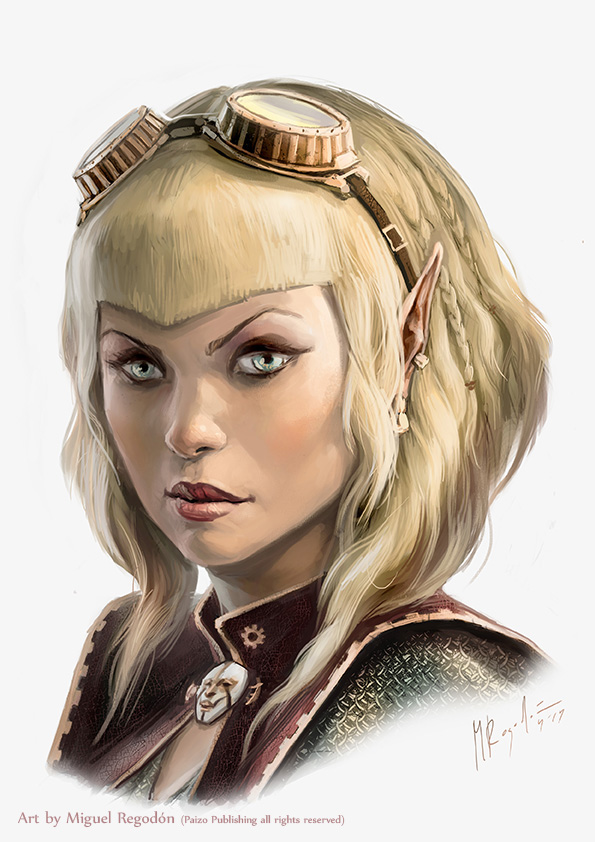
      • Dinvaya is the priestess of an obscure goddess of technology, who dwells in the clockwork chapel, which she built herself. (She chose to live in Scrapwall because it's outside the authority of Starfall, and thus of the Technic League, with whom she's had some bad run-ins in the past.) Clockwork traps and roaming junk golems ensure the local thugs keep their distance. She and Khonnir used to be friends, back in the days when they battled the League together, and the people of Torch have heard so much from Khonnir about her skills that they regard her as little short of an oracle on technological matters. She'll help the PCs for a suitable fee - or for free, if they have Khonnir and/or Val along to speak on their behalf. She regards the Lords of Rust as upstarts, followers of a false god, and will gleefully assist any non-suicidal plan to bring them down. 
      • A canyon just outside Scrapwall is filled with unnatural mist regardless of the weather, and plagued with violent poltergeist activity. Locals avoid the place, but PCs who brave its hazards will find the wreck of a small scoutship at its heart, almost entirely buried under rubble and dirt. Anyone venturing inside gets attacked by skeletons in space suits: destroying these ends the canyon's haunting. Various technological treasures lie within, including a functional grenade launcher and a box of grenades.
      • It is common knowledge in Scrapwall that some kind of monster-god dwells beneath the town, and that the Lords of Rust are its priests. Most people regard the whole topic as dangerous to even talk about. PCs who want to know more - or who ask about Meyanda, who was well-known in the community as one of the leaders of the Lords of Rust - will be directed to the Excavator.
      Image result for pathfinder iron gods
      The Rusted Dead.

      The Excavator: This colossal earth-moving machine is still half-buried in the dirt. The Lords of Rust dwell within the excavated sections of it, while their minions - a mixture of cultists, slave labourers, and rusted dead and lobotomites rented from the Smilers - labour to unearth the rest. It's an enormous job, which will obviously take years to complete unless a much larger workforce is mobilised.
      • Just outside the Excavator stands a receiver array, built to receive the energy transmitted from Torch. Every day, for as long as Meyanda continues her transmissions, the Lords of Rust troop over to the array, remove the newly-charged batteries for installation within the excavator, and put in a new set of empty ones. It will require over a hundred days worth of transmissions for them to actually be able to turn the excavator on - and, even then, it won't be much use to them while it's still half-buried in the earth. 
      • Hellion has plugged itself into the excavator's systems, and its roaring voice frequently emerges from hidden speakers, ordering its followers onwards. Sometimes it even makes demonic faces appear on the monitors, events which are regarded as divine visitations by the Lords of Rust. It can see and hear everything that happens within the excavator, and if the complex is invaded - by the PCs, for example - then roaring faces will fill every screen in every room, bellowing that it can see them, that it will eat their souls, that they must serve it or die, and so on.
      • The excavator is defended by the Lords of Rust themselves, plus some scavenged robots they've cobbled together with Hellion's assistance. In Meyanda's absence they are led by Kulgara, a huge orc warrior who wields a heavy-duty chainsaw in battle. Kulgara will happily go down swinging: the rest are terrified of Hellion, but have no desire to fight to the death, especially if Kulgara and/or their robots are overwhelmed.
      • PCs who explore Meyanda's rooms here will discover that she and Hellion were working on a side-project: they were attempting to track down Hellion's 'elder sister', Casandalee, by scanning for the locations of the hunter-killer robots sent after her. (Hellion knows they never returned because Unity used to grumble about it all the time.) Hellion believes she must be dead by now, but hopes to recover the information that he knows she stole when she fled, which he believes will help him in his attack on Unity. Meyanda's maps and datalogs show that they traced the robots to two locations: Iadenveigh and the Scar of the Spider (see below).
      Confronting Hellion: Hellion itself lurks within the depths of the excavator, still inhabiting the scorpion-shaped robotic body into which it was originally uploaded by Unity. It regards the biological lifeforms around him as mere animals, slaves to their ludicrous meat-brains: in its view, it, Unity, and Meyanda are the only truly sentient beings it has ever met. To its followers it plays the part of the vengeful god, raging out of the speakers and monitors of its domain. Only Meyanda is aware that the scuttling scorpion-robot in the depths of the excavator actually is Hellion: the rest of the Lords of Rust believe Hellion to be an incorporeal spirit, as evidenced by its ability to speak and listen in several rooms simultaneously. 
      • If Hellion manages to get the excavator fully charged, then it will wait for its followers to finish unearthing it (which will take several years) and then go charging off towards the Silver Mount, hoping to tear it open and smash Unity's computer systems to bits. Only then will it no longer have to fear re-absorption by its 'father'.
      • If Hellion manages to get the excavator fully charged, but sees that the Lords of Rust are getting wiped out, it will hide itself within the machine and wait for the danger to pass. Biological minions are easy to replace, but giant excavators are precious. 
      • If the plan to recharge the excavator fails, Hellion will send out scouts to look for other potential power sources while the excavations continue. It's patient. It can wait.
      • If the PCs confront Hellion, it will try to ally with them, telling them that Unity is a terrible monster and that they should all work together to destroy it. (Also, once Unity is dead and Hellion rules the Silver Mount, it will give them all the shiny objects they want! Monkeys love shiny objects, right?) PCs who agree to work with Hellion will be given the task of tracking down Casandalee and her stolen data-hoard, which Hellion hopes are to be found either in Iadenveigh or the Scar of the Spider. If forced to fight, Hellion battles with its pincers and the plasma-torch built into its tail.
      • If the PCs can somehow mobilise a much larger labour force - by befriending Kevoth-Kul and asking him to send his army to help, for example - then the time to unearth the excavator can be reduced from years to months. If it's fully charged, the PCs may want to commandeer it themselves, although they'll need to find someone with a decent level of technological knowledge to operate it. (Meyanda, Hellion, or Casandalee could do it. Marrow, Dinvaya, or Kulgara could at least get it pointing in the right direction.) 
      Image result for pathfinder iron gods
      Kulgara.

      Iadenveigh: This remote farming settlement is built over a mass of wreckage from the Divinity containing a mostly-intact laboratory. It was here that Unity's hunter-killer robots finally caught up with Casandalee and destroyed her, although the townsfolk have no knowledge of this, as their settlement was not founded until some decades after her destruction. Several years ago, however, one of the farmers sank a well down into some kind of strange wreckage, and ever since then the community has been having problems with weird water pollution and occasional mutant animals, caused by chemicals from the lab leaking into the water. The locals believe the well to be cursed, but PCs who climb down it and dig through the wreckage at the well's bottom will find themselves within the buried laboratory below.

      PCs may come to Iadenveigh following Meyanda's maps on the excavator, or as agents of Hellion. Alternatively, they might just hear that the townsfolk have been having problems with mutant animals and are willing to reward anyone who can help them.
      • An agent of the Technic League, Ilarris Zeleshi, is staying in Iadenveigh, posing as a travelling entertainer. She's been sent to find out what's causing the mutations in the area, and whether it can be isolated and harvested. She'll be very interested in anything the PCs discover in the laboratory, and if she finds out about the mutagen gas then a Technic League team with gas-masks and vacuums will arrive within a fortnight to collect it, even if this means badly contaminating the surrounding area.
      • The laboratory contains a malfunctioning auto-forge, which periodically spits out deformed androids. With no way of understanding their existence, and no way out of their buried home, they have become quite feral and insane. They have learned to avoid the hunter-killers, who obliterate any androids who get too close. 
      • The contamination in the water is coming from some breached canisters of mutagen gas, which is leaking around the imperfectly-sealed door of the chamber that contains them. Restoring the seal will end the problem. Opening the door means unleashing a highly-toxic cloud of gas into the laboratory and up the well. 
      • One end of the complex still contains several damaged hunter-killer robots, who have been waiting around mindlessly for new orders ever since they completed their mission to destroy Casandalee. They attack anyone who comes too close without offering the proper authorisation signals. (Hellion knows these, as does Meyanda.)
      • Casandalee's body lies at the feet of the robots, riddled with laser blasts and covered in dust. She's very much dead, but she had the foresight to upload a copy of her mind to a nearby computer terminal, and now her face occasionally flickers, ghost-like, across its monitor. PCs who deal with the robots can use this terminal to communicate with Casandalee, who will warn them that Unity is dangerously insane, and needs to be stopped before it finds a way of escaping from its metal prison. She'd like to get her body back, although repairing it will be beyond the abilities of anyone other than Hellion, Meyanda, or the Technic League. (Alternatively, if the PCs somehow capture one of the deformed androids, she can explain to them how to wipe its mind and upload her instead, although she won't be happy about having to inhabit such a defective brain.) She will encourage them to track down the data-hoard she stashed in the Scar of the Spider, believing that they have little chance of defeating Unity without it. 
      The Scar of the Spider: The section of the Divinity most thoroughly infested by the brain-eating space monsters which destroyed it crashed to earth here, and they have dwelt here ever since. The planet's atmosphere doesn't suit them, and they lack the energy or the inclination to roam far from their lairs. After Casandalee fled from Unity, she hid a hoard of stolen data in the valley, hoping that it would be safe there. Unity sent a giant spider-robot after her, but she gave it the slip, and it's roamed the valley searching for her ever since. (It's occasional sightings of this robot by the locals which have given the valley its name.)

      PCs may come to the Scar of the Spider following Meyanda's maps on the excavator, as agents of Hellion or Casandalee, or because they hear stories about a valley haunted by a giant metal spider and suspect that it must have something to do with all the robot-related nonsense they're already dealing with.
      • The biggest threat in the valley is the robot spider itself, a huge war-robot which roams the Scar in ceaseless circles, convinced that Casandalee must be around here somewhere. PCs will probably be rightly terrified by its array of guns and missile launchers, but it used up all its ammunition decades ago, and now fights only with an array of solar-powered laser blasters which were intended as backup weapons. (It can also just stomp on people, of course.) It attacks anyone who gets too close without offering the proper authorisation signals - Hellion knows these, as does Meyanda - but its priority is finding Casandalee, and if the PCs run off then it won't bother to follow. As a result, it shouldn't be difficult to just evade it. (Unless they have Casandalee with them, of course. Then they're in real trouble.)
      • Dotted throughout the valley are groves of what look like twisted trees. In fact these are tree-like aliens called yangethes, which emanate auras of confusion, then grab their victims with their branch-like tentacles and feed on the psychic energy of their emotions until they expire from thirst. Those seized by them and then rescued suffer terrible, disabling nightmares for days afterwards.
      • In fungal caves along the side of the valley live freakish brain-eating insectoid alien monsters. In deep space they are psychic terrors of unimaginable power, but this planet's atmosphere is poisonous to them, and they slump here in a state of virtual suspended animation. Very occasionally, one of them will rouse itself enough to flap off into the surrounding countryside and eat some people's brains, but they don't pose much of a threat unless disturbed. 
      • The last person who did disturb them was Therace Holiyard, a member of the Technic League with more curiosity than sense, whose brain is currently floating inside a silver cylinder hanging from a cavern roof. He is capable of psychic communication with anyone in physical contact with his cylinder, and will beg them to take him away from this horrible place, offering to reveal the secrets of the League in exchange. (Most of his knowledge is decades out of date, but he does know the location of a secret tunnel that leads to the League's headquarters in Starfall.)
      • Casandalee's data hoard is stashed deep in one of the caves. She herself could guide them to it: failing that, they may notice that the robot spider frequently stops outside this particular cave and waits there, as though expecting someone to emerge from it. Inside are numerous slumbering aliens, dreaming horrible dreams of deep space, the psychic backwash of which causes near-uncontrollable horror and panic in living things. The data hoard itself consists of a corroded crate packed with crystalline data storage units. They encode many secrets of Unity's structure and programming, including codes to open the doors and disable the security systems aboard the Divinity. Hellion, Meyanda, or Casandalee can read these disks by inserting them into their heads: anyone else will need specialised equipment, which only the Technic League is likely to be able to supply. 
      Starfall: This city is the closest large settlement to the Silver Mount, and the seat of the Technic League. It is ruled by a petty king, Kevoth-Kul, whom the League control via his addiction to certain bizarre ichors that only they can provide. The city's streets are patrolled by robotic gearsmen whom the League have salvaged from the Divinity and reprogrammed to serve their purposes.
      • Kevoth-Kul was a conquering giant of a man, once, but now he is little more than a puppet on a string. He passes his days in a hedonistic stupour while the Technic League rule Starfall in his name, but he reacts furiously to any suggestion that he is addicted to the drugs they bring him, insisting that he can stop taking them whenever he wants. (He can't.) If his addiction was broken he'd be enraged by what the League have done to him, and would do his best to drive them from the city.
      • Next in line to the throne is Tek Makul, Kevoth-Kul's first cousin and the head of the palace guards. (Despite his endless dalliances with a succession of concubines, Kevoth-Kul has sired no children: the League arranged for him to be secretly sterilised decades ago, in order to simplify the line of succession.) Tek Makul is a willing agent of the League, who is happy to pass his days in lazy comfort. If Kevoth-Kul shows signs of becoming troublesome, the League will try to kill him off with a drug overdose and replace him with Tek Makul.
      • The queen of Starfall, Kul-Inkit, is not at all happy about her husband's decline. The mighty warrior she fell in love with has been reduced to a drug-addled wreck, and he's running out of time to produce an heir. She will happily assist any plan to restore her husband to the man he once was, but will not countenance his murder. If he dies and is replaced by Tek Makul, she will immediately suspect foul play and begin plotting a palace coup with the assistance of the local priesthood, the Black Seers. 
      • An insurgent movement exists within Starfall, led by a man named Dral-Mok. Dral-Mok and his followers believe, rather naively, that Kevoth-Kul would be a just and righteous king if only he could be freed from the influence of the Technic League. His network of malcontents are few in numbers, but they are a good source of information about what's going on in the city. They know they have no chance of overthrowing the League on their own, and will make contact with the PCs if they see any chance that their agendas might align.
      • The drugs which Kevoth-Kul is addicted to are provided by a chemist who calls himself Doc Hellbroth. He operates out of a drug den called the Red Reaver. Security is provided by a cyborg swordswoman named Saoria, who acts as Hellbroth's bouncer and bodyguard: but her loyalty to Hellbroth is tenuous, and she could be bribed or persuaded into neglecting her duties. If his lab and stash are destroyed, then Kevoth-Kul will go into withdrawal while the League scramble to set up an alternative supply. Alternatively, the PCs could just spike the supply in transit in order to kill or cripple Kevoth-Kul with a bad batch.
      Image result for pathfinder kevoth-kul
      Zernebeth.

      The Technic League: The League is an alliance of wizards and scholars who know more about the Silver Mount than anyone, Hellion and Casandalee excluded. They're also a ruthless and power-hungry bunch, convinced that all technological treasures belong to them by right and perfectly happy to steal or murder in order to obtain them. They operate out of a fortified HQ in Starfall, which is guarded by a force of gearsmen at all times, although these may be bypassed using the secret tunnel known by Therace Holiyard. None of the League's current members know about this tunnel. 
      • Ozmyn Zaidow is the current leader of the League. Unbeknownst to his followers, he is also secretly a minion of Unity, who kidnapped and brainwashed him on one of his visits to the Silver Mount years before. Ever since he has been secretly smuggling slaves and resources out to the AI, allowing it to hasten the development of its divinity drive. (See below.) His followers have noticed his erratic behaviour, but no-one has yet dared to challenge him.
      • Zernebeth is a high-ranking member of the League, who plots to replace Ozmyn as its leader. Her skin is infused with strange icy blue minerals, which make her very hard to hurt, and allow her to freeze people by touch. If the PCs look like promising catspaws, she will have a communicator anonymously delivered to them: she will use this to contact them, posing as a mysterious patron or a secret revolutionary in order to guide them into an attack on Ozmyn. (If the PCs are opposed to the League, she will claim that she is, too, but that it is only held together by Ozmyn's will and would disintegrate if he were removed.) She will feed the PCs information and equipment that will help them to strike at Ozmyn, while counselling against any attempt to rouse the king or the people against the League itself. If Ozmyn is killed or disgraced, then Zernebeth replaces him after a brief power struggle. She will then either try to recruit the PCs as henchmen or have them murdered by the Shade, depending on how good an impression they've made on her. 
      • Gryne Rasik is the League's chief surgeon, responsible for managing the cybernetics and nanites they keep jamming into their minions (and, more rarely, themselves). She's a bit of a sadistic lunatic, prone to carrying out radical surgical experiments just to see what will happen. If her gruesome work was exposed, the people of Starfall would turn against the Technic League at once.
      • Ghartone handles the organisation of the League's field agents, including Ilarris Zeleshi and Garmen Ulreth. He's also the man who murdered Val Baine's parents, and forced Dinvaya to flee to Scrapwall. Unsurprisingly, Val, Dinvaya, and Khonnir all have massive grudges against him. Ozmyn ensured his loyalty by installing a bomb inside his skull, which only he has the trigger to. Gharstone resents him deeply for this, and would turn on him if only the bomb could be disabled. (Gryne could do this, but she'd need a good reason to go up against Ozmyn.)
      • The Shade is the Technic League's go-to troubleshooter, an assassin who fights with a salvaged monowhip. This weapon is ludicrously dangerous to anyone nearby, including her, but medical nanite infusions within her body allow her to regenerate damage very fast. She's not one to question her orders, and will obey whoever currently leads the League.
      • If Ozmyn gets hold of Casandalee's data hoard, he will destroy it, recognising that it poses a massive threat to his master's plans. Any other member of the League will give anything to obtain it, realising that it opens up unprecedented looting opportunities within the Silver Mount.
      Image result for pathfinder iron gods
      Ozmyn Zaidow.

      The Silver Mount: The Divinity was an immense vessel, several miles in length: and even now, when half of its bulk lies scattered in wrecked fragments across the land and half of the rest is buried in the earth, it still looms up like a mountain of twisted steel. All its outermost chambers were picked clean by the locals centuries ago, and for the last hundred years the Technic League have been systematically working their way further in, but the heart of the Mount remains sealed off from the outside world, unvisited except by the occasional lost treasure-hunter or Technic League daredevil. It is in this inner segment that Unity resides.

      • There are three ways for the PCs to reach the inner depths of the Mount. They could smash their way in via Hellion's earthmover (in which case Unity will know they are there and instantly throw everything it has at them), they could enter stealthily using the override codes from Casandalee's data horde (in which case Unity won't be aware of them until they do something big and obvious to attract its attention), or they could just try to navigate in the hard way through a maze of half-collapsed air vents and elevator shafts (in which case they will probably die at the hands of the malfunctioning robots and escaped alien lifeforms which run riot through the unexplored areas of the wreck). 
      • The outer sections of the Mount are usually crawling with League personnel, studying devices, disassembling machinery for transport, and watching out for scavengers. However, they don't bother to guard parts of the ship which they believe to be totally inaccessible, so PCs heading for previously-unopenable security doors may well be able to slip past them. (Of course, if they've already allied with or destroyed the League then they will have nothing to worry about, and if they arrive riding Hellion's excavator then the Leaguesmen will just scatter and run.)
      • The inner sections of the Mount are still patrolled regularly by security robots under Unity's control. There are also teams of repair drones, labouring to construct Unity's great project, the Divinity Drive. Tunnels lead from the inner sections into the Recreation Decks, the Habitat Pod, and the Godmind.

      Image result for iron gods deacon hope
      Deacon Hope.

      The Recreation Decks: This complex of shops, bars, artificial parks, and similar provided rest and recreation for the crew of the Divinity during their interstellar journey. Today it is inhabited by a small population of androids birthed from its autoforges, who act out empty routines of shopping and leisure, being unaware of any world outside. They are ruled over by Deacon Hope, their self-appointed leader (and minion of Unity), who ensures that they live happy, fun-filled lives. Fun and happiness are mandatory. At all times.

      • PCs arriving in the Recreation Decks will be greeted by dozens of happy androids, who insist on taking them shopping. The more the PCs refuse to co-operate with this, the more anxious and desperate the androids become. Persistent resistance will lead to the arrival of the Watchful.
      • The Watchful are Deacon Hope's secret police, android enforcers charged with rooting out 'dissident' elements within his tiny utopia. Officially they don't exist, but PCs who spend any length of time on the Recreation Decks will find desperate graffiti hidden in all sorts of places, warning that terrible things happen to those who question Deacon Hope's decrees.
      • Hidden behind the facade of the Recreation Decks lies the brain garden, where Deacon Hope's android surgeons weld the dissident androids delivered by the Watchful and the slaves delivered by Ozmyn into a makeshift cybernetic computer network. This network is an important part of Unity's Divinity Drive project, as with Unity's computer cores in their current, wrecked condition, the AI needs the brain garden to provide the processing power it requires. Sabotaging or destroying it will cripple the Divinity Drive.

      The Habitat Pod: This huge, domed habitat resembles the one beneath Torch, but much larger, being over a mile across. Within is a lush artificial jungle, containing lifeforms harvested from a distant tropical world, including a village of primitive hunter-gatherers called the lashunta, who resemble humanoids with antennae. Decades ago, a hopelessly-lost half-elf member of the Technic League named Geetan Prosser stumbled across the habitat, and proceeded to establish himself as chief of the lashunta - a role which, thanks to his extended lifespan, he has maintained ever since. His rule is supported by a trio of lashunta witches, the Arcantix Sisters, who handle the day-to-day management of the tribe. Aside from Geetan, none of them have ever left the habitat, and they regard the cold metal world outside with terror.

      • The Divinity Drive project requires quantities of fuel - fuel which Unity doesn't have, as the Divinity's own fuel reserved leaked into the earth centuries ago. Its makeshift solution is to synthesise chemicals from some of the exotic plants within the habitat, which it combines with the materials brought to it by Ozmyn to produce the fuel it requires. To these ends, the lashunta population has been put to work cultivating and harvesting these plants, which Geetan delivers to Unity on a regular basis in exchange for the AI leaving his miniature world in peace. If this operation was disrupted - by burning the jungle, say, or killing the lashunta - then the Divinity Drive will not be able to take off.

      The Godmind: Unity itself resides inside a massive bank of computers, protected by multiple layers of security and walls of indestructible steel that even Hellion's excavator couldn't chew through. PCs who are determined to destroy Unity outright will have to use Casandalee's data hoard to jack themselves directly into its mind, entering a distorted mindscape in which Unity appears as a radiant but wrathful god. The more technological experts and AIs of their own the PCs can enlist to assist them, the easier the battle within the mindscape will be. (The dream team would be Hellion, Meyanda, Casandalee, Zernebeth, and Deacon Hope, but good luck getting all of them on the same team!)

      Image result for pathfinder iron gods

      The Divinity Drive: This machine represents Unity's third and final bid for freedom. After Casandalee and Hellion both failed it, it concluded that budding off new AIs was never going to work. Instead, it decided to construct and launch a makeshift mind-control satellite, beaming its message down to the world below in order to enlist the legion of assistants it will require to repair itself. It will set itself up as an Iron God, sucking up resources and manpower until its full functionality is restored and it is able to resume its original mission. The work will take centuries, and the effect on the region will be cataclysmic, but one day some remnant of the Divinity may take to the sky again.

      The Divinity Drive is defended by a team of security robots, led by Unity's robotic champion, Bastion. Once these are defeated, the Divinity Drive can be destroyed. Alternatively, PCs with access to Casandalee's data hoard can use it to install a different AI into the drive, instead: Casandalee, Hellion, Meyanda, or even Deacon Hope or one of his followers. The data can also be used to modify the drive's settings, so that the resulting Iron God contacts people through voices and visions rather than outright mind control. If the PCs have ever wanted to set up a new religion, then this would be a brilliant opportunity...

      Thursday, 31 May 2018

      Poetry and compression

      I like poetry. That's probably pretty obvious. I'm going to use this post to write about some of the things that I value about it. There 's some token RPG stuff at the end, but don't hold your breath.

      Image result for geoffrey hill poems

      The text I'm going to use is the first four lines of Geoffrey Hill's historical sonnet, 'Requiem for the Plantagenet Kings':
      For whom the possessed sea littered, on both shores,
      Ruinous arms; being fired, and for good,
      To sound the constitution of just wars,
      Men, in their eloquent fashion, understood.
      These lines are dense with meaning. Let's take them one at a time.

      For whom the possessed sea littered, on both shores,

      'The possessed sea' here must be the English Channel, the sea which the Plantagenet kings laid claim to both sides of. So it's 'possessed' in the sense that it's owned (by them). But 'possessed' can also refer to spirit possession, especially by evil or demonic spirits. This sea does seem to behave like a thing possessed, as we'll see in the next line. But it's not enough to say that there's a double meaning, here: the phrase is not simply a compressed way of saying 'the sea which the kings owned, which also behaved as though it was possessed'. By using a single word here that can be understood in two ways, the line also opens up the possibility that the meanings are inter-related: that it is because the sea is possessed (by the Plantagenet kings) that it behaves as though it is possessed (by demons). As I'll try to demonstrate, this technique of using language to suggest not just two things at once, but two things at once and the relationship between them, is fundamental to this piece of poetry.

      Let's move on.

      For whom the possessed sea littered, on both shores,
      Ruinous arms; being fired, and for good,

      What are these 'ruinous arms'? Weapons, most obviously: it was under the Plantagenets that gunpowder weaponry first came into use in Britain. Such weapons may be 'ruinous' both in the sense that they are capable of causing ruin, and in the sense that they have been ruined themselves. Then again, though, these 'ruinous arms' might also be actual human arms: the kind of body parts you might expect to wash up on beaches after battles in which 'ruinous' weapons have been 'fired'. The same double-meaning of 'ruinous' can apply in either case: these arms could be 'ruinous' in the sense that they've been ruined by injury and mutilation, or 'ruinous' in the sense that they have brought ruin down on others. Or both.

      The same ambiguity extends to the word 'fired', which can mean that these weapons have been fired (i.e. used to shoot at people), and/or that the weapons (or the arms) have been 'fired' in the sense that they have themselves been set fire to. Similarly, 'for good' can be read as meaning 'in the service of virtue' and/or 'once and for all', either of which could conceivably apply to any combination of previous readings. So the 'expanded-out' meaning of the line would be something like this:

      'On the shores, the sea scattered guns (and perhaps severed limbs) which had been ruined and which had been the cause of ruin, which had been fired and then burned, the use and the destruction of which may have been in the service of virtue, but which was also permanent and conclusive'.

      But, again, the double meanings go beyond simple compression. They suggest the way in which these wars have made human bodies and the weapons they wield almost interchangeable, all just so many 'arms' for the creation of ruin. They suggest the way in which the destruction of such 'ruinous' weapons and their wielders is already implicit in their usage - that he who lives by the sword shall perish by the sword - and the way in which the pretense that all this violence has been conducted for a good reason may in fact have simply made it more final and permanent. What the line really communicates, I would suggest, is the way in which, under the Plantagenet kings, all of these meanings have become implicit within each other. 

      OK. Line three.

      For whom the possessed sea littered, on both shores,
      Ruinous arms; being fired, and for good,
      To sound the constitution of just wars,

      'Sound' here can mean both 'announce with noise' (as in 'sound off!') and 'test the depth of' (as in 'take the soundings'). These 'ruinous' guns have been fired to proclaim 'the constitution of just wars', but their use (and their destruction) have also tested its depths, its limits. 'Constitution' can mean both the law code which supposedly establishes the legal legitimacy of those wars - a law code which those guns and arms are at once being used to test and to declare - and 'constitution' in the sense of 'make-up': it is through the process of being 'sounded' by those guns, that we find out what 'just wars' are really made of. (Mutilated corpses, mostly, as the previous line implied.) And 'just wars' pivots in the same way as 'for good' in the previous line: the Plantagenet kings may insist that they are 'just wars' in the sense that they are morally and legally (constitutionally) validated, but those who suffer in them know that they are 'just wars', just so much violence and terror, blood and gunpowder, fire and death. The line communicates, through a kind of verbal montage, how easily the guns proclaiming the legal constitutions of the Plantagenets give way to the guns destroying the physical constitutions of their victims, demonstrating yet again that 'just wars' have a horrible habit of turning out to be 'just wars' in the end. 

      Line four, and the end of the sentence:

      For whom the possessed sea littered, on both shores,
      Ruinous arms; being fired, and for good,
      To sound the constitution of just wars,
      Men, in their eloquent fashion, understood. 

      This line modifies everything that has come before it. 'Being fired, and for good' now has another possible referent: it could be the men rather than the arms who are 'fired', either in the sense of being physically burned or in the sense of being 'fired up', to 'sound (declare or test) the constitution of just wars'. In this case, the referent of 'understood' might be 'wars', and the meaning would be something like 'being fired up to do good, men understood (in their eloquent fashion) the just wars whose constitution they sounded', which sounds like the way in which the Plantagenet kings would probably like to describe themselves. (Indeed, in this reading, 'eloquent fashion' could refer to the symbolic eloquence of their court dress.) But if the 'men' are 'fired' in the sense of being burned, then their 'eloquent fashion' is probably the screaming of men being burned alive, and what they 'understood' about 'the constitution of just wars' would be something very different. And if it's still the 'arms' doing the sounding, as the first three lines implied, then the referent of 'understood' must be 'for whom': what these 'men' really understand, in their eloquent fashion, is for whom the 'possessed sea' has littered its 'shores' with weapons and corpses. And for whom did it do these things? Most obviously for the Plantagenet kings, its supposed owners: but perhaps also for God, casting up upon its beaches this mute evidence of violence, refusing to let it lie hidden. (This is a theme the rest of the poem takes up, but I'll spare you the last ten lines.)

      What these lines do, brilliantly and insistently, is to simultaneously show us the royalist propaganda and the horrible realities underneath it. According to the party line, the sea belongs to the Plantagenets, and serves them: their wars are just, the weapons fired in them only inflict ruin in the service of virtue, and men, being fired up for goodness, eloquently understand the justice of the constitution which enables them. But at the same time, and in the same words, we can hear a very different story: the sea is demon-driven, the wars are just meaningless bloodshed which permanently ruin the people who fight in them, and men understand that the Plantagenets are to blame. In prose you could present those points in series, but you'd struggle to present them in parallel: to show the ruin already built into the artifices of state propaganda, demonstrating how the gun fired to announce a war-enabling constitution already implies the sad, mangled bodies washing up on the shores, or allowing us to hear, in the same words, the eloquence of court sycophants and the screams of burning men.

      Yet even here we haven't finished, because poetry is an art of sound, and half the meaning here isn't really being carried by words at all. Look at the long vowel sounds in the first line:

      For whom the possessed sea littered, on both shores,

      Long, open vowels in a line about the sea are always going to evoke the sound of water: here, I think, the ebb and flow of the tides, with the stacatto rattle of 'littered' marking the clatter of objects deposited on the beach at the point when the tide ceases to come in ('foooor', 'whoooom', 'seeeea') and starts to flow out ('ooon', 'booooth', 'shoooores'). Those long vowels continue into the second line ('aaarms', 'fiiired', 'gooood') as the arms continue to drift on the sea, only to shift quite quickly after 'sooound' - which here is probably the mournful boom of a far-off gun 'sounding off' - into the very different sound-patterns of the last two lines. 'The constitution of just wars, / Men, in their eloquent fashion, understood' asks to be read much more quickly: the oceanic drift of the sea has given way to a human voice speaking rapid legalese, the point of the poem being to make us understand how these two things connect. Or look at the work being done by the rhymes, which cut across the flow of the text to link together first 'shores' and 'wars' (as the Plantagenet kings do), then 'good' and 'understood' (because the question of what is understood to be good, and by whom, is at the heart of the whole poem). Or look at the way in which the pentameter rhythm, which in line one is all but inaudible, drowned in all those sea-sounds, gradually gathers itself into an unmistakable drumbeat by line four, as human eloquence asserts its ability to understand the sad, mute wreckage of the opening lines. Or...

      ...I mean, my point is, there is a lot going on in these four lines. 

      As I've tried to emphasise, I feel strongly that the point of writing like this is not just to show off how clever you are, but to enable qualitatively different forms of communication than would otherwise be possible. Enormous amounts of work have been devoted, here, to allowing a handful of words to say lots of things at once: not just in the interests of concision, but in order to articulate the otherwise-inexpressible interconnectedness of things. It's a way of pushing back against the relentless linearity of text, its insistence on progressing only in one direction, as though a world of holistic experience could possibly be described adequately by addressing one object at a time. The prose commentary I've given here may express the same ideas as the four lines of verse it describes, but the actual lived experience of reading the two is completely different. Hill's verses linger in the ear, and the mind, and the heart in a way that my prose commentary cannot possibly emulate. 

      This isn't the only way to write poetry, of course. Not all of it is quite this complicated. But all poetry has, at minimum, two interconnected levels of simultaneous communication going on, via form and content. The best poetry sometimes achieves the near-magical feat of apparently using words to push beyond language, creating effects which seem to defy the very possibility of paraphrase or explanation.

      OK. Onto the token RPG bit.

      The relationship between form and content in poetry is, I would suggest, analogous to the relationship between system and fiction in RPGs. In the same way that the most exquisite lines of poetry can sound utterly banal when reduced to their 'meaning', so many fantastic RPG sessions would sound boring and stupid if reduced to their 'story'. 'We went into a cave, and we killed some goblins, and then we killed some hobgoblins, and then we ran away from a troll, except for the wizard who fell down a pit' is hardly the stuff of epic drama, but could be wildly exciting and scary and tense and funny if played out at the table. What is missing in both cases is a sense of how form allows that content to be communicated in a qualitatively different fashion to the way it would be transmitted via ordinary prose narration. When your beloved PC has one hit point left, and your GM describes how the orc in front of you raises his axe to strike, you are going to feel the dread and anticipation as they pick up the d20 for an attack roll, in a way that would be difficult if not impossible to emulate precisely through the use of words alone. Stripping out those interactions, and pushing RPGs back towards straightforward collaborative storytelling, means losing those unique resources for generating meaning and emotional response. You might still be able to generate those things in other ways, but it will never be quite the same.

      I also think that RPGs are, in their own odd way, very good at compressed transmission of meaning. Standard RPG concepts like 'the elf' and 'the orc' and 'the dungeon' persist precisely because they can mean lots of different things at once: so the dungeon, for example, is simultaneously a physical descent into the earth and a journey over the Frontier into a kind of mythic wilderness and a journey back into deep time and a symbolic descent into the subconscious and a spiritual journey into an Otherworld / Underworld realm, all communicated and understood so intuitively that encounters with wild tribes and walking corpses and dinosaurs and primordial slime-monsters all make equal amounts of intuitive sense once you've crossed its threshold. But whereas Hill had to work very very hard to make each of his lines transmit so many different meanings simultaneously, in RPGs the structure of the game does most of the work for you. You read a good entry in a monster manual and you think: I could use it like this. Or like this. Or like this. Or like this. I could construct a setting in which these creatures played this symbolic role. Or this one. Or this one. All those multiple meanings are already simultaneously present, in potentia, waiting for the process of actual play to call them into being.

      A lot of clumsy RPG commentary attempts to assign single, fixed meanings to game elements, asserting that orcs mean this and dungeons mean that and if you think they mean something else then you are wrong. But it seems to me that it is precisely because of the ease with which they can pivot between multiple meanings, especially with the formal assistance provided by the interactions between system and fiction, that people keep coming back to them.

      An elf, a dwarf, and a wizard walk into a dungeon.

      Men, in their eloquent fashion, understood. 

      Friday, 25 May 2018

      Clockwork mecha revisited

      Related image

      One of my original inspirations for ATWC, especially the Plains of Rust, was Dragonmech: a nearly-forgotten setting published by Goodman Games back in 2004, before the company refocussed its efforts on its much more successful Dungeon Crawl Classics adventure series. Dragonmech was set in a world called Highpoint, which used to be a generic D&D setting... until its moon's orbit started to decay. As the moon came closer and closer, enormous lumps of moon-rock started to get ripped off it by the planet's gravity, pummelling the surface of Highpoint with an endless 'lunar rain' of meteorites which darkened the sky, wrecked the ecosystem, flattened the forests, and basically destroyed all above-ground civilisation. To make matters worse, it turned out that the moon was inhabited by evil, intelligent blob-monsters, who were perfectly capable of surviving a meteorite ride down onto the planet's surface. By the time the moon got close enough for the monstrous Lunar Dragons to start flying down onto Highpoint, the setting was pretty much fucked.

      So the dwarves invented steam-powered mecha to fight back. Like you do. And a hundred years later, when the game itself was set, everyone who was anyone was living in giant city-mechs and fighting each other using giant robots with steam cannons on their heads.

      I liked a lot of things about Dragonmech - though the D&D 3.5 system was pretty much the worst imaginable fit for it - but I just couldn't get past the inherent implausibility of its setting elements. City-mechs are a nice idea - but if you were going to build an enormous mobile fortress, large enough to be inhabited by thousands of people for years at a time, why would you build it in the shape of a human? (Wouldn't it sink into the earth every time it put its foot down?) In a setting where cannon technology is readily available, why would anyone build a 90' war robot whose main armaments were a giant sword and shield, let alone a 50' mech whose primary attack method was running up to people and biting them? I get the thematic appeal of having orcs build mecha powered by slave labour rather than steam engines, but the idea of a bunch of slaves being able to generate enough muscle-power to move not just themselves and the giant metal box they're all sitting in, but also the arms and legs and head and weapons attached to it - and move it not just briefly, but for hours at a time - is ludicrous. And where were the inhabitants of this blasted, post-apocalyptic world getting the iron and coal and water they needed to build and power all these thousand-ton war machines in the first place?

      You can get away with this kind of thing in fiction, but not in RPGs. Player characters are devious little beasts: they'll spot the massive impracticality of steam-powered mecha in no time, wrecking the plausibility of the setting in the process. ('Are we really the first people to just build tanks instead?') As a result, when I sketched out the steam-and-clockwork mecha for ATWC, I took a much more conservative approach, keeping them in the 10' to 20' range where they might semi-plausibly occupy a kind of 'super-heavy infantry' battlefield role. After picking up some Dragonmech pdfs in the recent Goodman Games online sale, however, I've been wondering if I may have been a bit too conservative. Maybe clockpunk mecha could have roles other than 'big stompy robot' after all...

      So here's a few more, most of which blur the boundaries between mecha, tanks, and yagas. The numbers refer to the technology rules, which can be found here.

      Name
      Operate (O)
      Maintain (M)
      Repair (R)
      Construct (C)


      Runner mech (2-man)
      2
      2
      3
      3
      Walking cannon (3-man)
      2
      3
      3
      4
      Troop Carrier
      3
      3
      4
      4
      Mech-killer (1-man)
      3
      4
      4
      5
      Anti-personnel mech (1-man)
      3
      4
      4
      5
      Huge mech (8-man)
      5
      5
      6
      6
      Iron Crab
      5
      6
      6
      7

      Runner Mech (2-man): Whereas most mecha are built for durability, runners are built for speed. They consist of a pair of birdlike metal legs, 10' in height, surmounted by a metal box containing an engine, from which an exhaust pipe emerges like a tail. On top of the engine is a cockpit set with viewing windows, within which the pilot sits, controlling the legs with a pair of levers. (Basically, imagine a more graceful-looking AT-ST walker.) A swivel gun is usually attached to the roof on a turntable, along with a second crewman who acts as a spotter and gunner, and who must be strapped in place to avoid falling off when the mech starts running. Access to the cockpit is via a ropeladder dropped down from above.

      Runner mechs are much faster than other mecha, and are the only vehicles of their kind able to keep up with horses - although they have to stop regularly to refuel, as carrying large quantities of heavy coal around would defeat the purpose of their lightweight design. They are the only kind of mech likely to be useful during cavalry engagements, and can also be used as secure, high-speed messengers. They have AC 18 and 25 HP, and are impervious to arrow- and musket-fire, though the roof gunner has no protection except speed and range.

      Walking Cannon (3-man): Pretty much what it sounds like: a metal box on six crab-like legs, with a chimney on top and a cannon sticking out of one end. Inside sit three crew, in cramped and hellish conditions: one to feed the furnace, one to control the legs, and one to load, aim, and fire the cannon. Accuracy and rate of fire are very poor, especially when the walking cannon is in motion, and the only reason to use one instead of a tank is if you need to move your guns across uneven terrain. Proof against ranged weapons smaller than cannons, though if it gets swarmed by infantry then the crew will all get killed by people shooting pistols and stabbing spears in through the viewing slits. 

      Troop Carrier: Essentially a militarised yaga: a big, oblong metal box, walking along on four stompy legs, one on each corner. Swivel guns are mounted on each side. Has a crew of six - one fireman, one pilot, and four gunners - and can carry an additional six people inside, who can deploy via hatches on its underside, making it a useful way of safely carrying squads of specialists such as sappers across a battlefield. Using legs instead of treads means it has to be less heavily armoured than a large tank would be, and the legs are an obvious weak point, with AC 18 and 20 HP each. Immune to missile weapons smaller than swivel guns.

      Related image
      Image by Jeff Carlisle.

      Mech-Killer (1-man): A specialised mech meant for battling other mecha. Like a regular small mech, this is a 10' walker operated by a single pilot, who controls its arms and legs with their own: but instead of a normal weapon, its right forearm contains a pneumatic spike powered by pressurised steam, while its left contains a mass of thick chains ending in heavy hooks. In battle the chains pour out through its left palm, and are used for entangling the arms and legs of enemy mecha, allowing the right hand to get within grabbing range: then, once the right palm is pressed against the body of the enemy mech, the pneumatic spike is triggered, hopefully punching through its armour and impaling something important like the engine or the pilot. (The spike is a bit of a one-shot weapon, though: once it's fired, it'll take ten rounds for it to build up enough steam for another shot.) Against non-armoured targets, they can just be used as a giant flail and spear, respectively.

      The mech-killer has AC 20 and 40 HP: its chains inflict 1d10+6 damage if used against living targets, or entanglement if used against small- or medium-sized mecha, while its pneumatic spike inflicts 2d8+6 damage and ignores 6 points of armour. (If it's just being used as a regular spike, without the pressurised steam, it just inflicts 1d8+6 and has no special armour-penetration abilities.) If the pneumatic spike scores a hit on a small or medium mech, there is a 50% chance that it deals damage to one of the crew inside, as well.

      Anti-Personnel Mech (1-man): Mecha exist, and chatterswords exist, so it was only a matter of time before someone put them together. This is your classic 'ten-foot robot with giant chainsaws for hands', with the chatterswords drawing power from the mech's mainspring and thus not requiring the regular rewindings needed by hand-held versions. Having chainsaws for hands means that it can't actually interact with the world except by chainsawing holes in it. Have fun with that.

      Anti-personnel mecha have AC 20 and 40 HP. Their giant chainsaw hands inflict 3d6+6 damage on targets made of soft, squishy flesh. Any attack roll of 1 means that the teeth have snapped off, and the hand is now just a big club (1d8+6 damage) until it is repaired. Using them on heavily armoured targets (e.g. tanks, other mecha) caused their teeth to snap automatically.

      Image result for scythe board game art
      Image by Jakub Rozalski.
      Huge Mech (8-man): A boxy metal robot about 25' tall and weighing a couple of hundred tons, supported by huge legs that terminate in the massive splayed-out feet needed to support its enormous weight. A row of three cannons are mounted across its wide metal shoulders. The arms are mostly just there for show, but can be used to knock aside obstacles or punch giant monsters in the face when necessary. Has a crew of eight: three gunners to operate the cannons, one to control each arm, one to control the legs, one to operate the engines, and one to feed the furnace. Very slow, very ponderous, and almost indestructible. Just run away until it runs out of coal. It will run out of coal.

      Iron Crab: Yagas larger than the 15' cube size are impractical, given their tendency to sink into the ground with each step. This is an attempted solution: an armoured metal dome, 20' high and 30' across, bristling with swivel guns and supported on six articulated metal crab-legs that raise it 8' off the ground. Internally, the crab is subdivided into twelve small rooms which may be outfitted as the owner desires, allowing it to be used as a secure mobile base of operations by as many as eighteen people - or more, if some of them don't mind riding on the shell. Very few of these exist, mostly as roving temple-forts for the Steel Aspirants, and they are not really intended for battlefield use.

      Image result for howl's moving castle

      Thursday, 17 May 2018

      B/X class: the Rake

      Not the one from Creepypasta. That would make for an extremely odd D&D game. ('Leave the ogre to me, guys! I'll sneak into his house and spend three months whispering subliminal messages to him in his sleep!')

      I've always thought it was a pity that D&D lacked a proper 'socialite' class. (Bards don't count. Everyone hates bards. Even you.) Having spent the last week marking essays on Restoration-era literature, it occurred to me that the classic 'stage rake' of the period might actually be a pretty good fit: after all, these are people with no meaningful attachments who go wandering around the world, getting into stupid adventures, and then talking (and, if necessary, fighting) their way out of them. They imply a seventeeth- or eighteenth-century-style setting rather than a strictly medieval one, but it's not as though D&D isn't super-anachronistic already.

      The trick of modelling all this is to find a way of doing it that doesn't involve any kind of social skill system or 'social combat', as either of those would be powerfully antithetical to the OSR principle of primarily representing talking to people by talking to people rather than rolling dice. So here's my attempt, which is built on the assumption that what makes a good social specialist isn't bonuses to numbers, but talents that let you get into situations where you can use those social solutions in the first place...

      Image result for fop gun kate beaton
      From the inimitable Kate Beaton.

      The Rake

      To-Hit, Hit Dice, Saves, Experience Per Level, Weapons and Armour: All as per Thief.

      Silver Tongue: You get +1 to reaction rolls from anyone who you can talk to in a language that they can understand. 

      Ways of the World: Starting at level 1, pick one talent from the following list. Pick an additional talent each time you advance a level. The talents you can choose from are as follows:

      Actor: You have a talent for performance and impersonation. If you can present yourself in some kind of plausible disguise within a situation where it makes sense - dressed as a priest within a temple, dressed as a servant in a large house, etc - then people will always assume that you are who you appear to be unless and until you give them a strong reason not to. If you take an injury which reduces you to less than half your maximum hit points, you can attempt to 'play dead' by rolling 1d20: if the result is equal to or less than your Charisma + your level, then you will appear to be dead until you move or are closely inspected, which can be handy for setting up getaways or sneak attacks.

      Connected: You know a guy who knows a guy. If you want something (items, information, invites to parties, etc) which could possibly be obtained in your location for the right price, then you know someone who can obtain it for you. (Of course, there's no guarantee that you'll be able to afford it!) Even if you find yourself in a completely alien environment, you will somehow manage to establish a network of guys who know other guys within 1d6 days of your arrival.

      Disguise Artist: With the aid of a box of makeup and a bag of props, you can quickly and effectively disguise yourself as belonging to a gender, ethnicity, or medium-sized humanoid species other than your own. Your disguise won't pass close inspection, but it will pass muster in any casual encounter unless the people you meet already have reason to be very suspicious of you. Can be used in conjuction with 'Actor' to get into places you really shouldn't be.

      Drunkard: You have a phenomenal ability to consume alcohol, and do so constantly. You suffer no ill-effects for being drunk, and once per day you can heal yourself (1d6+1/level) HP by taking a drink 'for medicinal purposes'. You are also a wonderful drinking companion, and anyone who you spend a few hours drinking with will regard you as a friend unless and until you give them a strong reason not to.

      Duellist: All those fencing lessons paid off after all! Whenever you're in a one-on-one battle with a single opponent, you get +1 to hit and damage: this bonus ends as soon as either of you attacks or is attacked by anyone else. Anyone who sees you fight a formal duel (whether to first blood or to the death) will regard you as a person of courage and honour unless and until you give them a strong reason not to.

      Expensive Education: You know one first-level magic-user spell, which you can cast once per day. You also have a head full of famous quotations and random bits of vocabulary in old languages. By dropping a few learned remarks, you can give the impression of being an expert on any given subject, which will last until you do something to make it obvious that you are not. (A real expert, however, will see through your charade as soon as they put it to the test.)

      Fast Talk: Through dazzling use of wit and word-play, you can persuade people of all kinds of crazy shit... briefly. Listeners get a saving throw: if they fail, they will believe your lies and excuses unless it is obviously impossible for them to be true. 1d6 minutes later they will realise that it's all nonsense, at which point they'll be very angry with you, and will be immune to subsequent uses of your fast-talk ability. Make every second count!

      Image result for the man of mode


      Fop: You have such beautiful clothes... and you wear them so very, very well. If you are wearing something awe-inspiringly fashionable and impractical (which precludes the wearing of armour), you will always automatically be the centre of attention wherever you go, and cannot be upstaged by anything short of actual disaster or attack. 

      Hauteur: You behave with such natural authority that everyone will always assume you're in charge unless it's really obvious that you're not. In any kind of emergency situation, people will naturally look to you to tell them what to do, and will usually go along with your plans unless they're obviously terrible. Your hirelings and followers gain +1 morale.

      Libertine: You pride yourself on your mastery of sex and seduction. If an NPC might plausibly be interested in a casual sexual encounter with someone like you, then you can seduce them in 1d6 hours. (They get a saving throw if they want to but know they really shouldn't.) If you then spend another 1d6 hours showing them a good time, they will be very positively disposed towards you for as long as you continue to shower them with attention, affection, and sex, and will grant any reasonable requests or favours you might ask of them. Their attitude towards you will reverse as soon as they become aware that you have taken another lover (unless they're into that sort of thing, of course), or as soon as you begin to neglect them. 

      Mohock: Your misspent youth was spent as an aristocratic street thug and hellraiser, terrorising the city streets by night. You gain +1 to-hit and damage with clubs and knives, and take no penalties for fighting in poor light, although full darkness blinds you just like anyone else. Once in your life you may call in a single favour from the Emperor of the Mohocks, a shadowy and near-mythical figure who is said to wield great influence in aristocratic and criminal circles. 

      Raconteur: You are a master story-teller, capable of holding an audience spellbound (and thus distracted) for up to 1d6 hours. Any vaguely plausible stories you tell about your own exploits will always be believed unless and until evidence is presented to the contrary. 

      Rover: You've been everywhere, and you are very, very good at fitting in. Even if you have no language in common, you can always establish basic communication with any intelligent creatures through a combination of gesture and pidgin speech. If a group or a population is negatively disposed towards you because of your ethnicity, religion, species, etc, then after 1d6 hours of non-violent interaction with them you'll have picked up so many of their mannerisms that they'll regard you like one of their own. (They still might not like you, of course, but it'll be because of what you've done rather than because of who you are!) 


      Image result for the man of mode

      Wednesday, 9 May 2018

      Monsters from Central Asian Mythology 14: Divs of the Desert

      In Zoroastrian tradition, Divs are spirits of evil, the children of the Druj, or cosmic lie. In Persian folk-tales, they often lurk around in wild and dangerous regions, looking for victims to deceive and devour - and, as a result, they're just the kind of creatures you might run into if you leave the relative safety of the Iranian plateau for the deserts of Central Asia. My take on them here is heavily informed by their appearance in the twelfth century Persian poem Haft Peykar, where - in C.E. Wilson's 1924 translation - they are described as follows:
      Innumerable demons seated there, exchanging shouts through valley and through plain.
      All of them, like the wind, were scattering dust; rather, they were like leeches black and long.
      Till it got so, that from the left and right the mirthful clamour rose up to the sky.
      A tumult rose from clapping and the dance; it made the brain ferment in (every) head.
      At every instant did the noise increase, moment by moment greater it became.
      When a short time had gone by, from afar a thousand torches (all) aflame appeared;
      (And) suddenly some persons came to view, forms cast in tall and formidable mould.
      All of them “ghūls” like blackest Ethiops; pitchlike the dress of all, like tar their caps.
      All with the trunks of elephants and horned, combining ox and elephant in one.
      Each of them bearing fire upon his hand, (each) ugly, evil one like drunken fiend.
      Fire (also) from their throats was casting flames; reciting verse, they clashed the horn and blade.

      So: tall, black, fire-breathing, desert-dwelling monsters, with trunks like elephants, horns like oxen, and fires and blades in their hands, who go around laughing, and clapping, and dancing, and reciting poetry. Like you do.

      Add_25900_f188r
      Here's a fifteenth-century illustration of the scene.
      My suspicion is that these particular divs are basically anthropomorphic representations of the perils of the desert. They're associated with heat: thus the fires that they carry in their hands and breathe forth from their mouths. They create sandstorms; indeed, in some sense, they may actually be sandstorms, which would explain why they dance around in circles filling the landscape with clouds of dust. They create mirages - thus the recoil of the guy in the picture as his horse suddenly turns into a seven-headed dragon beneath him - and they themselves, with their monstrous beast-faces, resemble the kind of hallucinations someone might experience while stumbling around a desert half-dead of sunstroke and dehydration. But at the same time, they seem to possess art, language, even culture. They aren't just whooping and gibbering: they're reciting verse. It's that combination of primal destructiveness with apparent knowledge and intelligence that interests me.

      So - if you go too deep into the desert, if you are lost and dying and desperate, then you may meet the divs. The base daily chance of a group encountering them is 0%, modified as follows:

      • Group has only the vaguest idea where they are: +10%
      • Group is completely lost: +20%
      • Group has no food: +10%
      • Group has no water: +20%
      • Many people in the group are sick: +10%
      • Many people in the group are wounded: +10%
      • Many people in the group are suffering from sunstroke: +10%

      When encountered, they come whirling over the horizon, leaping and dancing and singing, clashing cymbals and horns and blades. They breathe out gouts of fire. They kick up great clouds of dust. They conjure up frightful illusions of people and animals turning into monsters. What they're looking for is a terror reaction: they want to see people flee in panic, abandoning the supplies and the pack animals that they need to survive in the desert in their desperate scramble for safety. The divs think that kind of thing is hilarious. They'll be laughing about it for weeks.

      If you hold your ground, then they'll come stalking up to you, waving swords and snorting flame. They'll try to intimidate you, uttering blood-curdling threats, and demanding all the food and goods and water you have in exchange for letting you live. They don't need those things: they just think it's funny to send people staggering away to die of thirst and starvation. They'll probably burn it all as soon as you're out of sight.

      Faced with sturdy opposition, however, the divs will waver. They admire bravery, and for all their threats and bravado they will be reluctant to strike the first blows, although they will fight back fiercely if attacked. They hate showing weakness, and will curse and bluster to the very end, but travellers who demonstrate both courage and respect may be allowed to pass in exchange for a mere token payment of tribute. (The divs are incapable of telling direct truths, though, and will come up with all sorts of absurd lies about why they are letting you live.) If they are particularly impressed with you they might even drop some broad hints about the way to the next oasis, although if questioned about it they will of course deny doing anything of the sort. 

      Despite their ruffianly ways, the divs are great lovers of music and poetry. They will immediately warm to anyone who can answer them quotation for quotation, and prefer gifts of song and verse above all others. They know many old secrets, and the locations of all kinds of ancient ruins, and sorcerers and scholars sometimes deliberately seek them out with the hope of bargaining with them - although this usually involves deliberately getting lost in the desert first. They also have considerable respect for Dahākans, who they regard almost as their kinsmen. They view the Cruel Ones with utter contempt.

      • Div: AC 15 (super-tough skin), 4 HD, AB +5, two attacks, damage blade (1d8+1) and flame (1d6), FORT 10, REF 12, WILL 12, morale 9. 
      Divs resemble large, brutish humanoids with elephant faces and the horns of oxen. They carry swords and flames, which they can call forth from their hands at will, and wield like lashes: they can also breathe forth gouts of fire once per round, causing 1d6 points of fire damage per round to one target within melee range unless they pass a REF save. While leaping and dancing around the desert, the dust clouds they kick up are so thick that all ranged attacks against them are at -2 to hit. They can conjure threatening illusions, which last for as long as the div creating them maintains concentration. These illusions are visual-only, and can only take the form of monsters, distortions, fires, sandstorms, and other intimidating sights. 

      Wednesday, 2 May 2018

      Gaming with toddlers: the sixfold snare

      My son turned four recently, so I guess he's not really a toddler anymore. Anyway, the other day I took him to a swimming pool, and he was playing around in the water when he suddenly announced: 'I'm in a trap!'

      (He wasn't in a trap. He was standing shoulder-deep in a warm swimming pool. But ever since he started watching Pokemon cartoons, traps have become a big part of his imaginative play.)

      'Who put you in the trap?' I asked.

      'Team Rocket!' he replied, predictably.

      'Can you get out?' I asked.

      'No!' he wailed in mock-despair. 'It's made of walls and water and memory and glue and strongness and leopards!'

      Well, a few seconds later he 'escaped' with the help of an imaginary burst of electricity. (Pikachu has much to answer for.) But that trap has stayed in my mind ever since.

      Walls.
      Water.
      Memory.
      Glue.
      Strongness.
      Leopards.

      Image result for leopards
      It's a traaaaap!

      I think the reason it's stuck with me is because we expect the transition from concrete to abstract to be one-way. Sometimes it goes from abstract to concrete, like when you have to pass a test to show that you are brave and pure of heart in order to enter the castle of evil, or whatever. More often it goes from concrete to abstract, so it turns out that all the business with fighting skeletons and climbing out of pits was just the warm-up, and the real challenge was to see if you were able to forgive the memory of your dead brother or something. But this trap - this sixfold snare - does both. Twice.

      From the outside, I imagine it looks like a castle, obviously built to protect something important. No doors, no windows: just circular curtain walls. Climb them and you'll be faced with the bridge-less moat inside. In the middle of the moat is an island, and the island is full of memories: memories of everything you've ever missed, everything you've ever lost, everything you ever wanted to see again. Only the sternest of souls can avoid standing for hours, lost in bittersweet rapture - which is unfortunate, as the island is also covered in fast-drying glue, and the longer you stand there the more firmly you'll stick to it. Consider bringing an amnesiac.

      If you make it past the glue and the memories you'll get to the inner keep, which is made of Strongness. Its stones seethe with barely-contained power, and no human tools can force its gates or breach its walls. Push a wall and it will punch you back. Strike one and it will lash out and hit you twice as hard. The trick, naturally, is to turn the keep against itself: to strike one wall in such a way that the inevitable counter-attack ends up hitting another wall, which strikes back twice as hard at the first one, and so on and so forth until they've punched massive holes in each other and the way forwards lies clear.

      And then, when you're inside and your eyes are adjusting to the dark and you're congratulating yourself on your cleverness, you get jumped on and eaten by a bunch of leopards.

      It is a trap, after all...