Monday, 11 April 2016

Monsters from Central Asian Mythology 9: The Sirtya

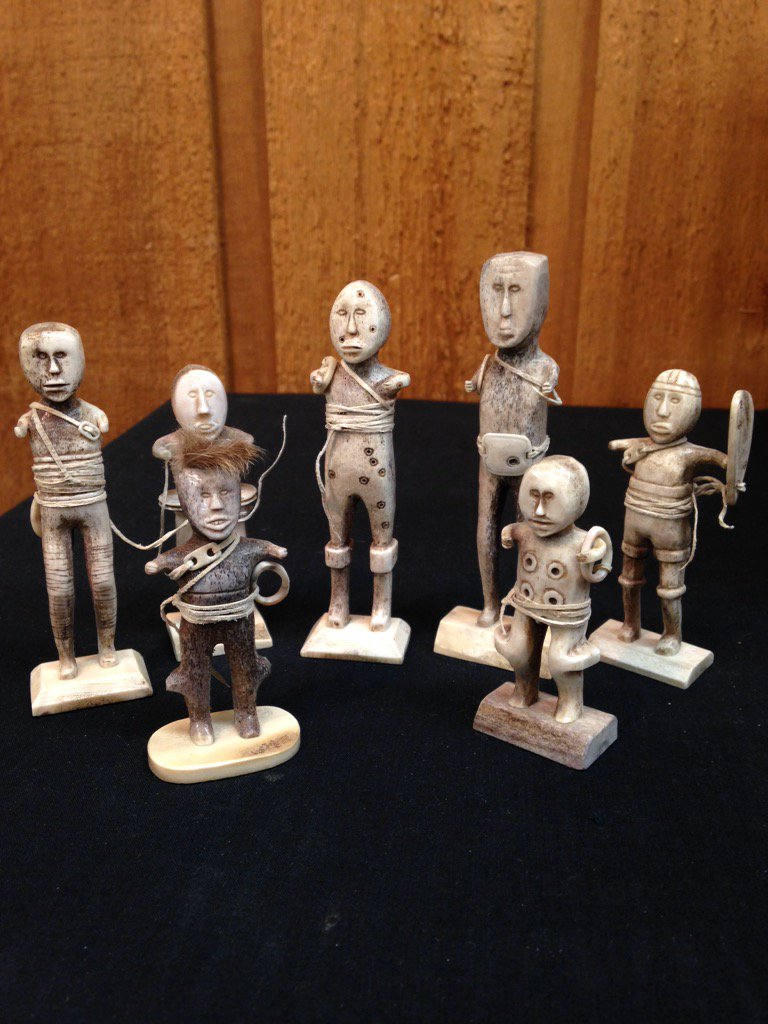
Nenets carvings of Sirtya, made from reindeer antler.

This is a companion-piece to my last post, The Island of Cairns. I'm really pushing the definition of 'Central Asia', here, because there's nothing remotely 'central' about Vaygach Island, which is where the stories of the Sirtya come from: it's right on the northern edge of the continent. And yet the Nenets people who live there are of Central Asian origin, and their beliefs and religious practises have clear similarities with those practised in Mongolia; so, as with Azerbaijan, I'm going to include them anyway. Nor am I alone in doing so: I found Nenets religion discussed under the heading 'Central Asian mythology' in one of the encyclopedias of mythology I consulted on the topic. Maybe Central Asian-ness is a state of mind.

So. The Sirtya are a race of magical white dwarves who live on the coasts and islands of the Frozen Sea. They are very small, perhaps half the size of a human, and very beautiful; their skin is snow-white in colour, and they wear strange metal garments hung with bronze trinkets, seemingly unbothered by the extreme cold. They can see perfectly in the dark, and usually only come out after dusk. They are expert bronze-workers, and their underground tunnels are assumed to be full of furnaces and forges - although no-one really knows for sure, because their entrances are extremely well hidden and well guarded, and there's no practical way to fight or sneak into a complex of tunnels which are only 2' wide and 3' high. They are widely reputed to have the ability to become invisible, and to be able to sink into or rise out of the ground at will; but in fact neither legend is true: both are due simply to their extreme stealthiness and their tendency to honeycomb the territories which they inhabit with networks of concealed tunnels. Turn your head for an instant, and they may very well seem to vanish: but it'll be because they've just jumped into a hidden tunnel someplace, rather than because they've actually sunk into the ground.


Other legends about them have a stronger basis in fact. It is quite true that the Sirtya know spells for calling down clouds, upon which they then ride like floating palanquins: unlike the cloud clans of the Deep Taiga, who catch their clouds with lassos and ride them like beasts, the Sirtya simply sing them down from heaven and direct their flight with verses of murmured song. They know another song for singing fish out of the water and up into their hands, which provides them with their primary means of sustenance: these fish are then skinned and boned, and their flesh eaten slimy and cold and raw. As they live on raw fish, can see in the dark, and do not feel the cold, they need neither home-fires nor cook-fires nor torches, and all the fuel they gather goes straight to their hidden furnaces under the earth. No-one knows what they do about all the smoke.

For the most part, the Sirtya manage to live peacefully alongside the humans of the Frozen Sea; they are not warlike and have no love of conflict, preferring to flee from confrontation on their flying clouds. But greedy clansmen sometimes try to catch them in order to rob them of their embroidered bags and their metal garments, both of which are always of the highest quality; and during bad winters, when every net-full of fish becomes a resource to be bitterly hoarded, conflicts over food-thefts or fishing rights can easily explode into violence. When threatened or engaged in battle, the Sirtya sing a third magic song, which clouds the minds of men; if it works, they then attempt to take ruthless advantage of their confused enemies, knowing that the greater size, strength, and numbers of the humans will surely allow them to prevail in anything resembling a fair fight.

  • Sirtya: AC 15 (bronze harness), 1-1 HD, AB 0, spear (1d6 damage), FORT 15, REF 14, WILL 14, morale 7. May sing down clouds to use as mounts; these can float up to 5' off the ground or over the surface of water, and move as fast as a horse at a gentle trot. When in natural terrain with a decent amount of cover, may 'disappear' in moments, hiding so expertly that they will never be found without an exhaustive search. Anyone who hears their battle-song must make a WILL save or suffer confusion for 1d10 minutes, during which they suffer a -1 penalty to morale and are unable to effectively co-ordinate their actions with others. (The effect of multiple battle-songs does not stack.)

Learning the Songs of the Sirtya: Humans who have performed great services for the Sirtya are sometimes offered the chance to learn their magical songs; but even when both teacher and student apply themselves rigorously to the task, few humans ever manage to perform one of them successfully, as Sirtya voices are able to articulate a range of sounds of which very few human throats are capable. A human who is offered the chance to learn such a song has a percentage chance equal to their Charisma score of being able to master it after several months of practice; failure means that they will never be able to master that song, no matter how much teaching they receive. A different roll must be made for each of the three songs that they attempt to learn. Disciples of the Word and Fan Dancers, due to their extensive vocal training, increase their chance of learning these songs successfully by an additional 10% per level. Even if a Sirtya song is learned successfully, performing it places such a strain on the human throat that it can be performed no more than once per hour.


Sirtya as Player Characters: It would be odd, but not quite unheard-of, for one of the Sirtya to wander south into warmer lands, perhaps even ending up in the Wicked City. If you want to play one you must have Dexterity and Wisdom 12 or higher. Game information is as follows:
  • You can use any thrown or melee weapon, and can use light shields. You can use any kind of armour, but due to your small size it will need to be made specially. (Most Sirtya make their own armour.) You are unfamiliar with guns, but can easily learn how to use them after a few weeks of practise. Note that due to your small size, a single-handed weapon for a human will usually be a two-handed weapon for you: only daggers and similar tiny weapons are small enough for you to wield one-handed.
  • You gain a bonus to all your to-hit rolls equal to half your level, rounded down.
  • You gain 1d6 HP per level.
  • Your natural agility grants you a +2 bonus to REF saves.
  • You can see perfectly in the dark.
  • You are small, nimble, and very good at hiding. When in a place with a decent amount of cover, as long as no-one is actually looking straight at you then you may spend one round to 'disappear', hiding so expertly that they will never be found without an exhaustive search. 
  • You can sing clouds down from the sky and ride around on them, steering them with your voice. (On a cloudless day this ability is useless.) If you get off the cloud, or if you are silenced or otherwise unable to sing, the cloud stops moving and breaks up after 1d6 minutes.The capabilities of these clouds depend on your level:
    • At level one your clouds an float up to 5' off the ground or over the surface of water, have the carrying capacity of a small pony, and move as fast as a horse running at a gentle trot.
    • At level 4 your clouds can rise up to 10' off the ground, have the carrying capacity of a light horse, and can move at the speed of a horse running at a canter.
    • At level 7 your clouds can rise up to 20' off the ground, have the carrying capacity of a heavy work horse, and can move at the speed of a galloping horse. 
  • You do not feel the cold, and are immune to cold damage.
  • You can perform a song which clouds the minds of any humans that hear it. (It affects allies just as much as enemies, so your friends might want to invest in earplugs!) Anyone hearing it must make a WILL save or suffer confusion for 1d10 minutes, during which they suffer a -1 penalty to morale and are unable to effectively co-ordinate their actions with others. At level 5 or higher, it also imposes a -2 penalty on their to-hit rolls. The effect of multiple battle-songs does not stack.
  • You are a highly-skilled metalsmith, especially expert in the forging and working of bronze. Given suitable tools and raw materials, you can manufacture any kind of weapon, armour, or decorative metalwork to an extremely high standard. Your insight into smithcraft grants you a flat +2 bonus to your technology rating. You are also really good at embroidery, but that probably won't come up as much during play.
Sirtya Summary Table

Level
Hit Points
To Hit Bonus
Fortitude save (FORT)
Reflex save (REF)
Willpower save (WILL)
1
1d6
+0
14
12
14
2
2d6
+1
13
11
13
3
3d6
+1
12
10
10
4
4d6
+2
11
9
11
5
5d6
+2
10
8
10
6
6d6
+3
9
7
9
7
7d6
+3
8
6
8
8
8d6
+4
7
5
7
9
9d6
+4
6
4
6
10
10d6
+5
5
3
5

Starting equipment: Bronze harness (AC +5), bundle of small spears (1d6 damage, can be thrown), beautifully embroidered clothes and bag, smith's tools, beautiful bronze jewelry worth 3d6x10 sp.

Thursday, 7 April 2016

The Island of Cairns

From somewhere
a traveller is approaching,
he has reindeers without antlers,
reindeer-bulls without antlers...
This is Vaygach Island, in the Arctic Ocean.


It's about the same size as Long Island in the US, but almost no-one lives there: it's too cold, too bleak, too bare. There are no trees. There is no shelter. Back in the Soviet period, the Russians tried to run a mine there, using conscript labour from the Siberian gulags. It wasn't a success.

Vaygach is regarded as a holy site by the Nenets people of northern Siberia. For centuries, they came here to raise idols and offer up sacrifices to the great spirits, Num and Nga, a dualistic pairing of sky-god and underworld-god comparable to that of Tengri and Erlik further south. They were reindeer herders. They painted the idols with the blood of slaughtered reindeer. They raised piles of stone and wood, Arctic equivalents of the Ovoo cairns of Mongolia, and placed the skulls of the sacrificed reindeer on top of them. Thus the spirits were appeased.


Vaigach Today -- Nenets
A Nenets idol is returned to its original home on Vaygach Island. Photo by Tomasz Kizny.

Like most of Siberia's indigenous peoples, the Nenets suffered badly during the twentieth century. The Soviets disapproved of their nomadic lifestyle, and forced them to move with the times: settle in one place, learn Russian, practise collectivised agriculture. Today their southern cousins, the Forest Nenets, are in a very bad way; there are only a couple of thousand of them left, their language is dying out, their songs and traditions have mostly been forgotten. But the tundra Nenets, the ancestral keepers of Vaygach Island, still manage to maintain some kind of continuity with the past.

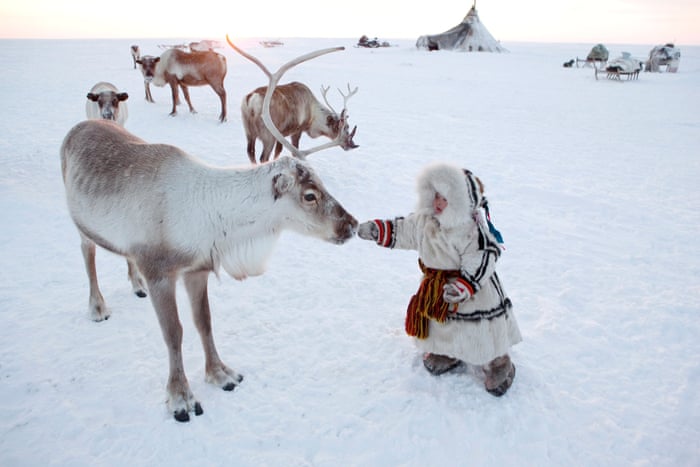
Nenets toddler with reindeer. Her family's reindeer-skin tent can be seen in the background. Photo by Bryan Alexander.

So: far, far to the north of the Wicked City, beyond the steppe, beyond the taiga, beyond the tundra, there is a frozen sea. In that sea is an island; and on that island are many cairns and no houses, many idols and no trees. The cairns and the idols are maintained by the Reindeer People, who drive their herds across the tundra, but even they don't actually live on it. No-one lives on it. It's too holy for that.

On the Island of Cairns, the world of spirits presses very, very close to the world of men. Here, anyone, even a non-shaman, may communicate with the spirits simply by killing an animal, pouring its blood over an idol, putting its skull on a cairn, and then stating their message or request. Do this, and the spirits will heed you; and if they want to answer you then they will come to meet you in person, stepping out from the shadow of a cairn or an idol in the form of a man, or a woman, or a great wild beast. They seem to regard the island as a kind of antechamber to the spirit world, within which it is proper for them to give due audience to those who come to seek them; and even the most hostile and unreasonable of spirits can usually be counted upon to give its supplicants a decent hearing if invoked amongst the cairns of the frozen sea. They may still refuse to give their aid, or demand completely exorbitant offerings in exchange for their assistance, but at least they'll hear you out.

"Zemblien". Allain Manesson Mallet, Description de l'Univers, t. 1, Paris, Denys Thierry, 1683.:
17th century engraving of Nenets hunters. Note the idols in the background.

The Reindeer People say that the spirits are not the only inhabitants of the island. They say that there is a secret race of dwarves, white-skinned and furtive, inhabiting caves beneath the surface; that these dwarves are great magicians who ride across the sea on clouds, singing the fish out of the water and up into their nimble, pale little hands. They say that sometimes, in the depths of winter, huge men like giants come riding across the frozen sea on sleds drawn by great white reindeer without antlers. If you wish to communicate with the dwarves, or with the giants, you must leave offerings for them out on the cairns, and state your message or request with all the courtesy that you can muster. You won't see them, but they will be watching. They will be there.

Magical though they may be, the dwarves and the giants still need to eat, and food is scarce on the shores of the Frozen Sea. Sometimes there are tensions. Sometimes they and the Reindeer People come to blows; and when they do, it's usually the Reindeer People who get the best of it, because unnatural stature and magical powers are no match for having a whole clan of kinsmen backing you up. If you kill a giant or a dwarf, though, it is very, very important that you take their body back to the Island, and build a new cairn over it. Doing anything else invites the most terrible bad luck.

Nenets carvings, made from reindeer antlers, depicting the white dwarves of the Arctic.

Due to their long-term saturation with the energies of the spirit world, the bones, stones, and wood of the island's cairns and idols possess considerable magical power. The merest pebble from such a cairn, worn threaded on a string around the neck as a good luck charm, is worth a +1 bonus to saving throws; wearing a bear or reindeer skull taken from a cairn as a helmet grants protection from misfortune while travelling, while arrowheads made from the antlers of reindeer skulls placed on such cairns, or from the bones of giants or dwarves buried below them, seem almost never to miss, granting a +4 bonus on to-hit rolls. But to plunder the cairns is to risk the wrath of the spirits. Who would dare commit such impious deeds?

Surely only the agents of the Wicked City...

Vaygach Island, Вайга́ч, Vaygach) - Google Search:

Tuesday, 5 April 2016

New B/X class: the Orc

Another in my ongoing series of 'B/X monster classes written while I should be working.' Essay marking is really boring, OK?

I was always a bit frustrated by half-orcs being the default PC race option: if I want to play an orc I should be able to play a bloody orc! You don't see people playing half-dwarves, do you?

(Yes, I know there were rules for half-dwarves in Dark Sun. But everyone in that just played half-giants and insect people and psychic cannibal jungle halflings, so the point still stands.)

So here's a B/X-compatible orc class. Like the dwarf, it's basically a fighter with some minor additional rules for flavour purposes. Have fun hitting people with axes!


B/X Class: The Orc

To-Hit, Hit Dice, Saves: All as per Fighter.

Weapons and Armour: Orcs can use any weapons, but are not proficient with any armour heavier than chainmail.

Experience Per Level: As per Dwarf.

Nocturnal: Orcs can see perfectly in the dark, but bright light pains them. When in bright sunlight, or close to a bright source of light, they suffer -1 to-hit until they can get back into the darkness.

Ritual Cannibalism: Whenever an orc eats the heart of a creature it has personally killed in battle, it gains a number of HP equal to the HD of the dead creature. (Note that eating a heart takes at least a couple of minutes, even for an orc!)

Orc Rage! Orcs get angry really, really easily. Whenever something happens to anger you (e.g. being insulted, being frustrated, being betrayed, etc) you may declare you are going to enter a battle rage. While raging you fight with no heed for your own personal safety: you gain a +1 bonus to-hit and damage, and a +4 bonus to saves against fear effects, but suffer a -2 penalty to AC. Your rage ends when the being(s) that provoked it are defeated, or after a number of minutes equal to your level, whichever comes sooner.

Speak Loudly and Carry a Big Axe: Orcs love huge, impractical, poorly-balanced weaponry. Given a few hours and a heap of scrap metal, you can modify any two-handed weapon to be even bigger, heavier, and spikier than it was before. The resulting weapon is the kind of thing that no-one except an orc would ever consider using, but your combination of brute strength and raw enthusiasm means that in your hands it becomes a lethal if clumsy weapon, inflicting +1 damage at the cost of a -1 penalty to-hit. 

A brief public service announcement

There's a piece on sexual harassment in gaming culture doing the rounds right now. It's called "Tabletop Gaming Has A White Male Terrorism Problem", which is a regrettably clickbait-esque title, but it's a sad and eloquent account of one woman's experiences with sexual harassment and sexual assault in circles associated with tabletop gaming.

I don't want this blog to get dragged into the mire which is gender politics on the internet, but I will say this: if you're ever in a game, or a store, or a convention at which a woman (or a man, come to that) is complaining of sexual harassment or assault, please take it seriously. Get the organisers involved. Get the authorities involved. If you are the organiser, then do everything in your power to get to the bottom of it. It might often feel as though there's nothing you can do. It might often be true that there's nothing you can do. It might even ultimately turn out to be a false accusation. But the simple act of taking these things seriously, of treating them as though they matter rather than just being something to be shrugged off with a muttered comment about boys being boys, actually does a whole lot of good, both for the individuals concerned and for the surrounding culture as a whole.

We now return you to your regularly scheduled OSR D&D weirdness.

Sunday, 3 April 2016

The Kergeden, or Siberian Unicorn

You all saw the news report at the end of March, right? Elasmotherium sibiricum, previously thought to have died out in the middle of the Ionian Stage of the Pleistocene Epoch about 350,000 years ago, actually seems to have survived in what is now Kazakhstan until about 27,000 BC, which in evolutionary terms is pretty much yesterday. That means they lived alongside humans. People probably met them. People probably ate them. That's probably why there aren't any of them left today.

They looked like this. Probably.

Given how late populations of woolly mammoth and woolly rhinoceros survived in Siberia in the real world, I've just kinda assumed that they're still around in ATWC, being domesticated and ridden by nomadic clans in the depths of the Deep Taiga. After this, the Siberian Unicorn - or 'Kergeden', to use the Turkic word for 'unicorn' or 'rhino', which is presumably what the people of the area would call them if they were actually still alive - is totally getting added to the list. The only unicorns that exist in the setting are now 7' tall, 15' long, shaggy-coated monsters with a horn the length of a sword.

They are rare, of course. They are so rare that many people believe them to be mythical. But in a few remote areas of the steppe and taiga, the kergeden still live: huge, ill-tempered beasts, fearsomely strong, with great horns on their heads easily long and strong and sharp enough to impale a grown man right through. No ordinary man or woman can ride one, and they disdain domestication: but something in their fierce natures makes them warm to the bravest and hardiest of warriors, and to these and these only will they submit themselves as mounts. Folklore says that they can smell both courage and fear, and that if their rider should ever disgrace them by some act of cowardice, the kergeden will immediately toss them up into the air and attempt to catch them on their horn, goring them to death in order to wipe out the dishonour of allowing themselves to be ridden by such a dastard soul.

Or maybe they looked like this? No-one actually knows how big their horns were...

In game terms, kergeden are mounts for higher-level characters. It's not enough to be a generally courageous person: only when your bravery has been proven in the face of severe adversity, not just once but many times, will the kergeden allow you to use it as a mount. (You also have to be a highly skilled rider and animal handler, of course: but as I've mentioned before, I take for granted that all ATWC PCs will fit that description.) This doesn't mean screaming and charging all the time, no matter the odds, which all the steppe peoples recognise is the mark of a stupid warrior rather than a brave one - these are the people whose signature battle tactic was the false retreat, after all - but it does mean that whenever things got rough, your focus must always have been on achieving your objectives as best you could rather than on saving your own skin. Anyone whose record of courage under fire has been less than exemplary can expect to be gored to death instead. Because it is widely known that only the bravest of warriors may ride such a beast, actually doing so will grant you a +1 reaction bonus from anyone who cares about martial prestige: this includes just about all steppe peoples, and most inhabitants of the desert and taiga, as well.

The kergeden eats lots and lots and lots of grass. Trying to ride them into the desert is probably a bad idea unless you have a lot of fodder.

  • Kergeden: AC 14 (very thick, tough hide) or AC 20 (hide plus metal barding), 7 HD, AB +4, gore and trample (1d8+4 damage), FORT 6, REF 10, WILL 7, morale 9. Inflicts double damage when charging. Anyone charged by a kargeden must make a morale roll to hold their ground; if they do, even if its charge attack misses, then they must make a REF save or take 2d6 damage from being smashed and trampled underfoot.

Thursday, 31 March 2016

New B/X Class: the Deep One Hybrid

Everyone wants to be a Deep One really! Swim all day, pray to Cthulhu all night, study forbidden secrets from before time, live forever, maybe run your own cult... What's not to like?

All together, now: Ph'nglui mglw'nafh Cthulhu R'lyeh wgah'nagl fhtagn...

(I promise my next post will actually be about Central Asia again!)

Deep One Hybrid, from Pathfinder Bestiary 5.


B/X Class: The Deep One Hybrid

To-Hit, Hit Dice, Saves, Weapons and Armour: All as per Fighter.

Experience Per Level: As per Magic-User.

Natural Swimmer: At level 1, you can swim at the same speed you can move on land, and hold your breath for a number of minutes equal to your Constitution score. You have webbed feet.

Water Breather: At level 2, gills open on the sides of your neck. You can now breathe freely underwater.

Innsmouth Look: At level 3, your eyes become huge and bulging. You can now see perfectly even in very low light (although not in total darkness).

Teeth and Claws: At level 4, your teeth become long and sharp, and your hands warp into claws. You can do 1d4 damage in melee even when unarmed.

Oceanic Adaptation: At level 5, your skin becomes rough and scaly, and your body bulks out with the masses of blubber and muscle required for existence in the ocean depths. You gain +1 AC, and inflict +1 damage in melee due to your increased bulk and strength. By this point you look like a total freak, and may want to consider investing in some very big hats and coats.

Blessing of Hydra and Dagon: From level 6 onwards, you gain spell-casting abilities equal to those of a Cleric of half your level, rounded down. (You don't gain any other cleric abilities: just the spells.)

Lord of the Seas: At level 7, you gain the ability to command the creatures of the swamps and seas. This functions as per the Chaotic cleric ability Command Undead, except it applies to aquatic and amphibious creatures instead of undead. This ability does work on intelligent creatures such as Bullywugs, but they get a save vs. spells to resist it.

Command the Formless Spawn: At level 8, your Lord of the Sea ability also allows you to command unintelligent slime and ooze monsters. 

Call the Cult: At level 9, you intuitively reach out through your dreams to nearby unstable individuals, calling them together to form a cult of which you are the leader. Over the next few weeks, 3d6 crazy people (a mixture of 1st-level fighters, thieves, and magic-users) will arrive, and serve you with fanatical loyalty. Whenever one dies, an equally crazy replacement will turn up 1d3 weeks later. Each time you go up another level you gain another 1d6 cultists.

The Sea is Calling: At level 10, you hear a song in your dreams that calls you to a holy place in a sunken city at the bottom of the sea. If you follow it, and complete the hazardous journey successfully, you undergo a final metamorphosis in which you shed the last remnants of your humanity. You cease to age, become immune to disease, and will live forever unless killed by violence.

Image by Dan Moore

Tuesday, 29 March 2016

Sir Gawain Goes Hexcrawling


I was preparing an extract from the 14th-century chivalric romance Sir Gawain and the Green Knight for a class the other day when I suddenly realised that it's basically a description of a rather aimless D&D hexcrawl. Gawain is on a quest for the Green Chapel, but he doesn't know where it is except that it's 'somewhere in the wilderness of Wirral'; so all he can do is blunder about from hex to hex, fighting monsters and having random encounters, until finally he's reduced to praying for outright divine intervention. He even sleeps in his armour like a proper D&D character!

Here's the text. Original Middle English on the left. My (painfully literal) translation on the right. 

Middle English Text
Literal Modern Translation
He made non abode,
Bot wyȝtly went hys way;
Mony wylsum way he rode,
Þe bok as I herde say.

He made no stop,
But manfully went on his way;
Many tiresome paths he rode,
As I have heard the book say.

Now ridez þis renk þurȝ þe ryalme of Logres,
Sir Gauan, on Godez halue, þaȝ hym no gomen þoȝt.
Oft leudlez alone he lengez on nyȝtez
Þer he fonde noȝt hym byfore þe fare þat he lyked.
Hade he no fere bot his fole bi frythez and   dounez,
Ne no gome bot God bi gate wyth to karp,
Til þat he neȝed ful neghe into þe Norþe Walez.
Now rides this hero through the realm of Logres,
Sir Gawain, on God’s behalf, though he thought it no game.
Often alone and friendless he lodged at nights
There he found not before him the fare that he liked.
He had no friend but his foal by forests and downs,
And no-one but God to talk with on the way,
Until he had almost come into North Wales.
Alle þe iles of Anglesay on lyft half he haldez,
And farez ouer þe fordez by þe forlondez,
Ouer at þe Holy Hede, til he hade eft bonk
In þe wyldrenesse of Wyrale; wonde þer bot lyte
Þat auþer God oþer gome wyth goud hert louied.
And ay he frayned, as he ferde, at frekez þat he met,
If þay hade herde any karp of a knyȝt grene,
In any grounde þeraboute, of þe grene chapel;
And al nykked hym wyth nay, þat neuer in her lyue
Þay seȝe neuer no segge þat watz of suche hwez
of grene.
All the isles of Anglesey he kept on his left side
And fared over the fords by the forelands
Over at Holy Head, until he had landed
In the wilderness of Wirral; there very few lived
That loved either God or man with good heart.
 And always as he fared, he asked the people that he met
If they had heard any talk of a green knight
Or of the green chapel in any place thereabout; 
And all replied that, no, never in their lives
Had they ever seen a man of such a hue
Of green.
Þe knyȝt tok gates straunge
In mony a bonk vnbene,
His cher ful oft con chaunge
Þat chapel er he myȝt sene.
The knight took strange roads
On many a rough bank
His mood often changed
Before he saw that chapel.

Mony klyf he ouerclambe in contrayez straunge,
Fer floten fro his frendez fremedly he rydez.
At vche warþe oþer water þer þe wyȝe passed
He fonde a foo hym byfore, bot ferly hit were,
And þat so foule and so felle þat feȝt hym byhode.
So mony meruayl bi mount þer þe mon fyndez,
Hit were to tore for to telle of þe tenþe dole.
Sumwhyle wyth wormez he werrez, and with wolues als,
Sumwhyle wyth wodwos, þat woned in þe knarrez,
Boþe wyth bullez and berez, and borez oþerquyle,
And etaynez, þat hym anelede of þe heȝe felle;
Many cliffs he climbed over in strange countries,
Far asunder from his friends, lonely he rode.
At each ford or water where the hero passed 
It was strange if he found not a foe before him, 
And that so foul and fell that he was forced to fight.
So many marvels in the mountains there the man found,
It would be tedious to tell of the tenth part.
Sometimes with serpents he warred, and sometimes with wolves,
Sometimes with wild men, that lived in the cliffs,
Both with bulls and bears, and at other times with boars,
And giants, that assailed him from the high fells;
Nade he ben duȝty and dryȝe, and Dryȝtyn had serued,
Douteles he hade ben ded and dreped ful ofte.
For werre wrathed hym not so much þat wynter nas wors,
When þe colde cler water fro þe cloudez schadde,
And fres er hit falle myȝt to þe fale erþe;
Ner slayn wyth þe slete he sleped in his yrnes
Mo nyȝtez þen innoghe in naked rokkez,
Þer as claterande fro þe crest þe colde borne rennez,
And henged heȝe ouer his hede in hard iisse-ikkles.
Þus in peryl and payne and plytes ful harde
Bi contray cayrez þis knyȝt, tyl Krystmasse euen,
al one;
Had he not been doughty and stern, and served God,
Doubtless he would often have been dead and slain.
But war tried him not so much that winter was not worse,
When the cold clear water fell from the clouds, 
And froze before it could fall to the earth.
Nearly slain by the sleet he slept in his irons
More nights than enough on naked rocks,
Where the cold burn ran clattering from the crest,
And hung high over his head in hard icicles.
Thus in peril and pain and plights full hard
Through the country wanders this knight, until Christmas eve,
Alone;

Þe knyȝt wel þat tyde
To Mary made his mone,
Þat ho hym red to ryde
And wysse hym to sum wone.
The knight well that tide
To Mary made his plea,
That she would direct his riding
And lead him to some home.


(Spoiler: She does! And that's when the real adventure begins...)