Saturday, 20 June 2015

Technology rules for ATWC

So cute! Let's repair him and take him home! Image by Jordan-Aexander Thomas
The world of ATWC is littered with weird clockwork machinery, created by mad savants, fallen empires, and people who really, really like watching gears tick round in circles. Some of the resulting technology is in relatively widespread use: airships, clockwork wings, and prosthetic clockwork limbs may not be common, but people know they exist, and in major cities they can usually be obtained by someone with enough money to throw around. Other forms are rarer: one-off masterworks clicking away in the workshops of eccentric engineers, or ancient machineries rusting into useless amidst the ruins of long-lost civilizations. 

All ATWC characters have a Technology rating, which is equal to their Intelligence modifier. (With traditional D&D magic-users out of the picture, this gives the intelligence stat a reason to exist.) ATWC uses a LotFP-style ability modifier system, so 3 is -3, 4-5 is -2, 6-8 is -1, 9-12 is 0, 13-15 is +1, 16-17 is +2, and 18 is +3. Scholars and brass men get bonuses to their technology rating, as detailed in their respective class descriptions. The average person has a technology rating of 0; tech 1-2 is enough to operate most common clockwork machinery, while more sophisticated technology requires tech 3-4. Tech 5 and above is usually needed only for the most fantastically complex clockworks.

Each piece of clockwork technology in ATWC has four associated complexity ratings: Operate (O), Maintain (M), Repair (R), and Construct (C). A regular pocket-watch, for example, might be OM 0, R 1, C 2: anyone with tech 0 or higher (i.e. anyone of average intelligence) can use and maintain it, but repairing a broken one requires tech 1, and creating one from scratch requires tech 2. A clockwork automaton which simply performs a single task, such as dancing, might be OM 1, R 2, C 3. 

  • If your tech rating is equal to or higher than the rating required for the task you want to attempt, then you can do it, provided you have enough time and access to the appropriate tools and materials. No roll is required.
  • If your tech rating is one point lower than the rating required for the task you want to attempt, then you have a 50% chance of success. If you succeed, it works; if you fail, you mess something up and damage the mechanism. So a character with tech 0 who attempts to repair a broken pocket watch (R 1), has a 50% chance of getting it working again, and a 50% chance of just damaging it even further. 
  • If your tech rating is two or more points lower than the rating required for the task you want to attempt, then you fail. A glance at the machinery will tell you that you are facing something far beyond your limited skill. If you insist on trying anyway, you'll only end up damaging it.
All this assumes that you actually understand what the device is and roughly how it's supposed to work. If, on the other hand, you've just come across an enigmatic pile of clockwork junk in an old ruin someplace and want to try to repair it or get it working, you need to make a technology roll: roll 1d6, and add your tech rating. If the result is equal to the device's relevant rating plus five, then you succeed; otherwise, you can't work out how to do it. If you fail with a roll of 1, you also damage the mechanism in the process.

Example: Adilet (tech 1), Jyrgal (tech 3), and Taalay (tech 0) are adventuring in the wilderness when they chance across two cute little clockwork robots. (OM 2, R 3, C 4) One looks mostly intact; the other is badly damaged. Adilet thinks they're adorable, and insists on trying to get them working and bring them home.

Jyrgal, the group's scholar, sets to work on the intact one. Its Operate difficulty is 1, well below his tech modifier,so normally this would be no problem; but he's working with unfamiliar technology, here, so he has to make a tech roll, trying to hit 6 or higher. He rolls a 2, and fails; he just can't figure out how to make it work. Adilet pushes him aside to see if she can work it out, and rolls a 6. To Jyrgal's mild embarrassment, she soon works out how to get it operational, and within minutes the robot is scooting around and trying to eat the coal from Taalay's saddlebags. 

Nettled, Jyrgal turns to repairing the broken one. Its Repair difficulty is 3, so repairing it requires a tech roll of 8 or higher; just a glance into the labyrinthine clockwork mechanisms inside it tells Adilet and Taalay that there's no point in them even trying. Jyrgaal gets out his tools and sets to work, though, and this time his technology roll is a 5, for a total of 8. After several hours of tinkering, he manages to get the second robot fully operational; Adilet's already worked out how they're activated, so soon they have two cute little clockwork buddies running along behind them. Taalay's coal supply doesn't stand a chance. 

Friday, 19 June 2015

D&D Monsters from improbable sources 1: Poems by eighteenth-century schoolboys

'Sudden deep-groan'd the yawning earth;
A ghastly Phantom rear'd his head!
Grim Tart'rus gave the monster birth;
On his torn breast the Vulture fed.

His eyeballs flash'd with livid fire:
The sad shrill shriek discordant broke!
The furies all the Fiend inspire!
His black lips trembling, thus he spoke...'

These lines come from a poem called The Fate of Lewellyn, or, The Druid's Sacrifice, written in 1777 by a seventeen-year-old British schoolboy. It demonstrates conclusively that seventeen-year-old boys have been the same throughout history, and are genetically programmed to think that monsters that look like they've escaped from the covers of old heavy metal albums are really, really cool.

Still, though... a black-lipped phantom with flaming eyeballs that bursts out of the earth with a vulture eating its guts is pretty fucking metal. I mean, was the vulture down there underground with it the whole time, or what? How did it breathe? No-one gives a fuck. There's something kinda charming about that.

So, with no further ado:

  • Black-Lipped Phantom: AC 16, 4 HD, +4 to hit, 2 claws (1d8 damage) or 1 fire-blast (2d6 damage), saves 10, morale 12, special attacks: shriek, gut vulture. Regenerates 2 HP per round whilst underground.

The Black-Lipped Phantom is a demonic undead monster born from the spirits of those who die raging against their fates. Their rage is so intense that it traps their spirits in their bodies. Gradually their anger takes physical form within them, in the shape of a single huge black egg nestled deep in their guts. If, at this stage, someone digs up the corpse, pulls out the egg, and smashes it, then their spirit will chill the fuck out and proceed to the afterlife. If this doesn't happen, however, then the egg will hatch into a grotesque vulture-thing, made of anger and shadows, which tears ceaselessly at their regenerating guts in a constant enactment of their endless rage.

MY LIPS ARE BLACK WITH HATE

Black-Lipped Phantoms lurk under the ground in the soil where they were buried. (If no-one buried them, they dig themselves into the ground as soon as they become animate.) Animals can sense their presence and refuse to go anywhere near them unless forced. Whenever any living creature approaches their grave, they will 'swim' through the soil towards it (at normal human walking pace) and then burst up right in front of their victim, with a 5-in-6 chance of causing surprise. As they do so, they will emit a shriek of such ear-splitting volume that anyone who hears it must make a saving throw or be struck deaf for the next 1d6 hours. Also the vulture flies out of their guts and starts eating people: being made of shadows it can't be harmed in any way, ignores armour, and will happily rip away at its chosen victim for 1d2 damage per round. It cannot go more than 10' from the phantom (to which it remains attached by a tether made of entrails), and will vanish if the phantom is killed.

In combat, the phantom will attack either with its two claws (1d8 damage each) or by emitting blasts of livid fire from its eyeballs (2d6 damage, 15' range). As it fights, it will rage and gibber about how much it hates everything and how everyone deserves to die. If 'killed' it sinks into the soil and starts regenerating, but it (and its vulture) will remain comatose until it is fully regenerated. If dug up and burned during this time, it can be gotten rid of for good.

Despite their hatred of all life, Black-Lipped Phantoms have an overwhelming, irrational fear of teenage girls, and will not attack any party which contains one.

Central Asia vs. Western Europe: differences to bear in mind whilst gaming

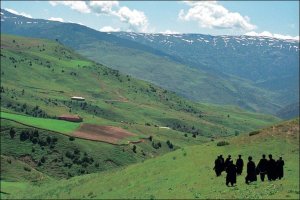
Photo by Umida Akhedova. Imagine those guys in the bottom right as your PCs.

As I've mentioned a few times, the setting of ATWC is (loosely) inspired by the history and geography of central Asia. I think everything in it would still work if you relocated it to a standard generic vaguely European fantasyland; but if you don't, there are a few things to bear in mind about the differences between central Asia and the western European nations which form the blueprint for most fantasy settings. So:

1: Distances are enormous

Let me just emphasise this: central Asia is huge. If you're in the middle of the steppe, and you pick a direction, and you ride all day and you ride all night, you know where you'll be? That's right: still in the middle of the goddamn steppe. Travel times are measured in weeks, months, and occasionally years. As a result of this, trying to find a single site amidst all this empty immensity is like trying to find a needle in a haystack: unless it's on a major landmark (on the top of a large mountain, at the fork of a major river, by the side of an important road), you're simply never going to be able to locate it unless you have someone with you who really knows the territory.

2: The landscape is unforgiving

It's not lethal. We're not talking about Death Valley or the wilds of Iceland or the middle of the Sahara Desert, where if you wander off without proper preparation you can easily be dead within 24 hours. But the steppe and the desert and the mountains and the taiga are... hard. The wind is strong. The nights are cold. Sources of food, water, and shelter can be few and far between. An unprepared traveller probably won't die on the first night, or the second, but sooner or later the combination of cold and hunger and exposure will wear them down.

3: Horses are not optional

This is a natural consequence of 1 and 2. In a lot of fantasy games, horses are a kind of added convenience: they mean that you can get from A to B in two days instead of four, but really, who cares about travel times? Spend the money on extra weapons instead! In a central Asian setting, though, where the landscape is huge and open and relatively flat, horses make an enormous difference: a journey which would be nightmarish on foot becomes manageable on horseback, not just because it's faster, but also because it matters less to the rider if sources of water or shelter are many miles apart. All ATWC characters start play with horses for a reason, and are assumed to be proficient at riding in much the same way that they are assumed to be proficient at breathing.

4: Authority is decentralised

Imagine trying to run a heavily-centralised empire so huge that it could take several months for a messenger to travel from the capital to the frontier and back. As soon as the first real crisis hit, you'd have two options: give up on the centralisation, or give up on the empire. You can't afford to keep all the military and administrative authority hoarded up in the capital, because by the time you're able to respond to news from the frontier, your border garrisons have all already fallen to the enemy and your frontier territories have been subjected to months of looting and occupation. You  need to have regional governors on the ground with all the authority and resources they need to deal with a full range of situations, and that means that they're usually going to behave more like local kings than government officials, because in practise that's pretty much what they are. This also means that rebellions (either of the open 'I declare myself a king' kind, or the de facto 'I'm just going to start treating my orders as optional suggestions' kind) happen all the time, creating a background hum of low-level political instability which is rife with opportunities for adventure.

* * *

Personally, I feel that all of these are positive things from the perspective of fantasy gaming. Enormous, lightly-settled landscapes make the presence of weird creatures and lost ruins more credible than just dropping them into a wood halfway between fantasy-Cambridge and fantasy-London. ('There's a whole tribe of monsters living in here? Wow. You'd think someone would have noticed!') Harsh landscapes, as well as providing suitably inspiring backdrops for adventure, keep things from getting too comfortable: you can't just strike out into the wilderness with five friends, ten hirelings, and twenty horses and assume that you'll all be able to live off the land. Decentralised authority solves the 'we call in the cops' problem: your characters might love to hand whatever horrible problem they've just stumbled into over to the proper authorities, but the proper authorities are months away, and the local governor has one regiment of horsemen with which to keep order in an area the size of France. All in all, the net effect should be to foster a sense of sturdy self-reliance in PCs: an awareness that if they don't solve the problem, or find the lost temple, or even work out how to gather enough food to complete the journey, then no-one else is going to do it for them. I happen to think that's rather a good thing.

Thursday, 18 June 2015

Glimpses of the Wicked City: the Ruined Districts

The basic inspiration for the Wicked City came from three artists: Giovanni Piranesi, Joseph Gandy, and Gustav Doré. All three of them were fascinated by the relationship between the modern cityscape and the ruins of the ancient world. They knew what happened to great civilizations: they rose, and then they fell. They looked at the cities around them and they saw ruins in the making.

The Wicked City is a city which, while still inhabited, is falling into ruins. It originally had a population of more than a million; now it's down to less than half that, and its physical infrastructure is falling apart. Whole areas of the city have been allowed to collapse into ruin and decay. 

So here are some images from the Ruined Districts. First, some by Giovanni Piranesi: human beings dwarfed by the ruins amidst which they live.


Some Gandy, to give an idea of what the more ruinous sections of the city look like:


Some Doré, looking out towards the ruined districts:


The more inhabited sections look like Doré's London engravings, while the centre - the Cobweb and the King's Tower - are crazy mega-architecture like something out of Magic: the Gathering's 'Ravnica' setting, like this:


I'll probably discuss them in more detail in a future post. 

Wednesday, 17 June 2015

Denizens of the Wicked City 3: Brass Men (playable character class)


The Brass Folk are a self-perpetuating race of intelligent brass and clockwork automata. They claim to have been created by a woman whom they call the Cogwheel Sage: they worship her as the mother of their race, and claim that she still lives somewhere beyond the mountains, having long since replaced her frail flesh-and-blood body with a superior frame of indestructible brass. (Occasionally, especially devout Brass Folk set out on pilgrimages to find her, although they either return empty-handed or not at all: the mountain passes are not kind to those who are heavy of tread.) They travel the land in great clanking caravans, pulled by enormous bronze horses. They are expert in all forms of clockwork and metalcraft, including the repair and creation of their own kind, although building the brain of a new Brass Man or Brass Woman from scratch is so labour-intensive, and requires so much ultra-fine clockwork, that most Brass Folk caravans only expand their own numbers in times of great prosperity.

When the Brass Folk come to a community, they will offer to carry out mechanical repairs, make or fix metal objects, sell guns, clocks and pocket-watches, and manufacture clockwork prosthetics for anyone who has lost a limb. In return, they always want the same things: metal and coal. They avoid violence whenever possible, but a community which treats them poorly can expect to find itself afflicted with a severe clockroach infestation the day after they depart.

Game information for Brass Folk PCs is as follows:
  • You must have a strength and constitution of at least 12 to play one of the Brass Folk.
  • You may use any weapons or shields. Your bulky mechanical body grants you +5 AC, but prevents you from wearing any other armour.
  • You gain 1d10 hit points per level.
  • You gain a bonus to all your to-hit rolls equal to half your level, rounded up.
  • You gain a bonus to technology rolls equal to half your level, rounded up.
  • Your heavy brass fists allow you to inflict 1d4 damage with melee attacks even when unarmed.
  • You get a -2 penalty to REF saves (included in the table below), and a -2 penalty to initiative rolls.
  • The whirring and clanking of your heavy brass body makes a hell of a lot of noise. Your enemies are never surprised, and you always fail any attempts to move silently.
  • You do not need to eat, drink, or sleep, and you are immune to poison and disease. 
  • You need winding up in order to function. All brass folk have steam-powered auto-winders, normally built directly into their bodies; when fed a supply of wood or coal, these auto-winders will spin rapidly, turning the brass man's key in the process. They must sit still during the winding, or else they risk damaging their delicate internal machinery. One hour's auto-winding will power three hours of activity. If fuel for it is unavailable, the key may be turned by hand, but doing this rakes six times as long, is amazingly boring, and risks causing strain injuries. For obvious reasons, they cannot wind themselves up.
  • When you have been wound for a number of hours equal to your Constitution score (thus permitting three times your Constitution score in hours of continuous activity), your main-spring is fully wound and further winding has no effect. If you reach the end of your 'powered' time without having a chance to rewind, you can stumble on for one extra hour, getting slower and slower: you have -4 Dexterity and Strength during this time. At the end of this extra hour, you shut down entirely until rewound. 
  • You do not feel pain. Normal healing does not help you, but you can repair yourself when damaged, regaining 1 HP per day for field repairs carried out on the march, and 3 HP per day for a day spent doing nothing else. These numbers each rise by 1 if there is someone with a technology bonus of 3 or higher around to lend a hand. 
  • If you are reduced to 0 HP, you are too badly damaged to be repaired in the field, but with the right tools and expertise you can still be repaired in a well-equipped workshop, and will retain your memories and personality unless your clockwork brain has also been damaged or destroyed. 
Brass Folk Summary Table

Level
Hit Points
To Hit Bonus
Technology Bonus
Fortitude save (FORT)
Reflex save (REF)
Willpower save (WILL)
1
1d10
+1
+1
14
16
14
2
2d10
+1
+1
13
15
13
3
3d10
+2
+2
12
14
12
4
4d10
+2
+2
11
13
11
5
5d10
+3
+3
10
12
10
6
6d10
+3
+3
9
11
9
7
7d10
+4
+4
8
10
8
8
8d10
+4
+4
7
9
7
9
9d10
+5`
+5
6
8
6
10
10d10
+5
+5
5
7
5

Starting equipment: Huge two-handed hammer (1d10 damage), 2 pistols (1d8 damage, 3 rounds to reload, one built into each forearm), compass (built into palm), bronze horse (twice as strong as a normal horse but slow and very clumsy, eats coal, needs winding just like you do - replaces default riding horse), box of tools and spare parts, bag of coal, 2d6x10 sp. 

Tuesday, 16 June 2015

Stealing inspirational art from Magic: the Gathering

I play Magic: the Gathering. Don't judge me. It's far easier to get one person to sit down for a 20-minute one-off card game than it is to get six people together for a three-hour RPG session once a week.

Magic has just spent the last year doing a block of expansion sets with a central Asian theme. Convenient, no?

Most of their art, of course, is totally inapplicable to ATWC, because it's full of Cool Fantasy Guys posing with glowing swords and shit while something explodes in the background, and that's not really the vibe I'm looking for. But a few of their pieces do fit. I'm just gonna dump them here.

Some very cool, central Asian-inspired armour designs on this one.

I'm sure there are a bunch of guys who ride giant falcons in ATWC somewhere.
War goats. War. Goats.
And war... rams?
Yeah. War rams. I love these guys.
These totally exist somewhere and you absolutely don't ever want to go there.
Horrors of the Wicked City.
More horrors of the Wicked City.
Crag-top monasteries.
Their students have Strong Opinions about the Wicked City. They are Against it.

Adventures set inside the bellies of giant fish are automatically 50% more awesome.
Ghosts of the desert sands.
Awesome shaman dude 1.
Awesome shaman dude 2.
Love the armour on this one.
Artificer at work.
Ruined cities on the backs of giant zombie turtles fuck yeah.

Monday, 15 June 2015

20 things your trickster might have 'acquired' and not be quite sure what to do with

Oirat Woman, Oblispolk, Mongol, Russia. Taken during the 1920s.
The pipe helps her think. She'll work out what to do with her latest haul sooner or later.
Well, I've done Fighters and Scholars, so now it's the trickster's turn. As with the others, there's a quick starting equipment table (roll or pick), and then the important bit: what has your trickster recently come into possession of that's only going to get them into way, way more trouble a bit further down the line?

(Fighters look grimly at mementoes. Scholars forget to return library books. Tricksters have wacky adventures that lead to them stealing things which will embroil them in further wacky adventures. So it goes.)


Trickster Additional Starting Possessions Table (Roll 1d6)


Roll
Possessions
1
Gambler's gear: Fancy clothes, concealed chain shirt (+4 AC), concealed pistol (1d8 damage, 3 rounds to reload), loaded dice, marked cards, 3d6x10 sp.
2
Burglar's gear: Lightweight clothes in dark colours (treat as light leather jacket, +1 AC), pistol (1d8 damage, 3 rounds to reload), 50' rope with grappling hook, set of lockpicks, 3d6x10 sp.
3
Entertainer's gear: Heavy travelling coat (treat as buff jacket, +2 AC), colourful performance costume adorned with ribbons, musical instrument, songbook, juggling balls, 3 daggers (1d4 damage, also for juggling), pistol (1d8 damage, 3 rounds to reload), 1d6 firecrackers, 1d6 marionettes and glove puppets, 1d6x10 sp.
4
Con-man's gear: Respectable-looking clothes, concealed chain shirt (+4 AC), concealed pistol (1d8 damage, 3 rounds to reload), 1d6 fraudulent contracts, paper and ink, 1d6 vials of coloured water with labels claiming that they are rare and expensive drugs, 1d3 pieces of ostentatious jewellery (all fake), 6d6x10 sp (half real, half realistic forgeries).
5
Spy's gear: Nondescript clothes, concealed chain shirt (+4 AC), concealed pistol (1d8 damage, 3 rounds to reload), lockpicks, disguise kit containing wigs and make-up, paper and ink, tiny capsule of poison (suicide pill), 2d6x10 sp.
6
Wastrel's gear: Flamboyant and expensive clothes (now shabby and in need of repair), ostentatious hat with 1d3 feathers, concealed chain shirt (+4 AC), pistol (1d8 damage, 3 rounds to reload), bottle of strong drink, deck of cards, musical instrument, box of cigars, 1d6x10 sp.

20 Things Your Trickster Might Have 'Acquired' And Not Be Quite Sure What To Do With (roll 1d20)

1.   A bundle of incriminating papers, implicating an influential local figure in a variety of crimes and misdemeanours. About half of them look genuine, but you're pretty sure the rest are high-quality forgeries.
2.   A hand-drawn map of a local temple, with several secret passages marked on it. Next to one of them - which appears to connect the temple with another nearby building - someone has written the words: 'NEVER use this tunnel after dark.'
3.   A collection of exquisite pornographic woodcuts, depicting an assortment of extremely unnatural acts. Selling them to the right person could earn you a lot of money. Selling them to the wrong person could get you into a very large amount of trouble.
4.   A performing monkey, trained to do amusing impressions of various famous people. Has a nasty habit of grabbing small, valuable objects and throwing them out of windows while you're not looking.
5.   A stack of passionate love letters, tied with a red ribbon, written to a local noblewoman by someone who was definitely not her husband. Frustratingly they're all anonymous, but various internal clues suggest the author was not a member of the aristocracy.
6.   A mass of papers written in some kind of complicated cipher. You haven't been able to crack it, yet, but you're working on it...
7.   An anonymous journal, which records in obsessive detail the suspicious activities of a variety of seemingly-innocuous local citizens, whom the author seems to have been keeping under close observation. Either he was totally paranoid, or they are engaged in some kind of conspiracy. Maybe both.
8.   A tiny, gilded metal box, the size of your closed fist, locked tight. All your efforts to open it have so far proven ineffectual. When shaken, it makes a very soft clinking sound, as of tiny glass objects bouncing off one another inside.
9.   A stash of very powerful, oddly-scented opium. Taking it induces dreams of a tower on some distant hillside... but it's always the same tower, and the time and season in the dream-visions match those in real life. The more you take, the more powerfully you feel that something inside the tower is trying to reach out and contact you through your drug-induced dreams...
10.  You stole a cart. Hidden at the bottom of the cart there was a coffin. The coffin is locked shut with seven different locks, and something keeps bumping around inside it. It's been more than a week, now, and whatever's in there has had no food or water, but it just keeps thumping around. It's really starting to freak you out.
11. Your ex-lover's wedding ring. Now that was a complicated relationship. You spent most of your time screaming insults at each other and throwing things, but every time you look at the ring you can't help but wonder whether you should track them down and give things one more try...
12. A map, which shows in painstaking detail how to navigate the ring of deadly reefs around a distant island. A point near the middle of the island is marked with an X. There is no hint as to what 'X' might actually be.
13. Chapters six, seven, and nine of some kind of book on mechanical engineering, seemingly torn from a larger work. They describe in enormous detail how to construct an intricate clockwork mechanism, but what it’s supposed to do is left unclear – and, besides, with chapter eight missing you wouldn’t know how to build one of the most important parts…
14. An old family tree, showing the ancestry of a local noble family. If it’s accurate – and it looks like it might be – then a whole branch of the family has somehow disappeared since it was written, despite (or because of) the fact that they should really be the primary heirs to the family’s land. You wonder if there are any surviving members…
15. A letter of recommendation, signed and sealed by a king from a far-off land, which declares you to be the All-Conquering Slayer of Beasts and Monsters, Katarina the Magnificent. You’ve never heard of her.
16. A bronze-and-clockwork head of a woman, slightly larger than life-sized, clearly missing a chunk of mechanisms from the area of its throat. When wound up, the gears turn and the lips move as though trying to speak, but no sound comes out.
17. A notebook in which someone has recorded, in great detail, the gastronomic preferences of a whole range of important and powerful people. Very handy if you want to make a good impression - or to set someone else up to make a bad one!
18. The personal seal of a high-ranking local official, used to authorise official documents. The official is currently away on some kind of sensitive diplomatic mission, and you have no idea when (or if) they will return.
19. A land grant, bearing the seal of a dead official, declaring Lord Farhad and his daughter Ara to be the rightful owners of Seven Lake Country. As far as you know, Farhad and Ara have been dead for years, and Seven Lake Country is way, way out into the wilderness; but still, if you can pass yourself off as a descendant, maybe you can find more profit than they did out on the frontier…
20. A beautiful wedding dress, totally soaked in lethal contact poison. You’re sure it’ll come in handy one day!