Wednesday, 20 April 2016

Random Encounter Tables: The Steppe

This is the first of a bunch of wilderness encounter tables to complement the ones I wrote last year for the Wicked City itself. I'll do one each for the desert, steppe, and taiga, and then maybe one for the tundra. After that, I'm really not sure there's much of ATWC left to write. Maybe something about hirelings?

The main thing to remember about encounters in the steppe is that it's very, very big and has very, very little cover. You are going to see them coming. They are going to see you coming. Evasion is going to be about speed rather than stealth nine times out of ten. Consider investing in a very high-quality telescope and you might just see them before they see you...

Woman with yak, Mongoilia:

Random Steppe Encounters (Roll 1d12)

  1. A band of evil spirits are camped out on the steppe; they look mostly human apart from their very long noses, but closer examination will reveal both that they have no shadows and that their horses have no tails. They are eating a horrible tarry black sludge of indeterminate origin, which they cook up in a huge pot over a fire, and invite travellers to share it with them. They will interpret outright refusal as an insult, but will accept polite excuses if they can't think of a plausible-sounding reason not to. Actually eating their food will induce vomiting, sickness, and spirit possession, in that order.
  2. A shaman from one of the steppe tribes, riding with her apprentices to make offerings to a powerful spirit of the land. She has a deep knowledge of the personal histories, likes, and dislikes of all the nearby spirits, but will be reluctant to share it with outsiders unless bribed with high-quality drink or tobacco from the city, for both of which she has something of a secret weakness. Anyone who harms her can expect furious retribution from both the local spirits and the local tribes. 
  3. A warband of steppe warriors looking for a chance to do some opportunistic raiding. They're heading in the direction of the Great Road, hoping to shake down a few caravans for 'tribute' and maybe steal some horses from rival clans along the way. Their leader is one of the sons of a minor local khan, and is keen to achieve some deed that will help him to stand out from amongst his many brothers. Wise PCs will want to persuade him that helping them with their mission will be a better route to glory than robbing them of their treasure or besting them in combat. 
  4. A team of wrestlers on their way to a major competition. (They'll take part in the horsemanship and archery events too, which they're also pretty good at, but for them the wrestling contest is the main event.) They are always looking for chances to show off their prowess and will challenge people to wrestling matches on the slightest of pretexts. PCs who demonstrate high levels of skill and sportsmanship will be rapidly befriended and invited to attend the next tournament for a rematch. 
  5. A headless clockwork giant, 14' high, stumbles across the steppe with a distinctive lurching gait: one of its legs is slightly longer than the other. Creaking windmills rise from its shoulders, allowing it to partially power itself with the wind that blows across the steppe. Its pilot, a middle-aged woman from one of the far-off Rust Clans, steers it from her seat within its torso, peering out at the world through the ancient bullet holes which riddle its armour plating; a chain around its waist attaches it to a sturdy cart, in which her two brothers bump along behind it. The three of them have heard of the Cogwheel Sage, and are midway through an epic pilgrimage to find one of her holiest shrines, in which they hope to be initiated into her faith. They regard any non-initiates they encounter along the way as completely fair game for raiding, especially if they happen to be carrying supplies of spare parts or coal.
  6. A band of treasure seekers from a nearby city, accompanied by local guides. Their leader is a scholar who believes that he has discovered the approximate location of the tomb of one of the Wolf Khans, and maybe he has; but his knowledge of their empire comes entirely from books, and he's now riding back and forth across the steppe, eagerly examining every grassy mound in case there's a ruin under it. It is worryingly easy to persuade him that just about any vertical stone of man-size or larger was originally a balbal. He is willing to pay for information about any ruins or monuments the PCs come across in the area. Each month after he is encountered, there is a 10% chance that he finds the tomb he's looking for and promptly gets beaten to death by its guardians.
  7. A clanking caravan of brass men on bronze horses, stomping their way slowly across the steppe. They wouldn't normally come this far from the cities, but a wealthy local khan has commissioned them to make guns for his warriors and clockwork toys for his children and they don't want to pass up the opportunity to earn some of his gold. The greatest artificer among them is an enthusiastic advocate of the benefits of logician implants, and will offer to bolt clockwork computers onto people's skulls at very reasonable rates. (Weirdly, none of the nomads he's met so far have been interested.) He dreams of building a new generation of brass men to serve as his 'children' and apprentices, and hopes that the khan's gold will help him to achieve this.
  8. A group of Blood Man mercenaries wandering across the steppe, looking for a good war to get stuck into. They ride big, angry, poorly-trained stallions, and are constantly getting bitten and kicked by them, which they mostly think is hilarious. In the last town they stopped in, someone tried to steal their enchanted cauldron; as a result of this their chief is extremely paranoid about its safety, and never lets it out of his sight, going so far as to sleep inside it at night. Anyone behaving remotely suspiciously will be assumed to be in league with the thieves.
  9. A murderous band of skull wearers haunt this part of the steppe, preying upon anyone who looks weak enough to ambush, loot, and eat. Their victims are littered all around the area, buried in dozens of shallow graves. They avoid anything resembling a fair fight, and much prefer to attack at night. They are strong, skilled, and ruthless killers; but they all hate each other, and only barely manage to function together as a group. It would only take a very small amount of provocation or frustration to set them at one another's throats.
  10. A large grassy mound with a few stones sticking out of it is all that marks the fact that this was once the site of an ancient city. The local inhabitants are members of a wizard-cult, who believe that the sorceress who once ruled the city will one day return to rebuild it. In the meantime they worship a bejewelled statue of her which they believe to be inhabited by her spirit, but which is actually just haunted by the ghost of a child who starved to death nearby on a cold night two thousand years ago. Their 'goddess' demands constant offerings of food and fire, but in truth she is nothing but the spirit of a scared little girl whom any sympathetic shaman could probably lay to rest if given the chance. 
  11. A nomadic clan is encamped here. Fearing that their enemies may attack them at any time, they have decided to activate their greatest asset, a skull chieftain: so now the spirit of one of their great warrior-ancestors is wandering around the camp, giving the young men archery tips and watching out for raiders, while everyone around him does their very best to avoid reminding him that he's actually been dead for a couple of hundred years. Enemy scouts lurk nearby, and will offer substantial bounties to any outsiders willing to enter the camp and get rid of the skull chieftain in order to clear the way for an attack.
  12. The grave of a recently-deceased heroine of the steppes, complete with newly-erected balbals and a modest shrine in case she returns as an ancestor spirit. Her faithful Kergerden mount refuses to leave the side of its mistress, even in death, until it meets someone else worthy of riding it: until then it simply grazes the land around her tomb. So far everyone who has attempted to mount the beast has been impaled or trampled for their troubles. Anyone riding it would win enormous prestige among the heroine's clansmen, who are much the most powerful clan in this region of the steppe.

Wednesday, 13 April 2016

Your Demon Lord Doesn't Need That Many Hit Dice

[This post is just me rambling again. Feel free to skip it if you're just here for the actual game stuff.]

People talk a lot about how D&D characters have become 'more powerful' in more recent editions, but power in D&D is relative: if you have twice as many hit points, but all the monsters do twice as much damage, then nothing has really changed except the size of a number on your character sheet. (See also: the entire history of World of Warcraft.) So the real question is: 'more powerful when compared to what?'

'When I was level 1, I could kill the orcs and wolves in the level 1 area in two or three hits. Now I'm level 100, I can kill the super-orcs and mega-wolves in the level 100 area in... two or three hits. So it was totally worth the wait!'

If one compares the abilities of PCs with a range of monsters across the various D&D editions, it swiftly becomes apparent that, as usual, it's been the poor old humanoids who have been the biggest losers. In both Basic and 1st edition AD&D, a single lowly goblin was very nearly the equal of a 1st level fighter in combat; but more modern PCs are expected to be able to scatter goblins, kobolds, skeletons, and similar low-level foes like chaff, even at level 1. The mid-level monsters have remained roughly stable: some, like the various save-or-die monsters or the level-draining undead, have lost their scariest abilities, but the general assumption that a troll or an ogre should be a pretty tough fight for a low-level party has held pretty constant across editions. PCs have been big winners, going from fragile dungeon explorers to badass, tough-as-nails fantasy superheroes, but they haven't been the biggest winners. The biggest winners have been the high-level monsters.

Remember Lolth, spider-goddess of the drow? When Sutherland and Gygax wrote Queen of the Demonweb Pits in 1980, their assumption was that she would be a tough but not impossible boss-fight for a party of level 10-14 characters. How about Tiamat, mother-goddess of all evil dragons? According to the AD&D 1st edition monster manual, she has AC 0 and 128 HP, although 80 of those are 'in' her various heads: doing 48 damage directly to her body will kill her outright. (You don't even need magical weapons to hit her!) Orcus? 120 hit points. Asmodeus and Demogorgon? 199 and 200 HP respectively. Yes, they're crazily powerful, and, yes, they're quite capable of killing your PCs: but they still clearly exist on the same scale as trolls and giants and dinosaurs and high-level player characters. Tellingly, Asmodeus, the overlord of hell, capo di tutti capi of all the other arch-devils and all-around second-baddest dude in the multiverse, is described as being 'physically stronger than any other devil', but we're then immediately told what that actually means: he is 'as strong as a storm giant', i.e. Strength 25. The single strongest devil in existence is stronger than your fighter, but he's not that much stronger. If a party of, say, 18th level PCs really went gunning for Demogorgon, and managed to solve the obvious problems involved in getting to his hell-realm and breaking into his throne room and so on, then they'd probably have a pretty good chance of taking him down. 

He's only got 120 HP! Just kill him and take his wand already!

Now, as much as D&D PCs have been boosted over the years, their top-end foes - dragons, demons, demon lords - have been boosted even more. High age-category dragons, for example, have gone from 'a bit tougher than a giant' to gigantic mega-monsters with completely surreal numbers of hit points. In AD&D 1st edition, the maximum number of hit points for a regular goblin was 7, whereas in D&D 3.5 it had risen to 9: but over the same time, the maximum HP for a red dragon of the largest size had risen from 88 to 880, meaning that the toughness of the dragon had increased roughly eight times as fast as that of the goblin. (It's not a completely fair comparison, because the 1st edition rules for dragons meant that their maximum HP were also their average HP - but even an 'average' maximum-age red dragon has 660 HP in D&D3.5.) The demon lords are now meant to be capable of taking on whole parties of level 25+ PCs, even though those PCs are vastly more powerful than their same-level equivalents would have been 'back in the day'. I think Asmodeus and Demogorgon may have transcended stats entirely. Early D&D presents a universe with a relatively 'flat' power distribution, in which something like a night hag or a fire giant or a 9th level PC is already about halfway up the scale. Modern D&D puts them all way down in the foothills, staring wistfully up at the mountain above, while Orcus sips cold drinks with a great wyrm dragon somewhere near the summit.

'I increased my hit points by 900% by following this one weird tip...'

The thing that got me thinking about all this was reading a list of Pathfinder's demon lords and thinking how much more useful they'd be if only they were a bit, well, smaller. A demonic sadist with the head of a dove, who eats the eyes of his victims, makes minions made from their flayed corpses, and lives in a house in which every room contains some new tableau of the macabre? That's great! Stick him and his horrible skinless minions and his horrible creepy house in a hex somewhere right away! But wait: he's 'challenge rating' 26, meaning that only a party of level 25+ characters would have a decent chance of beating him, and his 'house' is an entire dimension. Boring. How am I supposed to use that? (Yes, you could send the PCs in to rescue someone or something and then get out before he catches them, but once you've done one 'escape from hell' scenario you've done them all.) A demonic princess who looks like an angel who has been dismembered and then stitched back together with copper wire, her eyes and mouth sewn shut, presides over a ruinous city of profaned churches and drives its fallen priests to suicide: awesome. Except she's a god-level enemy and her 'city' is a layer of hell. Boring. A city you can save, or at least save parts of, haunted by a demon you can fight, or at least evade: that's something you can get a decent game out of. An urban hell-realm ruled by a demon goddess is just another abstract bit of spiritual real estate floating around in the Abyss somewhere. Why should your PCs care about something which is so manifestly beyond their power to meaningfully affect?

In the original Conan stories, the hero can't seem to manage a half-hour's walk without tripping over some benighted valley full of crazy demon-worshippers revering a monster-god from before time. These stories almost always end with Conan stabbing the beastie to death and wandering off. That's not because Conan is a super-duper-high-level-mega-ultra-badass fantasy superhero: it's because the demonic god-monsters in his world just aren't all that tough. Early D&D reflected that sensibility, and I think it was the stronger for it, because it makes the resulting monsters - dragons, demons, archdevils, and the rest - so much easier to use in actual play. There is a place in games for enormously, unbeatably powerful monsters, but it's quite a small place, and you're unlikely to need very many of them in any one campaign. The further removed they are from human-scale action, the less likely they are to be useful in stories which are, ultimately, always going to be about human beings. Or almost-human beings, at any rate.

So before you give the super-awesome demon you just came up with a thousand hit points and nine different kinds of get-out-of-death-free cards and seven layers of the abyss as his personal fiefdom, just pause for a moment to reflect whether he wouldn't actually be more useful to you as the seriously scary but far-from-invincible demonic patron of a single horrible city someplace, instead...

Monday, 11 April 2016

Monsters from Central Asian Mythology 9: The Sirtya

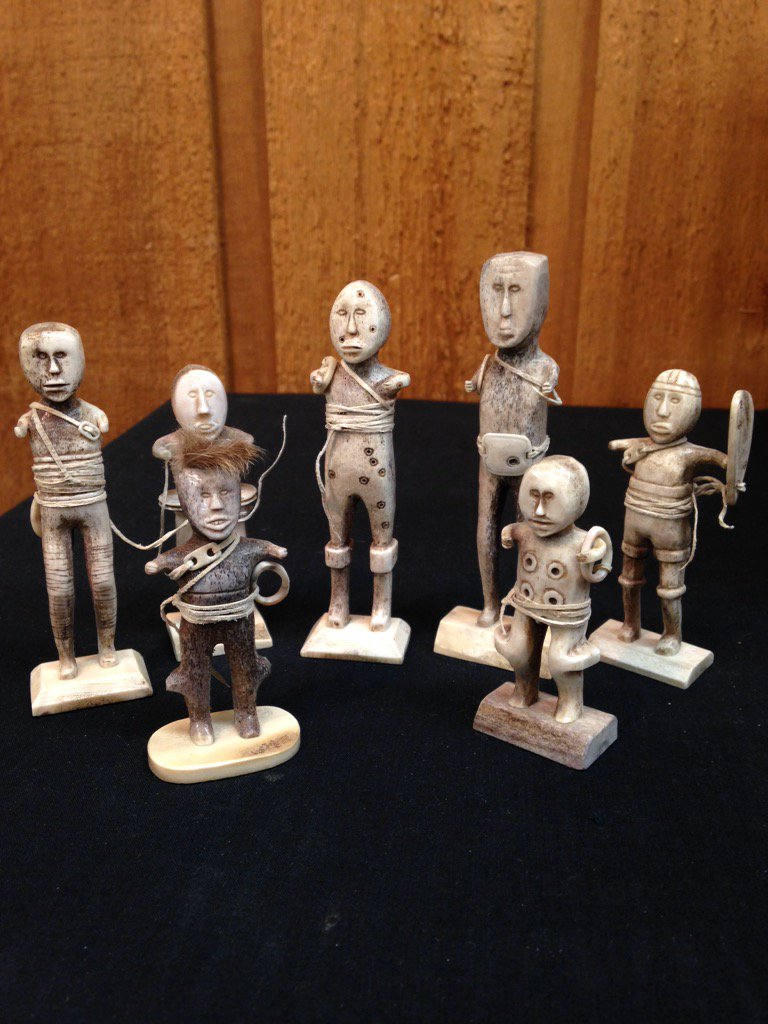
Nenets carvings of Sirtya, made from reindeer antler.

This is a companion-piece to my last post, The Island of Cairns. I'm really pushing the definition of 'Central Asia', here, because there's nothing remotely 'central' about Vaygach Island, which is where the stories of the Sirtya come from: it's right on the northern edge of the continent. And yet the Nenets people who live there are of Central Asian origin, and their beliefs and religious practises have clear similarities with those practised in Mongolia; so, as with Azerbaijan, I'm going to include them anyway. Nor am I alone in doing so: I found Nenets religion discussed under the heading 'Central Asian mythology' in one of the encyclopedias of mythology I consulted on the topic. Maybe Central Asian-ness is a state of mind.

So. The Sirtya are a race of magical white dwarves who live on the coasts and islands of the Frozen Sea. They are very small, perhaps half the size of a human, and very beautiful; their skin is snow-white in colour, and they wear strange metal garments hung with bronze trinkets, seemingly unbothered by the extreme cold. They can see perfectly in the dark, and usually only come out after dusk. They are expert bronze-workers, and their underground tunnels are assumed to be full of furnaces and forges - although no-one really knows for sure, because their entrances are extremely well hidden and well guarded, and there's no practical way to fight or sneak into a complex of tunnels which are only 2' wide and 3' high. They are widely reputed to have the ability to become invisible, and to be able to sink into or rise out of the ground at will; but in fact neither legend is true: both are due simply to their extreme stealthiness and their tendency to honeycomb the territories which they inhabit with networks of concealed tunnels. Turn your head for an instant, and they may very well seem to vanish: but it'll be because they've just jumped into a hidden tunnel someplace, rather than because they've actually sunk into the ground.


Other legends about them have a stronger basis in fact. It is quite true that the Sirtya know spells for calling down clouds, upon which they then ride like floating palanquins: unlike the cloud clans of the Deep Taiga, who catch their clouds with lassos and ride them like beasts, the Sirtya simply sing them down from heaven and direct their flight with verses of murmured song. They know another song for singing fish out of the water and up into their hands, which provides them with their primary means of sustenance: these fish are then skinned and boned, and their flesh eaten slimy and cold and raw. As they live on raw fish, can see in the dark, and do not feel the cold, they need neither home-fires nor cook-fires nor torches, and all the fuel they gather goes straight to their hidden furnaces under the earth. No-one knows what they do about all the smoke.

For the most part, the Sirtya manage to live peacefully alongside the humans of the Frozen Sea; they are not warlike and have no love of conflict, preferring to flee from confrontation on their flying clouds. But greedy clansmen sometimes try to catch them in order to rob them of their embroidered bags and their metal garments, both of which are always of the highest quality; and during bad winters, when every net-full of fish becomes a resource to be bitterly hoarded, conflicts over food-thefts or fishing rights can easily explode into violence. When threatened or engaged in battle, the Sirtya sing a third magic song, which clouds the minds of men; if it works, they then attempt to take ruthless advantage of their confused enemies, knowing that the greater size, strength, and numbers of the humans will surely allow them to prevail in anything resembling a fair fight.

  • Sirtya: AC 15 (bronze harness), 1-1 HD, AB 0, spear (1d6 damage), FORT 15, REF 14, WILL 14, morale 7. May sing down clouds to use as mounts; these can float up to 5' off the ground or over the surface of water, and move as fast as a horse at a gentle trot. When in natural terrain with a decent amount of cover, may 'disappear' in moments, hiding so expertly that they will never be found without an exhaustive search. Anyone who hears their battle-song must make a WILL save or suffer confusion for 1d10 minutes, during which they suffer a -1 penalty to morale and are unable to effectively co-ordinate their actions with others. (The effect of multiple battle-songs does not stack.)

Learning the Songs of the Sirtya: Humans who have performed great services for the Sirtya are sometimes offered the chance to learn their magical songs; but even when both teacher and student apply themselves rigorously to the task, few humans ever manage to perform one of them successfully, as Sirtya voices are able to articulate a range of sounds of which very few human throats are capable. A human who is offered the chance to learn such a song has a percentage chance equal to their Charisma score of being able to master it after several months of practice; failure means that they will never be able to master that song, no matter how much teaching they receive. A different roll must be made for each of the three songs that they attempt to learn. Disciples of the Word and Fan Dancers, due to their extensive vocal training, increase their chance of learning these songs successfully by an additional 10% per level. Even if a Sirtya song is learned successfully, performing it places such a strain on the human throat that it can be performed no more than once per hour.


Sirtya as Player Characters: It would be odd, but not quite unheard-of, for one of the Sirtya to wander south into warmer lands, perhaps even ending up in the Wicked City. If you want to play one you must have Dexterity and Wisdom 12 or higher. Game information is as follows:
  • You can use any thrown or melee weapon, and can use light shields. You can use any kind of armour, but due to your small size it will need to be made specially. (Most Sirtya make their own armour.) You are unfamiliar with guns, but can easily learn how to use them after a few weeks of practise. Note that due to your small size, a single-handed weapon for a human will usually be a two-handed weapon for you: only daggers and similar tiny weapons are small enough for you to wield one-handed.
  • You gain a bonus to all your to-hit rolls equal to half your level, rounded down.
  • You gain 1d6 HP per level.
  • Your natural agility grants you a +2 bonus to REF saves.
  • You can see perfectly in the dark.
  • You are small, nimble, and very good at hiding. When in a place with a decent amount of cover, as long as no-one is actually looking straight at you then you may spend one round to 'disappear', hiding so expertly that they will never be found without an exhaustive search. 
  • You can sing clouds down from the sky and ride around on them, steering them with your voice. (On a cloudless day this ability is useless.) If you get off the cloud, or if you are silenced or otherwise unable to sing, the cloud stops moving and breaks up after 1d6 minutes.The capabilities of these clouds depend on your level:
    • At level one your clouds an float up to 5' off the ground or over the surface of water, have the carrying capacity of a small pony, and move as fast as a horse running at a gentle trot.
    • At level 4 your clouds can rise up to 10' off the ground, have the carrying capacity of a light horse, and can move at the speed of a horse running at a canter.
    • At level 7 your clouds can rise up to 20' off the ground, have the carrying capacity of a heavy work horse, and can move at the speed of a galloping horse. 
  • You do not feel the cold, and are immune to cold damage.
  • You can perform a song which clouds the minds of any humans that hear it. (It affects allies just as much as enemies, so your friends might want to invest in earplugs!) Anyone hearing it must make a WILL save or suffer confusion for 1d10 minutes, during which they suffer a -1 penalty to morale and are unable to effectively co-ordinate their actions with others. At level 5 or higher, it also imposes a -2 penalty on their to-hit rolls. The effect of multiple battle-songs does not stack.
  • You are a highly-skilled metalsmith, especially expert in the forging and working of bronze. Given suitable tools and raw materials, you can manufacture any kind of weapon, armour, or decorative metalwork to an extremely high standard. Your insight into smithcraft grants you a flat +2 bonus to your technology rating. You are also really good at embroidery, but that probably won't come up as much during play.
Sirtya Summary Table

Level
Hit Points
To Hit Bonus
Fortitude save (FORT)
Reflex save (REF)
Willpower save (WILL)
1
1d6
+0
14
12
14
2
2d6
+1
13
11
13
3
3d6
+1
12
10
10
4
4d6
+2
11
9
11
5
5d6
+2
10
8
10
6
6d6
+3
9
7
9
7
7d6
+3
8
6
8
8
8d6
+4
7
5
7
9
9d6
+4
6
4
6
10
10d6
+5
5
3
5

Starting equipment: Bronze harness (AC +5), bundle of small spears (1d6 damage, can be thrown), beautifully embroidered clothes and bag, smith's tools, beautiful bronze jewelry worth 3d6x10 sp.


Thursday, 7 April 2016

The Island of Cairns

From somewhere
a traveller is approaching,
he has reindeers without antlers,
reindeer-bulls without antlers...
This is Vaygach Island, in the Arctic Ocean.


It's about the same size as Long Island in the US, but almost no-one lives there: it's too cold, too bleak, too bare. There are no trees. There is no shelter. Back in the Soviet period, the Russians tried to run a mine there, using conscript labour from the Siberian gulags. It wasn't a success.

Vaygach is regarded as a holy site by the Nenets people of northern Siberia. For centuries, they came here to raise idols and offer up sacrifices to the great spirits, Num and Nga, a dualistic pairing of sky-god and underworld-god comparable to that of Tengri and Erlik further south. They were reindeer herders. They painted the idols with the blood of slaughtered reindeer. They raised piles of stone and wood, Arctic equivalents of the Ovoo cairns of Mongolia, and placed the skulls of the sacrificed reindeer on top of them. Thus the spirits were appeased.


Vaigach Today -- Nenets
A Nenets idol is returned to its original home on Vaygach Island. Photo by Tomasz Kizny.

Like most of Siberia's indigenous peoples, the Nenets suffered badly during the twentieth century. The Soviets disapproved of their nomadic lifestyle, and forced them to move with the times: settle in one place, learn Russian, practise collectivised agriculture. Today their southern cousins, the Forest Nenets, are in a very bad way; there are only a couple of thousand of them left, their language is dying out, their songs and traditions have mostly been forgotten. But the tundra Nenets, the ancestral keepers of Vaygach Island, still manage to maintain some kind of continuity with the past.

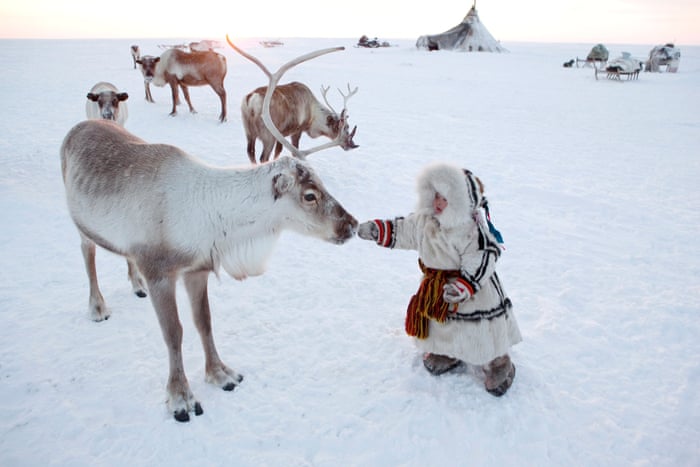
Nenets toddler with reindeer. Her family's reindeer-skin tent can be seen in the background. Photo by Bryan Alexander.

So: far, far to the north of the Wicked City, beyond the steppe, beyond the taiga, beyond the tundra, there is a frozen sea. In that sea is an island; and on that island are many cairns and no houses, many idols and no trees. The cairns and the idols are maintained by the Reindeer People, who drive their herds across the tundra, but even they don't actually live on it. No-one lives on it. It's too holy for that.

On the Island of Cairns, the world of spirits presses very, very close to the world of men. Here, anyone, even a non-shaman, may communicate with the spirits simply by killing an animal, pouring its blood over an idol, putting its skull on a cairn, and then stating their message or request. Do this, and the spirits will heed you; and if they want to answer you then they will come to meet you in person, stepping out from the shadow of a cairn or an idol in the form of a man, or a woman, or a great wild beast. They seem to regard the island as a kind of antechamber to the spirit world, within which it is proper for them to give due audience to those who come to seek them; and even the most hostile and unreasonable of spirits can usually be counted upon to give its supplicants a decent hearing if invoked amongst the cairns of the frozen sea. They may still refuse to give their aid, or demand completely exorbitant offerings in exchange for their assistance, but at least they'll hear you out.

"Zemblien". Allain Manesson Mallet, Description de l'Univers, t. 1, Paris, Denys Thierry, 1683.:
17th century engraving of Nenets hunters. Note the idols in the background.

The Reindeer People say that the spirits are not the only inhabitants of the island. They say that there is a secret race of dwarves, white-skinned and furtive, inhabiting caves beneath the surface; that these dwarves are great magicians who ride across the sea on clouds, singing the fish out of the water and up into their nimble, pale little hands. They say that sometimes, in the depths of winter, huge men like giants come riding across the frozen sea on sleds drawn by great white reindeer without antlers. If you wish to communicate with the dwarves, or with the giants, you must leave offerings for them out on the cairns, and state your message or request with all the courtesy that you can muster. You won't see them, but they will be watching. They will be there.

Magical though they may be, the dwarves and the giants still need to eat, and food is scarce on the shores of the Frozen Sea. Sometimes there are tensions. Sometimes they and the Reindeer People come to blows; and when they do, it's usually the Reindeer People who get the best of it, because unnatural stature and magical powers are no match for having a whole clan of kinsmen backing you up. If you kill a giant or a dwarf, though, it is very, very important that you take their body back to the Island, and build a new cairn over it. Doing anything else invites the most terrible bad luck.

Nenets carvings, made from reindeer antlers, depicting the white dwarves of the Arctic.

Due to their long-term saturation with the energies of the spirit world, the bones, stones, and wood of the island's cairns and idols possess considerable magical power. The merest pebble from such a cairn, worn threaded on a string around the neck as a good luck charm, is worth a +1 bonus to saving throws; wearing a bear or reindeer skull taken from a cairn as a helmet grants protection from misfortune while travelling, while arrowheads made from the antlers of reindeer skulls placed on such cairns, or from the bones of giants or dwarves buried below them, seem almost never to miss, granting a +4 bonus on to-hit rolls. But to plunder the cairns is to risk the wrath of the spirits. Who would dare commit such impious deeds?

Surely only the agents of the Wicked City...

Vaygach Island, Вайга́ч, Vaygach) - Google Search:

Tuesday, 5 April 2016

New B/X class: the Orc

Another in my ongoing series of 'B/X monster classes written while I should be working.' Essay marking is really boring, OK?

I was always a bit frustrated by half-orcs being the default PC race option: if I want to play an orc I should be able to play a bloody orc! You don't see people playing half-dwarves, do you?

(Yes, I know there were rules for half-dwarves in Dark Sun. But everyone in that just played half-giants and insect people and psychic cannibal jungle halflings, so the point still stands.)

So here's a B/X-compatible orc class. Like the dwarf, it's basically a fighter with some minor additional rules for flavour purposes. Have fun hitting people with axes!


B/X Class: The Orc

To-Hit, Hit Dice, Saves: All as per Fighter.

Weapons and Armour: Orcs can use any weapons, but are not proficient with any armour heavier than chainmail.

Experience Per Level: As per Dwarf.

Nocturnal: Orcs can see perfectly in the dark, but bright light pains them. When in bright sunlight, or close to a bright source of light, they suffer -1 to-hit until they can get back into the darkness.

Ritual Cannibalism: Whenever an orc eats the heart of a creature it has personally killed in battle, it gains a number of HP equal to the HD of the dead creature. (Note that eating a heart takes at least a couple of minutes, even for an orc!)

Orc Rage! Orcs get angry really, really easily. Whenever something happens to anger you (e.g. being insulted, being frustrated, being betrayed, etc) you may declare you are going to enter a battle rage. While raging you fight with no heed for your own personal safety: you gain a +1 bonus to-hit and damage, and a +4 bonus to saves against fear effects, but suffer a -2 penalty to AC. Your rage ends when the being(s) that provoked it are defeated, or after a number of minutes equal to your level, whichever comes sooner.

Speak Loudly and Carry a Big Axe: Orcs love huge, impractical, poorly-balanced weaponry. Given a few hours and a heap of scrap metal, you can modify any two-handed weapon to be even bigger, heavier, and spikier than it was before. The resulting weapon is the kind of thing that no-one except an orc would ever consider using, but your combination of brute strength and raw enthusiasm means that in your hands it becomes a lethal if clumsy weapon, inflicting +1 damage at the cost of a -1 penalty to-hit. 

A brief public service announcement

There's a piece on sexual harassment in gaming culture doing the rounds right now. It's called "Tabletop Gaming Has A White Male Terrorism Problem", which is a regrettably clickbait-esque title, but it's a sad and eloquent account of one woman's experiences with sexual harassment and sexual assault in circles associated with tabletop gaming.

I don't want this blog to get dragged into the mire which is gender politics on the internet, but I will say this: if you're ever in a game, or a store, or a convention at which a woman (or a man, come to that) is complaining of sexual harassment or assault, please take it seriously. Get the organisers involved. Get the authorities involved. If you are the organiser, then do everything in your power to get to the bottom of it. It might often feel as though there's nothing you can do. It might often be true that there's nothing you can do. It might even ultimately turn out to be a false accusation. But the simple act of taking these things seriously, of treating them as though they matter rather than just being something to be shrugged off with a muttered comment about boys being boys, actually does a whole lot of good, both for the individuals concerned and for the surrounding culture as a whole.

We now return you to your regularly scheduled OSR D&D weirdness.

Sunday, 3 April 2016

The Kergeden, or Siberian Unicorn

You all saw the news report at the end of March, right? Elasmotherium sibiricum, previously thought to have died out in the middle of the Ionian Stage of the Pleistocene Epoch about 350,000 years ago, actually seems to have survived in what is now Kazakhstan until about 27,000 BC, which in evolutionary terms is pretty much yesterday. That means they lived alongside humans. People probably met them. People probably ate them. That's probably why there aren't any of them left today.

They looked like this. Probably.

Given how late populations of woolly mammoth and woolly rhinoceros survived in Siberia in the real world, I've just kinda assumed that they're still around in ATWC, being domesticated and ridden by nomadic clans in the depths of the Deep Taiga. After this, the Siberian Unicorn - or 'Kergeden', to use the Turkic word for 'unicorn' or 'rhino', which is presumably what the people of the area would call them if they were actually still alive - is totally getting added to the list. The only unicorns that exist in the setting are now 7' tall, 15' long, shaggy-coated monsters with a horn the length of a sword.

They are rare, of course. They are so rare that many people believe them to be mythical. But in a few remote areas of the steppe and taiga, the kergeden still live: huge, ill-tempered beasts, fearsomely strong, with great horns on their heads easily long and strong and sharp enough to impale a grown man right through. No ordinary man or woman can ride one, and they disdain domestication: but something in their fierce natures makes them warm to the bravest and hardiest of warriors, and to these and these only will they submit themselves as mounts. Folklore says that they can smell both courage and fear, and that if their rider should ever disgrace them by some act of cowardice, the kergeden will immediately toss them up into the air and attempt to catch them on their horn, goring them to death in order to wipe out the dishonour of allowing themselves to be ridden by such a dastard soul.

Or maybe they looked like this? No-one actually knows how big their horns were...

In game terms, kergeden are mounts for higher-level characters. It's not enough to be a generally courageous person: only when your bravery has been proven in the face of severe adversity, not just once but many times, will the kergeden allow you to use it as a mount. (You also have to be a highly skilled rider and animal handler, of course: but as I've mentioned before, I take for granted that all ATWC PCs will fit that description.) This doesn't mean screaming and charging all the time, no matter the odds, which all the steppe peoples recognise is the mark of a stupid warrior rather than a brave one - these are the people whose signature battle tactic was the false retreat, after all - but it does mean that whenever things got rough, your focus must always have been on achieving your objectives as best you could rather than on saving your own skin. Anyone whose record of courage under fire has been less than exemplary can expect to be gored to death instead. Because it is widely known that only the bravest of warriors may ride such a beast, actually doing so will grant you a +1 reaction bonus from anyone who cares about martial prestige: this includes just about all steppe peoples, and most inhabitants of the desert and taiga, as well.

The kergeden eats lots and lots and lots of grass. Trying to ride them into the desert is probably a bad idea unless you have a lot of fodder.

  • Kergeden: AC 14 (very thick, tough hide) or AC 20 (hide plus metal barding), 7 HD, AB +4, gore and trample (1d8+4 damage), FORT 6, REF 10, WILL 7, morale 9. Inflicts double damage when charging. Anyone charged by a kargeden must make a morale roll to hold their ground; if they do, even if its charge attack misses, then they must make a REF save or take 2d6 damage from being smashed and trampled underfoot.