Friday, 27 April 2018

Familiarity and Contempt

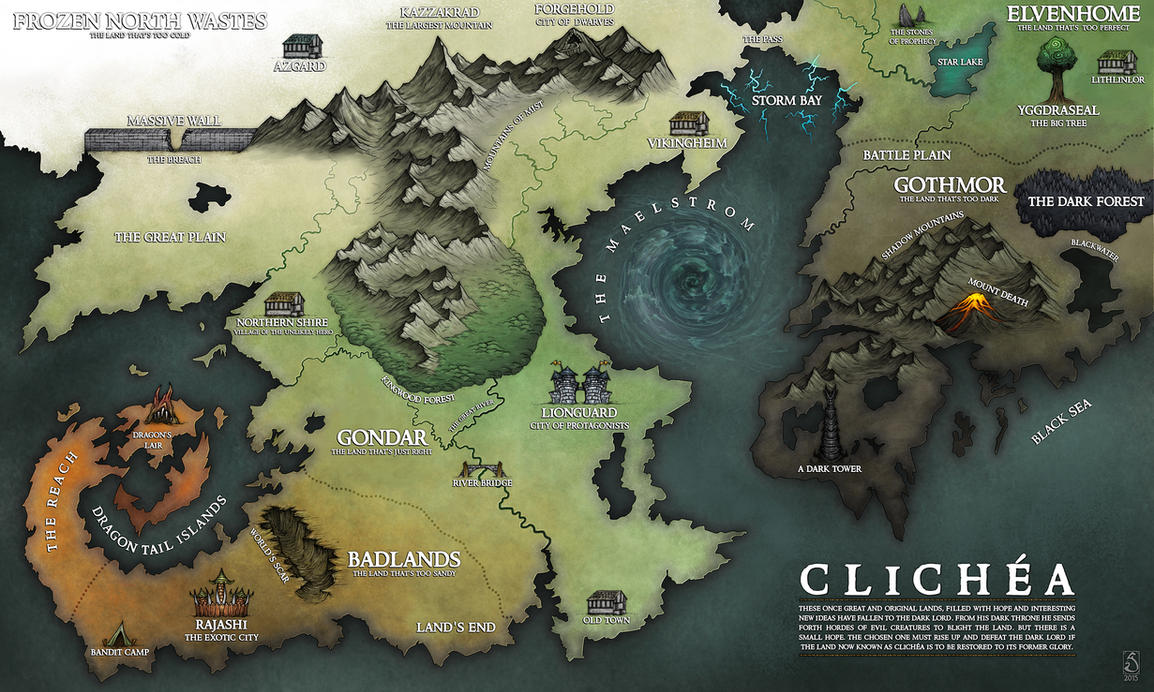
Map of Clichea by Sarithus
Map of Clichéa by Sarithus. You can view the full-size version here.

It's odd how quickly we get used to things. How the fantastical becomes mundane: how the strange and exotic becomes something we take for granted. Think of the tapestry of wonders which make up a generic fantasy world: beautiful forest-dwelling immortals inhabiting hidden cities of living wood and crystal, clans of industrious craftsmen carving out underground kingdoms beneath the earth, blood-crazed tribes of monstrous green-skinned savages who eat the corpses of their enemies, and so on. These figures are the stuff of dreams and nightmares... and yet if the first line of someone's setting write-up starts talking about how the elves are wise and graceful and the eldest of all peoples, I'll drop it in a heartbeat. It's boring. I've seen it a thousand times before.

The trouble is that this applies to everything. I catch myself sometimes talking about 'generic fantasy gods' or 'generic elder evils' or 'generic horror monsters', and I think: how does something designed to be shocking, or numinous, or horrific end up becoming generic? And yet it does: if I open an adventure module and read about a band of insane sorcerers sacrificing victims to the primordial tentacle-covered slime monster who lives beneath their prehuman temple of black basalt, I don't think 'gosh, how awe-inspiringly terrible!' I just think: 'OK, so they're generic fantasy Cthulhu cultists. What else have you got?'

I distinctly remember the moment I fell out of love with World of Warcraft. My quest required me to obtain some bottles of ice water, and the only way to get them was to kill ice elementals, who sometimes dropped them when they died. So there was my gnome assassin, leaping about with her enchanted daggers, hacking her way through gigantic, roaring monsters of living ice in the depths of a frozen chasm beneath a twilight-purple sky, and it was... boring. The game had taken something fantastical and turned it, through sheer force of repetition, into an interaction with a glorified vending machine. All I cared about was whether or not each murdered ice-beast was going to give me a bottle of cold water. I stopped playing the game shortly afterwards.

It's sometimes suggested that the solution to this problem is simply to be more original: to replace your orcs with walrus-men and your dwarves with miniature robot dinosaurs and so on. But as soon as something like this catches on, it can go from being excitingly new to feeling played-out and predictable within just a handful of years. Look what happened to steampunk: it started to really take off around 2005, and by 2012-ish it had already hardened into an almost completely predictable list of visual clichés. (Goggles! Corsets! Top hats and bowlers! Clockwork robots! Airship pirates! Gears on everything! Why aren't you excited yet?) Hell, look at what happened to D&D itself: many of the monsters that people now complain about as 'boring' and 'generic', such as gnolls or drow, were completely new and original back in the 1970s. 'Originality' is a treadmill. Yesterday's shocking new idea is today's mainstream default and tomorrow's tired cliché.

In his 1821 Defence of Poetry, Shelley wrote:
[The language of poets] is vitally metaphorical; that is, it marks the before unapprehended relations of things and perpetuates their apprehension, until the words which represent them, become, through time, signs for portions or classes of thoughts instead of pictures of integral thoughts; and then if no new poets should arise to create afresh the associations which have been thus disorganized, language will be dead to all the nobler purposes of human intercourse.
This, I think, is more or less what tends to happen to fantasy elements. They start off as fresh and vivid symbols for urgent realities, or what Shelley calls 'pictures of integral thoughts': orcs were Tolkien's way of articulating the brutalising effects of industrial capitalism, Cthulhu was Lovecraft's symbol for the way in which the cosmos fundamentally doesn't give a fuck about humanity, and so on. Then they get popular, and become 'signs for portions or classes of thought': so Cthulhu gets used as a kind of shorthand for 'A BIG SCARY THING THAT MAKES YOU GO CRAZY', because thanks to Lovecraft we've all somehow come to accept that a giant dragon-man with a squid for a face is an appropriate symbol for that, without it necessarily being connected to any of the things which originally provided the reasons for it to mean that. Soon they become almost entirely symbolic: so a game which features zombies and werewolves and vampires instead of orcs and ogres and dragons will get labelled as 'Gothic horror' instead of 'high fantasy', even if the horror-monsters never actually do anything horrific, because werewolves and vampires are understood to be symbolic of horror in general. And then we play the game and stab all the vampires and wonder why it doesn't actually make us feel afraid.

(You can see these loops playing out with almost comical literalness in games like Pathfinder. You start with a unique monster, like Grendel, and turn it into a type of monster: in this case, the D&D troll. But then the troll gets so overused that it's not scary any more, and no longer conveys the kind of threat communicated by the original. So you go back and you create a new monster, called a Grendel: a mega-troll so strong and powerful that it can terrorise even characters who have become blasé about normal trolls. The diminishing returns involved in such a strategy should be obvious. See also what happens to Dracula in just about every vampire fiction franchise.)

When fantasy fails to feel fantastic, I think it's often because its creators use these fantastical elements as shortcuts or placeholders, relying on their inherited symbolic associations to do all the imaginative heavy lifting. They rely on an audience which is going to find the very idea of dragons so awesome that they'll love your story just for having dragons in it, even if your dragons never actually do anything very impressive, or very dragon-like, or even very interesting. But the more familiar your audience is with the genre, the less credit they're going to give your work just for including orcs and elves and whatnot, because for them those figures will be part of a symbolic system which has been drained of all its inherent power by overuse.

So don't do that. Don't just rely on the fact that something is a troll to convey the fear and the power of it: maybe that would have worked a hundred years ago, but now they've been so drained of significance that your players are just going to see them as big bags of hit points with annoying regenerative abilities. Instead, you have to reconnect them with whatever it was that gave them force and meaning in the first place. 'A goblin' is a three hit point irritation. A giggling thing with too-long arms and a too-wide mouth and far too many teeth that comes squirming out from under your bed at night to cut you up with knives is fucking terrifying. 'An ogre' is a big dumb lump for your PCs to kite around a battlefield. An eight-foot giant who comes clambering from her cannibal larder, her hot breath reeking of carrion, her long hair matted with human gore, still retains some level of nightmarish power. At this point, the names have probably become active liabilities: the howling abhuman beast that roams the wastelands, larger and more savage than any man, becomes much less threatening once it has been identified as 'an orc' or 'a bugbear' or 'a troll'. You don't need to wear yourself out trying to come up with totally original, never-before-seen ideas in every damn adventure: after all, the classics are classics for a reason. You just need to make sure that, when you use the classics, you go right back to the source. 

Because the stories never truly lost their power. Not really. There's still something magical about the glimpse of the path through the woods at twilight, or the huge figure unfolding itself from the cavern in the hillside, or the whispering and scurrying of swift and unseen creatures in the dark. The shining city on the distant hilltop. The sound of something slow and heavy moving through the forest by night. It would be a shame if we let the overuse of our shared shorthand of fantasy iconography stand between us and the very real wellsprings of awe and terror which are, at base, still represented by those symbolic figures with which we have become so painfully over-familiar.

Orcs. Elves. Ogres. Giants.


eotenas ond ylfe      ond orcnéäs
swylce gígantas      þá wið gode wunnon
lange þráge·      hé him ðæs léan forgeald.

Monday, 23 April 2018

Glimpses of the Wicked City: the art of the Silk Road

Art plays a major role in how we visualise other cultures. Our view of ancient Greece is heavily shaped by all those white marble statues: we'd probably think of it very differently if their paintings had survived as well. Ancient Egypt is monumental sculptures and paintings in tombs. Medieval Europe is stained glass, illuminated manuscripts, and woodcuts. Victorian Britain is pre-Raphaelite paintings and sepia-tint photographs. And so on.

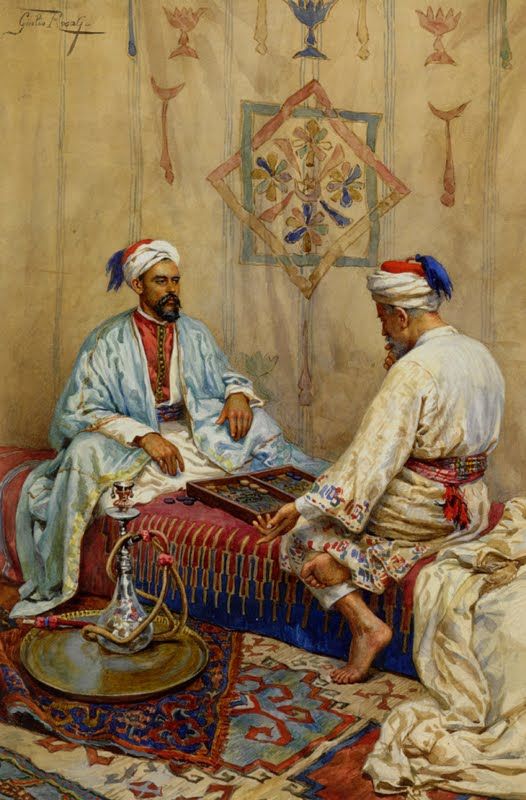
For most of us, if the Silk Road looks like anything at all, it's probably a nineteenth-century Orientalist painting: something by Rosati, perhaps, or Delacroix. But while some Orientalist paintings depict their subjects with skill and sympathy, an awful lot of them are just excuses for tiresomely repetitive 'naked slave-girl' scenes, and even the ones that aren't usually emphasise the qualities of the 'Orient' that their painters went out looking for: sex, passion, luxury, exoticism, and violence. They give little sense of how these people understood their own world, as people with their own lives to lead, rather than as part of the backdrop to someone else's adventure tourism - and besides, for my purposes, their period is out by roughly two hundred years.

Related image
Rosati, 'A Game of Backgammon'. If you want the slave-girl paintings you can google them yourself.

Probably the greatest representative art tradition to emerge from late medieval / early modern Central Asia was Timurid painting, especially in the form developed by the miniaturists of Herat in Afghanistan. It's a style which combined Persian and Chinese elements to depict blue-and-gold worlds of staggering beauty, which really have to be seen to be believed. (Online reproductions do them no justice at all.) Here are some examples from the reigns of the Timurid and Safavid shahs:


Now, Timurid art is wonderful - but it's very much a product of the earlier part of the early modern period, and its fascination with the sages and heroes of the past means that it tends to look back earlier still. For a sense of what Asiatic Islamic civilisation looked and felt like once modernity started to take hold - and of what life in the Silk Road kingdoms might have looked like if they hadn't been in terminal decline by the late 1600s - I look instead to seventeenth-century Ottoman and Safavid miniature paintings, especially the Rålamb Costume Book (1650s) and the works of Reza Abbasi (1565 - 1635) and Abdulcelil Levni (?-1732). Here are some figures from the Rålamb Costume Book:

This soldier is dressed as a Janissary with a leopard skin. The 'RÃ¥lamb Costume Book' is a small volume containing 121 miniatures in Indian ink with gouache and some gilding, displaying Turkish officials, occupations and folk types. They were acquired in Constantinople in 1657-58 by Claes RÃ¥lamb who led a Swedish embassy to the Sublime Porte, and arrived in the Swedish Royal Library / Manuscript Department in 1886.

Turkish woman "Turca". The 'RÃ¥lamb Costume Book' is a small volume containing 121 miniatures in Indian ink with gouache and some gilding, displaying Turkish officials, occupations and folk types. They were acquired in Constantinople in 1657-58 by Claes RÃ¥lamb who led a Swedish embassy to the Sublime Porte, and arrived in the Swedish Royal Library / Manuscript Department in 1886.

Cavalryman   Sipâhî.  Claes Rålamb (8 May 1622 – 14 March 1698) was a Swedish statesman. The 'Rålamb Costume Book' is a small volume containing 121 miniatures in Indian ink with gouache and some gilding, displaying Turkish officials, occupations and folk types. They were acquired in Constantinople in 1657-58 by Claes Rålamb who led a Swedish embassy to the Sublime Porte, and arrived in the Swedish Royal Library / Manuscript Department in 1886.

Executioner    The instrument was probably used for impaling.  The 'RÃ¥lamb Costume Book' is a small volume containing 121 miniatures in Indian ink with gouache and some gilding, displaying Turkish officials, occupations and folk types. They were acquired in Constantinople in 1657-58 by Claes RÃ¥lamb who led a Swedish embassy to the Sublime Porte, and arrived in the Swedish Royal Library / Manuscript Department in 1886.

Executioner with strangulation rope. "Chelat - Bödeln". The 'Rålamb Costume Book' is a small volume containing 121 miniatures in Indian ink with gouache and some gilding, displaying Turkish officials, occupations and folk types. They were acquired in Constantinople in 1657-58 by Claes Rålamb who led a Swedish embassy to the Sublime Porte, and arrived in the Swedish Royal Library / Manuscript Department in 1886.
These last two are executioners. The first one carries an impaling stake. The second carries a garotting cord.
Here are some by Abbasi:

Two Lovers, 1630 Reza Abbasi

Shah Abbas: Youth reading

Reza Abbasi

And here are some by Levni:

Acem Çengisi Maverdi Kolbaşı, minyatür   Persian Dancing Woman, miniature, Levni, 18th century

IV. Murat Levnî, Kebir Silsilenâme, Topkapı Sarayı Müzesi,

turkish miniature paintings - Google Search

Levni-Surname-i Vehbi-1720
Janissaries at a banquet. There's always one guy who can't keep his hat on...
Levni Ottoman Artist
I love the expression on this one. 'It says olive prices are down again. Fuck.'

The other visual source I keep coming back to is the sixteenth-century Tyrkervaerk of Melchior Lorck. Like the nineteenth-century Orientalists, Lorck's engravings show the Ottoman dominions through European eyes, but his perspective is completely different from theirs. The Orientalists painted from a position of assumed cultural superiority, safe in the knowledge that while the Islamic world might be excitingly dangerous to the individual traveller, it no longer posed any meaningful threat to European dominance. But Lorck's drawings of the armies of Suleiman the Magnificent reflect the strength and terror of the Ottoman Empire at its height, when it was an aggressively expansionistic imperial power which had demonstrated itself to be entirely capable of kicking the shit out of the forces of European Christendom. Here are some examples:

Melchior Lorck'un ağaç baskılarındaki Osmanlı figürleri ve ellerindeki dış bükey kanat şekilli kalkanlar..1570-83

Melchior Lorck ( (1526 / 27 – after 1583 in Copenhagen)

A Turkish warrior; WL figure, in profile to r; wearing spurs and holding a lance and a large shield in his l hand; from a series of 127 woodcuts.  1576 Woodcut

Melchior Lorck

Melchior Lorck, Danish-German, (1526/7-post 1583), Portrait of Suleyman the Magnificent (Hollstein 34), Engraving (IIIrd State), circa 1574 | Lot | Sotheby's

Lorck's Tyrkervaerk engravings are an important part of the way in which I imagine the Wicked City itself: a world dominated by strong, cruel, violent men and the weary, hollow-eyed despots who command them, full of militaristic pomp and spectacle, strong lines, sharp angles, and plumed soldiers marching through the streets in splendid uniforms while veiled figures with downcast eyes scurry into corners to avoid them.

The world of the Rålamb Costume Book is the world of the oasis kingdoms beyond, all bright colours and gorgeous fabrics and matter-of-fact violence. The world of Levni and Abbasi is the world of the rich and powerful, the merchant princes of the Great Road: a world of strong coffee and extravagant fashions, elegant youths in perfumed gardens, falconers and dancing girls, and people who really, really don't want to talk to you about exactly where all their custom-made guns and fancy clockwork machinery is coming from.

And outside that, in the steppes and the deserts and the mountains, is the blue-and-gold world of the miniaturists of Herat: a world of flowers and water, rocks and monsters, vast and strange and old and dangerous and very, very beautiful.

The taiga looks like Evenki folk art and Gennady Pavlishin illustrations.

I guess the gods and spirits of the steppe look like figures from Mongolian thangkas?

Fuck, this post is long enough already. I'm just going to hit 'publish' and have done with it.

Friday, 13 April 2018

Wheels within wheels: clockworkers and scrap mechanics of the Wicked City

Compared to its state a century ago, when it stood at the zenith of its prosperity, the Wicked City is a shadow of its former glory. Its streets lie in ruins. Its population has fallen dramatically. Its farmlands are turning to desert. Its state religion has become a hollow farce. But one segment of the city's economy which has not declined are its clockworking industries: and in this area, at least, the city retains its world-leading status, just as surely as it did before it lost its name.

Before the rise of the Wicked King, the city became preeminent in clockworking because its coal mines made it cheap to build and power metal automata, and because its position at the hub of the Great Road made it easy for its merchant dynasties to attract the most talented mechanics from both the eastern and western empires, sure that they would be able to find markets for their wares. Since then, the city has retained its edge largely because of the enthusiasm with which its government has invested in clockwork technology, ensuring that the clockworking guilds have never lacked for patronage. The government's willingness to tolerate the excesses of the Steel Aspirants has made the city a major centre for the cult of the Cogwheel Sage, and the low price of coal means that it still has a substantial community of Brass Folk: after all, they can 'eat' there more cheaply than they can anywhere else.

Construct Token by AdamPaquette.deviantart.com on @DeviantArt

The innumerable automata upon which the city's economy depends are manufactured partly by the Brass Folk, and partly by the old clockworking guilds, many of whose constituent families pride themselves upon having been clockworkers for three or four generations. Their guildsmen are a fussy and elitist bunch, much preoccupied with family trees and certificates of mastery, and deeply disdainful of interlopers and outsiders. It is their workshops which produce the heavy, ornate, slightly oppressive-looking clockwork machinery for which the Wicked City is famous the world over: it is their sons and daughters who maintain the gyrocopters of the Air Corps, and serve as mechanics in the King's Own Armoured Brigade. Their business practises are slow and obfuscatory, and the Ministry of Technology would like to dispense with them entirely; but no matter how much the minister might dream of uniformity and standardisation, clockworking remains iredeemably artisanal in nature. It is precise, fiddly, and technically demanding work, of a kind that favours obsessives and virtuosos: every workshop has its own house style, and every master teaches their own distinctive tricks and methods to their apprentices. Attempts by the Ministry to train whole regiments of slave-mechanics to a uniform standard have met with very limited success.

In most parts of the world, the expensive tools, materials, and training required to create clockwork automata ensures the craft is practised only by licensed masters and their apprentices: but modern clockworking has been practised in the Wicked City for over a century, now, on a scale which has made the maintenance of true monopolies impossible. Tools get stolen. Supposedly 'secret' methods get taught to curious friends or lovers. Mistreated apprentices run away and take their knowledge with them. Knowledge-hungry slum-kids catch stray clockwork songbirds in nets, and spend endless hours painstakingly taking them apart to see what makes them tick. As a result, alongside its official clockworking schools, the Wicked City has become home to a vigorous 'street clockwork' tradition characterised by ingenious use of improvised materials. For every 'legitimate' clockworker family operating out of a licensed workshop, there is at least one unlicensed scrap mechanic working in a hidden basement, cobbling together devices out of whatever salvaged fragments come to hand: and the asymmetrical kitbashed products of their labours can be often be glimpsed scurrying over the rooftops of the Wicked City, catching the evening sunlight with a dull glint of tarnished brass.

I found this on: http://www.robotvsbadger.com/images/steampunked-animals/ I've become a fan of steampunk recently....now that I actually know what it is :)

The unofficial symbol of the scrap mechanics is the cogworm. Little more than an adjustable tube of gears with a crank at each end, the cogworm allows power to be leeched from one machine to another: the user simply attaches the worm to moving machinery in such a way that the machinery turn the crank at one end of the tube, and then attaches the crank at the other end to the machine which requires winding, thus turning its key and winding its mainspring. Most scrap mechanics have, by dint of long practise, become extraordinarily dexterous in the use of cogworms: leave them alone with a large automaton for even a couple of minutes and it will end up with cogworms dangling off every part of it, like a horse that's just emerged from a leech-infested bog, each of them feeding power to some whirring contraption hanging from the other end. Many street automata actually incorporate cogworms into their bodies, which emerge like lashing metal tentacles to opportunistically siphon energy from any exposed machinery that may happen to be nearby. When draining power from other people's machines isn't an option, the scrap mechanics use homemade windmills or waterwheels, instead. Actually paying for coal is a last resort.

The scrap mechanics have found all kinds of niches for themselves within the city's grey economy, cobbling together everything from primitive washing machines for laundresses to clockwork messenger birds for gangsters. They employ gangs of street kids to gather scrap metal for them from the city's dumps, and make occasional excursions out into the countryside to loot rusted machinery from the city's old pumping stations - a practise which often brings them into conflict with the pig-men who now infest the abandoned irrigation tunnels. They are fiercely proud of their inventiveness and originality, and delight in competition, constantly facing off against one another in various contests of clockworking skill - everything from simple races in which the fastest automaton wins, to tournaments between chess-playing clockwork robots, to grand events in which whole teams of clockworkers will labour for months to assemble clockwork war machines which are then pitted against one another in battle. The city's gangsters often come to bet on these events, and the drink and drugs flow freely - a quality which has given them a near-legendary reputation among the apprentices of the legitimate clockworkers, many of whom secretly dream of sneaking away from their masters and becoming champion scrap mechanics in the slums, instead. In most cases these dreams lead them no further than occasionally creeping out to spend a night illicitly watching a clockwork street race, but every veteran guildsman can tell stories of promising but unruly apprentices who sneaked out one night and simply never returned, choosing lives of precarious outlaw glamour over the security of wealth and status that might otherwise have been theirs.

I see my mind as a well oiled machine made up of gears and cogs moving in perfect sync. Every once and a while one or two of the gears slip out of place and i do something stupid or make a bad judgment. But God is my tinker he puts it back where it was and oils it up good as new. Not to say Im a psycho lol

To find out what the local clockworker's guild is up to, roll 1d10:
  1. Working on a big order of clockwork machinery for the mines or irrigation works.
  2. Working on a big order of clockwork wargear for the military.
  3. Working on a big order of yagas for one of the merchant houses.
  4. Working on a small but highly-demanding order of clockwork toys and animals for one of the Cobweb families.
  5. Manufacturing clockwork luxuries (pocket watches, wind-up songbirds, etc) for export by the merchant houses. 
  6. Manufacturing a unit of clockwork soldiers for export to some far-off warzone.
  7. Carrying out arcane debates about their guild's rules, degrees, traditions, and regulations.
  8. Brainstorming how to best edit their family trees to make their collective pedigree look more impressive without the forgery being spotted by their rivals.
  9. Moaning about how no-one has any respect for real tradition and craftsmanship any more, and how apprentices these days would all rather sneak off to watch pit fights between robot gladiators than put in a good, honest day's labour polishing their master's brasswork.
  10. Planning elaborate security measures to prevent power from being siphoned from their machines by the cogworms of those damn scrap mechanics.
Image result for mechanical turk

To find out what the local scrap mechanics are up to, roll 1d10:
  1. Carrying out small-scale clockworking jobs for local businesses and residents, using scavenged tools and materials. 
  2. Carrying out a large-scale clockworking job for a merchant house that's too cheap (or in too much of a hurry) to get one of the legitimate clockworker's guilds to do it instead.
  3. Building clockwork traps, alarm systems, and kitbashed guardian automata to sell to local businesses. (50% chance these have built-in flaws that the scrap mechanics will subsequently sell to a local gang.)
  4. Building clockwork traps for a local gang, to help them fortify a section of the streets to which they have laid claim.
  5. Planning an expedition out into the farmlands to loot an abandoned pumping station for parts. Everyone is discussing what kind of clockwork devices they should bring with them to deal with the pig-men they are likely to find there, and how best to avoid the Man With Stones For Eyes on their way out of the city.
  6. Discussing the pros and cons of throwing in their lot with the Steel Aspirants, and whether or not the unquestionable coolness of having guns for arms is really worth having to take orders from a disembodied brain inside a battle tank.
  7. Building automata for an upcoming street race. (Roll 1d4 to determine type: 1 = automata with feet, 2 = automata with wheels, 3 = automata with wings, 4 = automata with human drivers.) All the competitors are hidden away in their respective workshops, tinkering away on their latest secret projects, each convinced that this time they've got a great idea which is certain to win the race. Bets are being taken, and the local gangsters will pay for inside information about who's building what.
  8. Practising for a nocturnal wingride (an aerial race in which all competitors use clockwork wings). Most competitors build their own wings, less because it's an actual rule than because otherwise pilot and mechanic just blame each other every time anything goes wrong. The tendency of the Wicked City's streets to rearrange themselves by night makes the sport a dangerous one, and the most successful wingriders are fearless daredevils adored by the children of the streets.  
  9. Working on clockwork brains for their chess-automata, in preparation for an upcoming tournament. Advice from human chessmasters is suddenly in high demand. The automata themselves can look like anything provided they wear a metal fez, and fanciful designs abound: chess-playing dragons, insects, cats, etc. Absolutely no hidden dwarves permitted. 
  10. Gathered in teams, building freakish robot gladiators for an upcoming arena fight. There are only a few of these events each year, and they are widely attended by locals, gangsters, and even members of the Cobweb Families. As the event approaches, excitement reaches fever pitch, and rival teams becoming increasingly willing to pay over the odds for that one weapon or component which might allow them to secure a surprise victory...
Image result for master trinketeer

(EDIT: The Scrap Mechanics and the Clockworker Guilds have now been added to my post on liberating the Wicked City.)

Tuesday, 10 April 2018

The value of raggedness

Despite the tribalism of their respective fans, OSR games and modern storygames have a lot in common. They both arose as responses to the same problem: the bloated, railroaded, rules-heavy, metaplot-infested RPGs of the later 1990s and early 2000s, which promised such vistas of wonder through their rules and settings, but delivered such disappointing experiences in actual play. As a result, they share an emphasis on clawing back genuine agency for their players, and on ensuring that 'story' is something that gets generated live at the table, instead of being written down in advance by some frustrated novelist turned GM. But they approach this objective in different ways: and while most storygames aim to simulate fictional genres, OSR games aim to simulate fictional worlds.

For as long as D&D has existed, there have always been players who have pushed back against its world-simulating tendencies. 'A game of D&D is supposed to be like a fantasy epic, right?', they say. 'So how come my heroic paladin can get killed by a stray arrow fired by some random goblin? Isn't it awfully anti-climactic to get all the way down to the big boss and then lose because of some bad dice rolls? And why do the rules punish me for fighting fair and charging bravely into battle, even though that's exactly the kind of thing that epic fantasy heroes do all the time?' In the early days, such players either played D&D with lots of house rules and fudged dice rolls, or else wrote their own fantasy heartbreakers which did a better job of reflecting how they felt the game 'should' work. These days, many have gravitated instead to games which are built from the ground up on the premise of emulating genres rather than settings: games in which the fact that heroic protagonists will never be killed by nameless henchmen, and that epic confrontations will always ultimately save the day (although often not without cost), are actually written into the rules.

There's a lot of clever design floating around in contemporary storygames. The crude ones simply mandate that this is the way things will work; the more subtle ones provide notional freedom, but weight their rules in such a way that, over time, genre-appropriate outcomes become increasingly unavoidable. If you want a game in which a heist is more-or-less guaranteed to play out like an actual heist movie, or one in which a magical quest is almost certain to play out like a fantasy epic, or whatever, then they're great. Even the later editions of D&D work towards this to some extent by giving PCs 'death saves', 'healing surges', and so on, thus reducing the likelihood of 'undramatic' events such as major characters dying at the hands of random minions. Fans of such games sometimes express confusion as to why anyone would prefer to use systems, such as B/X D&D, which do so little to guarantee genre-appropriate story outcomes. Why not use a game which ensures that every campaign will actually resemble the kind of fantasy narratives on which D&D is notionally based?

Now, there are a bunch of potential answers to this question. The three most common ones are probably a preference for games which test the skill of the players rather than those of the characters, an interest in exploring settings as if they were just as real as the PCs rather than mere backdrops for their adventures, and a commitment to truly open and emergent play within which any attempt to determine the direction of a story in advance would be viewed as tantamount to cheating. I have a lot of sympathy for all three, but recently I've been wondering whether the 'raggedness' of OSR play - by which I mean the way that it often maps very imperfectly onto the conventions of the genres it supposedly models - might also be potentially valuable in and of itself.

A genre is, by necessity, a system of simplifications. There's only so many pages in a book, only so many minutes in a movie, so foregrounding one kind of material inevitably means leaving out others: and one of the key reasons for using the trappings of genre is to advertise to potential audiences which kinds of content are likely to get foregrounded, and which ones are likely to get left out. But the constraints of RPGs are very different: an RPG campaign can easily run for dozens or hundreds of hours, and while films and genre novels usually have to hold themselves to a very tight narrative schedule, RPGs can (and often have to) incorporate substantial ebbs and flows as people arrive, leave, get tired, get inspired, get bored of things, have new ideas, and so on. If you view the objective of RPGs as genre emulation, then you probably view all that as a problem to be managed, in the name of keeping the game on-track and in-genre: this is one reason why storygames often lend themselves to very short campaigns. But if you see the objective as world-emulation, then you can embrace them. You can take advantage of the fact that RPGs make it not just possible but easy to tell the kind of weird, rich, ragged, unconventional stories that are normally found only in the realms of self-consciously experimental fiction.

An OSR D&D game will sometimes be one in which brave heroes slay wicked monsters in dark places and retrieve fantastical treasures. But it will often also be one in which whole expeditions grind to a halt because no-one remembered to bring enough iron spikes, or where the fighter ends up spending the whole evening gambling with bored watchmen in the local pub because he's a few coins short of being able to afford a new suit of armour, or where the Dark Lord of Disaster can leap out of his tomb, trip over a rope trap left by the party, and promptly fall to his doom down a bottomless pit. I love that. It's real. It's human. It's kind of sad and kind of funny and quite a lot like real life. It's less about 'realism' in the sense of modelling physics or biology, and more about just conveying a sense that the world is strange and complicated and unpredictable and often slightly absurd. I can never really believe in Mighty Heroes Slaying Evil, but I can totally believe in a wicked high priest getting randomly crushed to death after a couple of wily villagers dropped a boat on him.

Now, maybe the limitless complexity of human life is the last thing you want to model when you sit down for an RPG session. Maybe, for you, the whole point is to create a shared fictional universe in which the genre-appropriate thing always happens at the genre-appropriate time, precisely because it almost never happens that way in reality. But what I hope I've articulated here is that it's entirely possible to view the free-flowing randomness of the average RPG session, and the 'raggedness' of the narrative outcomes generated by 'old-school' RPG systems, as a feature rather than as a bug. If I just want to experience a story about epic fantasy heroics, I can watch a film, or read a novel, or play a computer game, or even play one of those D&D board games I wrote about a couple of weeks ago. But stories in which the vivid strangeness of fantasy is used to highlight the oddness and resilience of ordinary life, rather than just to heighten yet another operatic grand narrative, are very much rarer: and for those purposes, for me at least, there's still nothing quite like OSR D&D.

Monday, 26 March 2018

Dungeoneering fast and slow: some thoughts based on D&D board games

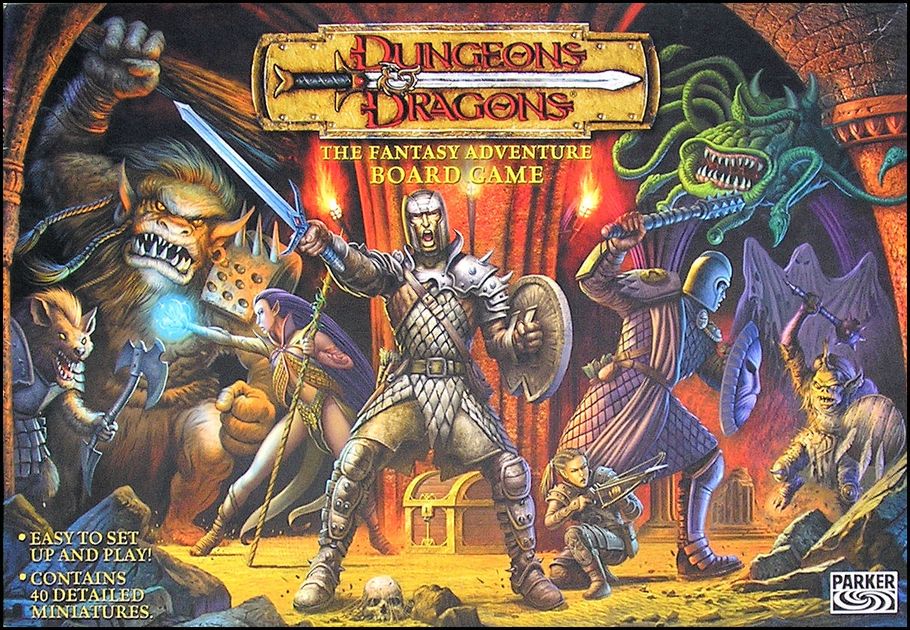
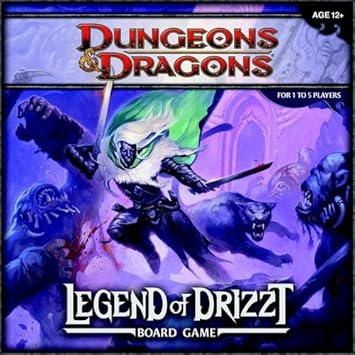
Thanks to the magic of ebay, I recently acquired copies of two D&D-themed board games at knock-down prices. The first one was the Dungeons and Dragons board game, published by Parker in 2003. The second was the Legend of Drizzt board game, published by WOTC in 2011. They share the same basic concept: each models a band of heroes exploring a dungeon, and each uses the same kind of board game technologies to accomplish this, including miniatures, map tiles, and treasure cards. But their conceptions of what the dungeon is, and how the heroes interact with it, are very different.


Image result for dungeons and dragons board game 2003
The 2003 Dungeons and Dragons board game.

In the 2003 game, the dungeon is essentially conceptualised as a series of discrete challenges. Each room contains a determinate number of threats, some of which - the nature and locations of the monsters - are revealed to the PCs, while others - the nature and locations of the traps - are hidden from them. There's no time limit, and no incentive to deal with more than one room at a time, but the PCs have a strictly limited amount of resources (hit points, magic points, items) with which to defeat the dungeon as a whole. A a result, optimal play consists of  slowly and methodically clearing the dungeon, room by room, until the objective is attained.

Related image
The 2011 Legend of Drizzt board game.

In the 2011 game, the dungeon is the kind of free-flowing, danger-filled environment you might expect to see in the climactic scenes of an action movie. Rather than a series of discrete rooms, each area flows into the next. Threats spawn continuously: everything is constantly exploding, the heroes are always under attack, and the dungeon is constantly damaging the players just for being inside it. The players have a lot more tools than their 2003 equivalents for controlling combat - how much damage they deal, how much damage they take, how often they hit, etc - but far fewer options for controlling their environment: traps just happen rather than being determinate obstacles that can be located and disarmed, and monsters surge abstractly from one zone to the next rather than having to move through specific squares that the players can target or block. Optimal play consists of racing through this murderously dangerous environment as quickly as possible, trying to reach your objective before it kills you.

At first, I instinctively associated these two dungeoneering styles with 'old-school' and 'new-school' D&D, respectively. The 2003 game has the very OSR-ish idea of the dungeon as a logical and logistical puzzle - it even has encumbrance rules! - while the 2011 game, with its focus on tactics rather than strategy and its emphasis on cinematic action, reminded me of more recent editions. But in other ways, the 2011 game actually reminds me more than the 2003 one of the old-school idea of the dungeon as a 'mythic underworld', innately hostile to human life, in which everything wants to hurt you and the pain just keeps coming until you leave or die. It was the new-school editions, after all, which did away with the emphasis on timekeeping and wandering monsters, thus permitting PCs to explore dungeons at their own pace rather than always keeping one eye on the clock.

OSR bloggers often write about taking very measured, systematic approach to dungeoneering: explore everything, search everywhere, accumulate knowledge and use it to deduce the positions of traps, treasures and secret doors, master the environment and manipulate it to your advantage, and so on. It's a natural response to the relative fragility of OSR PCs: you can't just outfight the monsters, so you have to out-think them instead, and that's hard to do if the dungeon doesn't let you gather enough information to base your plans upon. But back when I used to run D&D 3.5 games, I'd sometimes run dungeons in the opposite way, as a kind of stream-of-consciousness nightmare in which the threats never stopped coming and the dungeon was there to be sprinted through rather than meticulously explored. The fact that D&D 3.5 PCs were more resilient than the OSR equivalents made it easier, of course. But it did make me wonder whether the same effects could be achieved within a more planning-and-logistics-focused OSR context, as well...

Imagine a dungeon environment so hostile - so hot, so cold, so poisonous, so infested with aggressive creatures, whatever - that just being inside it would rapidly wear you down. Descending into it would be less like spelunking than pearl-diving, with each dungeon-delving expedition lasting not hours but minutes: a frantic dash into the darkness and then back to the light before the environment destroys you, hopefully with a new fragment of knowledge or progress to show for it. The objective for a delve might be no more than 'see what's at the end of the south corridor', or 'rig up a rope bridge across the chasm to the north', and success would be a matter of gradually linking together the meagre gains from each of these dashes into a strategy for actually accomplishing whatever it was you came there for. Obviously, such a dungeon (or dungeon sub-area) would have to be pretty small, and the PCs would need to have a very good reason for going into somewhere so horrible in the first place. But, in a very literal way, it might make for a entertaining change of pace, pushing PCs to consider a different set of logistics to the ones they normally have to manage. How many of their standard adventuring procedures will need rethinking when proceeding at normal dungeoneering speeds would kill them all within an hour?

Related image
'I really wish we'd come down here in more sensible clothes!'
Here are six possible 'hazard zones' that might lend themselves to this kind of 'fast dungeoneering':
  1. There is no floor. The whole area is an abyss, and awful bat-winged things surge up from below at irregular intervals. Each expedition would aim to attach a few more hooks, ropes, and pitons to the ceiling, gradually expanding the area which could be explored in relative safety - where 'relative safety' means 'fighting bat-winged monsters while dangling from the ceiling on a loop of rope', as opposed to 'being eaten alive by bat-winged monsters while hanging from the roof by your fingertips'. Would not work with a party that has access to flight.
  2. There is no air. The whole area is flooded. Lamps and torches won't burn down there, and your exploration radius is limited by the time for which you can hold your breath. Also there are probably piranhas. Progress would be about locating air pockets and gradually extending longer and longer breathing tubes from the surface, allowing air to be pumped down to people exploring new parts of the complex. Would not work with a party that has access to water breathing magic.
  3. Everything is on fire. Even in fire-resistant clothing, the heat will rapidly kill you, although it doesn't seem to bother the fire-monsters who live down here. Each expedition is a rapid dash through the flames and back again before you die of heat exhaustion, gradually allowing you to construct a map of the complex. Would not work if one or more of the PCs is fireproof.
  4. Everything is frozen. Each expedition is a race against hypothermia. Also everything is slippery as fuck, so a big part of each delve will need to be devoted to hammering in more ropes and spikes to make it easier to retrace your steps next time. There are probably wampas or something down here, too. Would not work if one or more of the PCs is immune to cold.
  5. Everything is poisonous. The air is heavy with poisonous gas, and staying inside it for too long will mean absorbing a fatal dose. Visibility is also terrible. Each expedition will mean simply mapping out a little bit more of the complex hidden within the fog, and maybe figuring out ways to improve ventilation of specific areas, all while dodging the inevitable poison-gas-exhaling zombies stumbling around within the clouds. Would not work if one or more of the PCs is immune to poison.
  6. Everything is haunted. This whole area is infested with angry ghosts which howl in the minds of all who enter, causing hallucinations, panic attacks, and poltergeist activity. The longer the PCs remain within it, the higher their risk of succumbing to possession or insanity. Assuming they have a cleric with them, progress means dashing into the zone, consecrating a tiny area to keep the ghosts out, and then dashing back again, gradually building up a network of 'safe zones' from which the area can be explored. Of course, some of the ghosts take the more direct approach of possessing corpses or objects and straightforwardly attempting to murder the intruders...

Thursday, 15 March 2018

[Actual Play] The Glasstown Job: Team Tsathogga pull off the crime of the century

So, remember when I said the Team Tsathogga PCs were planning a heist? This is how it went down.

The target was the Glasstown Academy of the Magical Arts, the kingdom's premiere institution of magical learning. When the ruthless mercenaries of the Company of the Hawk returned from Qelong, they brought with them a glass orb filled with akoum: the destructive magical radiation that had brought Qelong to its knees, which they had distilled in concentrated form from the corpses of innumerable victims in their unspeakable murder-castle. They then sold this orb to the Glasstown Academy. Abraxus, the head of the academy, and Hagen, the leader of the Company, had been carrying out research on it in a secret laboratory ever since.

Related image
THE OBJECTIVE.

It was this orb that the PCs wanted to steal - partly because they had long-standing grudges against both Hagen and Abraxus, and partly because they had become convinced that their subterranean war with the Science Fungoids would only end if they could find a way to destroy the Demonspore, and smashing open an orb full of concentrated evil magic right on top of it seemed as good a way as any to pull that off. Their previous attempt to break into the academy had been thwarted by Hagen's soldiers, but they had since been neutralised: recognising that the true lifeblood of any mercenary company is money, the PCs broke into Hagen's castle and stole all his gold months ago, and had watched with grim satisfaction as most of his followers proceeded to desert him. They knew the lab itself was guarded by mirror men, so they had taken the precaution of commissioning a mirrored mask, of the same kind that the Glasstown wizards used when dealing with such creatures, in the hope that this would help to protect them. And they had started rumours among the townsfolk of Glasstown that the Academy was up to something awful and unholy, relying on illusion magic and the assistance of Sophie's ever-talkative college buddy Becky to keep the stories in circulation. Now, after months of groundwork, they felt that the time had come to make their move.

Their first step was to get one of their own inside the academy. Most of the PCs were persona non grata in Glasstown due to their previous run-ins with the authorities, but their new companion Norm - an elf drug pusher whom they had befriended in the underworld - was still unknown there, and could just about pass for a (very odd) human: so he was sent into Glasstown with a bag full of gold, with instructions to pose as a foreign nobleman interested in enrolling in the Academy. The wizards were rather alarmed by Norm's strange behaviour and even stranger dress sense: but his willingness to pay their outrageously inflated enrollment fees, coupled with his obvious magical talents, were sufficient to override their doubts and allow him to register as a student. Norm promptly rented a house in Glasstown, and smuggled the rest of the PCs into it under the cover of illusion magic - all except for the obviously inhuman Tiny and Princess, who set about constructing a hidden encampment in the woods several miles from the town.

Step two was to obtain a following among the students. Still posing as a newly-arrived foreign nobleman with more money than sense, Norm threw a lavish masquerade party for his new classmates, at which the wine and drugs flowed like water: using this as cover, the masked PCs then circulated among the guests, using Charm Person spells to recruit the more impressionable students into a made-up secret society. Over the next several days they gathered a group of eleven followers, inviting them to secret meetings at which they were plied with mystical-sounding platitudes, invented initiation ceremonies, and enormous quantities of mind-altering drugs.

Image result for secret society
A bit like this but with way more narcotics.

Step three was gaining access to Abraxus. To these ends, Norm pretended to be completely starstruck, and approached the academy with a deal: he would give them a unique manuscript that he had brought with him from his 'family library', and all he wanted in exchange was a chance to have dinner with his academic idol. After seeing the manuscript - actually a copy of Magister Sorn's research notes on the snake-man ruins of the underworld - the wizards happily agreed, and soon Norm found himself at dinner with Abraxus, stealthily spiking his food with inhibition-lowering drugs.

After massaging the mage's ego with copious flattery, Norm told him a shocking secret: it had come to his attention that a rogue scholar named Simonides was delivering secret lectures to the students, free of charge, which undermined and ridiculed the teachings of the Academy. (The meetings of the 'secret society' had attracted enough attention to make this semi-plausible: it was obvious that something odd had been going on in Glasstown over the last few weeks.) Worst of all, the ideas which Simonides was promulgating had been blatantly and clumsily plagiarised from the research of Abraxus himself! Overcome with anger, Abraxus demanded that Norm reveal where this Simonides was to be found, so that he could be arrested: but Norm persuaded him that Simonides had a cult following among the students, and arresting him would only turn him into a martyr. Far better, he suggested, for Abraxus to come in secret to one of his lectures, and then defeat him in a public debate right in front of his followers, exposing him for the charlatan he surely was!

So the stage was set for step four: the fake lecture. The following night, in a rented room, 'Simonides' (actually Circe) held forth to an audience consisting of the PCs and their eleven student followers, all disguised in masks and robes. Outside, Norm stood with a spare robe and mask, waiting for Abraxus. And in a shadowy corner, swathed in cloth, lurked their ally, the Sister of Seraptis: a monster of the underworld with mouths in the palms of its hands, whose fangs injected a sedative poison which reduced its victims to a state of confused docility. The plan was to coax Abraxus inside, have the creature grab him and drug him, and then exploit his bewildered state to gain access to the laboratory in which the orb was held.

Related image
Free education, Team Tsathogga style.

Unfortunately for the PCs, Abraxus didn't come alone: he brought Hagen with him, eager to give his fellow researcher a chance to witness what he was certain would be his spectacular victory over 'Simonides'. Norm explained to Abraxus that Hagen couldn't join him inside, as he only had one spare robe and mask, and otherwise the effect of Abraxus revealing himself to the crowd would be ruined: so Abraxus reluctantly agreed that Hagen could wait outside, at least until the true confrontation began. Norm then led the masked Abraxus into the hall, where 'Simonides' was delivering a lecture composed of mystical gibberish, plagiarised research, and demands for free education. Trembling with rage, Abraxus tore off his mask and began denouncing Simonides as an imposter, challenging him to a debate on magical theory which would prove the true depths of his ignorance to everyone present, but 'Simonides' replied that Abraxus couldn't possibly compete with his 'hands-on teaching style'. Then the Sister grabbed Abraxus from behind and sank its poisonous teeth into the back of his neck - and one failed saving throw later, the master mage was reduced to staring blankly at the audience, apparently lost for words.

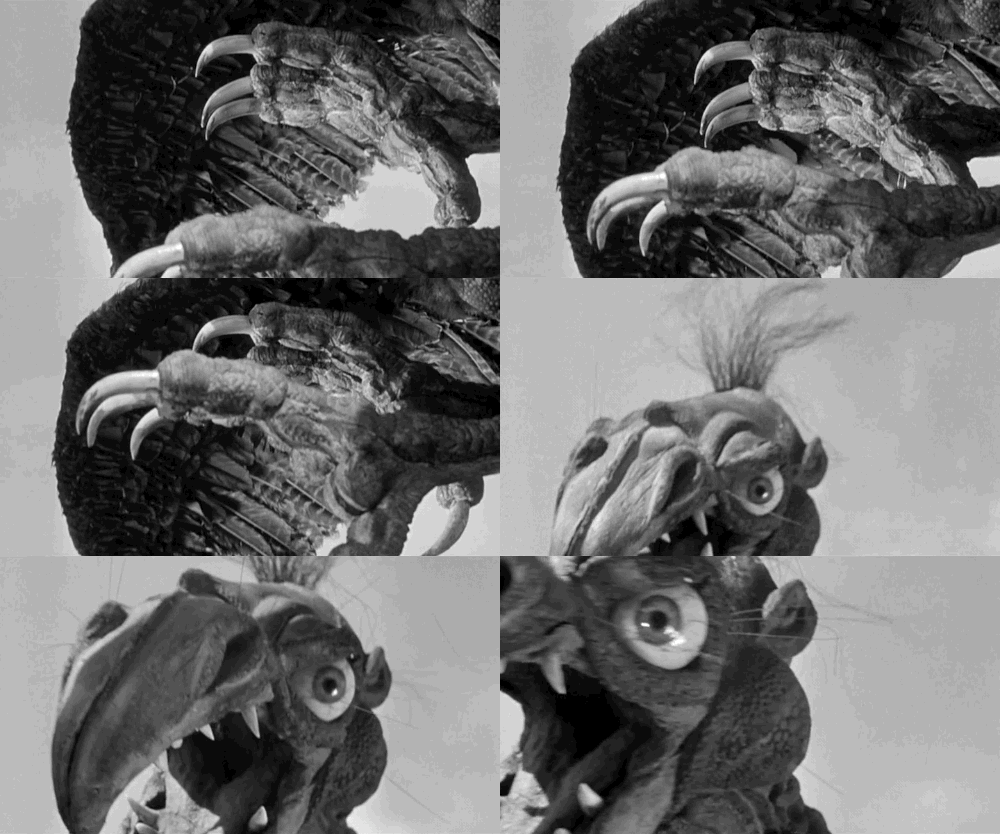
There was no time for the PCs to exult in this victory, however, as they knew Hagen would still have to be dealt with. Hoping to lure him inside, Norm yelled out that Abraxus had just suffered a stroke - but the only response was an odd creaking sound from the roof. Cautiously, the PCs moved out into the street outside, but Hagen was nowhere to be seen. Then, from somewhere, came a sound like the cawing of birds - and abruptly the students (and half the PCs) began to scream in abject terror as the world seemed to warp around them, the walls cracking and sliding, their bodies seemingly sloughing apart into heaps of hideous carrion. The shrieking, panicking audience fled into the street, and by the time Sovan managed to calm everyone down with a Dispel Magic spell, Hagen had already taken the opportunity to slip into the building and was starting to drag the stricken Abraxus upstairs. And what, exactly, was that huge flapping thing on the roof?

Sovan ran inside to try to stop Hagen - but the mercenary mage made a hook-fingered gesture and Sovan fell, psychically pinioned to some cosmic crag, helplessly hearing the approach of terrible wings. With dreadful effort he forced himself to move, casting Hold Person, but Hagen shrugged off the spell and the strain of casting it nearly killed him. Seeing Sovan collapse in the doorway, Hash and Skadi ran in and started firing arrows - but their shots simply tore holes in Hagen's clothes, revealing the glinting shirt of enchanted mail he wore beneath it, as he continued to haul Abraxus upstairs. Meanwhile the creature on top of the house - which seemed to be Hagen's pet bird, somehow grown to monstrous proportions - was tearing the roof away with its talons. Panicking students were fleeing in every direction, tearing off their masks while howling about visions and monsters, and from a nearby window the ever-reliable Becky looked out and screamed: 'OmiGAWD! The curse of Anthrax and Judacus has come again!'

Image result for giant bird claw
IT'S THE GIANT CLAW!

The situation was now deteriorating rapidly. Sophie cast Magic Missile on the bird, but while the blast caused a rain of apparently mummified flesh and dusty feathers to pour down into the street, the creature seemed undeterred by the damage it had sustained. Circe tried her snake-man pain wand, but the bird didn't even flinch. Skadi charged upstairs in pursuit of Hagen, and threw a vial of space-acid into his chest: ashen-faced with pain, Hagen responded with a spell that sent Skadi staggering back, torn by spectral talons. Then the very real talon of the giant bird reached through the roof and lifted both Hagen and Abraxus into the air, despite the volley of spells and arrows that the PCs hurled after it, and proceeded to wing its way towards the academy.

The party considered fleeing - but decided that with Abraxus sedated, Hagen badly wounded, and Glasstown in a panic, this was really too good an opportunity to miss. So instead they rushed to the academy, where the bird had dropped Hagen and Abraxus off on a balcony, before shrinking rapidly to normal size and following them inside. Hash cast Invisibility on himself, scaled the wall and tied a rope to the balcony; inside he could see Hagen slumped in a chair, talking to two men in academic gowns, who were taking turns to examine the unresponsive Abraxus. The rest of the party crossed the street and climbed the rope under the cover of an illusion spell cast by Sophie, who remained lurking in the alleyway below - but her illusion couldn't cover the inside of the chamber, to which she had no line of sight. So instead Pole cast Obscuring Mists, and under the cover of this sudden fog cloud the rest of the PCs swarmed up into the room - just in time to hear one of the academics incant a Dispel Magic spell. Instantly the mists vanished - and for a single, frozen moment, the two sides stared at one another in horrified recognition...

Hash moved first. His bow was already in his hands: now, with lightning speed, he sent an arrow across the room, burying itself fatally between Hagen's eyes. As the mercenary mage dropped, so too did his pet, which was now very obviously nothing more than a long-dead mummified bird. Sovan moved next, unleashing a Hold Person spell which froze both academics where they stood. Swiftly, Hash and Skadi bundled Hagen's corpse, the two paralysed magi, and the drug-befuddled Abraxus out of the window, down the rope, and over to Sophie,  while Sovan rushed out and started dragging furniture across the stairwell, forming an improvised barricade to keep anyone else from coming up.

Meanwhile, Pole and Circe ran up the stairs to the secret lab, the location of which they had discovered during a previous botched break-in. The unfortunate servant who tried to stop them was hit by a Command spell ('faint'), fell down the stairs, got whacked on the head by Sovan, and was then shoved under a large, heavy item of furniture as part of the barricade. Using keys taken from Hagen and Abraxus, they unlocked the door, flinching as a magical alarm went off: but when other members of the teaching staff came running, they found the stairs barricaded, with Sovan yelling out that he was holding Abraxus hostage and would kill him if they came any closer. (Meanwhile, yet another luckless servant who spotted all the shenanigans outside got shot in the neck by Hash before he could raise the alarm. Team Tsathogga may be many things, but genuine heroes they are not.)

Related image
High-speed barricade building is a skill every adventurer should learn!

Donning the mirrored mask, Pole stepped into the lab - and found himself face-to-face with the mirror men, who the party had been terrified of ever since their first brush with them at level 1. His mask ensured that they didn't attack him on sight, but the mirror men still wouldn't let him go anywhere near the orb, and insisted that they would only negotiate with him if he showed them his face - something he was intensely unwilling to do. With the situation on the stairs getting increasingly desperate, Pole requested the mirror men to speak to him at noon the next day, which they agreed to do. Then he, Circe, and Sovan fled down the rope as the barricade was blasted apart by a bunch of angry wizards below.

Fortunately for the PCs, Glasstown was still in a stage of upheaval, with terrified crowds convinced that the wizards had unleashed some awful monster upon them yet again. Using all the chaos as cover, they escaped over the walls and fled back to Tiny's hidden camp in the woods, using the Sister to sedate their two captive academics into submission before the Hold Person spell wore off. After looting Hagen's body for spellbooks and magic items, they questioned Abraxus about the nature of his bargain with the mirror-men, learning that Hagen had provided him with some 'undesirables' whom he had handed over to them, feeding their hunger for faces, in return for their service as guardians. Only he and Hagen were permitted to enter the lab, and only he could renegotiate or cancel their contract. The next day, at noon, the PCs spread a suit of stolen reflec armour out on the ground as an improvised mirror, and Pole leaned over it wearing his mirror-mask. Sure enough, his reflection began speaking to him: and after a few more failed attempts to get the mirror-men to change their position, Pole simply had the still-drugged Abraxus come over and release them from their contract. Given that only Hagen and Abraxus had been able to go into the lab safely, the PCs guessed that it would be quite some time before the rest of the Glasstown staff realised that the mirror-men inside it were gone. Now all they needed to do was get someone inside the academy.

That night, Sophie approached Glasstown from the west under the cover of illusion magic, accompanied by the Sister and her three new thralls. At the same time, Sovan and Hash crept towards the town from the east under the cover of darkness. When they were just out of sight of the city walls, Sophie stripped the three men naked and tied them together at the ankles, and the Sister ordered them to walk towards the city walls, crying out that they had escaped from their captors in the hills to the north. Sure enough, as soon as Abraxus and the other kidnapped professors were sighted from the city walls, a general alarm went up, with wizards and constables rushing out to bring them into safety and check for any signs of an ambush. While the town's guards were thus distracted, Sovan cast Strength and Silence on Hash, Hash cast Invisibility on himself, and then the silent, invisible elf slipped over the walls and hurried through the streets to the academy.

Scaling the walls and climbing through a window, Hash found the lab guarded by two armed men - but he could see in the dark and they couldn't, so he shot out their lamp and used his heightened strength to shove them both downstairs while they stumbled around in the darkness and magically-induced silence. Using Abraxus' stolen key he unlocked the lab door, relying on Sovan's Silence spell to hush the alarm: the mirror men had departed with the cancellation of their contract, so nothing remained to stop him from grabbing the orb and fleeing the town under the cover of a Darkness spell. He then rejoined the others at Tiny's camp, and the whole group hastily decamped in the direction of Bright Meadows, confident that by the time Abraxus and the other academics recovered from the Sister's poison they would be far away.

But before he left the academy, Hash left a note pinned to the wall, written in an elegant, flowing hand:

Witness the vengeance of Simonides!
The curse of Anthrax and Judacus is upon you!!
FREE EDUCATION FOREVER!!!

Sunday, 4 March 2018

RPG books as fiction

It seems to me that the majority of RPG books are in denial about their true function.

Most setting books maintain the pretense that someone's going to pick them up and run them, as written, straight out of the book. That someone out there will really run a whole campaign set in Your Made-Up Campaign World, just the way you wrote it, and that when their players ask them 'Who's the mayor of this town?', they're actually going to page through your Big Book of Made-Up Facts and give the answer that you've written down. Similarly, most adventure modules pretend - rather endearingly - that someone is actually going to run them exactly as written, right down to the read-aloud text. Monster books pretend that someone will actually use their monsters in play, giving them exactly the descriptions and statistics assigned by the book. And so on.

But even the briefest comparison between the way most RPG books are written and the way most actual RPG campaigns are played will demonstrate that this can't possibly be the case. For a start, how long is the average campaign, these days? Thirty sessions? Twenty? Ten? A 10-30 session campaign doesn't need whole continents worth of detailed setting information: one home base with 5-10 adventure sites scattered around it is closer to the mark. And yet campaign settings continue to be written as though PCs will wander around in them for years and years of real-time, roaming from city to city, province to province, like a band of high fantasy Marco Polos. They trade on the fantasy of a D&D campaign as something that might run more-or-less forever, rather than reality that you're usually looking at five or six interconnected adventures at best.

Image result for borderlands campaign setting frog god
No-one is ever going to use your road-by-road random encounter tables!

Adventure modules are, in theory, more realistic propositions, but they are produced - and purchased - in a volume that bears no resemblance to the rate at which they could actually be used. Plenty of people have bought all the D&D 5th edition hardback adventures - but playing through them all as written, at a rate of one session per week, would require a group to have been doing nothing else since 5th edition was released in 2014. The Pathfinder adventure paths are even more extreme: the Paizo forums are full of people who've read them all, but I would be surprised if anyone in the world had actually played them all as written from beginning to end. (You'd probably need to have been meeting twice a week, continuously, since 2007!) Then there are all the innumerable third-party modules which Bryce wades through so heroically over at tenfootpole. Many of those adventures probably aren't run as-written by anyone other than their playtesters (if they even have any), but people still buy them and read them. Browsing through the module reviews on RPGNow, DrivethruRPG, or DM's Guild, it rapidly becomes apparent that reviews by people who have actually played the modules, rather than just read them, are in a tiny minority.

Bryce often points out that the vast majority of adventure modules are written in a way which makes them almost useless for their supposed purpose of 'running a game in real-time at the table'. This is so obvious, and so trivially demonstrable, that its continued persistence strongly indicates that this is in fact not what most adventure modules are being used to do, and probably not even what most of their purchasers want them to do, even though it's exactly what most of their authors assert they are actually for. I strongly suspect that the same is true of most published campaign settings, monster books, etc, most of which similarly seem to be written with much more of an eye to being read than to being used. Not that there's anything surprising about this: after all, if people only bought the adventure modules, supplements, and campaign settings that they actually, seriously intended to use as-written, then the whole RPG book market would be a fraction of its current size. In the last two years, I've directly used six RPG books - Liberation of the Demon Slayer, Islands of Purple-Haunted Putrescence, Demonspore, Qelong, Death Frost Doom, and a couple of bits from Petty Gods - but, thanks to the magic of pdf-only bundle deals, I wouldn't know how to begin counting how many I've read. A hundred? More?

Image result for bundle of holding
Oh, Bundle of Holding. This is all your fault.

Skerples recently argued that there are three kinds of modules, which he calls 'modules as novels', 'modules as manuals', and 'modules as art'. I think he's onto something, and I don't think that it's only modules that his division applies to. Furthermore, I'd suggest that these three kinds of RPG writing correspond to three different ways of using RPG books:
  • RPG books written like manuals are best adapted to being used as-is at the table. Nothing else stands much chance of surviving contact with the chaotic process of actual play. 
  • RPG books written as art are best adapted to being used by people who are preparing or running RPG campaigns, and who are looking for material to adapt or borrow for their own games. Their true purpose is not to be used as-written, but to inspire GMs to come up with better material than they might otherwise have done. 
  • RPG books written as novels are best adapted to being read as a rather esoteric form of genre fiction.
This third one is one of the dirty little secrets of the RPG industry: that lots and lots of RPG books are bought and read by people who don't use them in play, and who know that they have no realistic prospect of ever doing so. RPG books written like novels proliferate not only because many people have no idea how to write useable adventure modules, but because that's precisely how they will be read by a large segment of their target audience. For such readers, reading the book, and imagining what the experience of playing it at the table might be like, takes the place of actually playing the game. As Skerples notes, 'If you're a big established game company with well-entrenched rich IP, your gamebooks can become storybooks.' (Anyone who remembers the bad old days of 1990s RPG metaplot will recall how literally this used to be the case!)

Image result for vampire masquerade giovanni chronicles
Thanks to 'adventures' like these, you too can have the thrilling experience of watching passively while super-powerful NPCs do things which will later be important to the metaplot!

If you don't do it yourself, it can be a bit counter-intuitive to think of RPG books being read as fiction. After all, the world is full of actual stories by professional authors, most of which are rather better-written than the average RPG sourcebook: so why read an RPG book when you could read a novel instead? But I suspect that what such books primarily provide, which traditional adventure fiction does not, is a form of meta-fantasy: not a chance to imagine yourself as a fantasy hero, but a chance to imagine yourself as part of a group of RPG players who are, in turn, imagining themselves as fantasy heroes as they experience the material in the book. People read RPG rulebooks, and they imagine how much fun it would be to play a character with a certain set of abilities. They read monster books, and imagine how much fun it would be to encounter those monsters during an RPG session. They read setting books, and imagine how great it would be to participate in a campaign set in that world. They read adventure modules, and imagine how much fun those adventures would be to play in. Then they put them back on the shelf and do something else, instead.

RPGs are hardly alone in this: it's well-known that people buy cookbooks on cuisine they'll never seriously attempt to cook, guidebooks on places they have no real intention of visiting, magazines full of detailed reviews of things they'll never be able to afford to buy, and so on. Reading about things usually isn't as satisfying as doing them, but it's much easier and less risky: reading an adventure module and daydreaming about playing it is a pleasant and undemanding way to spend an hour, whereas actually running it would require time, organisation, commitment from several people, and a real risk of failure or disappointment. I'm pretty sure that Paizo, at least, are well aware that more people buy their adventure paths to read than to play. Their whole business model makes a lot more sense once you recognise that they are primarily in the business of putting out monthly installments of shared-universe fantasy serial fiction for an audience of long-term subscribers, rather than that of producing usable adventure modules for people to actually run at the gaming table.

(Thus Bryce's endless complaints about D&D modules which dictate what the PCs should do, thus nullifying the point of the players turning up in the first place. Once it's understood that, in many cases, there are no players and never will be, the complaint becomes moot...)

Now, reading RPG books as fiction is a pretty harmless pursuit - and it's certainly one I've engaged in myself at various points in my life, when my circumstances made actual gaming impossible. However, problems can arise out of mismatched expectations - and the books themselves often aggravate this, by pretending to be things that they quite transparently are not. I recognise, of course, that the same book can serve different functions to different people: after all, many groups apparently do play through Pathfinder adventure paths exactly as-written, even though I struggle to understand how. But all too often, RPG books are riddled with what I've sometimes seen described as 'cargo cult design': the insertion of material (e.g. backstory, read-aloud text, extensive NPC statistics, price lists, floorplans, etc) simply because the authors have seen those things in other RPG books, rather than because they actually help the book to function in its primary role. Of course, I don't expect any author of RPG books to actually admit that their books are primarily intended to be read as fiction rather than used at the table: doing so would destroy the whole illusion on which the 'RPG book as fiction' subgenre is built. But I think that a bit more honesty and clarity about whether a given book is actually intended for use directly as-written or as a source of indirect inspiration, and a bit more effort devoted to matching form to function, could often go a very long way!