Sunday, 18 October 2020

Miniature Painting: The Greenwood Gang

Two years ago, in September 2018, I took up miniature painting. You can see my first fumbling efforts here, and my very-slightly-less-fumbling second efforts here.

Since then I have continued, in an extremely unsystematic way, to collect and paint miniatures. The pandemic has meant that I haven't actually done any miniature-based gaming, but painting tiny plastic goblins has proven to be a very calming activity in these uncertain times. One of my students recently confessed that she spent her spare time assembling Gundams because it was 'meditative'. I knew exactly what she meant. 

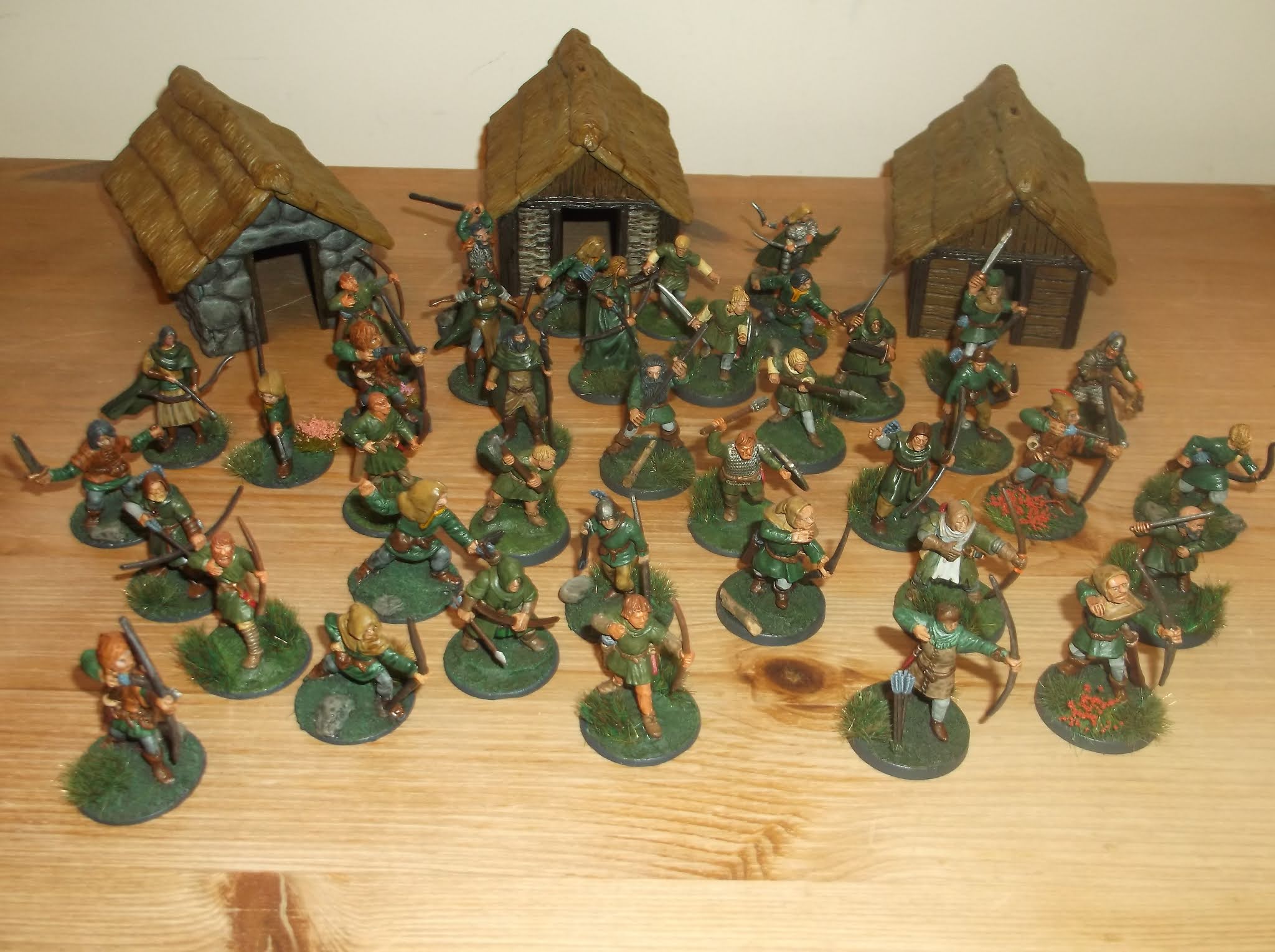
The Greenwood Gang are a good example of my haphazard approach to the hobby. A couple of years ago I bought a sprue of Dark Ages archers and painted them in green and brown, with the idea that maybe they were hunters or foresters and would thus be wearing clothes to camouflage with the woods in which they moved. From then on, every time I got a figure or two with a vaguely 'medieval outlaw' air to them, I painted them in the same colours. And so, gradually, the Greenwood Gang grew from a band of four archers to a force of thirty-nine, including everything from board game figures, to old-fashioned metal models, to modern plastics. They were painted at intervals over the last two years: some of them were painted when I was still learning and had almost nothing in the way of paints and basing materials, while others were completed much more recently. I rather like the motley appearance this gives them, even if the historian in me can't help noticing that some of them really don't belong within about five hundred years of each other. 

Anyway. Here they are. There's got to be some wargame out there in which they'd count as a rules-legal force...

Outlaws with swords.

Outlaws with staves.

Outlaws with mixed weapons.


Outlaws with bows 1.


Outlaws with bows 2.


Outlaws with bows 3.

Outlaws with bows 4.

The whole damn gang, swarming from their hovels to defend the forests from the Baron's men!

Monday, 12 October 2020

The White Tower: an edition-agnostic adventure for D&D

I took an overdose of fin de siรจcle Gothic fiction and wrote this, more as a finger exercise than anything else. Put it in a hex somewhere near the sea.

Advance warning: some of the themes addressed here are pretty heavy, even if they are approached rather obliquely, just as they are in the fiction that inspired it. Please use with appropriate care.

The Tower: It stands on a hilltop, shining white in the distance, visible for miles around. The land around is thickly forested. No-one goes there now, though the forest is dotted with the overgrown ruins of farms and villages, showing that the hills were once densely inhabited. The woods have an evil reputation with the locals, who avoid the place, especially after dark.

The Rumours: In the villages that cling to the riverside, the people are happy to talk about the tower on the hill, though never without first making signs to avert the attention of evil spirits. They say a sad old lord used to live alone there, until the day he rode along the sea cliffs the morning after a storm and found a beautiful girl cast up by the waves on the beach, more dead than alive and surrounded by broken timbers. He took her home, and she became his ward, and then his wife. She seemed to give him new joy in life, and one by one he called his old friends to live with them: a priest, a doctor, and an artist. Then one midsummer the whole household was found dead and dangling from the rafters - all save the lady, who had vanished without trace. After that nothing went right in the villages around the white tower. Soon the farms were all abandoned, and the forest came.

The Woods: By day the woods are harmless enough, and in the spring and summer they are thick with wild roses. Often a woman can be heard singing in the distance, though no amount of searching will ever find her. By night travellers will repeatedly glimpse swaying, broken-necked figures hanging from the branches out of the corners of their eyes, though these disappear when looked at directly. When the wind blows through the woods by night, it carries the sounds of crashing waves, screaming men, and shattering timbers, as though a shipwreck was happening just over the hill.

For each hour spent in the woods by night, there is a 1-in-3 chance of an encounter with a random ghost. Roll 1d6:

  1. Bianca, the maid, weeping uncontrollably as she dabs her eyes with an embroidered handkerchief, her broken neck jerking disturbingly with each heaving sob.
  2. Giuliano, the gardener, and Alberico, the doctor, locked in a feverish embrace, trying to kiss each other with heads that dangle from broken necks.
  3. Ortensia, the cook, dressed up in her best gown, roaming the woods and calling out: 'Lucia! Lucia!' Stiff coloured ribbons tied around her throat imperfectly conceal her broken neck.
  4. Jacopo, the chaplain, striding through the forests in his black soutane, his shattered neck almost, but not quite, held upright by his high and rigidly starched white collar. He holds a sealed letter out stiffly before him, the word Lucia just visible on the envelope. 
  5. Giustino, the artist, craning his broken neck and sketching feverishly with paper and charcoal at something only he can see. 
  6. Lord Orazio, brandishing a bleeding dagger, rushing through the night wild-eyed and howling: 'She is MINE! Mine only! Mine always! I found her! She belongs to ME!'
If any attempt is made to interact with the ghosts, it will instantly become obvious that what seemed like human forms were nothing more than a trick of the moonlight, their voices merely the moaning of the wind.

Approaching the Tower: One stumbles upon it suddenly, right in the middle of the wood. Its white stone walls are still strong and clean, untouched by overgrowth, in marked contrast to the condition of all the other ruins in the woods. Its wooden doors have rotted almost to nothing. The stables, servant's quarters, and other outbuildings are now mere heaps of mossy stone.

  • An immense serpent lazes on a rock nearby, huge and almost unkillable, covered in gorgeous, multicoloured scales. It will attack only in self-defence, but if any group of people try to enter the tower it will rear up and spit a stream of venom straight into the eyes of whichever of them has the lowest Charisma score. Unless dodged, this venom will cause permanent blindness unless treated with healing magic or washed away promptly with salt water and/or milk. (Any healers in the party will know this.) The snake can be distracted by giving it live prey to eat: the larger the animal, the longer it will spend eating it. A rabbit might buy you a minute, whereas eating and digesting a horse will occupy it for an entire day. 

A Note on Ghosts: Unlike the ghosts in the forest, the ghosts in the tower are completely physical. (They are not zombies: the actual corpses of all these people are still mouldering in their graves.) Their pale bodies can be cut down with mundane weapons, although they do not bleed and are weirdly resistant to harm. If 'killed', they reform the following midnight unless the tower's enchantment has been undone. Unless otherwise noted, none of them can leave their respective rooms.

A Note on Dreams: Anyone who attempts to sleep within the White Tower will be tormented by horrible nightmares of shipwrecks, serpents, stabbing daggers, strangling roses, hanging bodies, and staring eyes, and will wake up feeling more exhausted than they were when they first went to sleep. Sleeping under these conditions will not allow the recovery of lost hit points or spells.

Ground Floor: The main doors lead into a great semi-circular room hung with faded scarlet tapestries depicting hunts, tournaments, and battles, with a grand flight of white stone stairs leading up. A doorway at the back leads to a warren of kitchens, one of which contains a trapdoor covering a rusted iron ladder leading down into darkness. The sound of a woman weeping echoes down from upstairs.

First Floor: A single room dominated by a huge table and an immense fireplace. Seven frayed ropes hang from the rafters, swinging lazily back and forth even when there is no breeze. White stone stairs lead up to the second floor.

  • The ghost of Bianca, the maidservant, haunts this room, weeping endlessly as she tries to wash the bloodstained floorboards with her tears. Her labour is useless: scrub how she might, the stained timber remains as scarlet as ever. Her skin is pale and her neck is obviously broken. She clutches an elaborately embroidered handkerchief in her calloused hands.
  • If questioned, Bianca responds only with incoherent torrents of self-reproach: 'They made me! I'm sorry! I'm so sorry! I loved her so much! But they all forced me to! Oh, if only I had been stronger! Oh, this is all, all, all my fault!' 
  • Bianca has a knife hidden up her sleeve, and will fight to the death to avoid parting with her handkerchief, the one token she has left of Lucia's love. If she can be persuaded that giving the handkerchief to the PCs will help Lucia find peace, however, then she will hand it over, although not without kissing it several hundred times first.


Second Floor: Three bedrooms branch off a central landing. A narrow flight of stone stairs continues upwards.

Master Bedroom: This room belonged to Orazio and Lucia, and is still haunted by the ghost of Lord Orazio. Its walls are lined with bookcases, weighed down with ponderous legal and scholarly tomes, some of them of great value. From the open window, it is possible to smell (although not see) the sea. Behind a wooden screen, painted with images of sea birds, stands a huge white marble bath.

  • Orazio's ghost paces around the room on an endless patrol, his grey old head swinging alarmingly from side to side on its broken neck. In his hand he clutches his grandfather's dagger, still stained with Lucia's blood. From time to time he mutters: 'Lucia! Lucia!' and 'Faithless! Faithless!' under his breath. 
  • If he sees the PCs, Orazio will demand to know what they are doing in his house, and will ring the bell for the servants (who, obviously, do not come). He becomes agitated if anyone points out his unnatural condition, or that of the tower. If Lucia is mentioned, even obliquely, he accuses them of being her lovers and attacks in a frenzied rage. Any wounds he inflicts with his dagger, even the slightest scratch, will just keep bleeding and bleeding until proper medical attention is given or the victim dies.
  • Orazio's power is this: if he gives a direct order to a single PC, they must save or obey it to the best of their ability. Orazio can only give orders that conform to his understanding of gentlemanly behaviour: 'leave my house' or 'restrain this trespasser' are fine, but 'murder your friends' or 'slit your own throat' are right out. Anyone whom he has wounded with his dagger receives no save against this ability.
  • If the bath is filled with salt water (e.g. from the lake or the pit), then anyone bathing in it will regain half their lost hit points. Full immersion will also heal blindness caused by the serpent's venom or bleeding caused by Orazio's dagger. Its magic will function only once for each PC.

Second Bedroom: 
This room was occupied by Alberico, the doctor, and was the site of his illicit liaisons with the gardener, Giuliano, whose ghost still haunts the room. Its cluttered shelves and wardrobes are almost invisible beneath the masses of flowering rosebushes which grow across the walls, floor, and ceiling, filling the room with an overpowering floral scent, regardless of the time of day or year.
  • Giuliano's ghost lurks unseen amidst the rose bushes, which grow through and out of his beautiful, pale body. He cannot speak for the roses that grow from his mouth. He hungers for warmth, and nourishment, and life.
  • For every minute that PCs remain in the room, they must save or sink into a drowsy stupor, lulled by the scent of the roses. As they lie in this state, rose vines will stealthily curl around them and impale them with a hundred thorns, drawing off blood to feel Giuliano. The more blood he drinks, the more he will stir amidst the vines, making it easier for the PCs to spot him, and to see that he is clearly still too weak to break free from the roses that pin him to the walls. If attacked, he defends himself with clouds of soporific pollen, and with walls and waves of lashing thorns.
  • If Giuliano drinks more than two gallons of blood in a single day, he becomes strong enough to break free. (This much blood loss would kill two ordinary people, but spread between six it would just leave them feeling woozy and weak. Alternatively the PCs could feed him an animal from the forest, or the hairy thing from the pit under the house.) He can also be freed by cutting through the roses that bind him using either Orazio's dagger or Ortensia's cleaver. (If severed with normal blades, they regrow as fast as they are cut.) 
  • If freed, Giuliano will stagger upstairs to the Study, and seize Alberico in an urgent embrace. More rose-vines will erupt from both men's bodies, binding them tightly together, and soon there is nothing but a mass of roses to mark the place where they once stood. Cutting through them will reveal no trace of either man, and they will not reform the following midnight. With Giuliano gone, the roses in this room become normal flowers, and will promptly wither if out of season. 
  • A trunk under the bed contains Alberico's medical supplies, including plenty of bandages (which will be useful if anyone has been cut with Orazio's dagger), and bottles of saline solution (which are handy for washing the eyes of anyone hit by the venom of the serpent).

Third Bedroom: This room was shared by the chaplain, Jacopo, and the artist, Giustino. It is easy to guess who slept where: one half of the room is hung with sombre colours, with a tiny shrine to a miserable-looking saint in one corner, while the other half is scattered with paints and half-finished clay models, with expensive clothes in extravagant fabrics flung heedlessly across the bed and over the backs of chairs. Giustino's clothes and Jacopo's holy icons could both be very valuable to the right buyer. Their ghosts are not here, haunting the chambers above.
  • Hidden under the pillow of Jacopo's bed is a silk bag containing a stash of passionate love letters addressed to Lucia by Jacopo, interspersed by terrible (but obviously heartfelt) attempts at erotic poetry. Each page has been torn neatly in half.

Third Floor: This floor has the same layout as the one below, but instead of three bedrooms the central landing opens onto a library, a study, and a chapel. A set of spiral stairs, wound claustrophobically tight, twists upwards to the fourth floor.

Library: This room is full of bookshelves and cabinets of curiosities, packed with trinkets from far-off lands, some of them of considerable value. A writing desk sits by the window.

  • One wall is dominated by a large painting of Lucia, signed by Giustino. It depicts her seated by an ornamental lake, surrounded by roses, with the White Tower itself clearly visible in the background. She holds an embroidered handkerchief - recognisably the same one used by Bianca - and looks very, very beautiful, if somewhat vacant. Anyone with an above-average Wisdom score will be able to tell at a glance that the painter was obviously in love with his subject.
  • On the desk is an open book, a bestiary of strange creatures from many lands. It has been opened to a page describing 'syrens, wicked spirits of the ocean, beauteous of body but void of soul, whose songs draw men to madness and destruction.'
  • In the locked drawer of the desk are legal papers drawn up by Orazio, petitioning a local (and now long-dead) magistrate for divorce from Lucia on the grounds of her 'infidelity and promiscuity', 'unnatural practises', and 'neglect of her marital duties'. The papers are complete, but have not been signed or sealed. 

Study: This room smells strongly of poppies. It is haunted by the ghost of Alberico, the doctor, who fusses endlessly with his books and potions as he tries, uselessly, to come up with an adequate diagnosis of Lucia's nature and his own bizarre condition. As he works he takes regular gulps from the bottle of laudanum that rests on the table, using his free hand to physically hold his head up by the hair as he does so to allow himself to swallow despite his broken neck.

  • Alberico is extremely resistant to the idea that he is dead, and will come up with quite insanely convoluted 'rational medical explanations' to account for his situation. He will insist that he could leave this room if he wanted to, but that his work is much too urgent to wait. If confronted with irrefutable evidence that he is dead he will suffer a massive nervous breakdown, chug down the whole bottle of laudanum, and collapse in a narcotised stupor for 1d8 hours. When he wakes up he will carry on with his work as though nothing had happened.
  • More rational than the other ghosts, Alberico will freely admit to having plotted to murder Lucia. 'Quite a disruptive influence, she was. Threw the whole household out of order. A thoroughly abnormal type - something wrong with her nerves, no doubt. Everyone agreed by the end. Desperate cases require desperate solutions!' His memory of the event itself is blurry, but he remembers hearing Lucia singing 'a song that sounded like the sea', and seeing Lord Orazio plunge his grandfather's dagger into her chest in a desperate attempt to shut her up. 
  • Alberico's desk is covered in masses of case notes, documenting his fruitless attempts to diagnose Lucia's nature. He will happily allow the PCs to consult these, although he will not allow them to be removed. Anyone looking through the notes will notice that Alberico has idly sketched Giuliano's face dozens of times in the margins. Anyone who has seen Giuliano in the second bedroom will recognise the face as his, but if questioned Alberico will insist that the face is of 'no-one in particular. Just idle doodling, I'm afraid...'
  • Alberico will violently resist any attempts to meddle with or remove his case notes, and if the PCs persist he will grab a large bottle from a shelf and smash it open, releasing a buzzing cloud of furious insects whose stings induce rapid swelling and unbelievable, crippling pain. They are hard to fight with normal weapons, but smoke (e.g. from the second-floor fireplace) or any kind of strong air current (e.g. the wind on the roof) will soon disperse them. 
  • Alberico's power is this: during combat, he will look at a random PC each round, mutter a brief diagnosis of them based on their current behaviour (e.g. 'shouting too loudly - probably hysterical', or 'face looks flushed - probable heart condition'), and make a swift note in his pocket book. This diagnosis will then become the truth, causing those who fight against him to swiftly dissolve into a mass of physical and mental infirmities. (Note that Alberico can't use this power aggressively, by e.g. diagnosing someone with a fatal heart attack: he genuinely thinks he's just observing what's already there.) If Alberico is defeated, or his pocket-book is destroyed, these induced conditions disappear. 
  • If Alberico is reunited with Giuliano (see Second Bedroom, above), the PCs will be free to read and take his notes at their leisure.

Chapel: This cold, severe-looking room is hung with icons depicting bleeding saints and martyrs, posed in various expressive attitudes of agony. The ghost of Father Jacopo, the chaplain, kneels in silent meditation before the altar. His bowed head makes his broken neck horribly obvious, making him look rather martyr-like himself. 

  • Jacopo's power is this: if anyone enters the chapel, Jacopo rises and turns his stern gaze upon them. The intruder will instantly become overcome with feelings of hysterical shame and self-loathing, and will subject themselves to increasingly extravagant forms of self-harm until they are physically pulled from the room, while Jacopo watches silently with an expression of mingled pity and contempt. 
  • If Jacopo is confronted with either the love letters from the third bedroom, or the erotic drawings of him from the studio, his composure disintegrates and his gaze loses all its power. He begins kicking up a storm of poltergeist activity, throwing the heavy bronze candlesticks around the room while howling about how Lucia bewitched him into vice and sin. 
  • If Jacopo is defeated, anyone examining the altar will discover the true object of his veneration: a golden reliquary containing a nude drawing of Lucia, stolen from Giustino's studio. The reliquary is beautifully engraved with patterns of flowers and vine leaves, and would be of great value to any church with a relic worth putting in it. 


Fourth Floor: This wide-open, barely-furnished room was converted into Giustino's studio, on account of the brilliant light that shines in through its huge windows. It is littered with half-finished statues and paintings, and the walls are covered with layer upon layer of charcoal sketches drawn with a hasty, urgent hand. The older ones beneath are mostly of beautiful young men, but the newer sketches pinned on top of them are all of Lucia. A hidden folder in a locked drawer contains a sheaf of erotic sketches of Father Jacopo, obviously drawn from life. A flimsy-looking ladder leads up to a trapdoor on the roof.

  • The ghost of Giustino haunts this room, labouring endlessly at a clay sculpture of Lucia. He begins work each day at dawn, periodically breaking off his sculpting to consult his sketches, until at midnight he looks his sculpture over, realises his failure, and tears it down with a howl of anguish. He starts again the following morning.
  • If his work is interrupted, Giustino will become furious and order his unfinished statues to animate and attack. They are sad, clumsy, lumpen things, but there are quite a lot of them and they carry on fighting until they are smashed to pieces. 
  • Giustino's power is this: whenever he looks at a person, the way that he sees them will become the truth of them for as long as his gaze remains fixed upon them. Giustino's gaze is not false, exactly, but it tends to simplify people almost to the point of caricature: so a strong woman would remain strong while he looked at her, but would become almost incapable of anything other than feats of strength. In game terms, whomever he is currently looking at keeps their highest ability score and halves all the rest until he looks away.

Roof: The wind blows strongly here, a continuous torrent of air that smells of salt and sounds like the roaring of the sea. PCs who don't tie themselves onto something risk being blown clean off the roof and falling sixty feet to the ground below. From up here the lake is clearly visible, sparkling like a clear blue jewel among the remains of what were once the tower's gardens.

Basement: This crumbling subterranean warren of storerooms and wine cellars is the hunting ground of the ghost of Ortensia, the cook. Quite the maddest of the ghosts, she roams the cellars with her cleaver in her hand, snarling to herself. 

  • Upon seeing the PCs, Ortensia will mistake whichever of them has the highest Charisma score for Lucia (regardless of gender) and launch herself forwards to attack, howling a volley of misogynistic abuse - 'Whore! Bitch! Temptress! Slut!' - as she does so. 
  • As she 'dies', she will stare up pitifully at the PC she has mistaken for Lucia, and use her last breath to whimper brokenly: 'Why? Why choose her? Why couldn't it have been me?'
  • If the PC whom she has mistaken for Lucia shows her any kind of affection, she will throw her cleaver away and collapse into floods of helpless tears, apologising over and over again for her part in Lord Orazio's murder plan. Soon afterwards she will attempt to kill herself if not prevented.
  • One of the wine cellars contains a small fortune in rare wines, although without Ortensia's help it will take a thorough search to reveal it.

Sub-Basement: Lord Orazio's grandfather, Giovanni, oversaw the construction of the White Tower and was buried down here, among its foundations. PCs who come down here will hear him tap-tap-tapping on the inside of his tomb with his bony fingers. If they dig him up, he will rear up in his ragged winding-sheet and begin clack-clack-clacking with his ghastly yellow jawbones. (Unlike the other inhabitants of the White Tower, Giovanni is very much a corpse, not a ghost, and he stays dead if destroyed.) By signs and gestures he will attempt to indicate his frustration with the current state of the tower, and his desire for its inhabitants to be put to rest. If asked how, he picks up a rock and scratches twelve words onto the wall: FREE THE GIRL FROM THE WOOD. FREE THE WOOD FROM THE GIRL. 

Giovanni is nothing but a literal bag of bones, and would be no use in a fight either as an enemy or an ally. If the PCs free Lucia after digging him up, however, then as he collapses back into death he uses his last conscious moment to ensure that he falls pointing to a particular stone in the wall. PCs who remove this stone will find a stash of antique gold coins buried behind it, hidden by Giovanni to be used in his family's hour of need. 

Under the Foundations: Beside Giovanni's grave is a deep, damp pit, descending down into the wet earth. It is inhabited by some awful scrambling creature with thin, hairy limbs and yellow gnashing teeth, which will come scrabbling from its hidden holes to cut ropes, douse lamps, and murder intruders. At the very bottom of the pit are three feet of salt water, a mass of hair and bones of indeterminate origin, and a rock on which someone with beautiful handwriting has scratched the words Still so very far above the sea. Hidden behind this rock is Lucia's wedding ring, which would bring quite a price if it was cleaned up a bit.

The Lake: It is surrounded on all sides by masses of dense undergrowth, making it very difficult to find unless the PCs have either worked out its position relative to the tower using the painting in the library, or seen it directly from the roof. Here Lucia stumbled, singing and bleeding and dying, after Orazio's attempted murder. Sea nymph that she was, she merged herself with the water of the lake, and gradually with the water table of the whole forest. The lake is obviously freshwater, fed by hidden subterranean springs, and yet it tastes as salty as the sea. 

Anyone who spends more than a few minutes by the lake will hear a woman's voice murmuring, softly: 'Give me back to myself'. 

To undo Lucia's literal and metaphorical murder, any five of the following objects must be thrown into the lake:

  • Bianca's handkerchief.
  • The painting from the library.
  • The divorce papers from the library.
  • Lord Orazio's bloodstained dagger.
  • Alberico's case notes.
  • The drawing from Jacopo's reliquary.
  • Giustino's unfinished clay statue of Lucia.
When one object is thrown in, the water in the lake begins to churn.
When two objects are thrown in, the water in the lake takes on the colour of blood.
When three objects are thrown in, the outline of a woman can be glimpsed below the surface, although anyone diving down finds only stones and weeds.
When four objects are thrown in, Lucia's bleeding corpse can be seen lying at the bottom of the lake, very cold and very pale and very dead.
When five objects are thrown in, Lucia's eyes snap open and she rises, dripping and shuddering, to the surface.

The Rivals: If Bianca, Ortensia, Jacopo, Giustino, and/or Orazio are still 'alive' when Lucia rises from the water, they will instantly be aware of her resurrection and come rushing from the tower, screaming that she is theirs and theirs alone. If the PCs stand in their way, the ghosts will attack them furiously to get to Lucia: otherwise they will fight among each other until only one remains. Lucia will smile indulgently at her final 'suitor', and kiss them on the forehead, causing them to drop dead on the spot with a rapturous expression on their face. Then the serpent slithers over and eats them.

Unbroken Wings: Once the suitors are dead, Lucia will call the serpent to her, and merge with it, becoming a vast, undulating sea snake with a woman's face. As she does so, her necklace and bracelets will snap and fall from her body. Her coral-red lips open, pouring forth a song that fills the forest with the sounds of the sea. Then she dives down into the lake and is never seen again.

The left bracelet bears a green jewel. Anyone who wears it can breath water as though it was air.
The right bracelet bears a blue jewel. Anyone who wears it can drink salt water as though it was fresh.
The necklace bears a white jewel. Anyone who wears it will never be harmed by any sea creature except in self defence.


Aftermath: With Lucia gone, the White Tower begins to crumble. Its unquiet ghosts dissipate. Decades catch up with it in a matter of months. Within a year it is nothing but a heap of tumbled stones.

Once word spreads that the forests are no longer haunted, a distant relative of Lord Orazio will ride in and assert her ownership of the whole area. She visits the site of the tower, and takes a strange liking to the lake beside the ruins. Soon afterwards, she adopts a rose and serpent as the symbol of her house.

For years afterwards, fisher-folk along the coast claim to sometimes hear a woman's voice singing over the waters, especially on the mornings after storms. But Lucia does not return. 

Tuesday, 29 September 2020

Districts of the Wicked City 7: The River

It curves through the city in a great lazy meander, its waters discoloured by coal dust, its surface dotted with floating refuse. Here and there the chemical run-off from some adventurous serpent-folk laboratory creates shining puddles of oily, iridescent colour that spread across the water, to the delight of the shrieking children who splash and paddle in its shallows at low tide. Throughout the harvest seasons it is choked with fleets of barges, carrying confiscated wheat, barley and chickpeas from the surrounding fields and villages to feed the teeming and ravenous mouths of the city's people. For the rest of the year traffic upon the river is dominated by the skimming rowboats which carry passengers back and forth along its banks, evading the perpetual gridlock of the city's roads and bridges. There are still a few fishermen who ply their trade in its waters, but the fish in the river have grown scarce and strange in recent decades, and the fishing boats grow fewer every year. 

Shadman Malik bridge, Samarkand. (Built 1502 - this photo is from 1871.)


Shamans who commune with the spirit of the river upriver of the city say that he appears to them as a fine young man, proud and strong and straight-bodied, full of stories of the lands he has passed through and the hills he has made green. Those who commune with him downriver of the city find him terribly changed: an old man, haggard and shaking, wheedling and demanding, forgetful and irrational and vindictive. (Within the city, of course, the spirit will not appear at all.) Beyond the edge of the city's farmlands the river winds down into the desert, depleted by a thousand irrigation channels, and is lost in a maze of sediment-choked wadis. It does not reappear again. 

The riverfolk of the Wicked City are a breed unto themselves, a hardy race of scavengers who live among the mud and damp of the city's ruinous riverbanks. They make their homes among the leaning buildings that hang over the water at alarming angles, straining against their subsiding foundations, slowly losing their decades-long battle with gravity. They work on the wharves when work is to be had, caulking hulls, weaving ropes and nets, loading and unloading cargoes, and carrying passengers from bank to bank in agile little boats with sails like swift red wings. When work grows slack they take to salvage, digging amidst the muck in search of coals dropped from barges, or diving down into the basements of flooded buildings in search of something worth the taking. They swim like eels and stink of river-mud. A lifetime at the oars covers their bodies with braids of muscle, but the river's pollutants eat into their lungs and stomachs, and they usually die young. 

Turkmen boatmen, 1863.

Everything ends up in the river in the end. Toxic sludge from serpent-man drug-labs. The rusting hulks of crashed scrap-racers. The regalia of fallen noble houses, hurled into the water by their despairing heirs as the triumph of the Wicked King became inevitable. Mutilated statues from the king's statue network, their stone eyes gouged out to prevent them from witnessing who it was that toppled them into the river. The bodies of unfortunates murdered by the city's gangs, weighted down with rocks and thrown from the wharves at midnight, the river their only grave. Every riverman has stories about times they found more down there than they bargained for. Huge river-snakes swimming in from the Rubble. Flooded sinkholes leading down into the Maze. Sealed caskets of antique silver. Bullet-riddled corpses with bricks in their pockets, their faces still covered by the unmistakable death masks of the Secret Police. 

Most mysterious of all are the vast flooded spaces that extend beneath the temples and palaces that once lined the river in what are now the ruined districts. They may be little more than heaps of rubble on the surface, but the riverfolk swear that beneath them lie immense vaulted chambers, storerooms and basements and dungeons filled with river water, their treasures and secrets hidden beneath darkness and slime. Some of the most daring river scavengers are already in negotiations with the Scrap Mechanics. They want to hire digging tools and diving suits. They want to tear their way into the flooded vaults and drag their contents back into the light. 

One of them even hired a shaman from the steppes to ask the Downriver Spirit if he knew what was in them. The spirit claimed to have forgotten. But there was a crafty and desperate look in his demented eyes that suggested he may not have been telling the entire truth.

Thursday, 24 September 2020

The march of empire

I've mentioned before that the setting of ATWC is loosely pegged to the sixteenth and seventeenth centuries, which for the peoples of Central Asia were an era of imperial encroachment. Equipped with new gunpowder weaponry and a greatly improved logistical base, the Eurasian empires of the early modern period - Romanov Russia, Ottoman Turkey, Safavid Persia, Mughal India, and Qing China - were able to project force into the steppe, mountains, deserts, and taiga much more successfully than their predecessors. By the time the Nerchinsk Treaty of 1689 was signed, many once-impassible regions such as Azerbaijan, Sibera, Mongolia, and Afghanistan had been more-or-less carved up between them.

In ATWC, this hasn't happened yet. The steppe and taiga khanates still enjoy an uneasy independence, but every observer of current affairs can tell that change is on its way. Travel down the Great Road and you'll find foreigners everywhere: some southerners and some easterners and some westerners, but all carrying splendid-looking documents from far-off imperial courts and flanked by serious-looking men wearing strange military uniforms and carrying guns. They are always on the move, these foreigners. They study local languages. They map and survey and observe and inquire. They preach new religions, or disturbingly unfamiliar interpretations of old ones. They hold secret meetings with local princes that go on long into the night. Their horsemanship is comically terrible by steppe standards, and they possess a knack for starving to death in deserts that the locals find quite astounding, but despite these failings they carry themselves with a strange confidence. They seem convinced that the future belongs to them.

For the Tsar!


Wherever you go in the steppe khanates, or in the oasis kingdoms of the Great Road, you can bet that agents of foreign empires are there too. (They haven't made it very far into the taiga yet, but they're working on it.) Roll on the tables below to find out what they're up to.

Who is here? (Roll 1d8)
  1. Merchant-adventurers, scouting out the region's goods and markets on behalf of some far-off trade consortium, watched with loathing by local traders who have operated in this area for centuries. 
  2. Missionaries for some foreign faith, armed with official letters from a distant emperor, scornfully surveying the local temples.
  3. Negotiators come to arrange a treaty between a nearby ruler and some distant imperial state, speaking the local language very badly and looking extremely pleased with themselves.
  4. Explorers on horseback accompanied by local bearers, making notes and checking compasses, steadily filling in the blank areas on their maps.
  5. Scholars affiliated with a far-off university, surveying local customs and monuments and nodding sagely to themselves. 
  6. 'Archaeologists and antiquaries' (read: grave-robbers with fancy licenses), poking around in the ruins outside of town and casually asking where exactly your ancestors are buried.
  7. Military advisers decked out with the very latest in modern firearms technology, offering to help the local rulers modernise their pitifully outdated cannons and fortifications in exchange for a little quid pro quo.
  8. Roll again, but they're actually spies from a completely different foreign empire, here in disguise to watch over the activities of their rivals as part of some complicated game of international intrigue. 

For the Sultan!

Who leads them? (Roll 1d8)

  1. Bright-eyed true believer who genuinely believes that absorption into the greater imperial polity is the best thing that could possibly happen to a benighted backwater like this one.
  2. Dead-eyed veteran of the imperial war machine, whose utterly impersonal brutality makes even the most savage khans shiver.
  3. Long-term field agent who went native years ago, and now identifies more with the khanate they're posted to than the distant empire they supposedly serve.
  4. Embarrassing failure from a minor imperial house, sent out to the back of beyond with strict orders not to return home until they've actually accomplished something.
  5. Disgraced courtier who knows full well that they've been sent out here as a punishment, and resents it bitterly.
  6. Bookish academic convinced that their years of study in the archives have allowed them to understand the region much better than the people who actually live there.
  7. Enterprising merchant who sees the whole region as a series of mouth-watering opportunities for economic exploitation. 
  8. A member of a local ethnic group with a painstakingly acquired imperial education, who has carved out a precarious place for themselves as an intermediary between their country and the empire while feeling painfully out of place in both. 


For the Shah!


What is their true objective? (Roll 1d12)

  1. To lay the groundwork for the conquest and annexation of the region by the empire they serve.
  2. To change the region's culture and religion in ways that will align it with the empire.
  3. To gain revenge on the descendants of the nomad warlords who terrorised their empire generations ago. 
  4. To suppress the bandits and raiders based in the region, who are disrupting the empire's overland trade.
  5. To gain access to the natural resources of the region and exploit them for everything they're worth. 
  6. To turn the local rulers against their imperial rivals, who are also active in the region.
  7. To establish new trade routes and markets for the empire's merchants and manufacturers. 
  8. To bring down the local regime and replace it with one more amenable to their empire's interests.
  9. To establish a military alliance with the local rulers, in the hope of securing troops to fight in some distant imperial warzone. 
  10. To loot all the valuable books, treasure and antiquities they can get their hands on, on behalf of some far-off imperial archive or museum. 
  11. To establish covert diplomatic ties with the Wicked City. (All the empires insist loudly that they would never bargain with a state so obviously impious, but many of them do so anyway, albeit in secret. Empires always have uses for another delivery of cut-price muskets and clockwork soldiers!)
  12. Roll again, but the second roll is just a cover story: they're actually part of a rebel faction within the empire, secretly gathering allies and resources for a planned uprising. (Yes, if you also rolled an 8 on the first table, this means they're actually spies posing as rebels posing as something else. Welcome to the Great Game!)

For the Shahenshah!

How much backing do they have? (Roll 1d8)

(All imperial representatives travel with fancy letters declaring that anyone impeding their mission will face the wrath of the entire empire, but ink is cheap and armies are expensive. If push comes to shove, will anyone back home really care?)
  1. Less than zero. This mission has been deliberately set up to fail, as a deniable way of getting rid of someone inconvenient. No matter what happens to it, the empire will do nothing to intervene.
  2. Zero. This mission is essentially a punishment assignment for people who've made the wrong enemies. No-one in power will care if they don't make it home alive.
  3. Minimal. This mission is a gamble by some minor minister or provincial governor, who would very much like it to succeed but doesn't really have the resources to properly support it. Minor levels of military and/or financial reinforcement will be sent if they are in truly desperate need.
  4. Local. No-one really cares about this mission back in their distant imperial capital, but one local faction (roll 1d4 - 1 = religious group, 2 = ethnic group, 3 = political faction, 4 = merchant consortium) would like to see it succeed for private reasons of their own, and is willing to commit substantial resources to bring this about.
  5. Financial. This mission is being financed by someone with extremely deep pockets, and carries letters of credit that allow them to call upon staggering amounts of money on demand. 
  6. Military. This mission is being backed by someone with a lot of soldiers at their disposal, who is perfectly willing to send a whole lot of men to their deaths if it will help ensure the mission's success.
  7. Covert. Although only minimally supported by its notional patrons, the mission is actually being backed by another imperial power, for nefarious reasons of its own. They are willing to offer it substantial support, but only in indirect and deniable forms. 
  8. High. This mission has the full backing of the imperial government, which regards it as a strategic priority and are willing to launch large-scale military or diplomatic reprisals against anyone impeding or threatening it.
For the Son of Heaven!

Friday, 18 September 2020

Condensation in Action 9: Carrion Crown

As I try to get back into the groove of blogging again, I thought one good way to do it might be via another Condensation in Action post. I find these useful as mental exercises: looking at someone else's material and thinking about what I'd keep and what I'd cut, and why, is helpful practise for my work as a writer and GM of my own adventures. As usual, this post will take a massively bloated Pathfinder adventure path and hack it down into something that someone might actually be able to play. This time, the series in my crosshairs is Carrion Crown. 


Previous Condensation in Action posts can be found here:


Carrion Crown was Paizo's first attempt to do a proper horror-fantasy campaign. It's set in a mock-Eastern-European region which was clearly meant to be Pathfinder's answer to Ravenloft, and the whole campaign walks the PCs through a sort of 'greatest hits' version of the pop culture horror canon. Book one: ghosts. Book two: Frankenstein. Book three: werewolves. Book four: Cthulhu mythos. Book five: vampires. Book six: fantasy undead. 

All Adventure Paths are uneven, but Carrion Crown is extreme. Part one is a good low-level dungeon crawl in a haunted prison. Part six is a good high-level dungeon crawl in a haunted church. Almost everything in between is incoherent rubbish: one contrived fight scene after another with only the most tenuous tissue of railroaded plotting to hold them together. In this post, I'm going to be channelling my own inner Frankenstein as I cut out the best bits and try to stitch them together into NEW LIFE...

The Backstory: This adventure is set in a desolate region that was ruled, centuries ago, by an infamous necromancer called The Whispering Tyrant. The Tyrant was eventually defeated in battle, and his haunted stronghold, the Gallowspire, was left to fall into ruin. The whole region has had an evil reputation ever since.

Recently a young aristocrat named Adivion Adrissant, whose two main interests were necromancy and genealogy, discovered that the Tyrant's line was not extinct, as had previously been thought: he had a living lineal descendant in the form of one Count Galdana, a local nobleman. Upon learning this, Adivion came up with a terrible brilliant plan: using the unique magic he had researched, he would call the Tyrant's soul down through the generations into Galdana's body, allowing him to learn sorcery from one of the greatest necromancers in history! To help him gather the necessary reagents, he used his charisma, wealth, and connections to gather a small cult of debauched followers. Calling themselves the Whispering Way, they believed that the returned Tyrant would make them kings and queens in exchange for their assistance with his resurrection.

Adivion's plan required four specific components: the ectoplasmic essence of a powerful ghost, the heart of a werewolf alpha, the magic from a powerful holy item, and Galdana himself. Ever impatient, Adivion has sent his followers out to grab all these at once, hoping to rush through the Tyrant's resurrection while he is still young and beautiful. The consequences of these none-too-subtle acquisitions have destabilised the whole region... which is where the PCs come in.


The Hook: The default starting point is for the PCs to be passing through Ravengro, when the locals beg them to investigate their haunted prison. However, given that Adivion's actions have pretty much thrown the whole region into chaos, the PCs can start from just about anywhere, as all the threads connect to one another in the end. 

Harrowstone: The ruins of this infamous prison stands on the edge of the town of Ravengro. Once a place for the imprisonment and execution of the region's most notorious criminals, it burned down fifty years ago in a fire started during a prison riot, and has been abandoned ever since. It is also famously haunted, which led the Whispering Way to pick it as a good site from which to acquire the ghost essence their ritual required.

The Harrowstone fire claimed the lives of guards and prisoners alike, and ever since the ghosts of Harrowstone have existed in a kind of stand-off, with the ghost of the prison warden acting as jailer to the ghosts of his prisoners in death just as he did in life. Unfortunately the Whispering Way grabbed the warden's ghost in an ectoplasmic siphon, and now the murderous ghosts of Harrowstone are on the brink of breaking out. Only the ghost of the warden's wife, Vesorianna, stands between them and freedom.

Ravengro: Everyone in this town knows that something terrible is happening. Everyone's got stories to tell about nightmares, hallucinations, episodes of missing time, and poltergeist activity. Everyone blames the ghosts at the old prison, but any locals who go near the place get chased off by skeletons. As Vesorianna's hold over the ghosts weakens, the manifestations of the haunting grow more extreme: torches flame up and cause house fires, zombies shamble from the cemetery, screaming flaming skulls hurtle through the sky by night. The letter V starts turning up on buildings, daubed in blood: then, a few days later, the letters VE, and so on. (This is the work of the Splatter Man: see below.) If the haunting isn't stopped before he spells out the whole name VESORIANNA, then the ghosts of the prison will burst their cage and the whole town will be abandoned amidst mass spirit possession and indiscriminate poltergeist activity. The people will beg (and, if necessary, bribe) the PCs to help lay the ghosts in the prison to rest.

PCs who do some investigating can discover that the town's troubles began shortly after the arrival of a group of travellers who stayed a few days, supposedly in order to 'study the local landmarks', before riding on to Lepidstadt. (These, of course, were the Whispering Way cultists who abducted the warden's ghost.)

Approaching the prison: The prison graveyard, where executed convicts were buried in unmarked graves, has collapsed into a sinkhole, and mud-dripping skeletons of the vengeful dead will come staggering out to drive off those who come too close. Once these are defeated or bypassed then the prison ruins can be entered, but poltergeist activity within is rampant: floating brands try to burn intruders, hurtling scalpels fly around the prison infirmary, rusted chains fly up to bind and strangle, etc. Most dangerous of all is a rusted furnace containing the bones of a prisoner burned alive by sadistic guards: now his bones burn eternally, and the furnace lashes out with great tongues of flame at anyone who approaches. If his bones could be cooled (e.g. by throwing water on them) the furnace would go out. Vesorianna's ghost waits beyond, haunting the way down to the cells below.

Vesorianna's ghost. I'm sure there's a totally legitimate in-universe reason why the damage to her clothes persists but the damage to her skin does not.

Vesorianna: Like her husband, she died in the fire. Now she tries to hold back the teeming ghosts in the dungeons below, though her grip is weakening. She will tell PCs that the ghosts do not regard her as the true warden, and will thus not obey her, and begs them to retrieve her husband's badge of office from the dungeons beneath. If they tell her about the bloody letters in town she will realise that this is the work of the Splatter Man, and plead with them to stop him before he finishes spelling out her name. If the PCs can return her husband's badge to her, then she will take her place as the new warden of Harrowstone and force the ghosts of the prisoners back into their cells. However, if the Splatter Man finishes spelling out her name before this happens, she will lose all her power and become a mere wraith wailing around the ruins of the prison. 

Vesorianna saw the Whispering Way cultists who abducted her husband's ghost. She can describe them to the PCs, and tell them they spoke about heading to Lepidstadt next, but won't volunteer this information unless they help her with the prison situation. 

The dungeons: Here most of the prisoners died in their cells, burned by fire, suffocated by smoke, or crushed by rubble from the collapsing prison - but not before they got their hands on several of the prison guards, who were decapitated by the Lopper. (See below.) Now the ever-burning skulls and skeletons of the murdered guards roam the corridors attacking trespassers, in two separate patrols: one of headless flaming skeletons, and one of flying burning skulls. The cells are also haunted by the ghosts of four notorious criminals - the Lopper, the Piper, the Mosswater Marauder, and the Splatter Man - which each haunt a different part of the cells, and will attempt to stop the PCs from recovering the warden's badge of office.

The Lopper: A mad axeman who was imprisoned in the prison's oubliette. Now his axe-wielding ghost pops out of the oubliette to try to decapitate anyone nearby. Completely fixated on his axe, which can be found elsewhere in the prison: anyone wielding it can wound him, and destroying it banishes him.

The Piper: A serial killer who dosed his victims with paralytic poison, then used his pipes to call flocks of tame stirges to suck their blood. His ghostly piping has called stirge swarms to his section of the prison ruins, where they now nest, and if anyone approaches his bones he will pipe a tune that causes their muscles to seize up and blood to trickle out of tiny bleeding holes in their body. His pipe is still locked in an evidence locker in the warden's old office, and destroying it ends his haunting.

The Mosswater Marauder: Crazed by the death of his wife, this man murdered several people and smashed their skulls to pieces, convinced his dead wife could be revived if only he could find a piece that exactly matched the missing fragment of her skull. Now his ghost roams the prison whacking people with its ghostly hammer, accompanied by the floating, ghostly, incomplete skull of his wife. He has obsessively collected and reassembled every skull in the prison (apart from the flaming ones), and his cell is full of them. Destroying these skulls will banish him.

The Mosswater Marauder.

The Splatter Man: In life, a crazed serial killer with a gimmick - he would taunt his intended victims by writing their names in blood on walls and objects, then arrange for their deaths in apparently random (but extremely messy) accidents. Now he's a ghost, and causality runs the other way around: if he writes someone's name on something in blood, then that object will catastrophically break / fail / collapse when they come close, harming or killing them in the process. He keeps a herd of rats around for this very purpose, telekinetically draining them of blood. The strongest of the ghosts, he's sometimes able to slip past Vesorianna's guard and possess random villagers as they sleep, forcing them to write letters in blood on the walls of buildings in the town. If he finishes writing her name then her power will be broken, and he and the other ghosts will be free. His ghost haunts the torture chamber where the warden was murdered during the original prison riot, and where his rusted badge of office is still to be found. (No shortcuts on this one: the PCs are just going to have to run the gauntlet of his splatter traps to get the badge. Clever PCs can protect themselves by using fake names while in the dungeons, as he has no supernatural means of learning what their names are, and only a real name will trigger his traps.)

Lepidstadt: This large university town is currently in uproar. Everyone knows that the nearby swamps have been haunted for years by a hulking monster, the so-called Beast of Lepidstadt, who is blamed for dozens of murders and disappearances: but a few days ago the creature, which turned out to be an intelligent flesh golem, was caught breaking into the university archives! Now it's been captured and is being held for trial - and subsequent execution, as soon as they can figure out a way to actually kill it.

PCs who investigate the affair will swiftly realise it doesn't make much sense. When the monster was captured it was wandering around in a state of addled confusion, randomly smashing things, but if questioned it seems alert and articulate. It didn't break anything on the way in, heading instead for a single cabinet and smashing it open, and only afterwards began its random rampage. The seastone idol that the targeted cabinet once contained is now missing, even though everything else the Beast smashed is clearly present (albeit in pieces). And the Beast itself claims to have no memory of the entire affair, and also denies being responsible for any of the other murders it's been blamed for, claiming that it's been living peacefully in the swamps ever since it was first abandoned by its creator. (This isn't quite true - it has a bad temper and has killed a few people who antagonised it over the years - but it is innocent of the murders it's being accused of.) 

In fact the Beast was mind-controlled by the Whispering Way into carrying out the robbery, using the machine at Castle Caromarc (see below). They used the Beast to steal the idol, which they needed to trade to the Deep Ones at Ilmarsh, and then left it behind to take the blame. The last thing the Beast remembers before his memory blank is seeing a group of men approaching. PCs who come to Lepidstadt from Ravengro will be able to match them to the descriptions of the men who stole the warden's ghost. The Beast promises to help the PCs find them if they can help save it from execution.

Investigating the murders: The murders that the Beast is being tried for were actually committed by a pair of body-snatchers named Vorkstag and Grine, who have mastered a horrible technique for disguising themselves using preserved and flayed-off human faces. There are two main charges: a string of disappearances at a village in the swamps, and an arson attack on an asylum which stood on an island in a nearby lake. 

  • The village was targeted by Vorkstag and Grine because of the preservative qualities of its soil. They emptied its graveyard one grave at a time, and when demand outstripped supply they started murdering locals. Their first victim was a local poacher whose face Grine wore in order to infiltrate the community, and the actual murders were carried out by Vorkstag wearing the face of a horribly deformed man, ensuring that any witnesses would be led astray. The villagers still boast of how they drove the 'Beast' out of their boneyard, but a careful search of the site will reveal a secret stash containing medical tools and the poacher's preserved and flayed-off face. If the tools are shown to local manufacturers of medical implements, they can identify them as part of a bulk order sold to Vorkstag and Grine Chymical Works.
  • The asylum doctor had a two-way deal with Vorkstag and Grine, buying bodies from them in bulk for his own medical research while selling them the corpses of his own more physically unusual patients. He eventually became suspicious about exactly where all these fresh corpses were coming from and tried to break off the deal, at which point Vorkstag put on his monster face, killed the doctor, and burned the place down. Witnesses report seeing the 'Beast' fleeing the scene, but a careful search of the burned-out ruins reveal hidden dissection rooms below, and charred but still legible account books showing regular payments to and from Vorkstag and Grine Chymical Works. 
The Chymical Works: Vorkstag and Grine are still very much in business, running a horrible chemical company that supplies the university laboratories with all sorts of chemicals and compounds derived from human corpses. Their tightly-sealed compound, notable for the foul black smoke that pours day and night from its chimney, is staffed by freakish and horribly acid-burned workmen. Within, alchemical zombies float in pools of ice-water below the chemical works proper: these wretched creatures retain their intelligence only as long as Vorkstag and Grine give them regular alchemical injections into their brains, which they use to retain their loyalty. (If the PCs can steal the relevant chemicals and a box of syringes for them, they'll turn on Vorkstag and Grine in an instant.) In a locked room hangs a wardrobe full of flayed-off human skins, and a stack of hatboxes containing flayed-off human faces, which Vorkstag and Grine use for their horrible disguises. One of these is the deformed face that people at the village and asylum misidentified as belonging to the Beast, which should be enough to clear its name.

The skin wardrobe. Ewww.

Castle Caromarc: If the PCs save the Beast, it will tell them that the men who controlled it must have done so using the machines of its creator, the reclusive Count Caromarc. If they don't save it, then as it is dragged off to execution it will roar and bellow that its 'father' Count Caromarc will never forgive them for this, which should point them in the same direction!

Caromarc built the Beast years ago as a substitute child, after the death of his son. Unfortunately he liked the idea of being a father much more than the reality and soon got bored of it, leaving the neglected Beast to wander off into the swamps: but he recognised that having a nigh-indestructible golem on call might still be handy, so before it left he built a machine, the Bondslave Thrall, which allowed him to seize control over its body remotely from the comfort of his own castle. (The Beast has no memory of what it does while under the control of the machine.) The Whispering Way tried to recruit Caromarc, but when he rebuffed them they locked him in a cage to starve and used the Bondslave Thrall to force the Beast to steal the seastone idol from the university for them. Caromarc barely ever leaves the castle anyway, so his disappearance has not yet been noticed by anyone else.

Castle Caromarc has two main guardians. The main castle is roamed by a clattering hook-clawed apparatus that attacks anyone not accompanied by someone wearing the count's livery: fortunately uniforms can easily be looted from his various dead guards and servants. The count's private rooms - his museum, library, and laboratory - are protected by a blind flesh golem, accompanied by a fluttering cloud of six mind-bonded homunculi: these act as its eyes, allowing it to see six different places at once, but killing them all will leave it blind and easy to evade. Caromarc himself is locked inside a cage in his own lab, which has become the web-swathed nesting place of his latest creation, an awful human-spider hybrid monster released by the Whispering Way on their way out. He would have long since died of thirst were it not for his faithful mute homunculus, Waxwing, who sneaks in every day with meals of crumbs and water under the cover of its ring of invisibility. Waxwing will invisibly observe the PCs as they move through the castle, and will attempt to guide them up to the lab to free his master. The Beast has no desire to return to the castle, but clever PCs might locate and use the Bondslave Thrall to force it back there to fight Caromarc's guardians on their behalf. 

Count Caromarc: If the PCs save him, Caromarc will be hugely grateful, and will happily tell them about the Whispering Way. He knows that they came to Lepidstadt from Ravengro, and that some of them were planning to take the stolen idol to Ilmarsh, while others headed for the Stairs of the Moon in the woods nearby to seek out the local werewolves. He also recalls them discussing some kind of plan involving the nearby city of Caliphas.

The Stairs of the Moon: A ruined shrine deep in the woods, now used as a meeting place for the local werewolves. A band of Whispering Way cultists led by Auren Vrood (see below) ambushed the local alpha here, killed him, and stole his heart for their ritual: Auren then went on to Feldgrau, while his assistants carried the heart to the cult's leaders at Renchurch. Now the two leading werewolf packs - the Prince's Wolves and the Demon Wolves - are engaged in a civil war over who should be the next alpha, much to the consternation of the humans in the nearby villages, who are terrified by all the howling from the woods at night. PCs can pick a side in the battle if they like, or just interrogate a random werewolf to find out what's going on and then leave them to fight it out.


Feldgrau: Two decades ago, the people of this remote village were massacred in a petty war. The only survivor was a boy named Auren Vrood, who lived for in the ruins years as a traumatised scavenger before being found by Adivion Adrissant, who was on a bit of a dark tourism kick at the time. Adivion adopted Auren and taught him necromancy, and now he's returned to animate his slaughtered community as skeleton warriors to take revenge on the world in general. The werewolves know full well that he was involved in the murder of their previous alpha, and as soon as their civil war is settled they'll descend in force on Feldgrau to avenge him, even if it means fighting through Auren's nascent skeleton army. Auren is stubbornly loyal to Adivion's cause, but he's also rather unhinged, and PCs can potentially learn a lot about the Whispering Way's various plans in Ravengro, Lepidstadt, Ilmarsh, Renchurch and Caliphas by secretly listening to his ranting, goading him into making Evil Villain Monologues, etc. 

Ilmarsh: This town is under the protection of Deep Ones in the nearby bay, who watch over it in exchange for regular sacrifices. The Whispering Way came here because they needed a powerful holy mace, the Raven's Head, which was lost beneath the bay centuries ago. The Deep Ones agreed to retrieve it in exchange for the return of their seastone idol, which led the cultists to stage their break-in at the university. They've since picked up the mace and headed on to Renchurch via Caliphas.

PCs visiting Ilmarsh may want to amuse themselves by raiding the local not-so-secret temple to Dagon, or by exploring a ruinous manor house in the swamps nearby which houses the town's leaders: its foundations incorporate an ancient and unholy stone circle, and it is guarded by an ambibious marsh giant who serves as the Deep Ones' champion. They probably won't want to explore the underwater lair of the Deep Ones themselves, which is in any case guarded by a giant octopus. All they really need to do is kick in enough doors to learn that the Whispering Way carried the idol here, swapped it with the Deep Ones in exchange for something powerful from beneath the sea, and then left for Renchurch via Caliphas

The Stupid Fucking Vampire Subplot: So there are these three witches, right? Except one of them is about to get burned at the stake, so she distributes her consciousness into a massive swarm of spiders and they all run off into the mountains. And while they're up there they find this accursed immortal knight called Konas, who is just a suit of plate mail armour with blood constantly seeping from between the joints, and they magically control him into working for them. And then they meet Adivion and I can only assume that he was really fucking high at the time because he's like, hey, why not use your magic blood knight to make addictive strength-boosting blood potions for vampires and then use them to make some young vampires murder some old vampires and then we'll have an army of vampires and that'll come in useful, somehow, I guess. So now the city of Caliphas is full of vampires killing other vampires and the PCs might want to look into that at some point. If you only cut one part of the whole adventure, make it this one.

Caliphas: This large and decadent city has been thrown into consternation by the mysterious recent disappearances of some of its palest and most fashionable citizens, including the sinfully sexy Adivion Adrissant (who has, of course, left for Gallowspire to resurrect the Tyrant) and the ludicrously wealthy Count Galdana (who was abducted by Adivion). The other vanished notables were just vampires murdered as part of Adivion's shadow war. PCs looking into these disappearances will soon be sought out by Quinley Basdel, a dhampir thief whose vampire mother was among the victims of the recent killing spree. He can confirm that all the disappered other than Adivion and Galdana were old high-ranking vampires with plenty of mind-controlled spawn, all of whom are free now - but while the PCs will probably instantly suspect the spawn, the city's vampires have never even considered the possibility, because vampire spawn are normally unable to act against their own makers. Even a small amount of investigation by PCs without these particular blinders will reveal that the spawn were the killers, and that they've all been making regular visits to a winery outside the city ever since: this is where the witches give them the addictive bloodbrew which boosts their physical and psychic strength, allowing them to overcome the mind control of their sires, and encourage them to pass it on to other spawn like themselves. The witches currently have a small army of vampire spawn bloodbrew junkies coming and going from their winery by night, which is attracting some attention among the local population. 

The Winery: If the PCs raid the winery they'll find the two still-human witches, Aisa and Hetna, in there making bloodbrew potions using the blood that constantly leaks out of the accursed blood knight, Konas, while their spider-swarm sister, Oothi, acts as lookout, watching through a million eyes. They also have a sideline in distilling vampire essence from all those murdered vampires, with the objective of making potions of youth for their human patron, Countess Carmilla Caliphvaso, who owns the winery. Aisa and Hetna are absolutely terrible at OpSec, and their winery is full of incriminating (and rather spicy) correspondence between them and Adivion about the plan to resurrect the Tyrant, the cult's base at Renchurch, their activities in Ravengro, Ilmarsh, and Lepidstadt, etc. Konas is slow but borderline-unkillable, but killing Aisa and Hetna will break their control over him and allow him to flee back into the mountains to sulk for another few centuries, causing all the vampires junkies to die in agonising withdrawal pangs once the bloodbrew supply runs out.

Konas. From dark knight to vampire drug factory.

Renchurch: This ruined church, deep in the wilderness, is the stronghold of the Whispering Way. (If the PCs befriended the Beast or the werewolves, now would be a good time to call in their favours!) It is haunted by the ghost of an ancient heretic, the Grey Friar: steeped in centuries of evil, the Friar sees Adivion as a bit of an idiot, but is willing to work with him in the hope of bringing his old buddy the Whispering Tyrant back to the world. Adivion has stashed the kidnapped Count Galdana here, and the Grey Hermit is preparing him for his transformation by slowly leeching his mind and soul away, reducing him to a blank slate ready to be overwritten by the Tyrant's spirit. 

The church is guarded by a pale, crooked-bodied, three-armed giant in a black robe, as well as by a host of ghostly monks, the slaves of the Grey Friar. If the alarm is raised, the ghosts will ring the great, cracked bells, and waterlogged corpses will come lurching from the monastery pond, reduced to bog mummies by centuries in the earth. The nearby graveyard has been desecrated so many times that very earth has become furious, and now seeks to devour anyone who steps on it unless they obviously come to repair its tombs and rebury its plundered bones. (Clever PCs can use this against their enemies.) The iron doors of the church are built from hundreds of rusted, cursed swords, which snap outwards to decapitate intruders unless deactivated via a hidden switch nearby.

As PCs enter the church, its unholy power will wash over them: whispers fill their minds, weapons rot and rust, armour tarnishes, and holy symbols suddenly become loathsome to the touch. They will be stricken with nausea, and those who succumb will find themselves vomiting up floods of flesh-eating beetles that promptly try to eat them alive. The church is also guarded by a terrible undead wolf with human hands instead of paws, whose gaze causes sickness, and whose proximity induces crippling weakness and fatigue. Fortunately for the PCs, these supernatural security features have rendered the Whispering Way cultists within so complacent that they spend most of their time snorting mummy dust and inhaling ectoplasm from hookah pipes, and are consequently unlikely to mount any kind of effective defence. The one asset they do have is a giant life-draining lens that they use to turn human captives into ghouls, which they will attempt to deploy in battle as a potentially powerful but extremely inaccurate weapon. Once they are defeated, the way to the catacombs will be clear.

Renchurch Catacombs: Here bloated ghouls, created by the lens above, gorge themselves on corpses. Stuffed human heads line the walls: when intruders approach they begin gulping convulsively, sucking all the air out of the room, requiring PC to move quickly to destroy them before they suffocate. Sinkholes in the ground flood unpredictably with icy water mixed with worms, dead flesh, and bones. Side-rooms house the ghosts of dead necromancers who act as tutors to the cultists, and a collection of skulls and jawbones: matching a skull with the right jawbone allows the spirit trapped within to speak, but attaching the wrong jawbone just results in maddening chattering sounds that will bring the ghouls running. In the deepest subterranean shrine the Grey Friar himself hovers over Count Galdana, draining his life-force away by inches, surrounded by unholy ever-burning flames: these are piled high with the charred bones of all the human sacrifices burned within them, which will animate and leap out as flaming skeletons to defend the shrine from intruders. If these are defeated, the Grey Friar will simply vanish, letting the PCs take Galdana rather than risk his own immortal existence for the sake of Adivion's plan.

If saved, Galdana will gradually recover from his ordeal, but the ritual components the PCs have been tracking - the werewolf heart, the ghost essence, and the Raven's Head - aren't here. By interrogating Galdana, a captured cultist, or one of the talking skulls, the PCs can learn that Adivion took them with him to Gallowspire, where Galdana was meant to be brought for his final transformation.

Adivion in his stupid tryhard necromancer outfit. What a loser.


Gallowspire: Once the stronghold of the Whispering Tyrant, this tower stands in the middle of a ruined city of sulpherous sinkholes, impaling gardens, and pavements of skulls that turn to bite the feet of anyone who tries to walk upon them. It is surrounded by a perpetual storm of screaming spirits, and two giant zombie knights guard the gate. Countless rusted hooks hang from the tower on the ends of chains, with impaled bodies dangling from them - these are, of course, animated, and will swing out to grab at anyone who comes within reach. Adivion, being a massive drama llama, is sitting right on the top of the tower with the ritual components around him, practising his evil villain speeches and waiting for his followers to bring Galdana to him.

As soon as Adivion sees the PCs approaching the tower, he will realise that the game is up. Instead of waiting for Galdana, he will use the prepared ritual on himself, naively assuming that his own necromantic talents will be enough to keep the spirit of the Whispering Tyrant under control. The result will be a bit like locking a wannabe teenage Satanist in a room with Vlad the Impaler, and by the time the PCs get to the top of the tower Adivion will be in a pitiful state, screaming and pleading and babbling as his body disintegrates under the impact of the Tyrant's assault from within, his voice intermittently drowned out by the roars and whispers of the Tyrant himself. He's not part of the Tyrant's bloodline, and he hasn't been properly prepared for the transformation, so the result will never be more than a massively-imperfect synthesis of his own collapsing body with the Tyrant's undying will. Even that adds up to something pretty dangerous, though, so the PCs should really kill him before the Tyrant manages to integrate himself any further...

Aftermath: The death of Adivion means the end of the Whispering Way, and the end of the line for its various accomplices. The estates of Adivion and Countess Carmilla will be seized, and the grateful Count Galdana will see to it that the PCs are generously rewarded from both these funds and from his own vast personal fortune. If the PCs retrieved the skulls from beneath Renchurch, they will also be in possession of an incredible unliving library of magical knowledge, much of it otherwise lost to the ages. Equipped with such knowledge, they might even start speculating how to bind or banish the ghost of the Whispering Tyrant for themselves....